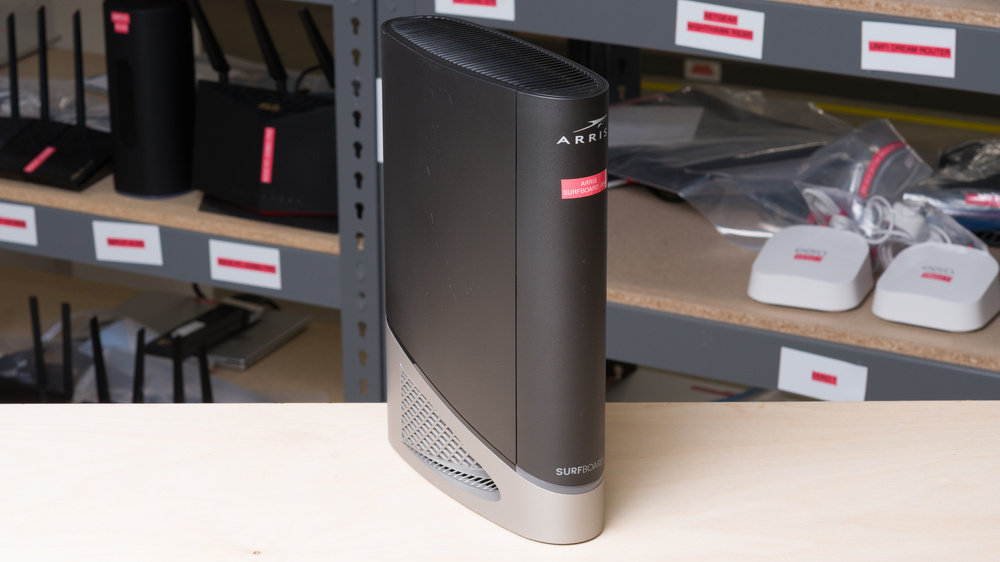
The ARRIS SURFboard G54 is a quad-band, two-in-one DOCSIS 3.1 modem and Wi-Fi 7 router with 2.4GHz, 6GHz, and two 5GHz bands. It features a two-tone cylindrical design with a sleek LED strip along its base and ventilation grilles on its sides. The gateway comes equipped with one 10Gbps WAN/LAN auto-sensing port, one coaxial cable port, and four 1Gbps LAN ports. Despite its Wi-Fi 7 designation, the G54 doesn't support Multi-Link Operation (MLO). You can configure it via its web interface or through the SURFboard Central app.
Note: We only test the routing and Wi-Fi capabilities of this unit and do not evaluate its performance as a DOCSIS 3.1 modem.
Our Verdict
The ARRIS SURFboard G54 is a great choice for apartments and condos. Its 6GHz peak speeds are excellent, making it suitable for large-file downloads and HDR streaming at close to medium range. Its quad-band design and Dynamic Frequency Selection (DFS) support improved performance in congested environments, although its selection of four 1Gbps LAN ports is suboptimal for high-speed wired networking. As an all-in-one solution, the G54 eliminates the need for two network devices with sufficient range for most single-story homes, although its 11.6" height requires some vertical clearance to accommodate.
Excellent top speeds on the 6GHz band.
Replaces a separate modem and router with one device.
Decent overall range.
No mesh support to extend coverage.
5GHz band slows down at longer distances.
Physically tall footprint.
The ARRIS SURFboard G54 is a good router for multi-level homes. Its standalone range is decent for small-to-medium spaces, and it performs excellently at short range, though its 5GHz throughput slows notably at a distance. Older devices lacking Wi-Fi 6E or 7 support won't see the same level of performance as devices on the latest standard. The G54 lacks native mesh support for easy coverage expansion, and while it features a 10Gbps WAN/LAN port, its four other LAN connections are capped to a slower 1Gbps.
Excellent top speeds on the 6GHz band.
Replaces a separate modem and router with one device.
Decent overall range.
No mesh support to extend coverage.
5GHz band slows down at longer distances.
Physically tall footprint.
The ARRIS SURFboard G54 delivers excellent throughput, reaching multi-gigabit speeds on its 6GHz band. It boasts a quad-band array with Dynamic Frequency Selection (DFS) channels, granting compatible devices additional headroom in crowded environments and busy networks.
Excellent top speeds on the 6GHz band.
The ARRIS SURFboard G54 has satisfactory range performance. Its 6GHz band is capable of multi-gigabit speeds, but its 5GHz performance is notably weaker, particularly at longer distances. It's a standalone unit without mesh capabilities, so you can't add satellite nodes to extend the signal further.
Decent overall range.
Changelog
- Updated Jun 22, 2026: We've updated this review to Test Bench 0.9.1! This is a minor change that makes the router type easier to see at the top of each review. Read the changelog for more info.
-
Updated Jun 10, 2026:
We've added a link to the newly reviewed ARRIS SURFboard G20 in the Interior Long Range section of the review.
- Updated May 08, 2026: We've updated this review to Test Bench 0.9! This update adds wireless latency testing to evaluate router gaming performance. Read the changelog for more info.
- Updated Apr 16, 2026: Review published.
Check Price
Differences Between Sizes And Variants
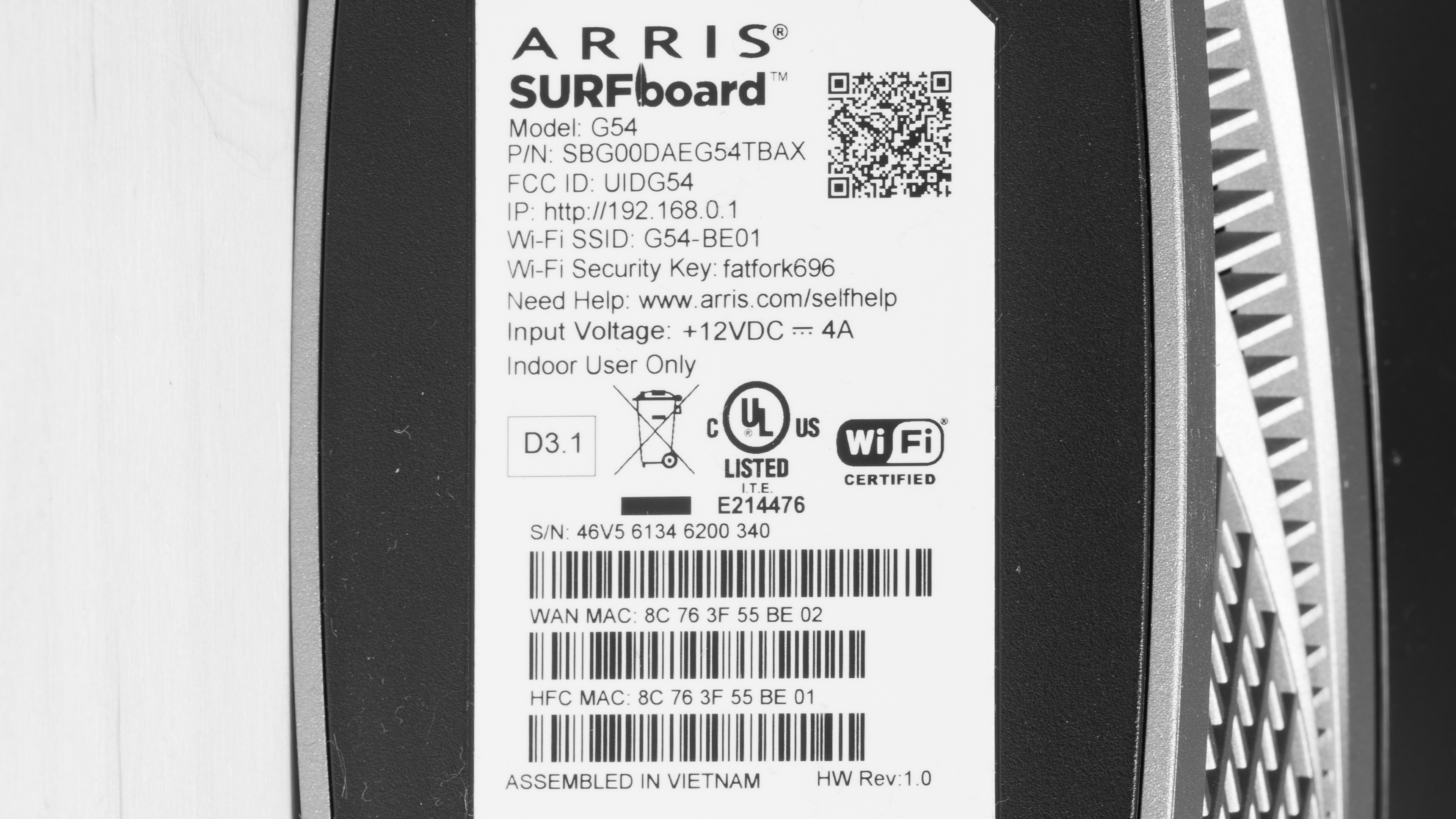
We bought and tested the ARRIS SURFboard G54. It's a cable modem and router combo unit available in a single black-and-silver colorway. See a photo of our product's label.
Popular Router Comparisons
The ARRIS SURFboard G54 presents an all-in-one solution for cable internet users as a Wi-Fi 7 modem/router combo with high speeds and a quad-band array. Its 10Gbps WAN/LAN port and 6GHz band make it a prime choice for multi-gigabit plans and modern devices, but with just four additional 1Gbps LAN ports, it's a lackluster option if you're after more extensive wired connectivity. Its performance surpasses routers like the NETGEAR Nighthawk RS300 thanks to its 6GHz band, but those wanting faster Ethernet connections may prefer the latter for its 2.5Gbps-rated ports. Compared to mesh solutions like the eero 7, the G54 hits higher peak speeds and roughly the same range in a standalone unit. As a combined modem and router, however, it's not compatible with mesh expansion and doesn't support Multi-Link Operation (MLO) like some routers do, albeit in a limited capacity. For more on this, check out our article on the truth behind MLO marketing.
Compared to dedicated routers in a similar price bracket, it becomes evident that you're trading some performance for the convenience of a built-in modem; premium standalones like the TP-Link Archer BE900 offer higher top speeds, superior range, and a much more impressive array of multi-gigabit wired networking ports. Regardless, the G54 serves as a major upgrade over its sibling, the ARRIS SURFboard G36, and an attractive option for users looking to simplify their network setup.
For more recommendations, check out our guides to the best Wi-Fi 7 routers, the best long-range routers, and the best routers for Spectrum.
The ARRIS SURFboard G54 performs significantly better than the ARRIS SURFboard G36, featuring a quad-band design, Wi-Fi 7 technology, and a 10Gbps WAN port for faster speeds on compatible devices. While both offer similar range performance, the G54 is best suited to households with newer devices that can utilize 6GHz frequencies, while the G36 remains viable as a dual-band option for Wi-Fi 6 or older clients.
The ARRIS SURFboard G54 is a more powerful cable modem/router combo than the ARRIS SURFboard G20, although each has its strengths. The former employs a quad-band Wi-Fi 7 design with a 6GHz band, delivers much faster top speeds, and has a more capable wired setup with a 10Gbps WAN port and four additional 1Gbps LAN ports. The latter is a simpler yet serviceable dual-band Wi-Fi 6 model with a 1Gbps WAN port and just two additional Ethernet ports, but it fares much better at long distances and maintains slightly lower latency. Its smaller footprint also makes it easier to work with if you're tight on space.
The ARRIS SURFboard G54 is a cable modem and quad-band router combo, while the NETGEAR Nighthawk RS300 is a standalone router. The ARRIS delivers faster peak wireless speeds on its 6GHz band and sports a 10Gbps WAN port, overtaking the RS300's 2.5Gbps limit. That said, the NETGEAR offers a higher speed ceiling for wired devices with its 2.5Gbps LAN ports, outperforming the 1Gbps ports on the ARRIS. Interestingly, while both are marketed as Wi-Fi 7 devices, our testing shows that neither supports Multi-Link Operation (MLO).
Although they share a similar price bracket as quad-band Wi-Fi 7 devices, the TP-Link Archer BE900 significantly outperforms the ARRIS SURFboard G54 across both speed and range tests. While the ARRIS offers space-saving convenience in the form of a built-in cable modem, it comes at the cost of worse wireless performance and slower 1Gbps networking ports compared to a premium standalone like the TP-Link.
Test Results
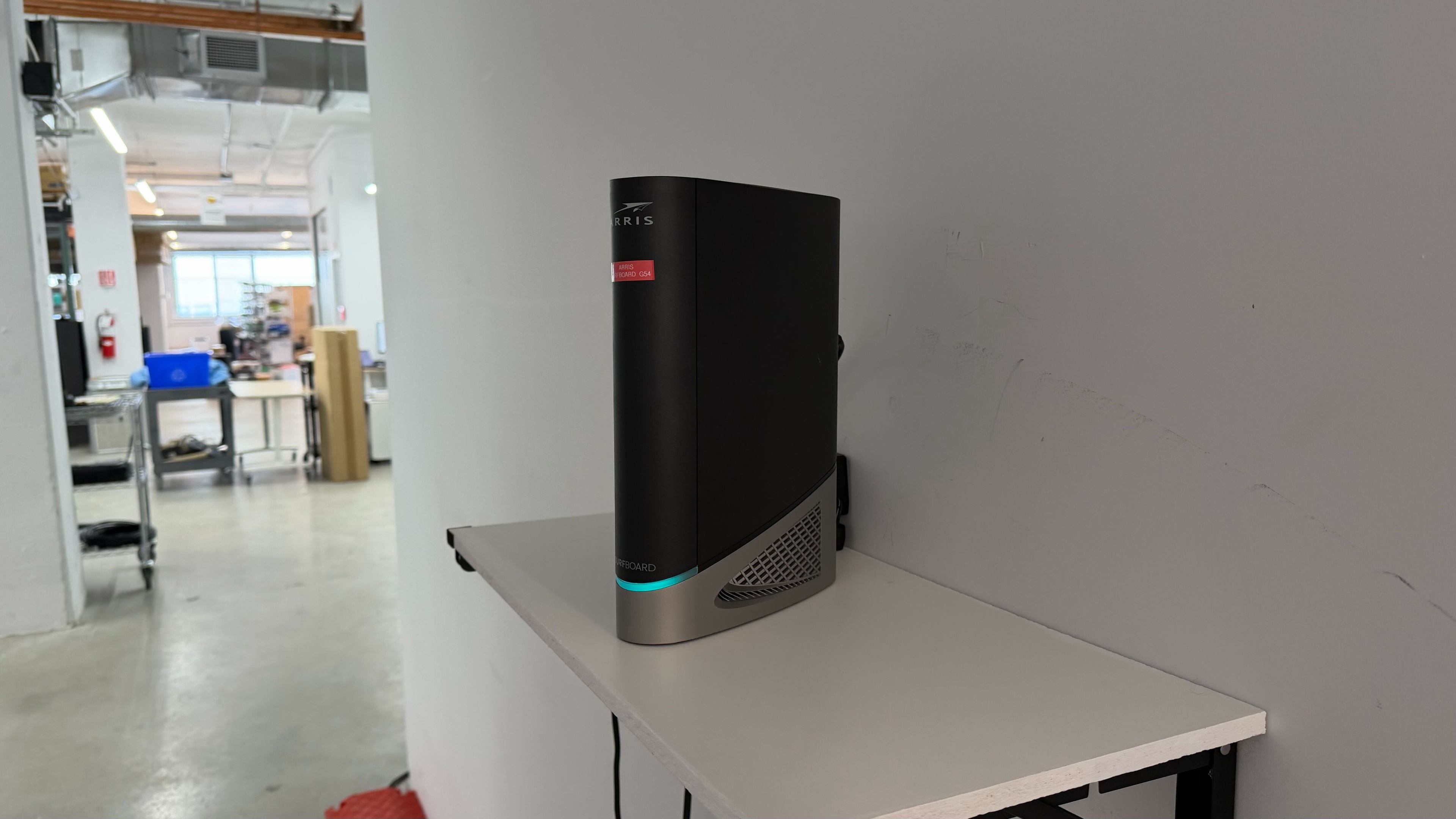

for pictures & test results
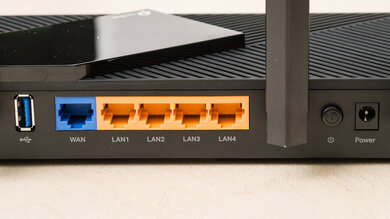
The G54's WAN port is rated for 10Gbps, while all four of its LAN ports are rated for 1Gbps.
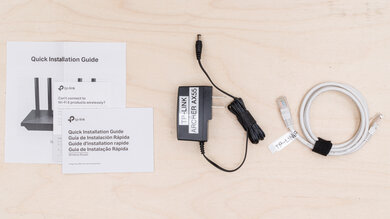
for pictures & test results

for pictures & test results
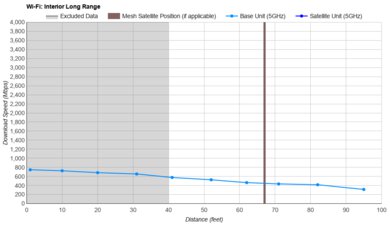
This router has a quad-band architecture with two distinct 5GHz bands: one limited to channels 36-64 and another to channels 100-165. If you don't split your bands into separate SSIDs, you can enable a "Quad Band Optimization" feature, which lets the router decide which band to use for the best performance.
For our testing, we configured the router with split SSIDs and reported results from the lower-channel 5GHz band, as it performs slightly better in our range test.
If you're interested in a modem/router combo with better long-range performance, check out the ARRIS SURFboard G20.
for pictures & test results
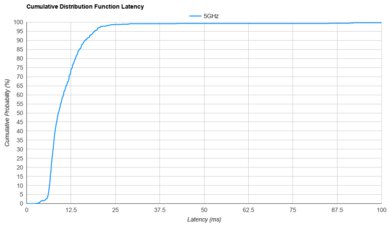
Despite the ARRIS SURFboard G54 being marketed as a Wi-Fi 7 device, we found no mention of MLO in its settings or user documentation.
Our unit was purchased and tested in Canada. MLO availability may differ for units provided directly by ISPs or those purchased in other regions.