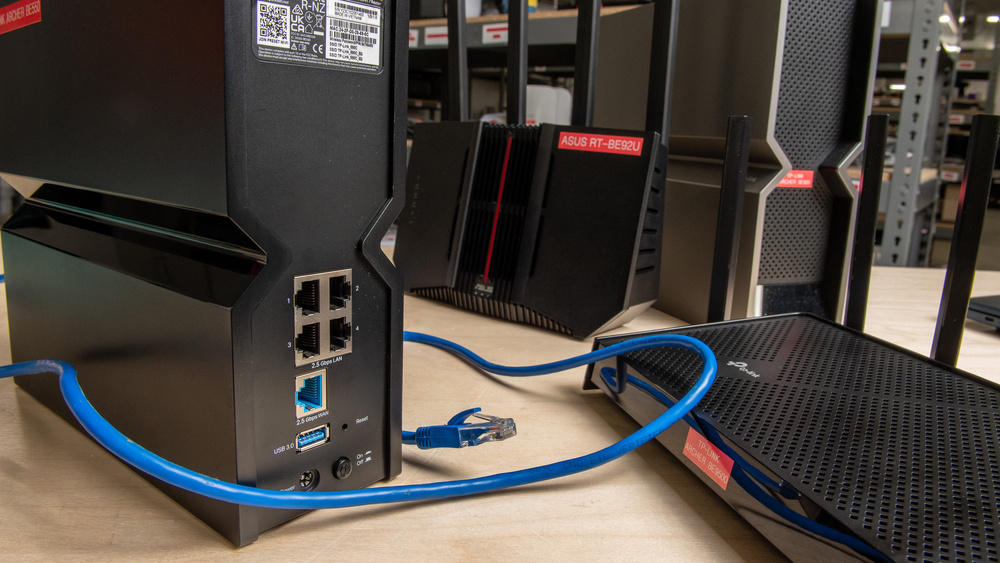
If you have fiber internet but aren't getting the speeds your plan promises, your router might be overdue for an upgrade. Fiber works by transmitting data as rapid pulses of light rather than electrical signals, allowing it to achieve much faster speeds and lower latency than traditional cable internet; that said, your actual connection speed is only as fast as your router permits. Taking full advantage of fiber depends on factors such as your router's hardware, location, and bandwidth (not to mention the limitations of your own connected devices).
The first thing to confirm is your internet plan's maximum speed, as a 1Gbps fiber plan doesn't require the same bandwidth as a 5Gbps or 10Gbps plan. Your home's size and layout also matter: a powerful standalone router can be a great fit for apartments and single-story homes, while a mesh system can help improve coverage across multiple floors or hard-to-reach areas.
We've tested over 80 of the most popular Wi-Fi routers on the market to help you determine the best router for fiber internet, depending on your needs. For more options, be sure to check out our recommendations for the best routers, the best Wi-Fi 7 routers, and the best mesh Wi-Fi systems.

Since we started reviewing them in 2024, we've tested over 60 routers. We maintain complete editorial independence and impartiality by purchasing each router ourselves, which ensures we aren't testing specially selected review units. Rather than casually assessing performance by throwing on Netflix and seeing if it works, we rigorously evaluate each router on a standardized testing platform, providing you with all the data you need to compare different models.
-
Best Router For Fiber Internet
 Apartment/CondoMulti-Level HouseGamingSpeedRangeLatencyWAN Port Speed:GbpsSee all our test resultsWi-Fi Version:Wi-Fi 7 (be)
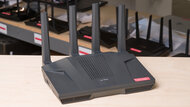
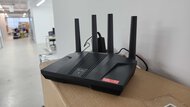
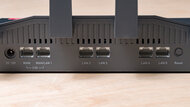
We recommend the TP-Link Archer BE900 as the best router for fiber internet if you're looking for a high-end standalone option. It's one of the best Wi-Fi 7 routers we've tested, with outstanding speed, excellent range, and a quad-band design built to take on multi-gigabit internet plans. It's outfitted with a generous selection of Ethernet ports, including two 10Gbps, four 2.5Gbps, and one 1Gbps connection, alongside a 10Gbps SFP+ port that's especially useful if you have a NAS (Network Attached Storage) system or home workstation.
It can hit wireless speeds of up to around 3Gbps on the 6GHz band, so it has no trouble keeping up with massive downloads, game updates, and streaming across dozens of devices. While we always recommend an Ethernet connection for competitive gaming, this router's latency is low enough that casual gaming over Wi-Fi is perfectly reasonable. And like most TP-Link standalones, you can pair this one with EasyMesh-compatible devices to form a whole-home mesh network; its secondary 5GHz band doubles as a dedicated wireless backhaul between nodes, which is nice to have for lower latency across your mesh. With all that said, this router is absolutely excessive if you're not even paying for the dizzying speeds it can achieve. Those on a standard gigabit plan will find far better value in our recommendations below.
-
Best Upper Mid-Range Fiber Router
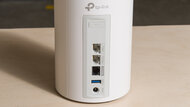
Apartment/CondoMulti-Level HouseGamingTravelSpeedRangeLatencyConfigurabilityWAN Port Speed:GbpsSee all our test resultsWi-Fi Version:Wi-Fi 7 (be)If you want a flexible mesh system for a larger home, we recommend the TP-Link Deco 7 Pro BE67 as the best fiber router at an upper mid-range price point. It's a tri-band Wi-Fi 7 mesh system with remarkable speeds, impressive range, and a 10Gbps WAN/LAN port, making it a great choice for homes that need broader coverage than that of a central standalone router.
Its primary appeal lies in its high degree of flexibility: in addition to its 10Gbps auto-sensing port, each unit comes equipped with an extra 2.5Gbps LAN port and a 1Gbps LAN port, perfect for connecting devices on different floors while leaving room for a wired backhaul. You can freely designate any BE67 node as the main unit, offering an additional degree of modularity that many competitors in the mesh space overlook. The latency is decently low for casual gaming over Wi-Fi, in line with most mesh systems on the market, but you'll still see the best performance over Ethernet. Regardless, if your main priority is strong, seamless coverage throughout a larger space, this is one of the best mesh solutions for fiber that we've tested.
The TP-Link Deco 7 Pro BE63 is a great alternative mesh system that's usually available for slightly less. The biggest differences between the two systems are that the BE63 has four 2.5Gbps networking ports and delivers slightly lower top speeds but slightly better range. It's a good option if you want to save some money and only have a 2.5Gbps fiber connection.
-
Best Mid-Range Fiber Router
Apartment/CondoMulti-Level HouseGamingTravelSpeedRangeLatencyConfigurabilityWAN Port Speed:GbpsSee all our test resultsWi-Fi Version:Wi-Fi 7 (be)The TP-Link Archer BE550 is our mid-range pick if you're looking for excellent performance without the flagship price. It's a tri-band Wi-Fi 7 standalone made for multi-gigabit plans and impressive everyday performance, touting a 2.5Gbps WAN alongside a handy spread of four 2.5Gbps LAN ports.
With snappy peak speeds of up to ~2Gbps on its 6GHz band, this router is plenty fast for households of gamers, smart devices, and remote workers. It might not match the upper limits of the flagship TP-Link Archer BE900, but most people don't have an internet connection fast enough to ever notice the difference. Its range is equally compelling for the price, and its multi-gigabit wired connectivity is ideal for bandwidth-hungry workstations and consoles.
While its 2.5Gbps WAN port leaves more than enough headroom for gigabit and 2Gbps fiber plans, it's an important limitation to note if you're paying for higher speeds. If you have a faster internet plan, consider the ASUS RT-BE92U as an alternative; it offers comparable performance to the TP-Link router and features an upgraded WAN port rated for 10Gbps. While its range falls slightly short of the BE550 at longer distances, it punches well above its weight in speed, making this a fantastic proposition if you're paying for top-end fiber in a condo or medium-sized home.
-
Best Lower Mid-Range Fiber Router
Apartment/CondoMulti-Level HouseGamingTravelSpeedRangeLatencyConfigurabilityWAN Port Speed:GbpsSee all our test resultsWi-Fi Version:Wi-Fi 6 (ax)We recommend the GL.iNet Flint 2 (GL-MT6000) as a standout option if you want strong fiber performance at a more accessible price. As a dual-band Wi-Fi 6 router with excellent speeds, impressive range, and a 2.5Gbps WAN port, the Flint 2 serves as a well-rounded entry with enough power to get the most out of any gigabit fiber plan.
With similar wireless performance and even better range than our mid-range pick, it's a well-equipped and versatile choice for everyday use. The router handles large downloads, 4k streaming, video calls, and multiple connected devices without breaking a sweat, with wireless speeds suitable for an internet connection up to ~1.5Gbps. It doesn't have a 6GHz band like our Wi-Fi 7 picks above, so newer Wi-Fi 6E and Wi-Fi 7 devices won't quite reach their full potential here, but its 5GHz speeds are still excellent for the price.
Fitted with two 2.5Gbps ports and four 1Gbps ports, this unit offers plenty of wired flexibility for devices like a desktop PC, NAS, or game console. It also runs OpenWRT-based firmware, giving you access to advanced features like VPN support, multi-WAN failover, and load balancing that you typically won't find on more mainstream routers. If you're after a dependable fiber router that won't break the bank and don't mind sticking to Wi-Fi 6, this router makes for a very compelling middle ground suitable for most homes. Just keep in mind that if you're after a plug-and-play solution, you might find its level of configurability a tad overwhelming compared to other options on this list.
-
Best Budget Router For Fiber Internet
Apartment/CondoMulti-Level HouseGamingSpeedRangeLatencyWAN Port Speed:GbpsSee all our test resultsWi-Fi Version:Wi-Fi 7 (be)If you want an inexpensive router for fiber internet, the TP-Link Deco 7 BE25 is our budget pick. It's a dual-band Wi-Fi 7 mesh system that offers solid speed and range performance for the price, making it a good option if you want better coverage than a basic standalone router without paying for a higher-end tri-band mesh setup. This system is well-suited to standard gigabit fiber plans or any household that simply needs more consistent coverage and reliable performance. It doesn't have a 6GHz band, but it performs well for everyday use, including streaming, browsing, video calls, and downloading large files over a gigabit connection.
Its mesh design is its biggest advantage; if your fiber line enters your home in a corner, basement, or utility closet, placing an additional node closer to your main living area can drastically improve your network's coverage and consistency. That said, because this is a dual-band system, a wireless backhaul will have your satellite nodes competing for bandwidth alongside your connected devices. For the best results, we recommend using a wired backhaul by running a cable between nodes.









Notable Mentions
-
eero Max 7:
The eero Max 7 is an exceptional mesh system with strong performance and fantastic wired connectivity. It technically outperforms the TP-Link Archer BE900 in raw speed and range, but it's far more expensive if you buy the multi-pack required to form a mesh network. It also locks some standard features, like QoS and parental controls, behind a paid subscription.
See our review -
ASUS ROG Rapture GT-BE98 Pro:
The ASUS ROG Rapture GT-BE98 Pro is a powerful Wi-Fi 7 quad-band router with a generous port selection and dual 6GHz bands that can be used for wireless backhaul in a mesh. It's great for enthusiasts, but the TP-Link Archer BE900 delivers similarly excellent performance in a much smaller and more practical form factor.
See our review
Recent Updates
Sep 17, 2026:
We've reviewed our recommendations to ensure they're all relevant and available, and we haven't needed to make any changes.
Aug 13, 2026:
We've mentioned the TP-Link Deco 7 Pro BE63 in the upper mid-range section as it's a great alternative to the TP-Link Deco 7 Pro BE67 if you have a 2.5Gbps fiber connection. We also confirmed that all picks are still relevant and available.
All Reviews
The models above are our current picks for the best routers for most people on a fiber plan. We factor in price, user feedback, and availability when deciding which routers offer the best overall value, and we strive to keep our recommendations up to date as the market evolves.
Need a hand narrowing it down? Use the powerful table tool below to browse our entire catalog of router reviews, and drop us a comment if you have any questions or suggestions.


