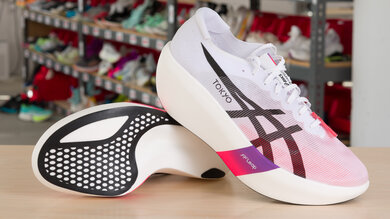
The ASICS METASPEED RAY is an ultralight, plated long-distance racing shoe built for efficient runners who land closer to the forefoot and want a soft, bouncy, and highly cushioned ride at speed. It sits above the ASICS METASPEED SKY TOKYO and ASICS EDGE TOKYO in the brand's racing lineup as its lightest, top-end option for racers chasing the fastest times. The excellent rebound helps you hold pace efficiently while keeping your legs very well protected over longer races. However, the extremely narrow platform and very soft midsole make it highly unstable, especially around turns or once fatigue affects your form. The softer forefoot also gives you less bite at toe-off than firmer racing shoes, and it isn't designed for regular training.
| ✅ Buy If: | ❌ Skip If: |
|
|
Our Verdict
The ASICS METASPEED RAY is an amazing option for the marathon thanks to its featherweight build, towering stack, and super bouncy midsole that keeps momentum rolling when you're locked into a steady rhythm. Protection is plentiful without feeling too sluggish, and the forefoot-only plate adds a smooth roll that's not overly stiff. The trade-off is stability, especially on technical routes: the soft platform and narrow base feel less planted through sharp turns or for runners whose running economy breaks down on the back half of a marathon, so it's best on flat, non-technical courses where you can hold pace and let the bounce do the work.
Exceptionally light build is very easy to turnover at race pace.
Excellent cushioning holds up impressively over the marathon distance.
Amazing energy return helps you maintain race pace efficiently.
Excellent forefoot energy return provides plenty of assistance at toe-off.
Forefoot rocker does a good job of carrying you through push-off.
Poor stability makes cornering and late-race fatigue challenging.
The ASICS METASPEED RAY is a great short-race option for non-technical, fast courses where low weight and efficiency matter. Its exceptionally light build makes quick turnover easy, while its stiff forefoot and excellent energy return give you plenty of assistance when pushing off. However, its soft forefoot doesn't provide the same solid base as firmer racing shoes, so runners who frequently accelerate or surge at very fast paces may prefer a firmer underfoot feel.
Exceptionally light build is very easy to turnover at race pace.
Stiff forefoot helps you provide leverage at push-off.
Forefoot rocker does a good job of carrying you through push-off.
Forefoot too soft for explosive accelerations.
The ASICS METASPEED RAY is a decent choice for long runs, particularly faster marathon-specific efforts. Its excellent cushioning remains protective over extended distances, while the extremely low weight and lively rebound help limit fatigue and maintain momentum. However, the very soft, narrow platform is difficult to stabilize at easier paces or once your form deteriorates, and the delicate construction makes it poorly suited to regular high-mileage training.
Excellent cushioning delivers great impact protection over long distances.
Exceptionally low weight makes longer efforts less tiring.
Forefoot rocker does a good job of carrying you through push-off.
Poor stability makes it harder to maintain secure footing when tired.
Fragile outsole makes regular high-mileage running a bad idea.
The ASICS METASPEED RAY is an inadequate choice for regular weekly running. Though its excellent cushioning protects your legs from road impact, its extremely narrow base and soft platform make it very unstable, especially at relaxed paces. Its exceptionally low mass and excellent energy return still make it a good option for occasional faster workouts, but its plated design is much too aggressive for daily miles.
Excellent cushioning protects your legs during regular miles.
Forefoot rocker does a good job of carrying you through push-off.
Poor stability makes relaxed running off the table.
Extremely narrow base especially makes it hard to trust.
Plated ride is much too aggressive for daily training duties.
Changelog
- Updated Oct 26, 2026: We've converted this review to Test Bench 1.0! This update adds Traction and Outsole Durability verdict scores to the review, making it easier to make a buying decision. Read the changelog for a full list of changes.
- Updated Sep 23, 2026: We've updated this review to Test Bench 0.16, expanding our coverage with new tests for breathability, water absorption, and drying time. For more details, see the changelog.
- Updated Sep 17, 2026: We've converted this review to Test Bench 0.15, which replaces Responsiveness with three specific performance usages: Bounciness, Snappiness, and Roll. To read more about the changes, see the changelog.
- Updated Aug 27, 2026: We've converted this review to Test Bench 0.14, which adds new lace-specific results. We've included a close-up photo of the laces, as well as details including lace type, width, thickness, and stretch. To read more about the changes, see the changelog.
- Updated Jul 03, 2026: We've converted this review to Test Bench 0.13, which identifies the different foams used in the shoe's midsole. We've included a microscopic image of the foam cells to give you an idea of what the microstructure looks like. To read more about the changes, see the changelog.
-
Updated Jun 26, 2026:
We've updated the Popular Comparisons section to include a comparison to the recently reviewed Saucony Endorphin Elite 3.
- Updated Jun 17, 2026: We've converted this review to Test Bench 0.12, which fixes how we measure firmness, a component of the Stability and 5K/10K Racing usages. There may be inconsistencies between the text and the scores for these usages, but the scores should still be considered valid. We've also brought back the Energy Return score and added two new usages: Daily Training and Long Run. To read more about the changes, see the changelog.
- Updated Apr 28, 2026: We've converted this review to Test Bench 0.11, adding two new rocker measurements to the Design section, and three new responsiveness tests to the Performance section. The Energy Return usage score has been replaced with Responsiveness. Check out the details in our changelog.
-
Updated Feb 26, 2026:
We updated the review to include text for the new Fit usage box, which was recently added to our test bench.
- Updated Feb 20, 2026: We've converted this review to Test Bench 0.10, adding a new set of fit tests to the Design section and an overall fit performance usage. Check out the details in our changelog.
- Updated Oct 30, 2025: Review published.
- Updated Oct 06, 2025: Early access published.
- Updated Sep 22, 2025: Our testers have started testing this product.
- Updated Sep 12, 2025: The product has arrived in our lab, and our testers will start evaluating it soon.
- Updated Aug 13, 2025: We've purchased the product and are waiting for it to arrive in our lab.
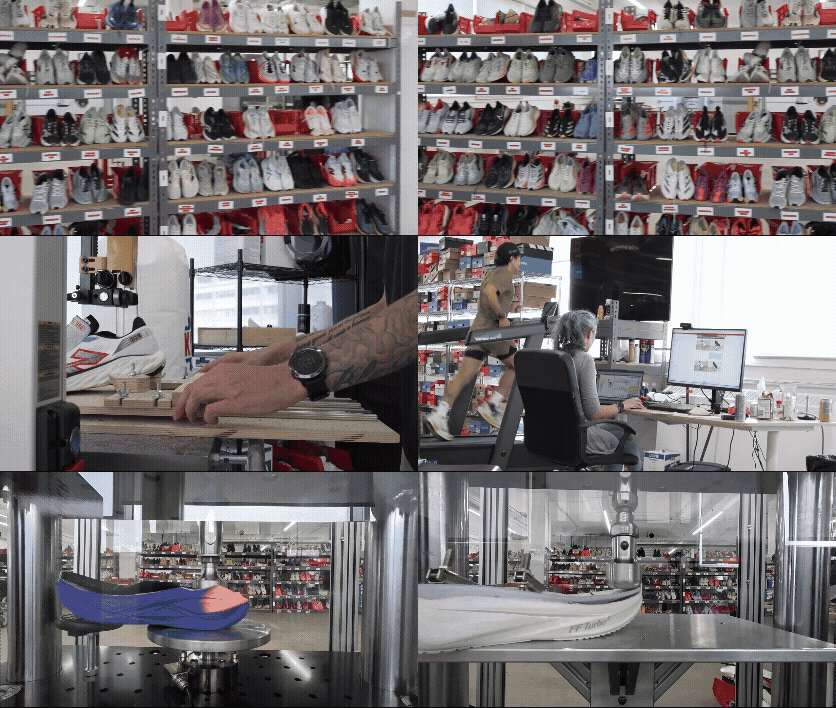
We've bought and tested more than 300 running shoes. Every pair purchased with our own money, never supplied or sponsored by brands. Our data-driven tests are designed to go beyond marketing claims, and since every shoe goes through the exact same methodology, you can directly compare results to find the right pair for your needs.
Test Results

Design
Forefoot rocker does a good job of carrying you through push-off.
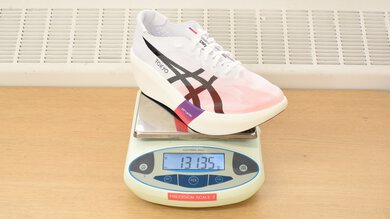
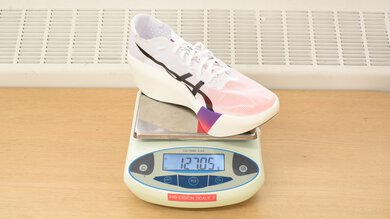
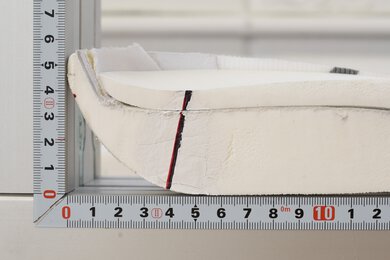
The ASICS METASPEED RAY is truly groundbreaking for weight, coming in a few grams lighter than the adidas Adizero Adios Pro Evo 2 and more than 30 grams lighter than the ASICS METASPEED EDGE TOKYO and ASICS METASPEED SKY TOKYO, which are already considered light super shoes. You almost forget you're wearing it thanks to the minimal upper, which is remarkable given the tall, soft stack underfoot. It pushes the category's weight boundary without obvious compromises to key efficiency factors like energy return, and while it's definitely not a durability champ, it's also not a one-and-done shoe like the adidas one.
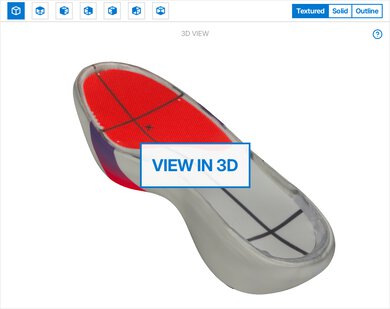
This shoe has a snug, performance fit that still leaves a touch of wiggle room in the toe box, so it feels race-ready without leaving you super cramped.


Energy Return
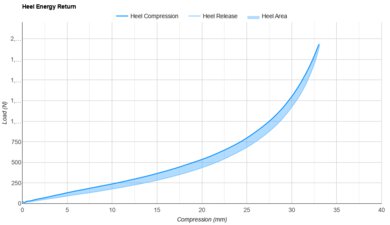
The ASICS METASPEED RAY has excellent energy return overall. Its forefoot returns an outstanding amount of energy with each step, helping you maintain faster paces efficiently over longer distances. The heel also returns an excellent amount of energy, so you get plenty of assistance regardless of where you land.
Outstanding forefoot energy return helps you maintain race pace efficiently.
Excellent heel rebound provides plenty of assistance for rearfoot strikers.
Forefoot rocker does a good job of carrying you through push-off.
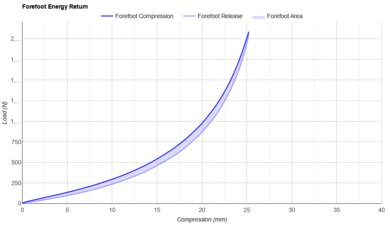
The ASICS METASPEED RAY is among the bounciest shoes on the market, compressing deeply and snapping back remarkably well. The sensation is elastic and playful rather than snappy and propulsive, so it feels wildly energetic even if it does not deliver the traditional snap of other shoes, such as the older ASICS METASPEED SKY PARIS.
Stability
The ASICS METASPEED RAY has poor stability overall, even for a racer. Its incredibly narrow heel and forefoot provide very little room for uncontrolled landings, while the narrow arch makes transitions unsteady, especially if your ankles tend to roll inward. Its very soft platform also makes it difficult to maintain your balance, requiring more concentration when cornering or when your form deteriorates late in a race. It's a poor choice for runners who need additional support or regularly race on technical courses.
Forefoot rocker does a good job of carrying you through push-off.
Incredibly narrow heel makes rearfoot landings unsteady.
Narrow arch makes transitions difficult if your ankles roll inward.
Very soft platform is very wobbly.
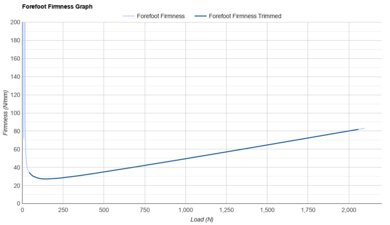
The ASICS METASPEED RAY's front end isn't the firmest for a super shoe. The thin, partial plate adds only minimal stiffening. Even the very soft Saucony Endorphin Elite 2 firms up more as load increases, whereas the ASICS shoe's forefoot firmness plateaus at high forces, so adding more power does not translate into a firmer, snappier response. This is a matter of preference: some will enjoy the plush front, others will want more bite.
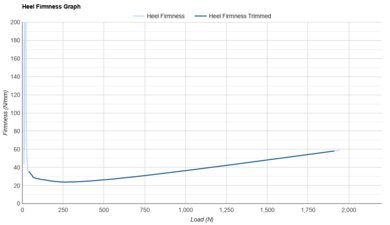
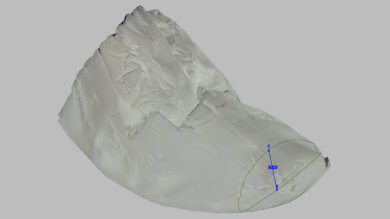
The heel feels very soft overall, and that shows up most clearly late in a marathon. Early on, when you're running well and landing farther forward, the heel stays out of the way, and the foam's give isn't an issue, as this level of plushness helps to spare the big muscles and joints. However, as fatigue sets in and foot strikes drift closer to the heel, the compliant midsole sinks more, so the small stabilizing muscles have to work overtime to keep you going. This negatively impacts efficiency, as some energy is spent on balance rather than forward propulsion. Strong, fast runners able to maintain form and stay off the heel will manage it better, but if you expect to fade or want a touch more heel structure, the ASICS METASPEED EDGE TOKYO's slightly firmer setup is the safer pick.
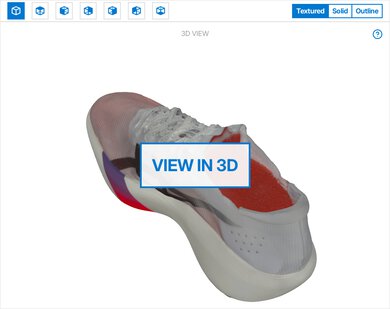
This model showed a unique pattern in real-world use that doesn't appear in our lab scan because the scanned pair is brand new and different from the pairs we use for outdoor testing. On runs, multiple testers saw unusual gray/black road marks along the midsole sidewalls, even on clean tarmac, likely because the very soft foam compresses so much that a significant portion of the flanks contact the ground. We also observed pronounced creasing after only a few kilometers. These are largely cosmetic early on, but they signal a limited lifespan and reinforce that this model prioritizes peak performance over long-term durability.

Cushioning
The ASICS METASPEED RAY has excellent cushioning overall. Its heel provides outstanding shock absorption, protecting your legs exceptionally well from road impact when landing farther back. The forefoot also absorbs an amazing amount of shock, and the cushioning holds up impressively over longer distances, keeping your legs well protected deep into a marathon.
Outstanding heel cushioning protects your legs exceptionally well from impact.
Amazing forefoot cushioning keeps landings comfortable when running on your toes.
Cushioning holds up impressively over marathon distances.
Forefoot rocker does a good job of carrying you through push-off.
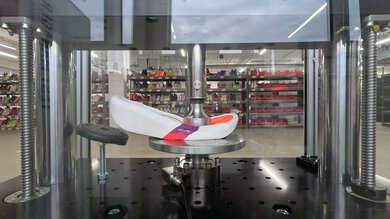
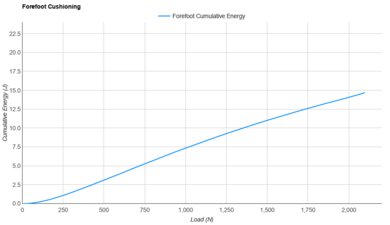
This shoe offers substantial forefoot padding that takes the sting out of repetitive strikes during workouts and races. There is enough depth underfoot to keep things comfortable deep into an interval session or a race, pairing soft impact control with an easy roll through toe-off.
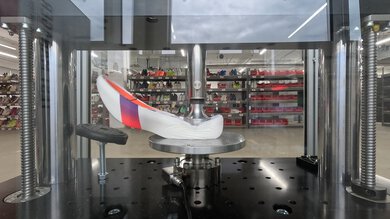
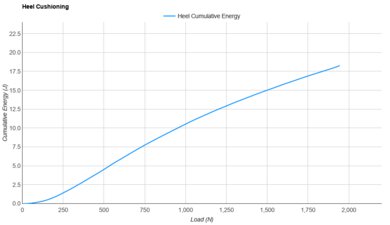
The ASICS METASPEED RAY provides fantastic heel protection. With no plate in this zone, the foam can deform and absorb freely, soaking up impact and spreading forces before they travel up the legs. Landings feel plush and controlled, which helps keep lower-leg fatigue in check over long efforts.
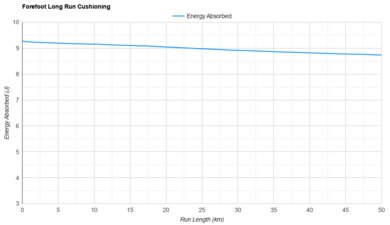
The ASICS METASPEED RAY's forefoot protection holds up well across marathon-length efforts. Cushioning declines gradually and almost linearly as distance piles up, with no sharp early drop-off that we often see in less premium compounds or even in the ASICS METASPEED SKY TOKYO, which features a layer of older PEBA-based foam. Here, the full A-TPU midsole stays protective through the longest runs of your marathon block and on race day itself.
Traction
The ASICS METASPEED RAY has disappointing traction overall. Though it provides adequate grip on both dry and wet concrete, you'll still need to be careful when pushing off or changing direction at pace, especially around crowded aid stations. Its grip on wet aluminum is poor, so drain covers and wet road markings are particularly slippery. It also performs terribly on gravel and poorly on mud, so it's a bad choice for races with unpaved or muddy sections.
Adequate grip on dry and wet concrete allows for paved racing.
Forefoot rocker does a good job of carrying you through push-off.
Terrible gravel and poor mud grip make unpaved race sections dicey.
Poor wet metal grip makes drain covers and road markings slippery.


Outsole Durability
The ASICS METASPEED RAY has poor outsole durability overall. The forefoot has mediocre abrasion resistance, so it offers some protection against repeated push-offs, but the heel wears down much more easily. There's also a considerable amount of exposed foam, particularly at the heel, leaving much of the midsole vulnerable to damage.
Forefoot rubber offers some resistance to wear from repeated push-offs.
Forefoot rocker does a good job of carrying you through push-off.
Poor heel abrasion resistance causes faster wear for heel strikers.
Extensive exposed foam leaves the heel even more vulnerable to damage.
Exposed forefoot foam also wears down with repeated road contact.

The ASICS METASPEED RAY has poor abrasion resistance overall, particularly at the heel. The forefoot does a mediocre job of resisting wear, so it can withstand some repeated push-offs. However, the heel rubber wears down much more easily, making it a poor choice for heel strikers.

The ASICS METASPEED RAY has poor outsole coverage, with much of its midsole exposed to the road. The forefoot has some rubber protection, though a fair amount of foam remains uncovered. The heel is particularly exposed, leaving very little protection from direct ground contact, so heel strikers will wear through the midsole much more quickly.
Wet & Warm Weather
The ASICS METASPEED RAY is excellent for wet and warm weather. Its highly breathable upper helps keep feet cooler during hot races, while low water absorption limits added weight in the rain. It also dries quickly afterward, making it easier to reuse following a wet session.
Superb breathability keeps your feet from overheating during hot races.
Absorbs very little water, so it won't feel cumbersome when racing in the rain.
Dries in less than a day, so it's ready for your next run.
Forefoot rocker does a good job of carrying you through push-off.


The upper is exceptionally breathable. Air passes through easily, helping heat escape during warm-weather races and sustained hard efforts.

This shoe takes less than a day to fully dry after the shoe gets soaked, which is great. However, it needs more time to shed absorbed water than the ASICS METASPEED EDGE TOKYO.


Bounciness
The ASICS METASPEED RAY has great bounciness overall. Its heel compresses deeply and rebounds well, giving you plenty of bounce when landing. The forefoot doesn't compress quite as much, but its outstanding rebound still provides plenty of spring when pushing off.
Deep heel compression provides plenty of bounce on landing.
Forefoot gives you plenty of spring when pushing off.
Forefoot rocker does a good job of carrying you through push-off.

The forefoot also compresses deeply, though the partial plate keeps it more controlled than the heel. Forefoot strikers get a soft, springy sensation with plenty of cushioning, while the added structure limits some of the excessive sinking found at the rearfoot.

The heel compresses very deeply under load because it's unplated, and the soft foam can deform freely. This gives rearfoot landings a plush, cushioned sensation, but it also increases movement underfoot and contributes to instability, particularly when your form deteriorates.
Snappiness
The ASICS METASPEED RAY feels decently snappy, though its response is less direct than that of many plated racers. Its forefoot-only plate makes the front of the shoe quite stiff and adds some snap, but the unusually soft foam and only moderately stiff rocker mute the response at toe-off compared with shoes that pair firmer foam with a stiffer rocker. Runners who enjoy an elastic, flexible response may like it, while those who prefer a firm, rigid lever may not.
Stiff forefoot provides very good leverage when pushing off.
Toe-off is very efficient.
Forefoot rocker does a good job of carrying you through push-off.
Very soft forefoot offers less of a solid base for explosive push-offs.
Compliant rocker reduces the assistance you get at toe-off.
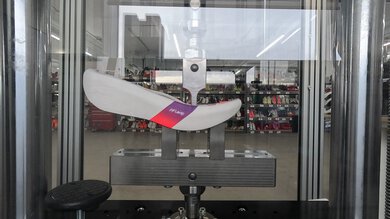
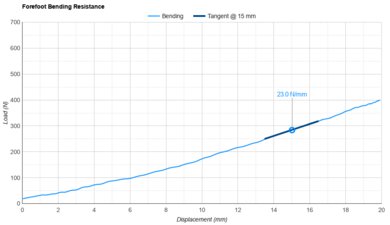
The ASICS METASPEED RAY is very stiff through the forefoot despite using only a partial plate. Because the partial plate sits directly beneath the area that bends during toe-off, it still creates a strong lever up front.

Roll
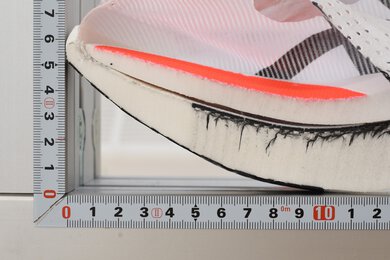
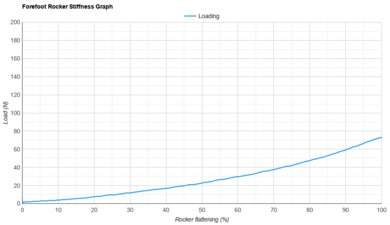
The ASICS METASPEED RAY delivers a smooth, decent rolling sensation. The pronounced heel rocker and well-shaped forefoot guide transitions effectively, while the partial plate gives toe-off enough structure to feel controlled. However, the soft platform and only moderately stiff rocker make the roll feel fluid rather than forceful, so it doesn't tip you forward as aggressively as firmer racing shoes.
Heel rocker helps you roll smoothly into your stride.
Forefoot rocker does a good job of carrying you through push-off.
Soft platform makes transitions less direct.
Compliant rocker flattens under load, reducing assistance through your stride.

True To Size
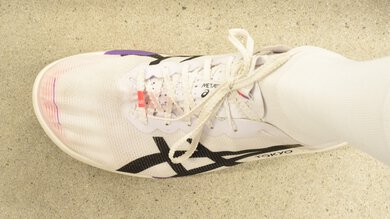
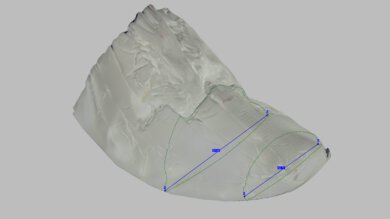
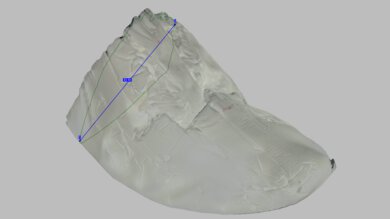
The ASICS METASPEED RAY fits true to size for a racing shoe. It's quite snug through the arch and has just enough space in the forefoot to accommodate some toe splay. The length is true to size, and most runners can buy their usual size.
Forefoot rocker does a good job of carrying you through push-off.
Popular Running Shoe Comparisons
The ASICS METASPEED RAY is a featherweight super shoe that's more energetic than the PUMA Fast-R NITRO Elite 3 and lighter than the adidas Adizero Adios Pro Evo 2. It pairs deep cushioning with excellent rebound, giving it a soft, springy feel that works best for runners with strong mechanics who land farther forward. However, its soft, narrow platform makes it much less stable than racers like the Diadora Gara Carbon 2 and Saucony Endorphin Pro 4, especially in turns or once fatigue starts to affect your form, plus its minimal construction may be much less resilient than traditional race-day options.
For more long-distance racing options, see our picks for the best marathon running shoes and best long-distance running shoes. For more from the brand, check out our best ASICS running shoes.
The ASICS METASPEED RAY is lighter than the ASICS METASPEED EDGE TOKYO and offers more bounce at faster paces, making it the better pick for mid-to-forefoot strikers chasing maximum race-day efficiency. The EDGE TOKYO is more stable and better suited to longer races, especially for cadence-driven runners or those who land farther back. Get the RAY for maximum speed; get the EDGE TOKYO for the more approachable marathon racer.
The ASICS METASPEED RAY is a better racing shoe overall than the ASICS METASPEED SKY TOKYO. It's lighter, more cushioned, and bouncier, while offering essentially the same energy return. The SKY TOKYO is much less soft underfoot and provides more assistance through the stride, making toe-off more forceful and controlled. Get the RAY if you want maximum cushioning and minimum weight; get the SKY TOKYO if you prefer more propulsion and a firmer feel underfoot.
The adidas Adizero Adios Pro Evo 3 and ASICS METASPEED RAY are ultralight marathon racers with soft, bouncy rides. Choose the adidas for its substantially lower weight and better cushioning late in a marathon, provided you don't mind its very steep price. Both are unstable, but the ASICS is more demanding to control. The ASICS delivers comparable energy return and overall cushioning for substantially less money, making it the better value if you can handle its narrow platform.
The ASICS METASPEED RAY and PUMA Fast-R NITRO Elite 3 are highly specialized super shoes, but they achieve speed differently. The ASICS is dramatically lighter and much softer, producing a bouncier ride, while the PUMA relies more heavily on its rigid platform and aggressive geometry to drive you through toe-off. Neither is especially stable, though the PUMA provides considerably more structure through the forefoot. Get the ASICS if minimum weight and bounce are the priority; get the PUMA if you prefer a more forceful, geometry-driven ride.
The Mizuno Hyperwarp Pure and the ASICS METASPEED RAY are two of the lightest super shoes available to the masses, but they will best serve different runners for different races. Despite its featherweight, the ASICS has substantial cushioning that holds up impressively well over long distances. Its higher stack height and soft foam do make it less stable, though, so it can become very wobbly late in the race if your form is fading. The Mizuno is a more stable shoe, thanks to its lower stack height and significantly firmer midsole, which also makes it feel much more tuned for shorter races like a 5K or 10K.
The ASICS METASPEED RAY and New Balance SuperComp Elite v6 represent two very different takes on a racing shoe. The ASICS has supremely soft cushioning and a featherweight construction, but is wildly unstable. It's an excellent marathon racing shoe for runners who can maintain good form. The New Balance shoe has much less absorbent cushioning, but it's much snappier and more stable (for a racing shoe). It's the better choice for shorter races and is available in multiple widths, making it a more accessible racing shoe option for wide-footed runners.
The ASICS METASPEED RAY and adidas Adizero Adios Pro 4 are both top-tier marathon racing shoes, but they differ significantly in feel and performance. The ASICS is much lighter and delivers a more efficient ride thanks to its highly energetic foam and partial forefoot plate, which creates a consistent bounce from start to finish. The adidas shoe uses full-length carbon-infused rods to add stiffness. While the adidas still offers strong cushioning, the ASICS is noticeably softer and retains its protection capabilities more consistently over long distances
. However, the adidas offers greater lateral stability, making it a compelling marathon option.
The ASICS METASPEED RAY and the HOKA Cielo X1 3.0 both sit on the soft end of the super shoe spectrum, so they deliver that deep, forgiving feel that keeps racing impact under control. The big difference is the weight: the ASICS is dramatically lighter and feels like a more efficiency-first design, so it stays protective without the shoe feeling like it's taking up extra space underfoot. The HOKA is still light for its category and stays very cushioned, but it feels more substantial in comparison. Plate-wise, the ASICS uses a partial carbon setup, which keeps it a bit more compliant and natural through the stride, while the HOKA uses a full carbon plate, so it feels more structured.
The ASICS METASPEED RAY and Saucony Endorphin Elite 2 are both exceptionally soft, high-stack racing shoes, but they take different paths to deliver speed. The ASICS is dramatically lighter and feels more cushioned and bouncy overall, prioritizing maximum rebound and a highly energetic forefoot feel. The Saucony shoe, while still soft, is firmer and more controlled under load (it compresses smoothly at lower forces but firms up as the pace increases), giving it a crisper, snappier toe-off and greater stability at marathon effort. Runners seeking the lightest, most cushioned option will gravitate toward the ASICS, while those who prefer a more structured, balanced feel with better control may favor the Saucony.
The ASICS METASPEED RAY and Kiprun Kipstorm Lab are soft, forefoot-plated racing shoes built for very fast runners. The ASICS is the better shoe overall, with lower weight, better cushioning, and more energy return for runners looking to maximize race-day performance. Both are unstable, but the Kiprun feels slightly more controlled and has a more rocker-driven ride, so get it if you prefer a ride that's not quite as extreme.
The ASICS METASPEED RAY and Mizuno Hyperwarp Elite are both super-light super shoes, but they feel very distinct in spirit. The ASICS is dramatically lighter and tends to offer better running economy as a result, but it's also the riskier choice at longer distances because it feels much less stable underfoot. Its midsole feels bouncier and more cushioned, yet softer, which can make it feel less secure and a bit mushy when fatigue builds or when you're trying to move smoothly through toe-off. The Mizuno is still quite lightweight, with a responsive, snappy feel that appeals to runners who want an immediate, mechanical return when they apply force, with a ride that feels less chaotic and more stable at race pace.
The Under Armour Velociti Elite 3 and the ASICS METASPEED RAY are two low-drop racing shoes, and the Under Armour was worn by the women's winner of the 2026 Boston Marathon, while the ASICS was worn by the runner-up. They offer two completely different rides: the Under Armour is rather stiff but decently stable, while the ASICS is soft and bouncy but extremely wobbly if your form breaks down. For racing purposes, a significant difference is that the ASICS is much lighter, just over half the weight of the Under Armour.
The Li-Ning Feidian 6 Ultra and ASICS METASPEED RAY both sit in the soft, bouncy subcategory of super shoes, and neither is a particularly stable option. The ASICS is the lighter and softer-feeling shoe, with less dense foam and only a partial plate toward the forefoot, so it feels more airy, squishy, and explosive underfoot. The Li-Ning feels more structured and responsive in the traditional sense, thanks to its asymmetric, two-tier carbon plate. Instead of using a simpler flat plate, the Li-Ning shoe's plate sits on two separate levels with a void under the midfoot. However, that can make the Li-Ning feel more punishing for midfoot strikers, while the ASICS feels more unstable because of its extreme softness and minimal structure.
Differences Between Sizes And Variants
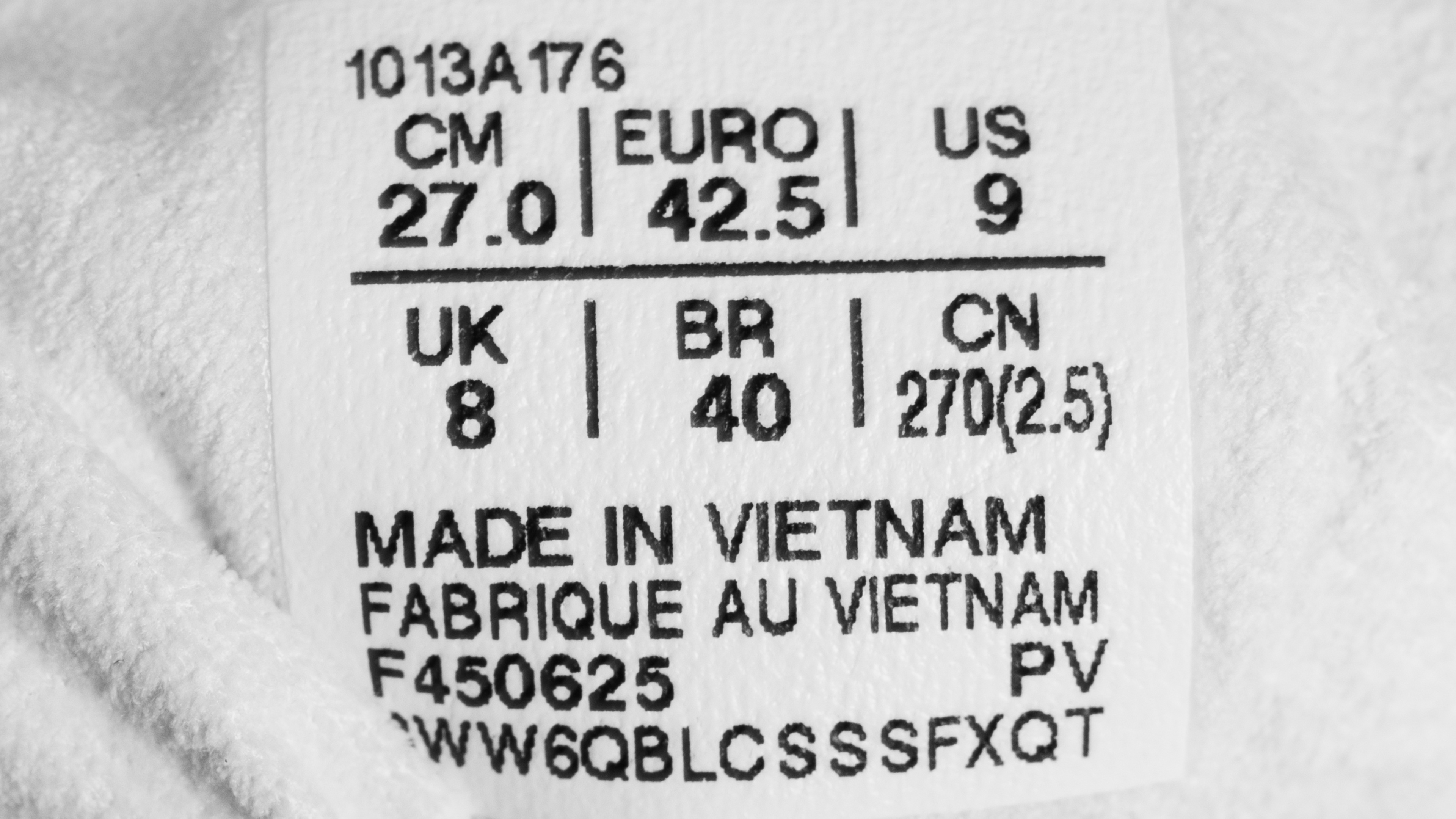
We bought and tested the ASICS METASPEED RAY in men's US size 9, as noted on the label for our pair. The pair we purchased is the White/Flash Red colorway. At the time of testing, no wide variants are available. Note that some prototype versions have been seen on elite athletes; those are not sold to the public and may not perform the same as retail pairs. The design section applies only to the exact model we tested, but we expect other sizes and gender variants to perform similarly.