Our running shoe Test Bench 0.10 tackles fit, an area in our testing methodology that had an important limitation. This update introduces a new way to measure exactly how true to size a shoe is in the midfoot and forefoot more comprehensively. It directly addresses feedback from the online running community, making our recommendations more personalized and relevant when you are trying to pick the best shoe for your specific foot shape.
What's Changed?
| Test Group | Description |
|---|---|
| Design | Forefoot Fit: Width |
|
| Design | Forefoot Fit: Height |
|
| Design | Arch Fit: Width |
|
| Design | Length Fit |
|
Taken together, these fit tests give a full view of how true to size a shoe fits across the forefoot, covering both its volume (height and width) and the midfoot around the arch.
Verdicts And Usages
| Performance Usage | Description | |
|---|---|---|
| True To Size | Introduction of a new True To Size Performance Usage, which reflects how well the shoe fits true to size overall |
New True To Size score calculated using:
|
This is currently the only usage affected by this Test Bench Update. Initially, we considered including fit as a scored component in our existing Marathon Racing usage as well. However, we ultimately decided against this because, while a well-fitting shoe is generally appreciated for running a comfortable marathon, this isn't a universal priority. Some runners, especially more performance-oriented athletes, are willing to sacrifice optimal fit to maximize efficiency. As a result, the True To Size usage and the Marathon Racing usage remain fully independent, allowing you to prioritize the factors that matter most to you.
How And Why Are We Making These Changes?
Fit is one of the most personal parts of choosing a running shoe, because small design changes can make a model feel comfortably roomy or too restrictive. Two shoes can look similar on paper and still feel very different on foot, depending on how the upper tapers around the midfoot and forefoot, which is exactly why our existing footbed measurements alone do not always predict how roomy or snug the shoe actually feels.
To capture this more directly, this update adds a 3D view of the shoe's interior. A 3D scan of the inside is performed using the Artec Space Spider, and width and height measurements are extracted from the model in the software for high precision. Those measurements are then compared to true-to-size reference values to show how much a model deviates from an average fit in a given zone (midfoot and forefoot). For all new shoes that we test, these measurements will be taken on a men's US size 9. For some shoes we had already reviewed before adding this test bench, measurements were taken on men's US sizes 8 and 13.
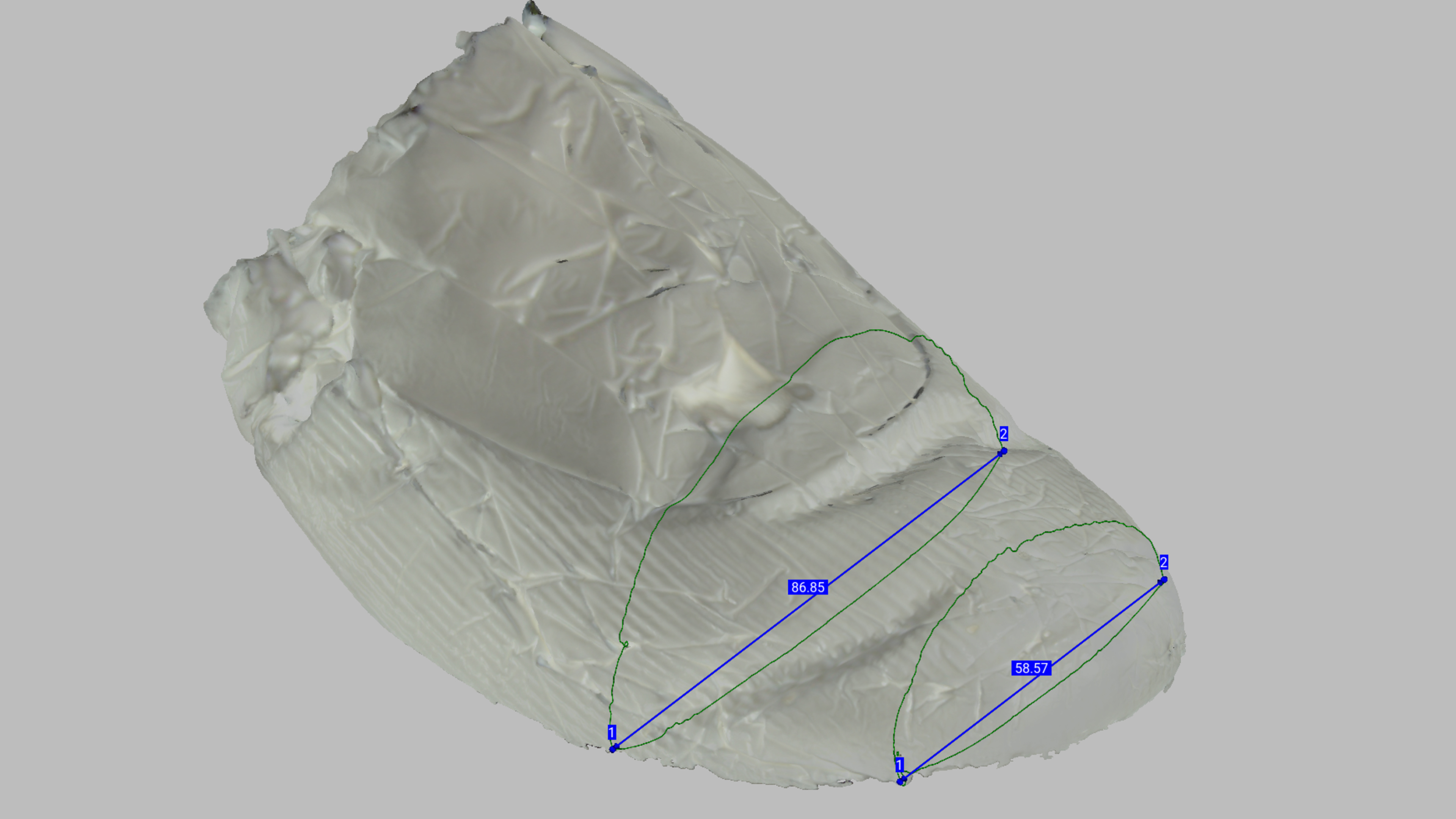
Because the results are expressed as a deviation from a standard, the data remains comparable across different shoe sizes, making it easier to apply the findings even if the tested size isn't the same for two given models. Finally, length is handled with a standardized toe-clearance check, marking where the longest toe ends to indicate whether most runners should stick to their usual size or consider sizing up or down. For all new shoes that we test, this measurement is taken using a mold of a true-to-size 9 foot. For shoes we had already reviewed and had to measure using men's US size 8 or 13 models, we measured with our testers' actual feet in the shoes.
Defining those true-to-size standards was a big part of making our data useful and comparable. However, true to size isn't a universally defined concept in the running shoe community, since most people use it to describe how a shoe fits them, and that varies widely depending on foot shape, personal preferences, and what other shoes they are used to. To create a consistent reference point, we built our true-to-size baselines from a sample of 20 specific shoes with well-established fit reputations, along with internal consensus from our testing team. This includes models known to run very roomy, others that run short and snug, shoes with specific quirks like restrictive arches, and several widely accepted as genuinely average in fit or true to size. Using this sample, we extrapolated a practical standard against which other shoes can be compared.
Of course, that doesn't mean the reference values guarantee a perfect match for every foot, but it gives you a reliable point of comparison for understanding whether the arch and forefoot run narrower, roomier, lower-volume, or more restrictive than average. Length is handled a bit differently because it's more preference-driven: the classic rule of thumb (pun intended) is to leave roughly a thumb's width up front to account for swelling, but a snug race fit can be desirable for short, fast efforts, while a first-time marathoner with wider feet may want even more extra space up front. Our length fit score reflects the amount of toe clearance our testers get when wearing the shoe, and we include a photo alongside the result so you can see the spacing directly and make the call based on your own foot and fit priorities.
Let Us Know What You Think!
With this update, we're expanding our test bench to better capture how a shoe truly fits on your foot. The new True to Size Performance Usage combines detailed length and volume assessments into a single, easy-to-understand, fully comparable score. Together with our other design and performance tests, this provides a more complete picture of each shoe's characteristics so you can choose the one that best aligns with both your foot and your objectives. Email us at feedback@rtings.com with any suggestions for improving our methodology, or leave us a comment!
136 Running Shoes Updated So Far
We are retesting popular models first. So far, the test results for the following models have been converted to the new testing methodology. However, the text might be inconsistent with the new results.
- 361 Flame 4
- adidas Adizero Adios 9
- adidas Adizero Adios Pro 3
- adidas Adizero Adios Pro 4
- adidas Adizero Adios Pro Evo 1
- adidas Adizero Adios Pro Evo 2
- adidas Adizero Boston 12
- adidas Adizero Boston 13
- adidas Adizero Evo SL
- adidas Adizero Prime X 2.0 STRUNG
- adidas Adizero Prime X3 STRUNG
- adidas Supernova Rise
- adidas Ultraboost 5X
- Altra Escalante 4
- Altra Escalante Racer 2
- Altra Experience Flow 2
- Altra Torin 7
- Altra Torin 8
- ASICS GEL-KAYANO 31
- ASICS GEL-KAYANO 32
- ASICS GEL-NIMBUS 26
- ASICS GEL-NIMBUS 27
- ASICS GEL-NIMBUS 28
- ASICS GLIDERIDE MAX
- ASICS GLIDERIDE MAX 2
- ASICS GT-2000 13
- ASICS GT-2000 14
- ASICS MAGIC SPEED 4
- ASICS MAGIC SPEED 5
- ASICS MEGABLAST
- ASICS METASPEED EDGE PARIS
- ASICS METASPEED EDGE TOKYO
- ASICS METASPEED RAY
- ASICS METASPEED SKY PARIS
- ASICS METASPEED SKY TOKYO
- ASICS NOVABLAST 4
- ASICS NOVABLAST 5
- ASICS SONICBLAST
- ASICS SUPERBLAST 2
- Brooks Adrenaline GTS 23
- Brooks Adrenaline GTS 24
- Brooks Adrenaline GTS 25
- Brooks Ghost 16
- Brooks Ghost 17
- Brooks Glycerin 22
- Brooks Glycerin Max
- Brooks Glycerin Max 2
- Brooks Hyperion 2
- Brooks Hyperion 3
- Brooks Hyperion Elite 5
- Brooks Hyperion Max 2
- Brooks Hyperion Max 3
- Brooks Launch 12
- Diadora Gara Carbon 2
- HOKA Bondi 9
- HOKA Cielo X1 2.0
- HOKA Cielo X1 3.0
- HOKA Clifton 10
- HOKA Clifton 9
- HOKA Mach 6
- HOKA Mach X 2
- HOKA Mach X 3
- HOKA Rocket X 3
- HOKA Skyward X
- Kiprun KD900X LD+
- Kiprun KS900 2
- Mizuno Hyperwarp Elite
- Mizuno Hyperwarp Pro
- Mizuno Hyperwarp Pure
- Mizuno Neo Vista
- Mizuno Neo Vista 2
- Mizuno Neo Zen
- Mizuno Wave Rebellion Flash 3
- Mizuno Wave Rebellion Pro 3
- Mizuno Wave Rider 29
- New Balance 1080v15
- New Balance Fresh Foam X 1080v14
- New Balance Fresh Foam X 880v15
- New Balance FuelCell Propel v5
- New Balance FuelCell Rebel v4
- New Balance FuelCell Rebel v5
- New Balance FuelCell SuperComp Elite v4
- New Balance FuelCell SuperComp Elite v5
- New Balance FuelCell SuperComp Trainer v3
- Nike Alphafly 3
- Nike Downshifter 13
- Nike Invincible 3
- Nike Pegasus 41
- Nike Pegasus Plus
- Nike Pegasus Premium
- Nike Revolution 8
- Nike Streakfly 2
- Nike Structure 26
- Nike Vaporfly 3
- Nike Vaporfly 4
- Nike Vomero 17
- Nike Vomero 18
- Nike Vomero Plus
- Nike Vomero Premium
- Nike Winflo 11
- Nike Zoom Fly 6
- On Cloudboom Max
- On Cloudboom Strike
- On Cloudboom Zone
- On Cloudmonster 2
- On Cloudmonster Hyper
- On Cloudrunner 2
- On Cloudsurfer 2
- On Cloudsurfer Max
- PUMA Deviate NITRO 3
- PUMA Deviate NITRO 4
- PUMA Deviate NITRO Elite 3
- PUMA Fast-R NITRO Elite 3
- PUMA ForeverRUN NITRO 2
- PUMA MagMax NITRO
- PUMA MagMax NITRO 2
- PUMA Magnify NITRO 3
- PUMA Velocity NITRO 4
- R.A.D UFO
- Salomon Aero Blaze 3
- Salomon Aero Glide 3
- Saucony Endorphin Azura
- Saucony Endorphin Elite
- Saucony Endorphin Elite 2
- Saucony Endorphin Pro 4
- Saucony Endorphin Pro 5
- Saucony Endorphin Speed 4
- Saucony Endorphin Speed 5
- Saucony Hurricane 25
- Saucony Ride 19
- Saucony Triumph 22
- Saucony Triumph 23
- Skechers Aero Tempo
- Topo Atmos
- Topo Phantom 4
- Tracksmith Eliot Runner
1 Running Shoes Planned To Be Updated
We are also planning to retest the following products over the course of the next few weeks: