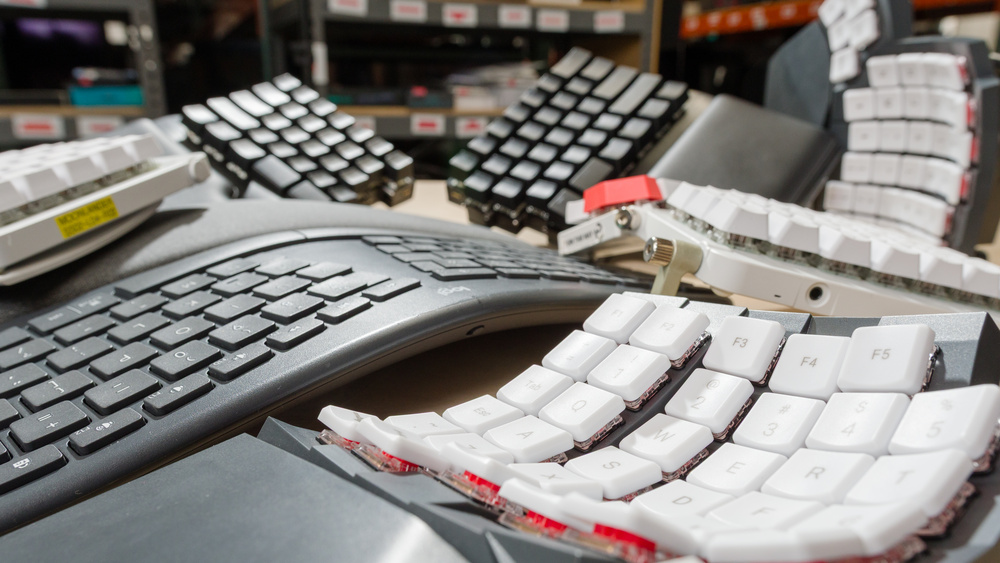
Ergonomics can be a tricky subject. For some, it simply means comfort, but it can also involve claims about posture, strain, and injury prevention, so it's worth approaching manufacturer claims with a critical eye. When shopping for an ergonomic keyboard, consider the following:
• Split or angled layouts: These can help keep your wrists, forearms, and shoulders in a more natural position.
• Tenting and negative tilt: Tenting can reduce forearm rotation, while negative tilt can help reduce how much you bend your wrists upward.
• Keyboard height: Slimmer keyboards and low-profile switches can reduce wrist extension.
• Wrist rests: A good wrist rest can improve comfort, but it should support the firm base, or heel, of your palm rather than your wrist itself. Resting directly on your wrist can put pressure on sensitive tendons and nerves, making your setup less ergonomic.
A few other practical factors are also worth keeping in mind:
• Layout and size: Smaller layouts can reduce reach and make more room for your mouse, but they may also omit keys you use regularly or require new shortcuts and workflows.
• Switch feel and weight: Switch preference is personal, but lighter switches may reduce typing effort for some people. Silent switches can also be useful if noise is a concern.
• Adjustment period: Unusual designs, especially fully split or columnar keyboards, can take a few weeks to get used to.
We've tested over 295 keyboards, and below are our top picks for ergonomic keyboards. If you're interested in seeing more conventional options, check out our recommendations for the best keyboards, the best keyboards for typing, and the best mechanical keyboards.
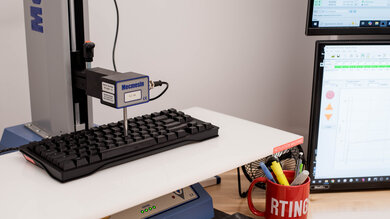
We test dozens of keyboards each year, and to maintain independence, we buy every unit ourselves. Our reviews go beyond subjective typing impressions or quick gaming sessions. Each keyboard is put through the same standardized test bench, so you can directly compare our results. We use specialized tools like a Mecmesin force tester to measure switch force curves and a Beagle 480 USB analyzer to capture input data for latency testing. Multiple teams contribute to each review in a process that can take days or even weeks from start to finish.
-
Best Ergonomic Keyboard
 GamingOfficeMobile/TabletProgrammingEntertainment / HTPCRaw PerformanceErgonomics:Size:TenKeyLess (80%)Connectivity:WirelessBluetooth:Curved/Angled:Split Keyboard:See all our test resultsKey Alignment:
For an ergonomics enthusiast looking for a highly adjustable keyboard, the MoErgo Glove80 is the best ergonomic keyboard we've tested. As more of a specialty product, this model isn't available from online retailers and is only available directly from the manufacturer's website.
This fully wireless keyboard has two halves that connect via Bluetooth and can pair with up to four devices simultaneously. Each side also has dedicated thumb clusters, a detachable wrist rest, and a concave key well with a columnar layout. This design minimizes how far your fingers need to travel while typing, which can reduce strain and fatigue. You can also tent both halves between 10 and 30 degrees to reduce forearm pronation. While this design may be overkill for those just dipping their toes into ergonomic keyboards, it's much more customizable and less strenuous to use for long stretches than standard straight keyboards.
In addition to the ergonomic adjustments, this keyboard allows you to customize layouts and record complex macros using ZMK firmware or MoErgo's web-based layout editor. While these configuration tools are powerful, they're less user-friendly than the more basic configuration software used by some other options on this list, like the Logitech ERGO K860. Altogether, as far as the best-split keyboards go, this is a standout wireless option if you're a true ergonomics devotee.
-
Best Mid-Range Ergonomic Keyboard
GamingOfficeMobile/TabletProgrammingEntertainment / HTPCRaw PerformanceErgonomics:Size:Full-size (100%)Connectivity:WirelessBluetooth:Curved/Angled:Split Keyboard:See all our test resultsKey Alignment:If you want a more common ergonomic design and don't want to spend as much for the more enthusiast-focused design above, we recommend the Logitech ERGO K860. It has a very comfortable plush wrist rest and a wave-like shape that effectively creates two separate key clusters on either side of the board, one for each hand. This shape aligns your hands, wrists, and elbows in a neutral position that isn't as taxing on your body as a conventional keyboard and can help you stay comfortable while typing, especially if you use your keyboard for long stretches. Overall, this design style is likely to be more suitable for most people compared to the fully split design of the MoErgo Glove80.
While it's made entirely of plastic, it feels high-quality and sturdy overall. The switches on this keyboard are light to press, so you don't need to worry about tiring out your fingers while you type. These switches are also very quiet, which is great if you're worried about bothering those around you in the office or at home. Also, you can connect this keyboard wirelessly with its USB receiver or via Bluetooth, so you don't need to worry about a cable getting in the way of placing your keyboard in a position that's most comfortable for you.
-
Best Budget Ergonomic Keyboard
GamingOfficeMobile/TabletProgrammingEntertainment / HTPCRaw PerformanceErgonomics:Size:Full-size (100%)Connectivity:WirelessBluetooth:Curved/Angled:Split Keyboard:See all our test resultsKey Alignment:If you're newer to ergonomic keyboards and want to spend even less for something with a less severe shape, the Logitech Wave Keys is our recommendation at a more budget-friendly price point. It has a much smaller footprint on your desk than the other options on this list, but it includes all the same keys as a full-size keyboard like the Logitech ERGO K860 above. It has a curved key layout that tents upwards slightly towards the middle. This overall design isn't as radical as a split-key cluster layout like the ERGO K860 (or fully split board like the MoErgo Glove80), but it comes close to offering a similarly neutral typing posture and does a good job of limiting how steeply you need to angle your wrists while typing.
The Logitech's design is quite compact overall, but it has an integrated wrist rest, so it's still fairly deep and isn't a particularly portable option. That said, it's still a great versatile choice for moving between spots in your home or between hotdesks in the office, as it connects wirelessly with a USB receiver or via Bluetooth with up to three devices at once. Its compact design also means its keys are spaced just a bit closer than most standard keyboards. This doesn't negatively impact how comfortable it is to type on, but it can take some getting used to at first.
-
Best Cheap Ergonomic Keyboard
GamingMobile/TabletOfficeProgrammingEntertainment / HTPCErgonomics:Size:Full-size (100%)Connectivity:WirelessBluetooth:See all our test resultsBoard Design:If you're even tighter for cash and want something even cheaper, we recommend the Kensington Pro Fit Ergo Wireless Keyboard. Like the Logitech Wave Keys above, it's a full-size board with a numpad, but it has a more divided, less compact design with more spacing between the left and right key clusters. Unlike the other options mentioned so far, it has flip-up risers along the bottom edge, allowing you to position the keyboard at a negative tilt, angled downward toward the desk. Ultimately, this comes down to ergonomic preference, but some people find a negative tilt more comfortable for long stretches and more preferable than the positive tilt common to most keyboards, which results in wrist extension and can lead to strain and fatigue.
The typing quality is decent overall, with switches that feel very similar to the Logitech Wave. Unfortunately, the lower price is felt in the build quality as the plastic feels flimsier. It also doesn't have any customization software available. However, it can often be found for quite a bit cheaper than any of the other options on this list, making it a decent all-around option, especially as an entry-level option or for a keyboard you don't intend to use all that frequently.
-
Best Ergonomic Keyboard For Gaming
GamingOfficeMobile/TabletProgrammingEntertainment / HTPCRaw PerformanceErgonomics:Size:Compact (60%)Connectivity:WirelessBluetooth:Curved/Angled:Split Keyboard:See all our test resultsKey Alignment:The Dygma Raise 2 is our recommendation for the best ergonomic gaming keyboard. It's a high-end gaming keyboard with a split design and extensive customization. It features a relatively standard 60% layout, which makes it easy to adjust to, and an eight-key thumb cluster that can be bound to frequently used commands, reducing the need for extensive finger movement. The base model lacks any incline options, but a built-in tenting kit is available as a separate add-on. Each half of the keyboard has its own dedicated MCU for lower latency. The keyboard offers excellent build quality, thanks to its very smooth switches and solid assembly. Performance-wise, it achieves very low latency, especially when it's used wired. Finally, the software is well laid out, reasonably intuitive, and offers a wide range of customization options, especially for creating complex macros and layers.
If you prefer a smaller TenKeyLess layout, you may want to consider our previous best ergonomic keyboard for gaming pick, the ZSA Moonlander. Unlike other options on this list, this is a wired-only keyboard, though thankfully, each half of the keyboard has its own wired connection, so you don't have to worry about positioning limitations. Each thumb cluster also offers incline adjustments, and both halves of the keyboard include rotating incline feet, which provide in-depth flexibility with positive and negative angle support to suit your ergonomic preferences. Some people may have issues with this keyboard's fairly unusual columnar-staggered key layout. While there's a good amount of research suggesting this layout is more efficient and typically takes less effort and movement for typing in the long run, it may take a while to get used to.








Notable Mentions
- ErgoDox EZ: The ErgoDox EZ is a fully split alternative that's more affordable than the MoErgo Glove80. It's also a mechanical unit with a hot-swappable printed circuit board, meaning you can change the stock switches without having to solder. That said, it isn't a wireless model like the MoErgo. It also doesn't have unique concave key wells, has higher latency, and isn't as lightweight. See our review
-
Keychron Q8 Max:
The Keychron Q8 Max is a good mid-range alternative if you prefer a mechanical keyboard with an Alice layout: a unibody split design with angled left and right key clusters. It also has excellent build quality, with an aluminum case and a double-gasket mount design. However, it's more expensive than the Logitech ERGO K860 and doesn't come with a wrist rest.
See our review -
ASUS ROG Falcata:
The ASUS ROG Falcata is a good alternative to the Dygma Raise 2 if you want a split ergonomic keyboard that’s more focused on competitive gaming. It uses magnetic switches with adjustable actuation and Rapid Trigger support, but the Dygma offers much more extensive ergonomic customization overall.
See our review -
Razer Pro Type Ergo:
The Razer Pro Type Ergo is essentially a gaming-focused version of the Logitech ERGO K860, with an extremely similar ergonomic design but lower latency and gaming-oriented features like addressable RGB lighting. However, its build quality is disappointing given its significantly higher price.
See our review
Recent Updates
Jul 08, 2026:
We've added the Razer Pro Type Ergo and ASUS ROG Falcata to our Notable Mentions. We've also updated the introduction with a quick guide covering key considerations when shopping for an ergonomic keyboard.
May 27, 2026:
We've audited this article and haven't changed our current recommendations, but we've made a few small language updates across several categories to better explain the benefits of certain ergonomic features.
Mar 19, 2026:
We replaced the ZSA Moonlander with the Dygma Raise 2 as our 'Best For Gaming' pick. We changed the article's layout to better reflect the market and available options, and added the Kensington Pro Fit Ergo as a cheaper option.
Mar 17, 2025:
We've confirmed pricing and availability, but we're not making any changes with this update; our current recommendations remain the best choices in each category.
Dec 16, 2024:
We've confirmed the prices and availability of our lineup of picks and are keeping our recommendations unchanged.
All Reviews
Our recommendations above are what we think are currently the best split and ergonomic keyboards for most people. We factor in the price (a cheaper product wins over a pricier one if the difference isn't worth it), feedback from our visitors, and availability (no keyboard that is difficult to find or almost out of stock everywhere).
If you would like to do the work of choosing yourself, here is the list of all our keyboard reviews. Be careful not to get too caught up in the details. While no keyboard is perfect for every use, most are good enough to please almost everyone, and the differences are often not noticeable unless you really look for them.