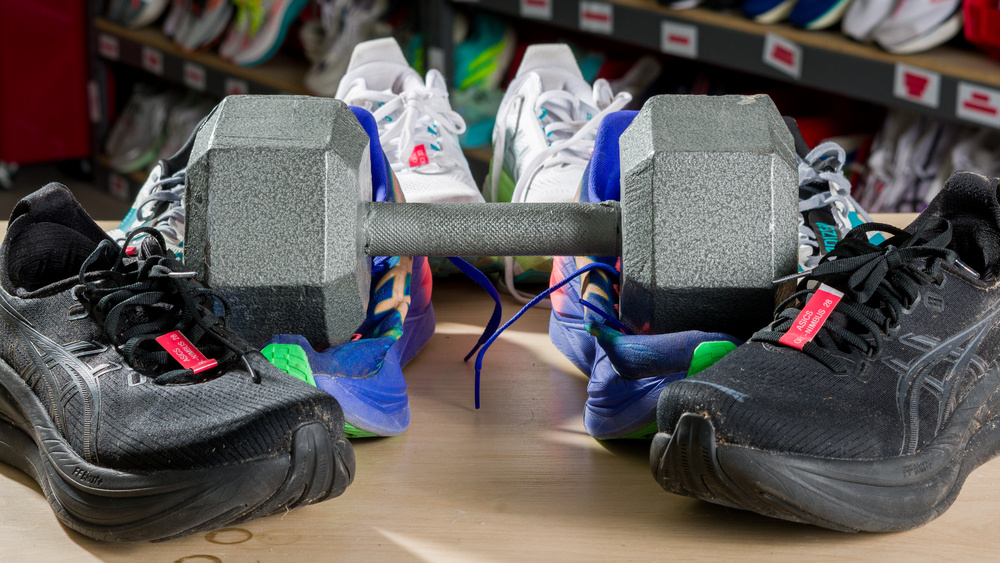
Finding the right running shoe as a heavier runner means looking for cushioning that absorbs strong impacts and enough stability to feel secure underfoot. Rocker stiffness and shoe weight are secondary considerations. Here's what to consider:
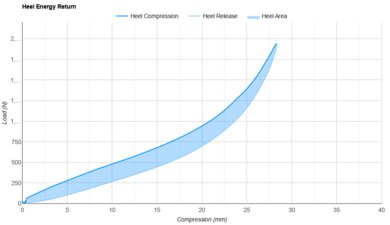
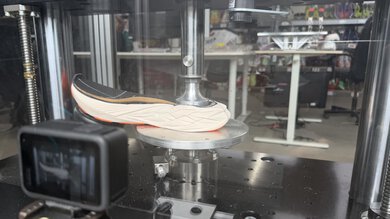
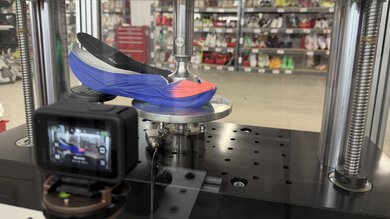
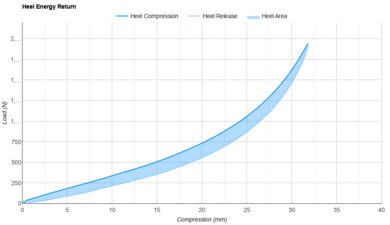
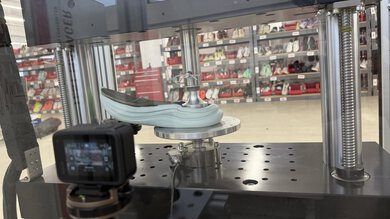
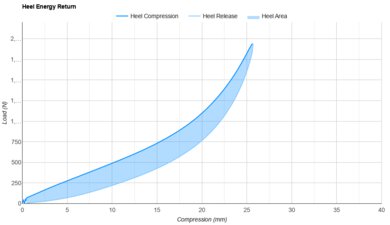
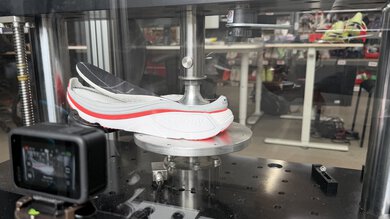
- Cushioning: Some shoes feel plush under light pressure but can bottom out when you land with more force. The heavier you are and the faster you run, the greater the impact with each landing. We use a compression machine to test cushioning across a range of forces designed to reflect real running impacts, up to 2,050 newtons, representative of a 220 lb (100 kg) runner just under a five-minute-mile pace (3:00 min/km). That said, 220 lb isn't a limit on who these results are relevant to. Check our custom tables to identify the appropriate force for your weight and pace. Our long-run cushioning test shows how well that protection holds up over repeated impacts.
- Stability: A stable shoe helps keep your foot centered instead of rolling sideways, which is especially important when you land with a lot of force. A score of 7.5 or more is good for daily use, but taller shoes are often less stable and require better form. A wide outsole base and firmer foam can help. Support features provide additional guidance if you need it, but a neutral shoe can also be stable by design.
- Rocker stiffness: A rocker is the upward curve of the sole that helps you roll through each stride. However, some rockers flatten under the pressure of your landing, making that motion less effective. Look for a shoe with high rocker stiffness that maintains its curved shape under your weight, especially for your faster runs.
- Shoe weight: Extra cushioning usually comes with extra weight. More than 260 g per shoe (in a men's US size 9) is on the heavier side and can feel cumbersome, especially for long runs or when you pick up the pace. A few grams might seem insignificant compared with your body weight, but your shoes are far from your center of gravity and swing with every stride. Added weight there takes much more energy to move than the same weight carried closer to your center of gravity.
We've tested over 300 running shoes, and below are our picks for the best running shoes for heavy runners. For our top picks across a wide range of uses, see our best running shoes. If comfort is your top priority, check out our most comfortable running shoes. If you're choosing your first pair, start with our best running shoes for beginners.
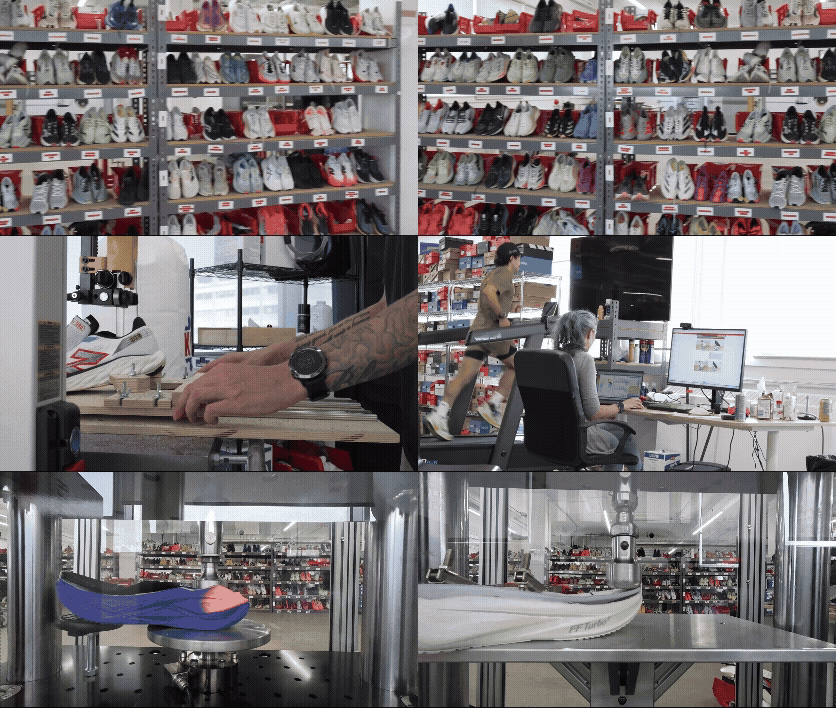
We've bought and tested more than 300 running shoes. Every pair purchased with our own money, never supplied or sponsored by brands. Our data-driven tests are designed to go beyond marketing claims, and since every shoe goes through the exact same methodology, you can directly compare results to find the right pair for your needs.
-
Best Running Shoe For Heavy Runners
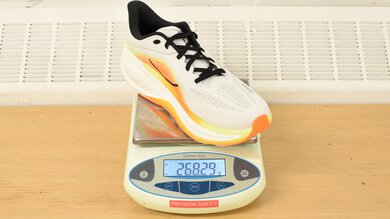
 Daily Training8.1Long Run7.6Cushioning8.9Stability7.7Weight:269.0 g (9.49 oz)See all our test resultsHeel-To-Toe Drop:8.8 mm
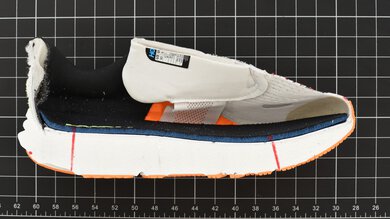
The HOKA Clifton PRO is the best running shoe for heavy runners we've tested. It's deeply cushioned and protective, with a wide base that keeps it stable underfoot, making it a dependable choice for daily training, recovery runs, and long runs. Its cushioning performs exceptionally well under the highest forces we test, so you can land with plenty of force and still get excellent impact protection to help keep your legs feeling fresh. That protection extends to long runs, with the midsole continuing to absorb impacts well after 40 km in our simulated long-run test.
However, it's fairly heavy, requiring more effort to keep moving and making it less suited to faster running. Also, its rocker also flattens relatively easily under load, limiting how much it helps you roll forward into your next stride.
-
Best Budget Running Shoe For Heavy Runners

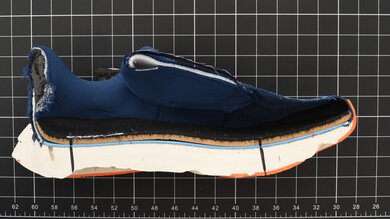
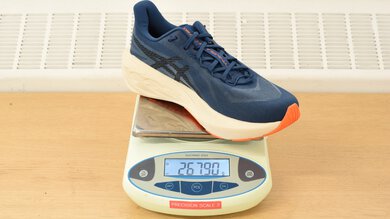
 Daily Training7.7Long Run7.2Cushioning7.2Stability8.2Weight:269.9 g (9.52 oz)See all our test resultsHeel-To-Toe Drop:9.6 mm
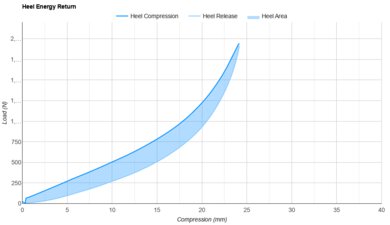
If you're a heavier runner looking for an everyday shoe that won't break the bank but still protects your legs pretty well, the ASICS DYNABLAST 6 is the best budget shoe we've tested. While these shoes offer much less cushioning than the HOKA Clifton PRO, making powerful landings feel harsher, it's still worth considering if cost is a factor. Its heel cushioning can absorb high forces better than the forefoot and handle powerful landings well for the price, especially if you're a heel striker rather than a forefoot striker. The DYNABLAST still provides decent cushioning on long runs, but it falls short of our top pick's protection and is better suited to shorter outings.
Its firmer foam and wide platform make it more stable than our top pick, the Clifton PRO, while its rocker holds its shape better, helping you roll through each stride. That said, it's still a fairly heavy shoe, so it's best suited to easy mileage.
For more affordable options, see our best cheap running shoes.
-
Best Long-Run Running Shoe For Heavy Runners
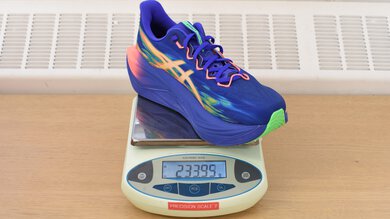
 Daily Training8.0Long Run7.9Cushioning9.4Stability6.4Weight:232.6 g (8.20 oz)See all our test resultsHeel-To-Toe Drop:7.1 mm
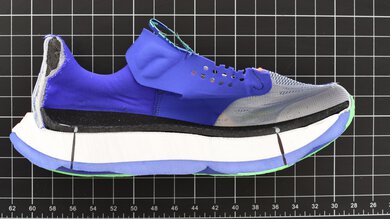
If you're a heavier runner looking for a shoe you can count on for your longest runs, the ASICS SUPERBLAST 3 is the best running shoe for heavy runners we've tested. Compared with our top pick, the HOKA Clifton PRO, it provides more cushioning throughout our simulated long-run test, helping keep your legs protected over repeated impacts. Its lighter build also feels less cumbersome mile after mile, while its more energetic midsole helps you maintain faster paces, making it a great choice for long runs that include quicker sections.
The main trade-off is stability. Its softer foam and narrower platform through the arch make it less secure than the Clifton PRO. If you struggle to feel confident in your landings, our top pick is probably the better choice for you, including for long runs. The SUPERBLAST also costs more, although it absorbs more impact under high forces and has a rocker that holds its shape better under load, helping you roll smoothly through each stride.
If you want more options for long runs, check out our picks for the best long-distance running shoes.
-
Best Running Shoe For Heavy Runners With Wide Feet
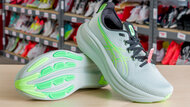
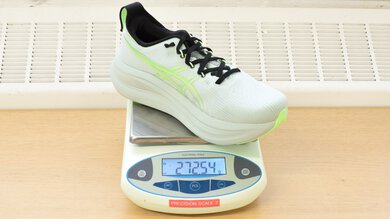
 Daily Training8.1Long Run7.8Cushioning8.6Stability8.3Weight:272.9 g (9.63 oz)See all our test resultsHeel-To-Toe Drop:6.4 mm
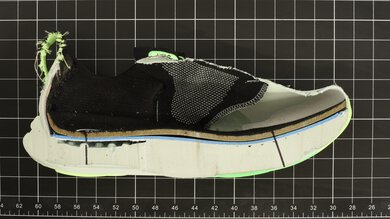
If you need more room for your feet, the ASICS GEL-NIMBUS 28 is our pick for heavy runners with wide feet. It comes in wide for both men and women, and extra-wide for men, giving you more options for a comfortable fit. While its foam absorbs plenty of impact from the road, it’s tuned a bit firmer, so it feels very stable underfoot, more so than any of the picks above. It also has a forefoot rocker that maintains its shape very well under load, helping you roll through each stride.
Compared with our top pick, the HOKA Clifton PRO, you get less cushioning when you land heavily on your heel, so those impacts can feel a little harsher. However, you still get excellent impact protection for daily training, recovery runs, and long runs.
For more options, browse our table of running shoes available in wide sizes.
-
Best Stability Running Shoe For Heavy Runners
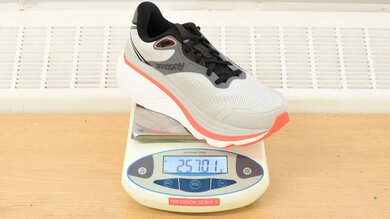
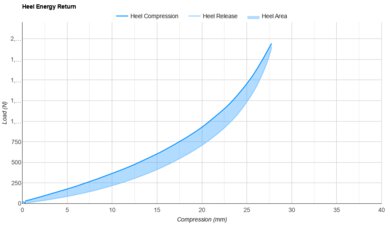 Daily Training8.1Long Run7.8Cushioning8.4Stability7.8Weight:260.6 g (9.19 oz)See all our test resultsHeel-To-Toe Drop:7.7 mm
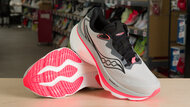
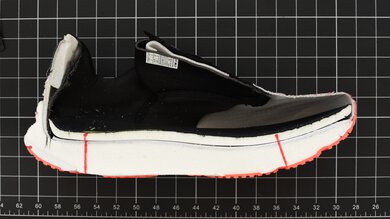
If you're a heavier runner who overpronates, meaning your feet roll too far inward, the Saucony Hurricane 26 is our top pick for stability. Its wide base and raised foam sidewalls help keep your foot centered through each stride. Most support shoes feel harsh underfoot, but the Hurricane combines gentler guidance with a cushioned feel that remains protective when you land heavily. That combination makes it a great option for keeping your legs protected during daily training and long runs.
Compared with our top pick, the HOKA Clifton PRO, you give up some impact protection under both the heel and forefoot when you land with a lot of force. However, the Hurricane's dedicated support features make it a better fit if you need additional guidance to feel secure underfoot.
For more shoes with dedicated support features, see our recommendations for the best stability running shoes.
Notable Mentions
-
Brooks Glycerin Max 2:
The Brooks Glycerin Max 2 is a heavily cushioned daily trainer with a rocker that holds its shape better than the HOKA Clifton PRO's. However, it's substantially heavier and less stable, and its heel cushioning absorbs slightly less impact when you land heavily.
See our review -
HOKA Skyward X 2:
The HOKA Skyward X 2 is a plush, carbon-plated trainer that absorbs more impact under both the heel and forefoot during powerful landings than the HOKA Clifton PRO. However, its taller, softer platform feels a lot less stable, and it's heavier.
See our review -
Nike Vomero Premium:
The Nike Vomero Premium is a towering shoe that provides even more impact protection than the ASICS SUPERBLAST 3, both during powerful landings and throughout our long-run test. However, it's considerably heavier and feels more cumbersome, so it's better suited to recovery runs where speed doesn't matter.
See our review
Recent Updates
-
Oct 14, 2026 at 10:30 am:
We replaced the Brooks Glycerin Max 2 with the newly released HOKA Clifton PRO as our top pick for its better heel protection during powerful landings, greater stability, and lighter build. We replaced the ASICS SONICBLAST with the cheaper, more widely available ASICS DYNABLAST 6 as our budget pick. We also replaced the ASICS GEL-KAYANO 33 with the Saucony Hurricane 26 as our stability pick for its better impact protection and lighter build.
All Reviews
Our recommendations above are what we think are currently the best running shoes for heavy men and women. We consider factors like performance, price (a more affordable shoe wins out if the extra cost isn't justified), user feedback, and availability; we don't recommend shoes that are hard to find or nearly sold out.
If you'd rather decide for yourself, check out our full list of running shoe reviews. There's no perfect shoe for everyone: your stride, preferences, and goals will always be the most important part of the equation.