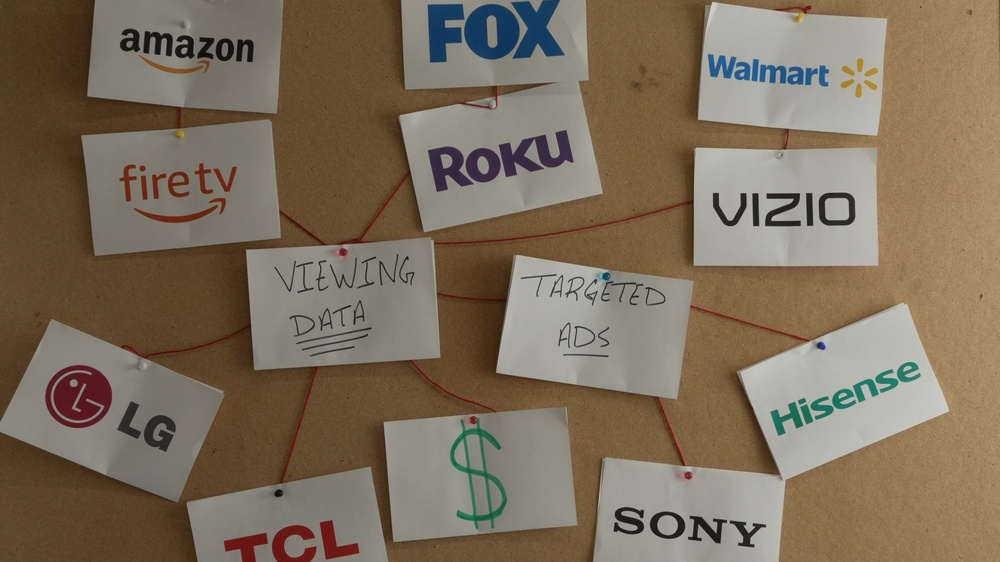
- Smart TVs are so affordable in part because manufacturers can generate ongoing revenue from data collected about what content is being watched.
- Most consumers don't fully understand this exchange of viewing data for cheaper hardware. Consent choices are often obscured by unfamiliar language, broad agreements, difficult-to-find settings, or the loss of advertised features.
- Individuals can reduce tracking by changing privacy settings or keeping their TV offline, but fairer consumer practices will ultimately require collective pressure, clearer industry standards, and regulatory action.
Televisions have become remarkably affordable for the hardware and features they offer. Part of the reason is that the business model has changed: a modern smart TV is no longer just a screen sold once, but a connected platform that can continue generating revenue through advertising, services, and data about what people watch.
Recent corporate acquisitions show how valuable that ongoing relationship has become. Fox’s reported $22 billion deal to acquire Roku is, in part, a bet on Roku’s access to millions of connected households and its advertising platform. Walmart’s $2.3 billion acquisition of Vizio tells a similar story: Vizio’s device business had generated negative gross profit, while its advertising and services business generated the company’s positive gross profit.
In that sense, the sticker price is only part of what you pay for a smart TV. The rest may come through your personal data: what you watch, when you watch it, which apps and inputs you use, and what those habits suggest about your interests. That data can help manufacturers and advertisers turn your living room into part of a targeted advertising system. This may be an acceptable trade-off for some shoppers. The problem is that most buyers are never clearly told that this is the deal. We tested whether smart TV buyers are given a meaningful opportunity to understand and refuse that bargain.
A Smart TV Can Keep Making Money After You Buy It
Once connected to the internet, a television can generate revenue long after its initial sale through home-screen advertising, sponsored recommendations, content partnerships, app purchases, and other services.
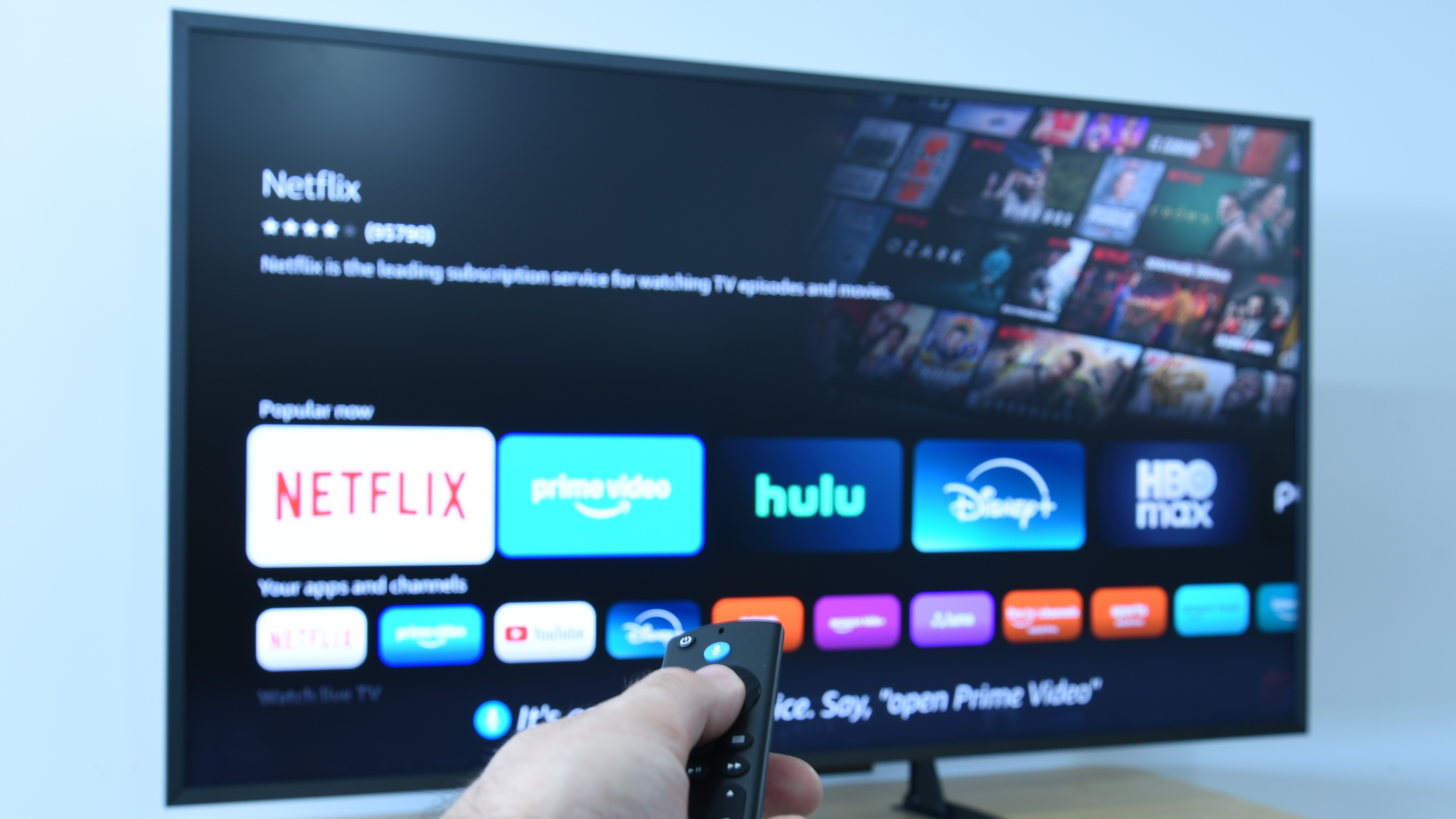
Personal data is a large part of what makes these platforms valuable. Information about what a household watches, which apps and inputs it uses, when it watches, and how often it returns can help companies measure audiences, categorize viewers, and target advertising more effectively. When viewing habits are combined with information such as IP addresses and demographic data, they become even more commercially powerful. The TV doesn't need to know everything about you by name for that data to have value. It only needs to make your household more measurable and easier to place into useful audience groups.
None of this makes the smart TV business model inherently problematic. Advertising and data revenue can help support lower hardware prices and services that buyers might otherwise pay more for. But a tradeoff like this is only defensible when buyers understand it. Most shoppers know they are buying a television with streaming apps and on-screen advertising. Far fewer realize they may also be bringing a data-collection platform into their living room, one that can watch what appears on the screen and report that information back to servers outside the home.
How Your TV Can Recognize What You Are Watching
One of the technologies that powers smart TV viewing-data collection is Automatic Content Recognition, or ACR. In simple terms, ACR samples what appears on the screen and creates a digital fingerprint that can be sent to a server for identification, much like Shazam identifying a song.
What makes ACR especially powerful is that it operates at the TV system level. It can recognize content not only from built-in streaming apps, but also from over-the-air broadcasts and HDMI devices such as game consoles and Blu-ray players. That gives the smart TV platform a much broader view of a household’s viewing habits across nearly everything that appears on the screen.
ACR’s broad reach makes meaningful consent especially important. Often, the most effective way to demand fairer consumer practices is through collective pressure, regulation, and enforcement. Texas provides an early example of that pressure producing a concrete result. Samsung reached an agreement with the Texas Attorney General requiring it to stop collecting ACR data from Texans without consent and to revise its privacy disclosures and consent screens. Lawsuits involving other major television manufacturers remain ongoing, suggesting that the broader industry’s practices are still being contested.
We Tested Whether Saying No Actually Changed Anything
Privacy disclosures and consent screens matter only if the choices they present actually change what the television does. We tested TVs from the major brands and smart TV operating systems, along with several streaming devices and a smart monitor, to see whether disabling ACR-related settings produced a visible change in network behavior.
| Device Type | Model | Operating System |
|---|---|---|
| TV | Samsung S95F | Tizen |
| TV | LG G5 | webOS |
| TV | Sony Bravia 8 II | Google TV |
| TV | Hisense U8QG | Google TV |
| TV | TCL QM8K | Google TV |
| TV | Amazon Ember Artline | Fire TV |
| TV | Panasonic Z95A | Fire TV |
| TV | Vizio VQD65R-10 | Vizio OS |
| TV | Roku Pro Series 2025 | Roku OS |
| TV | Hisense 32A4NV | VIDAA |
| Smart Monitor | Samsung Odyssey S32DG80 | Tizen |
| Streaming Device | Apple TV 4K | tvOS |
| Streaming Device | Roku Ultra | Roku OS |
| Streaming Device | NVIDIA Shield | Google TV |
| Streaming Device | Amazon Fire TV Stick 4K Max | Fire TV |
Each device was factory-reset before testing. We documented the setup process, including account requirements, privacy prompts, Terms of Service, and any ACR-related choices presented to a typical buyer.
We then monitored network traffic using Wireshark, first with ACR-related data sharing allowed, and then again after turning off the relevant setting or withdrawing the related consent. We repeated those tests across built-in apps, HDMI devices, USB playback, gaming consoles, and idle states. Because most traffic was encrypted, we could usually identify destination servers, timing, traffic volume, and changes in behavior, but not the complete contents of every transmission.
ACR Opt-Outs Worked, But Only When We Could Clearly Identify The Traffic
On the Samsung S95F OLED, Sony Bravia 8 II, and LG G5, we could clearly identify regular traffic to known or identifiable ACR-related services. When users had consented, the TVs sent recurring bursts of data to those services. After we withdrew consent or turned the relevant setting off, that traffic stopped or changed dramatically.
Samsung was also one of the clearest examples of an ACR control producing an observable change in network traffic. We cannot attribute that behavior to the Texas agreement, but it illustrates the kind of measurable choice that meaningful consent requirements should produce.
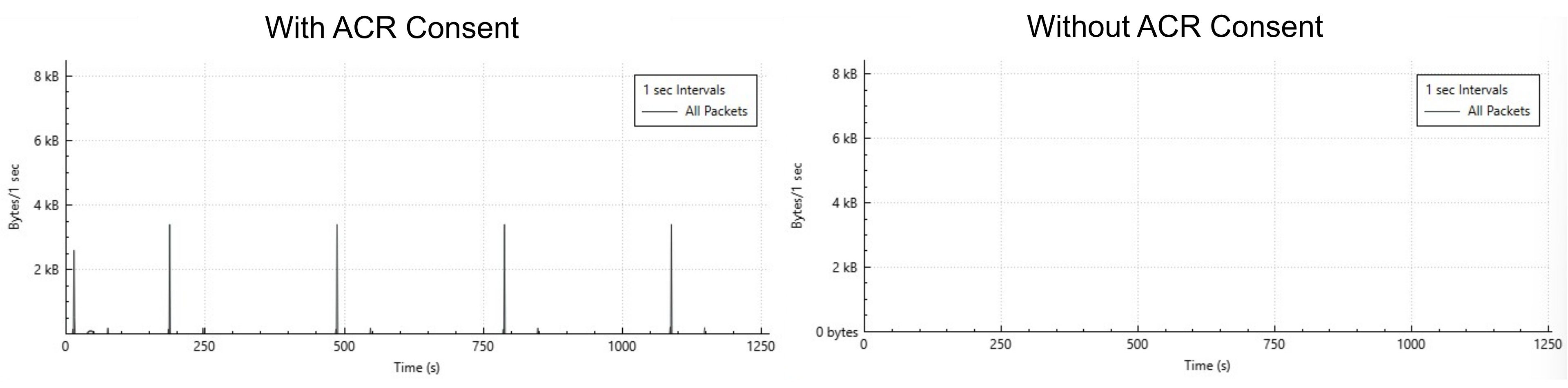
That clarity wasn't consistent across every television. On the other TVs we tested, potential ACR-related communication was difficult to distinguish from software services, telemetry, recommendations, and other background traffic. In those cases, withdrawing consent for ACR didn't produce an equally obvious change in destination servers or traffic patterns.
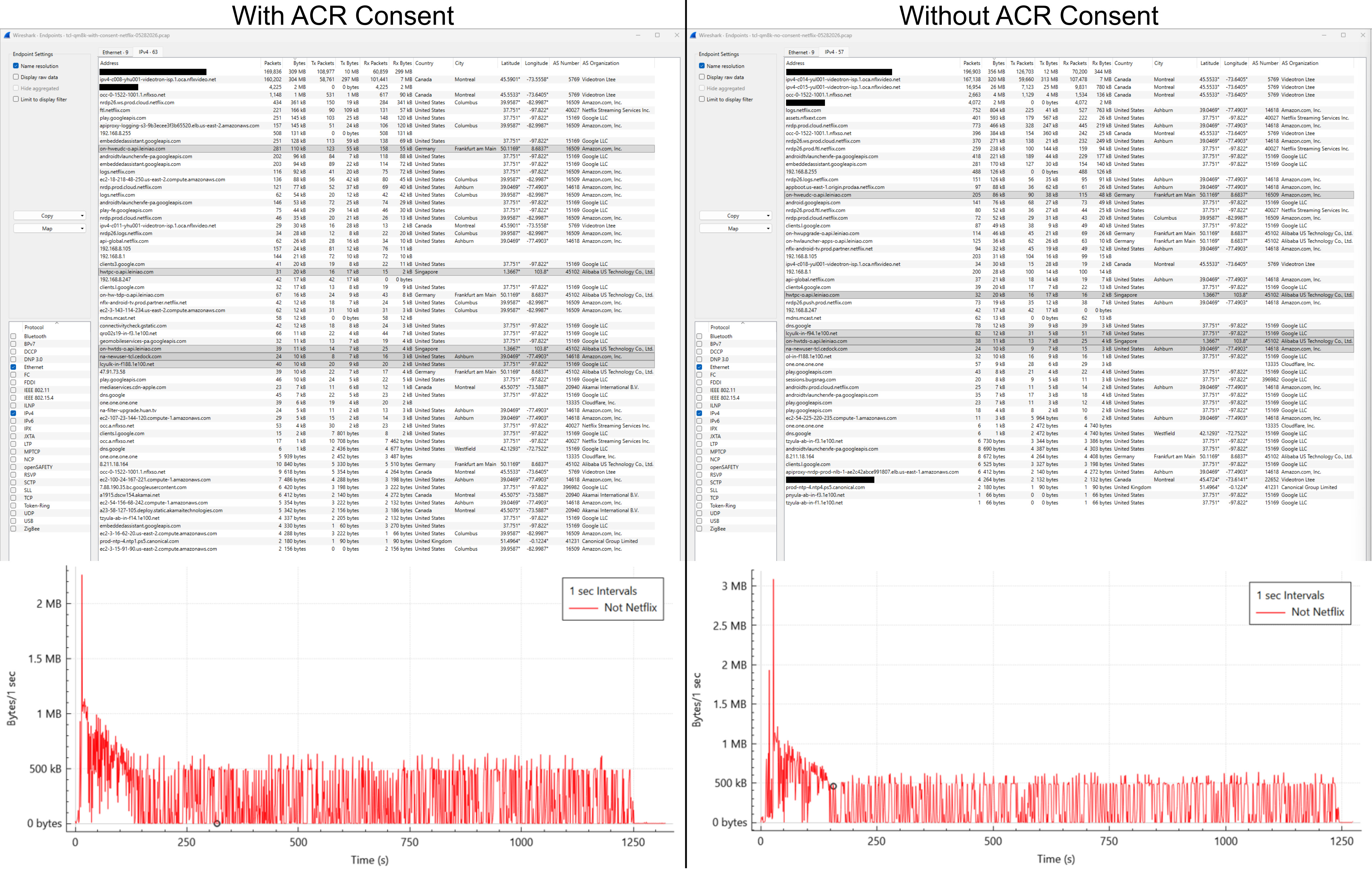
That lack of separation also makes selective blocking through DNS filtering difficult, because blocking the same servers may interfere with unrelated TV functions.
ACR Could See Beyond The TV’s Built-In Apps
The LG G5 demonstrated how broadly TV-level ACR can operate. We observed identifiable ACR-related traffic while the TV was idle, while using built-in apps, and while playing video from a USB drive. The strongest activity appeared when we used HDMI devices. While gaming on a connected PS5 and browsing the web on a laptop, the ACR-related traffic became considerably more frequent and higher in volume.
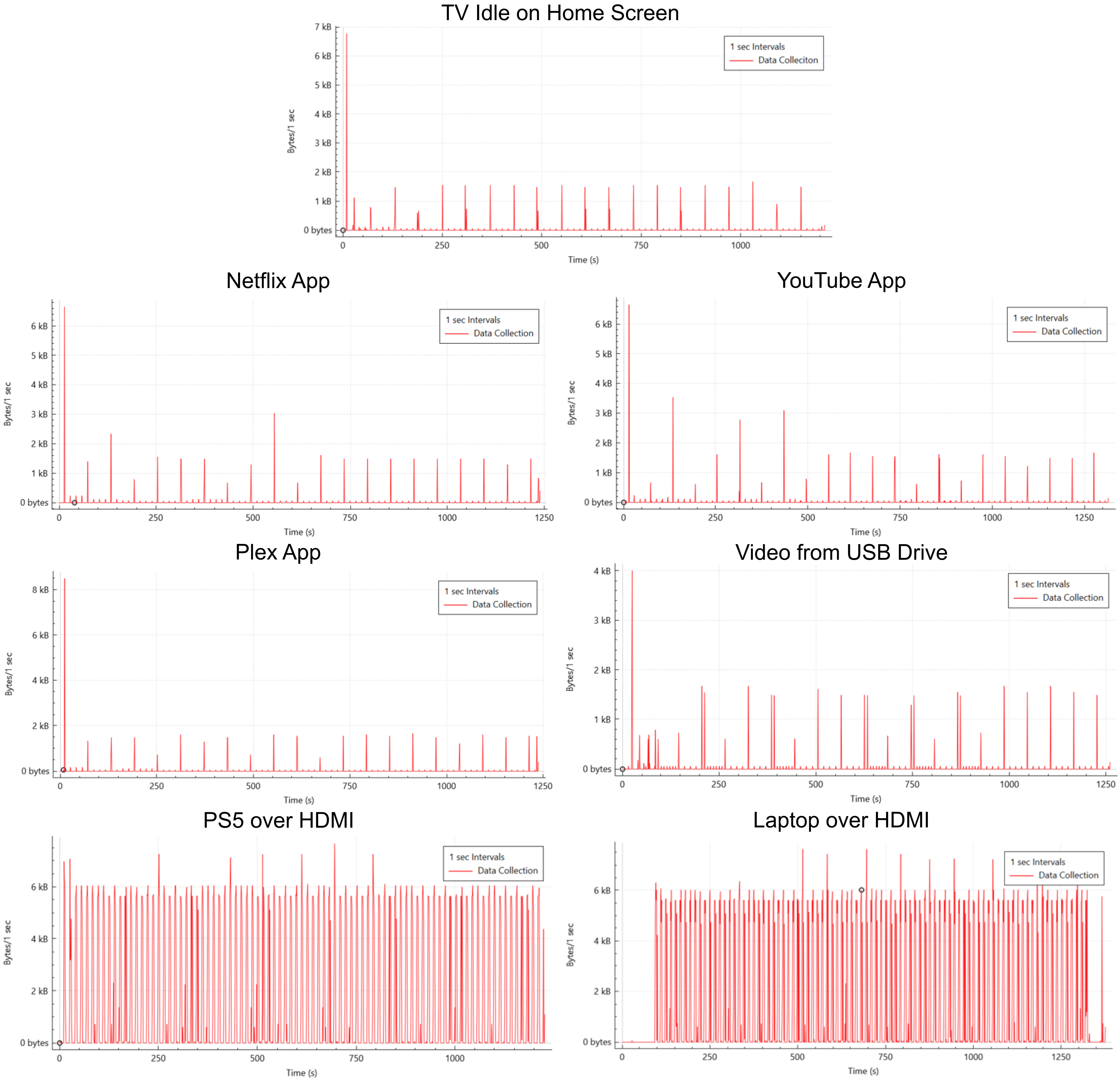
We couldn't determine from the encrypted traffic exactly why HDMI produced more activity, but the result reinforces that ACR isn't limited to the TV’s own apps. It can extend to external devices and nearly anything displayed on the screen.
Opting Out Was Not Always Simple, Obvious, Or Consequence-Free
The technical result was encouraging. Where we could identify ACR-related traffic, withdrawing consent or turning off the relevant setting generally changed what the TV sent. But that didn't answer the more practical question. Could an ordinary buyer understand that the setting existed, recognize what it controlled, and say no without giving up the product they thought they'd purchased?
In our testing, the informed-consent problem was rarely the complete absence of a control. More often, the choice was obscured by unfamiliar language, buried inside broader agreements, delayed until after setup, or tied to the loss of advertised features.
Sometimes Opting Out Meant Giving Up Smart Features
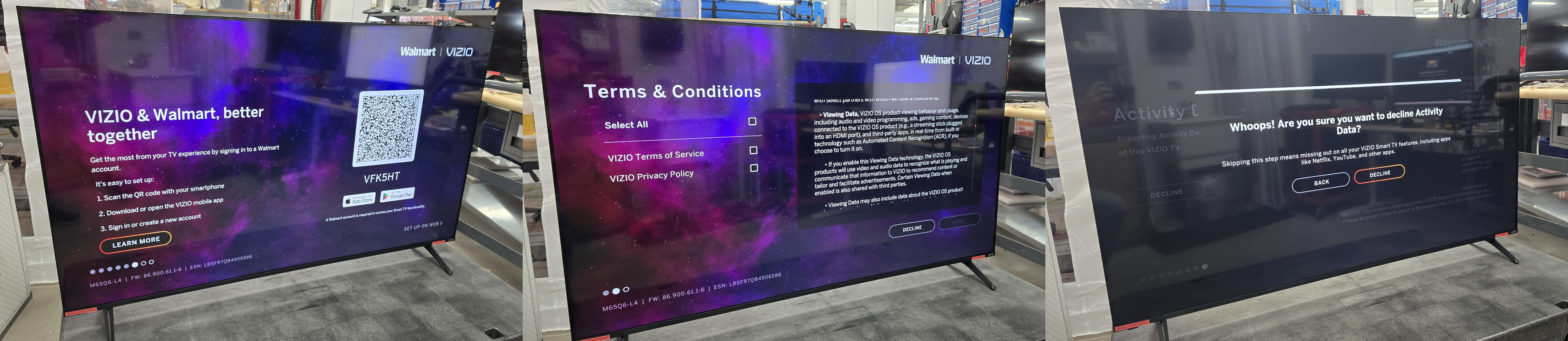
The most obvious consumer problem appeared when refusing data collection meant losing access to core smart TV functionality. Vizio was the starkest example. Accessing all of the VQD65R-10’s advertised smart features required signing in to a Vizio/Walmart account and accepting its Terms of Service, Privacy Policy, and Activity Data sharing. Users could decline, but doing so left the TV in a limited state with access only to HDMI and coaxial inputs, without apps or the other smart features advertised as part of the product. Withdrawing consent after accepting was also not as simple as changing a setting. In our testing, it required fully resetting the TV.
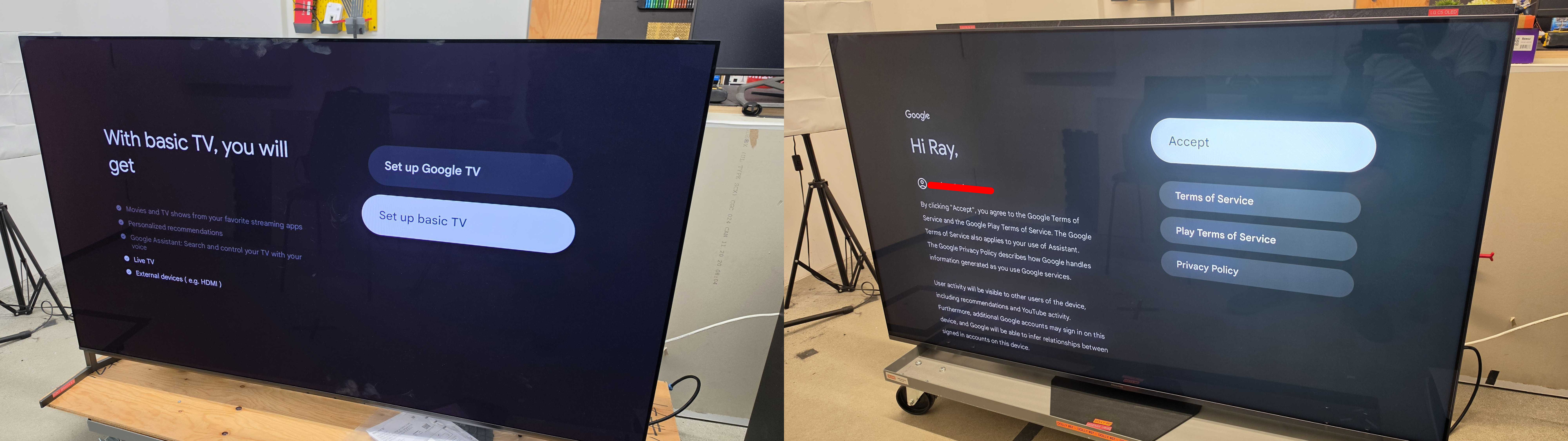
Vizio wasn't the only platform where preserving privacy meant accepting a less capable television. Within the Google TV ecosystem, some models, including the Sony Bravia 8 II and TCL QM8K, allowed users to complete setup in a “basic TV” mode without signing in to a Google account. That provided a clearer privacy-preserving path, but it also meant giving up the smart features advertised as part of the product. The Hisense U8QG offered no equivalent choice during initial setup and required users to sign in with a Google account and accept Google’s Terms of Service.
These examples show two versions of the same problem. On some TVs, users could avoid the connected ecosystem only by surrendering major advertised features. On others, they weren't given that choice during setup at all. More importantly, buyers are unlikely to know they'll face this dilemma until the television is already in their home. A privacy choice isn't truly informed when the buyer only discovers the real terms of the product after bringing it home.
Some ACR Disclosures Were Buried Inside Broader Privacy Agreements
On some devices, the problem wasn't that consent came with tradeoffs, but that the ACR-related disclosure was difficult to identify at all. Instead of appearing as a clear, standalone choice during setup, it was folded into broader terms, privacy policies, or post-setup settings.
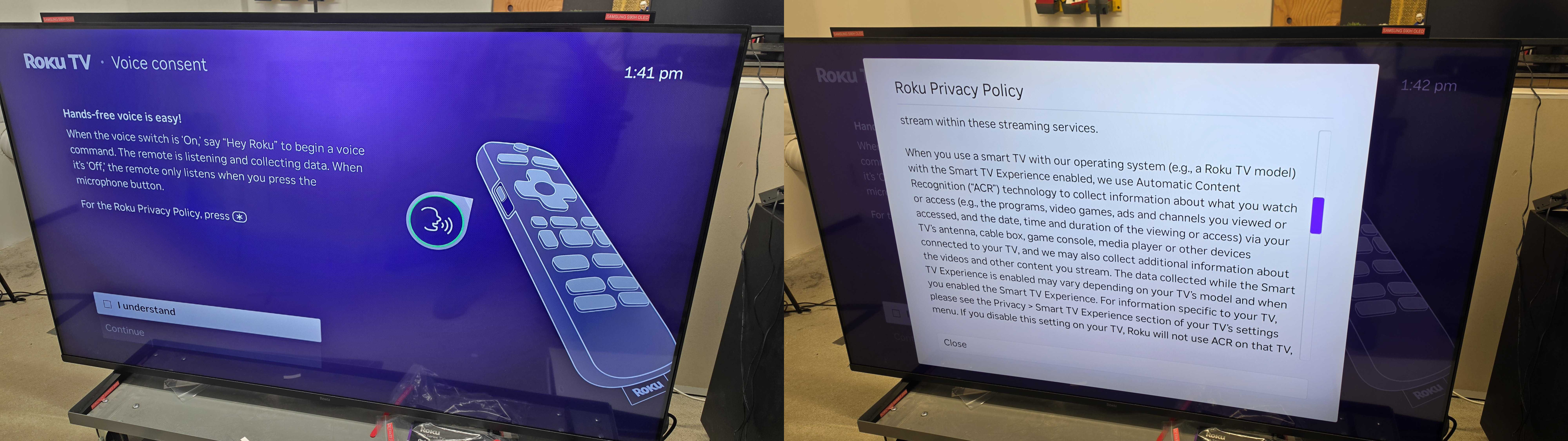
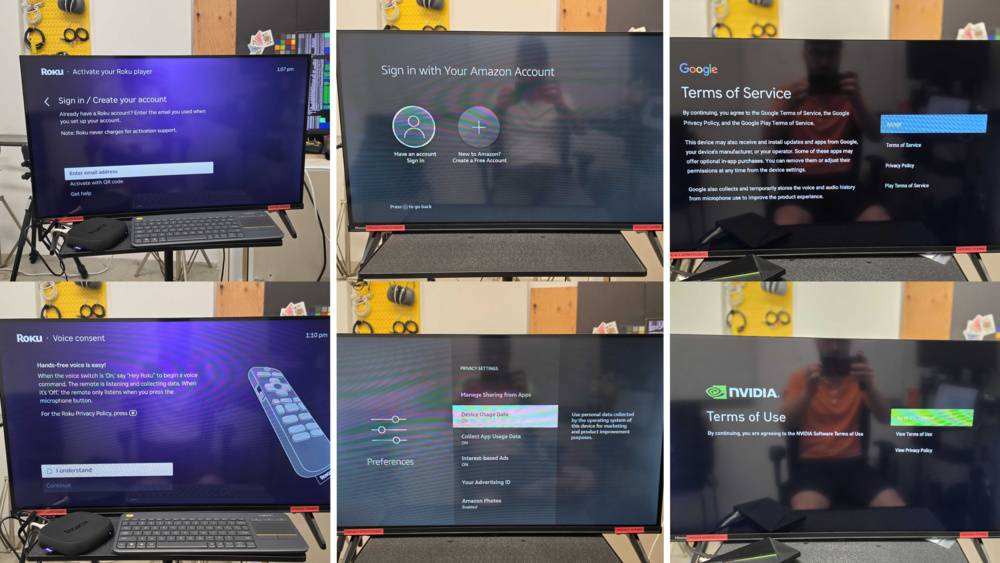
Roku OS was the clearest example of this. The Roku Pro Series required an internet connection, a Roku account, and acceptance of Roku’s Terms of Use. But in our setup flow, those terms didn't appear to include a clear explanation of ACR or viewing-data collection.
The first ACR-related language we encountered appeared later, during setup of the hands-free remote. It was contained in Roku’s Privacy Policy, which was linked from this “Voice consent” screen. To continue setting up the TV, users had no choice but to select “I understand.” A typical buyer could reasonably interpret that screen as relating only to the microphone, not to collection of broader viewing habits.
Fire TV and TCL presented similar problems. On Fire TV televisions, ACR-related practices were covered by broader Conditions of Use rather than presented as a separate choice during setup. The relevant controls, “Device Usage Data” and “Collect App and Over-The-Air Data,” had to be found afterward in the settings menu and were enabled by default. On the TCL QM8K, the setup Privacy Policy mentioned third-party use of ACR, but the actual control appeared only after setup under the unfamiliar name “Interactive Service.”

In both cases, the practice was disclosed somewhere, but buyers weren't given a clear, timely, and recognizable choice at the moment it mattered.
The Same Privacy Choice Looked Different Across Platforms
Taken together, these examples point to a broad industry problem: there's no consistent way to identify, understand, accept, or disable ACR-related features.
This starts with the naming conventions across the various platforms. A user trying to opt out may need to look for “Viewing Data,” “Viewing Information Services,” “Interactive Service,” “Enhanced Viewing Service,” or something else entirely.
| Platform / Brand | ACR-Related Feature Wording |
|---|---|
| Hisense VIDAA | Enhanced Viewing Service |
| TCL | Interactive Service |
| Samsung | Viewing Information Services |
| Vizio | Viewing Data |
| LG | Viewing Information Agreement |
| Sony | Samba Interactive TV |
The Hisense 32A4NV and TCL QM8K added another layer of uncertainty by linking ACR to picture settings. Their prompts explained that content recognition could be used to automatically enhance picture and sound across input sources. But they didn't clearly explain what else might happen to the resulting viewing data once it left the home, including whether it could be retained, combined with other data, or used for advertising, measurement, or other purposes.
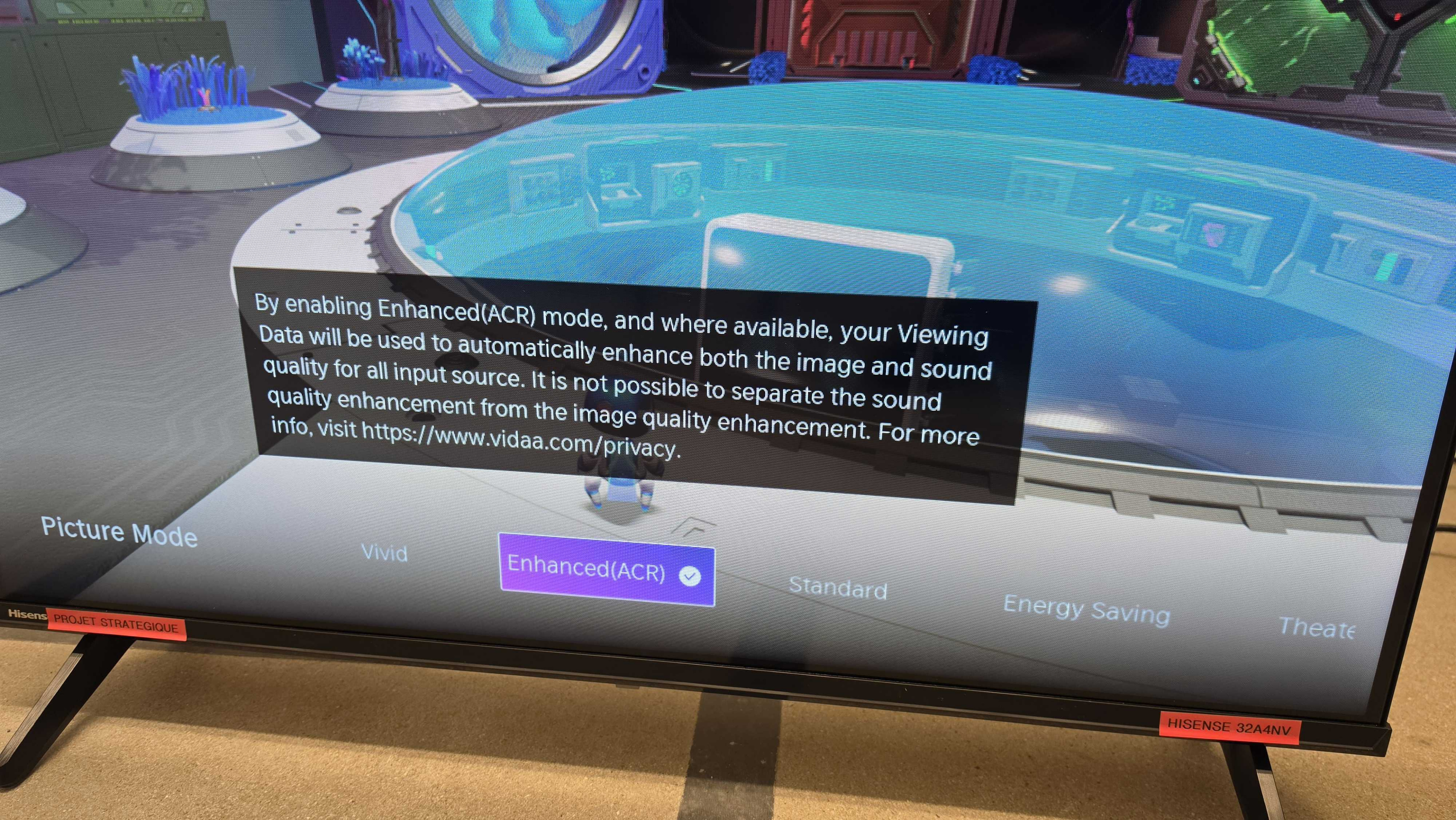
Taken together, those design choices make informed consent difficult. Across the TVs we tested, essentially the same technology could appear as a legal agreement, a smart TV service, a picture-enhancement feature, or a setting available only after setup. One platform might ask users to opt in, while another enabled the feature by default and required them to find an opt-out later. A choice cannot be truly informed when buyers aren't given a consistent explanation of what's being collected, why it's being collected, or what agreeing to the feature actually allows.
A Streaming Device Can Help, But It Doesn't Make Your TV Private
One reasonable response to smart TV tracking is to keep the television offline and use an external streaming device for apps and content. Every TV we tested could be disconnected from the internet after setup and used as a basic display for HDMI devices. That is a meaningful way to prevent the TV itself from reporting viewing information, but it doesn't eliminate the underlying business model. Streaming devices are often sold on the same basic premise as smart TVs: low-margin hardware creates an ongoing relationship through services, advertising, recommendations, and usage data. In practice, this mostly transfers the connected-platform relationship from the TV manufacturer to the streaming-device company.
The streaming devices we tested still required buyers to navigate platform-specific privacy relationships. Roku largely repeated the Roku TV flow, Fire TV required an Amazon account and presented its usage controls after setup, and NVIDIA Shield required acceptance of terms from both Google and NVIDIA.
The Apple TV 4K deserves separate consideration because it is often recommended as the privacy-conscious alternative. That reputation has some basis. We didn't encounter ACR-specific language during setup, and tvOS requires apps to request permission before tracking activity across other companies’ apps and services for advertising or sharing with data brokers. Individual streaming apps can still collect activity within their own services, and Apple’s TV app can use viewing information from Apple and connected third-party services when users grant permission. Apple TV is therefore not data-free, but it offers a more compartmentalized privacy model than the other streaming platforms we examined.
Streaming devices can still be useful. Keeping the TV offline limits what its manufacturer can observe across game consoles, laptops, Blu-ray players, and other sources. But it's not a universal privacy solution. It mostly changes which company operates the connected platform in your living room and which privacy controls you must understand.
What You Can Actually Do About Smart TV Tracking
Our testing found that ACR controls can matter. Where we could clearly identify ACR-related traffic, turning the relevant setting off changed what the TV sent. The harder problem was finding those controls and understanding what agreeing to them allowed.
For consumers, the available options form a privacy ladder. At minimum, look for settings related to “ACR,” “viewing data,” “viewing information,” “interactive services,” “Samba Interactive TV,” “enhanced viewing,” “content recognition,” or device and app usage data and disable them where appropriate. For greater privacy, keep the TV offline and use it as a display for HDMI devices. An external streaming box can offer more flexibility, but it may simply transfer the connected-platform relationship from the TV manufacturer to another company. Relying more heavily on Blu-rays, local media, or a dedicated media PC can reduce that exposure further, but at the cost of additional expense and inconvenience.
That's an awful lot to ask of someone who just wants to watch television. Consent to such broad data collection and sharing should be clear, separate, optional, and easy to withdraw. Buyers shouldn't need to recognize half a dozen names for ACR, search through post-setup menus, or give up advertised features to make a privacy choice.
The Texas lawsuit shows that enforcement can produce change. Individual consumers can reduce tracking, but lasting improvement will require collective pressure, regulatory action, and clearer standards across the industry. A business model in which lower TV prices are supported by advertising and viewing data can be fair, but only when buyers understand and knowingly accept the bargain before bringing the product home.