After a few years of absence from the U.S. market, Panasonic made the decision to release three models in 2024. These include the Mini-LED Panasonic W95A, the step-down WOLED Panasonic Z85A OLED, and this TV, the flagship Panasonic Z95A OLED. This model uses a WOLED panel with an MLA brightness-boosting layer, so it's a direct competitor to the LG G4 OLED.
The TV is loaded with modern features like HDMI 2.1 bandwidth on two ports, 4k @ 144Hz, and support for all VRR technologies. The TV uses Panasonic's HCX Pro AI Processor MK II that can analyze the content you're watching to automatically adjust colors, clarity, contrast, and sound. It runs the Fire TV OS and has support for Alexa and Apple AirPlay, with hands-free voice control thanks to the built-in mic. It features a unique 5.1 speaker system and soundbar built-in to the TV, tuned by Panasonic's own Technics speaker division. It's only available in a 65-inch size.
Our Verdict
The Panasonic Z95A is an impressive choice for a variety of uses. Its modern gaming features and smooth motion make it an excellent match for the latest consoles and PCs. Its outstanding performance with HDR content makes it equally suited for home theater setups, helped by its fantastic upscaling and PQ EOTF tracking performance. Its SDR brightness and reflection handling are good enough to fend off glare in well-lit rooms. Plus, its remarkably wide viewing angle means everyone gets a clear view, making it ideal for hosting sports watch parties.
Near-infinite contrast ratio for perfect blacks with no blooming around bright highlights.
Incredibly wide viewing angle for a consistent image from the sides.
Decent SDR brightness and excellent reflection handling makes it suitable for a bright room.
Colors are vibrant, lifelike, bright, and accurate, especially in HDR.
Excellent HDR peak brightness that makes highlights pop.
The Panasonic Z95A is excellent for a home theater setup. It delivers true blacks with no blooming, and its very good HDR peak brightness makes highlights pop in both movies and shows. Colors look vibrant and lifelike in HDR, with great overall accuracy. Its strong image processing capabilities ensure a clean picture even when watching lower-quality, low-resolution content, and HDR content shows minimal banding, although there's some if you look closely. Unfortunately, its near-instantaneous response time introduces some noticeable stutter in movies and TV shows.
Near-infinite contrast ratio for perfect blacks with no blooming around bright highlights.
Colors are vibrant, lifelike, bright, and accurate, especially in HDR.
Excellent HDR peak brightness that makes highlights pop.
Does an excellent job upscaling and cleaning up low-quality content.
Noticeable stutter due to the TV's fast response time.
The Panasonic Z95A performs well in bright environments, thanks to its relatively high SDR brightness for an OLED. It's bright enough to handle a well-lit room and effectively diminishes the intensity of reflections—like a lamp facing the screen—so you're not distracted by unwanted glare. In bright rooms, you sacrifice some of the signature deep black levels that OLEDs are known for, as the TV's black levels raise in brighter environments, but they remain sufficiently dark so that the image doesn't appear washed out. That said, colors aren't as vivid as they are in a dark room.
Decent SDR brightness and excellent reflection handling makes it suitable for a bright room.
Ambient light causes colors to lose vibrancy.
Ambient light causes black levels to raise somewhat, reducing the impact an OLED can have.
The Panasonic Z95A is a great choice for sports enthusiasts. Its exceptionally wide viewing angle ensures everyone sees a clear image, even from the sides, making it ideal for group viewing. With strong brightness and glare handling, it easily combats reflections during those bright Sunday afternoon NFL matchups. You won't be distracted by the dirty screen effect in areas of uniform color, allowing you to stay immersed in the action. It also handles low-quality content well and excels at upscaling lower resolutions, resulting in a sharp, clean picture. Plus, thanks to its near-instantaneous response time, there's virtually no blur behind fast-moving players and objects.
Incredibly wide viewing angle for a consistent image from the sides.
Decent SDR brightness and excellent reflection handling makes it suitable for a bright room.
Colors are vibrant, lifelike, bright, and accurate, especially in HDR.
Does an excellent job upscaling and cleaning up low-quality content.
Ambient light causes colors to lose vibrancy.
The Panasonic Z95A excels as a gaming TV, thanks to its near-instantaneous response time and low input lag, which create a highly responsive experience. It also supports VRR for minimal screen tearing, and its vibrant, well-saturated colors make your favorite games look stunning. This is especially true in HDR, as its HDR brightness is impressive, so highlights in HDR titles truly stand out, with vibrant colors. The TV's 'True Game' Picture Mode feature doesn't sacrifice overall picture quality. If you're a PC gamer, it also supports up to 4k @ 144Hz. The only real downside is that it only has two high-bandwidth HDMI ports, one of which is also the eARC port, so it can be a bit tricky to connect everything if you have multiple consoles.
Very low input lag for a very responsive experience, although slower at 60Hz.
Nearly instantaneous response time for no noticeable blur behind fast motion.
Colors are vibrant, lifelike, bright, and accurate, especially in HDR.
Excellent HDR peak brightness that makes highlights pop.
Only two HDMI 2.1 ports, one of which is also the eARC port.
The Panasonic Z95A has very good brightness overall. It's bright enough in HDR to make highlights pop, especially when set against its perfect black levels. It's also decently bright in SDR, certainly enough to look good in well-lit rooms.
Decent SDR brightness and excellent reflection handling makes it suitable for a bright room.
Excellent HDR peak brightness that makes highlights pop.
Being that the Panasonic Z95A is an OLED, it has outstanding black levels. Blacks are deep and inky when viewed in a dark room, with no blooming around bright highlights.
Near-infinite contrast ratio for perfect blacks with no blooming around bright highlights.
The Panasonic Z95A has great colors overall, especially in HDR, leading to a vibrant presentation when watching HDR content. Unfortunately, its color volume in SDR is decidedly less impressive, although it's decent enough for most people, and thankfully, it's very accurate in SDR even without calibration. It's also quite accurate in HDR, so most color purists won't feel the need to resort to a professional calibrator to get the most out of their TV.
Colors are vibrant, lifelike, bright, and accurate, especially in HDR.
Note: We're in the process of improving our tests related to image processing, but this score should give you a general idea of how a TV performs overall with its image processing capabilities.
The Panasonic Z95A offers great all-around image processing. Its low-quality content smoothing is good enough to remove most macro-blocking from streaming content, and its upscaling performance is oustanding; SD content is very crisp on this TV. HDR color gradients exhibit minimal banding, although there are some if you look closely enough. Finally, the TV is fantastic when it comes to following the content creator's intent.
Does an excellent job upscaling and cleaning up low-quality content.
The Panasonic Z95A has outstanding responsiveness while using the 'True Game' Picture Mode. It delivers crisp motion due to its almost instant pixel transitions, gaming feels responsive thanks to its incredibly low input lag, and it supports all three commonly used VRR formats. That said, there's some minor inverse ghosting in darker titles, which is unusual for an OLED, and its input lag at 60Hz is very good but not nearly as fast as on 120Hz and 144Hz.
Very low input lag for a very responsive experience, although slower at 60Hz.
Nearly instantaneous response time for no noticeable blur behind fast motion.
Only two HDMI 2.1 ports, one of which is also the eARC port.
We're in the process of fixing the way we evaluate a TV's overall motion handling. This section is currently broken, and the score isn't indicative of how well a TV handles motion overall.
Performance Usages
Changelog
-
Updated Sep 04, 2025:
We retested the TV's input lag at 60Hz with the 60Hz Refresh Mode setting enabled and confirmed that the setting reduces input lag at that refresh rate. We updated the results in the Input Lag section.
-
Updated Sep 03, 2025:
Mentioned the newly reviewed Panasonic Z95B OLED in the HDR Brightness section.
- Updated May 08, 2025: Converted to Test Bench 2.0.1. We did this to fix an issue with our scoring in the Supported Resolutions section, since TVs with a refresh rate higher than 144Hz were being penalized for not supporting 144Hz.
-
Updated Mar 26, 2025:
We confirmed the TV supports ATSC 3.0 after firmware update RS8112/2491 and updated the results and text in the Input Specifications section of the review to reflect that.
Check Price
Differences Between Sizes And Variants
We bought and tested the 65-inch Panasonic Z95 (65Z95AP), which is the only size available. There's no difference in performance in other regions, but the inputs vary depending on regional requirements for tuners.
| Size | Model Code |
| 65" | TV-65Z95AP |
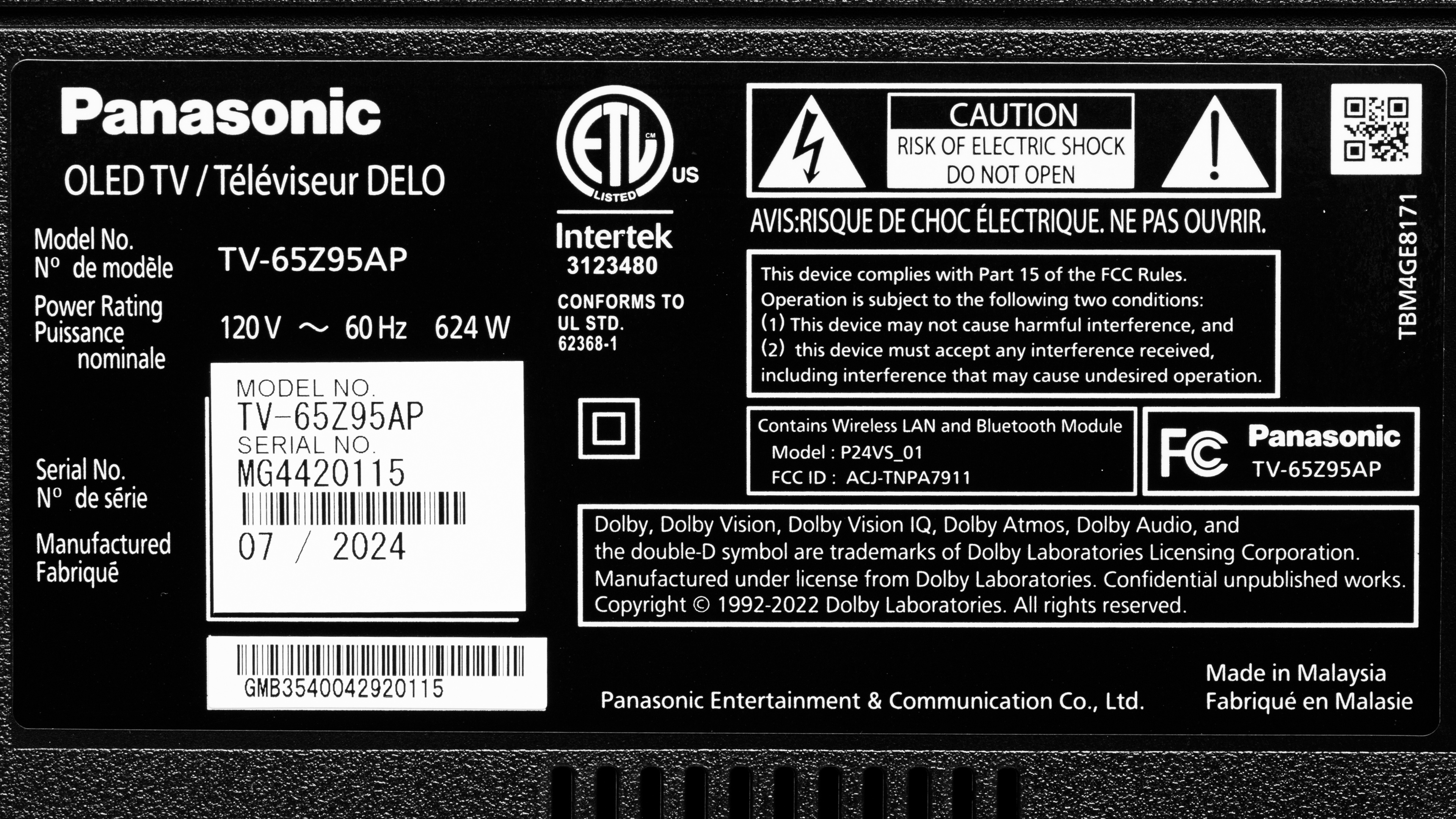
Our unit was manufactured in July 2024, as seen on the label.
Popular TV Comparisons
The Panasonic Z95A is one of the best TVs on the market in 2024, with very few direct competitors. Its closest competitor, the LG G4 OLED, is slightly better overall, but the differences are very minor. The Sony A95L OLED also delivers slightly better picture quality thanks to its better QD-OLED panel, but again, the differences are minor. Those three models trade blows in terms of picture quality, with all three offering a fantastic overall viewing experience, but Panasonic's processing and smart features are slightly worse overall.
For more options, check out our recommendations for the best OLED TVs, the best gaming TVs, and the best TVs for watching movies.
The Panasonic Z95B OLED offers a nice upgrade over the Panasonic Z95A OLED. The Z95B is brighter overall, so it offers brighter highlights in HDR and overcomes a bit more glare in bright rooms. The Z95B displays a wider range of colors, making them look brighter and punchier. Other advantages that the Z95B offers is better low-quality content smoothing, slightly better accuracy overall, and lower input lag.
The Sony A95L OLED is slightly better than the Panasonic Z95A OLED, but you can't go wrong with either one. The Sony has better processing, resulting in smoother gradients in HDR with less banding, and it smooths out low-quality content better. The Sony also delivers better color volume, and colors aren't as washed out in bright scenes.
The Panasonic Z95A OLED is slightly better than the LG C4 OLED, mainly due to its higher peak brightness. The Z95A gets brighter in HDR, especially in Game Mode, since the C4 dims considerably in its low-latency mode. On the other hand, the LG is a bit more versatile, as it offers full HDMI 2.1 bandwidth on all four HDMI inputs.
The LG G4 OLED and the Panasonic Z95A OLED are extremely similar overall, and it's difficult to recommend one over the other. The LG gets slightly brighter with most real content, and it has better low-quality smoothing, but the Panasonic has slightly better upscaling and sharpness processing. The design and smart interface are the biggest differences between these two TVs, so you should get the model with the interface and design that works best for your usage.

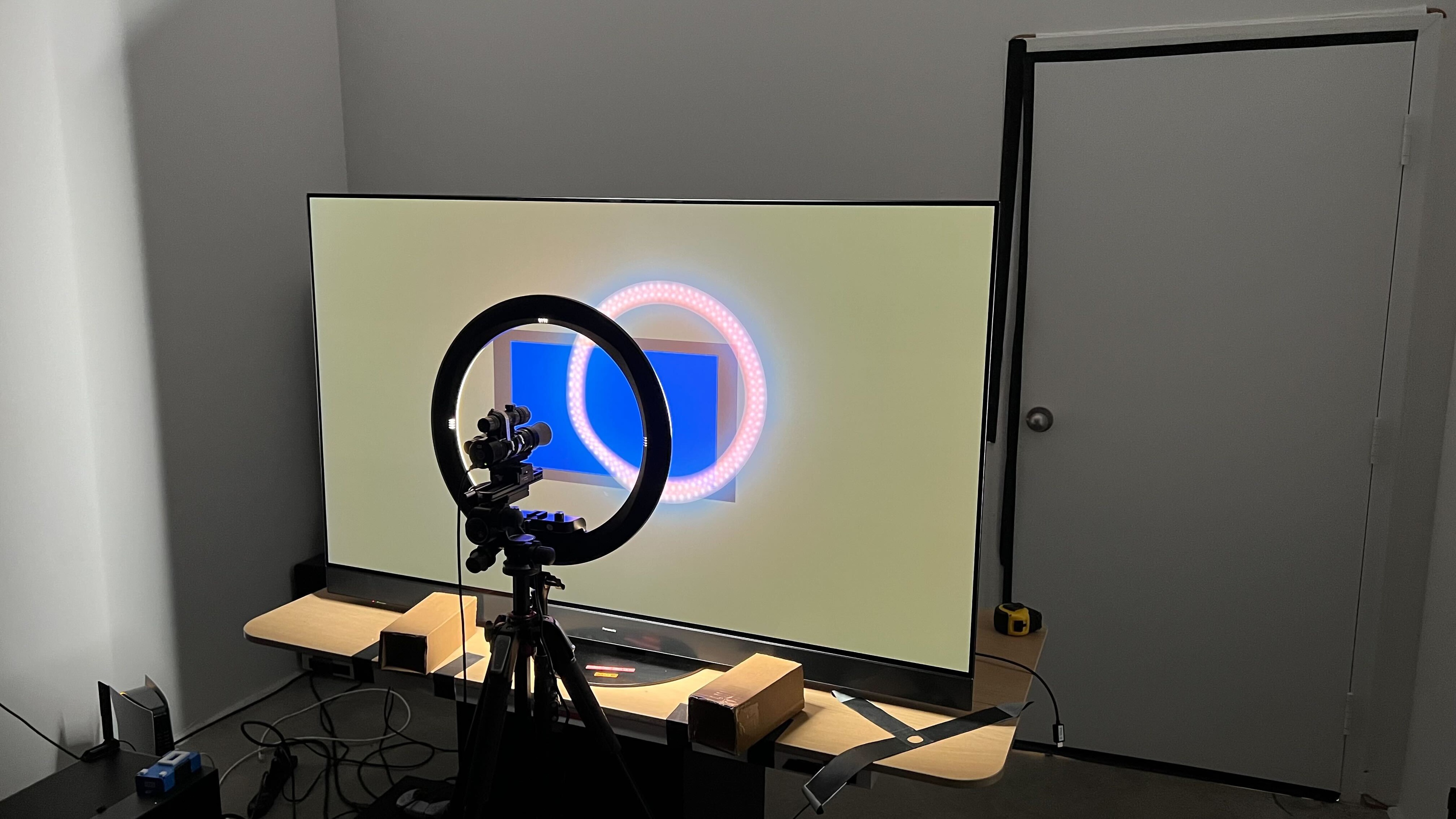
We buy and test dozens of TVs yearly, taking an objective, data-driven approach to deliver results you can trust. Our testing process is complex, with hundreds of individual tests that take over a week to complete. Most of our tests use specially designed test patterns that mimic real content, but we also use the same sources you have at home to ensure our results match the real-world experience. We use two main tools for our testing: a Colorimetry Research CR-100 colorimeter and a CR-250 spectroradiometer.
Test Results
for pictures & test results

for pictures & test results

for pictures & test results

The Panasonic Z95A OLED TV has very good HDR brightness thanks to its MLA brightness-boosting layer. Combined with its nearly infinite contrast, this TV provides an impactful HDR viewing experience, as bright highlights are very bright and stand out from the rest of the scene. Unfortunately, large bright scenes are significantly dimmer than smaller, specular highlights due to their aggressive Automatic Brightness Limiter (ABL).
In a three-way comparison with this TV, the Sony A95L OLED, and the LG G4 OLED, the Z95 is brighter in test slides, but with most real content, it's the dimmest of the three. The difference is very minor, though, and not noticeable unless you're comparing the three side by side.
These measurements are after calibrating the HDR white point with the following settings:
- HDR Picture Mode: Professional 1
- Ambient Sensor: Off
- Luminance Level: 100
- Contrast: 100
- Peak Luminance: High
- Gamma: 2.2
- EOTF Type: Auto
- HDR Tone Map: Normal
- Color Temperature: Warm 2
If you want an even brighter model, consider the newer version of this TV, the 2025 Panasonic Z95B OLED.
for pictures & test results

for pictures & test results

for pictures & test results

There's no noticeable difference with HDR brightness when the TV is set to Game Mode.
These measurements are after calibrating the HDR white point with the following settings:
- HDR Picture Mode: True Game
- Ambient Sensor: Off
- Luminance Level: 100
- Contrast: 100
- Peak Luminance: High
- Gamma: 2.2
- EOTF Type: Auto
- HDR Tone Map: Clipping
- Clipping Threshold: 2000
- Color Temperature: Warm 2
The Panasonic Z95A has decent SDR brightness and can easily overcome glare even in a bright room, especially combined with its exceptional reflection handling.
These measurements are after calibration with the following settings:
- Picture Mode: Professional 1
- Ambient Sensor: Off
- Luminance Level: 100
- Contrast: 90
- Peak Luminance: High
- Gamma: 2.2
- Color Temperature: Warm 2
Take a look at the Panasonic W95A if you want a Panasonic TV that gets even brighter in SDR.
for pictures & test results

The Panasonic Z95A has remarkable contrast and a nearly infinite contrast ratio. Due to OLED's self-lit pixels, the TV displays bright highlights next to perfect inky blacks, making it very impressive in a dark room.
for pictures & test results

Since OLEDs don't use local dimming and instead have individual pixels that can be lit up to their maximum brightness next to pixels that are turned off, there's no blooming when bright elements are surrounded by deep blacks.
for videos & test results

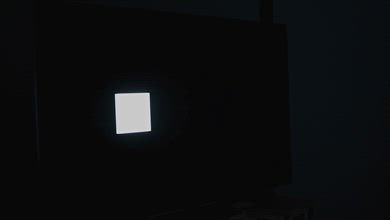
The TV is an OLED and has no backlight, so its self-lit pixels give it the same performance as a TV with perfect local dimming and no zone transitions. We still film the zone transition video on the TV so you can see how it compares to a TV with local dimming.


for pictures & test results

Because OLEDs can turn off individual pixels, the TV has incredible black uniformity with no blooming or halo effect around bright objects.
for pictures & test results

for pictures & test results

The Panasonic Z95A has decent SDR color volume overall. Its coverage of the DCI-P3 color space is great, but it does struggle with light reds, yellows, and magentas, and even some darker blues and greens. In the wider BT.2020 space, the TV is mediocre. Here it struggles with fully displaying most colors except some greens, yellows and blues, and it's worse with lighter colors.
| Volume ΔE³ | DCI-P3 Coverage |
BT.2020 Coverage |
|---|---|---|
| L10 | 91.44% | 60.69% |
| L20 | 94.32% | 63.31% |
| L30 | 95.84% | 65.25% |
| L40 | 95.40% | 66.97% |
| L50 | 94.42% | 67.50% |
| L60 | 88.80% | 63.12% |
| L70 | 84.23% | 54.36% |
| L80 | 86.14% | 53.34% |
| L90 | 86.53% | 53.95% |
| L100 | 68.65% | 45.83% |
| Total | 88.99% | 59.55% |
for pictures & test results

for pictures & test results

The TV has great color volume. It displays dark, saturated colors very well, and its ability to display bright whites is outstanding. Unfortunately, as with all WOLED panels, bright colors are washed out a bit, as the TV relies on the bright white subpixel to achieve the brightest highlights, which dilutes colors noticeably.
for pictures & test results

for pictures & test results

for pictures & test results

The TV has fantastic SDR accuracy even without a full calibration. Its white balance and color accuracy are nearly perfect, with no noticeable issues at all. Gamma is closer to 2.3 than the 2.2 target, and most scenes are a bit too dark.
for pictures & test results

for pictures & test results

for pictures & test results

The Panasonic Z95A OLED TV is very easy to calibrate, and the results after calibration are superb.
See our full calibration settings.
for pictures & test results

for pictures & test results

The TV has excellent HDR pre-calibration accuracy. Its white balance is fantastic, but there's a bit too much green and not enough reds in brighter mid-grays. This makes the TV's color temperature too cold, giving everything a blue-ish tint. Colors are accurate for the most part, but there are some inaccuracies throughout, especially with some blues and reds.
for pictures & test results

for pictures & test results

The TV has superb accuracy in HDR after calibration. Most issues with white balance have been fixed, even if greens and reds are still slightly overrepresented and underrepresented, respectively, in brighter mid-grays. Its color temperature is now closer to the 6500K standard, albeit now it's a bit too warm. Color accuracy is slightly better, but there are still some minor mapping errors throughout.
for pictures & test results

The PQ EOTF tracking on this TV is fantastic, and almost all HDR content is displayed at the brightness intended by the content creator. With content mastered at 600 or 1000 nits, there's a sharp cutoff at the TV's peak brightness, and the TV isn't brightness mapping at all, as it can display the full range. With brighter content mastered at 4000 nits, there's more of a gradual roll off near the TV's peak brightness, as the TV is preserving gradients at the expense of some brightness.
for pictures & test results

The low-quality content smoothing features on this TV are good overall. It does an excellent job at preserving fine details, but it's only decent at actually smoothing out the image, so there's still some noticeable macro-blocking in dark scenes.
for pictures & test results

The TV does an outstanding job with upscaling low-resolution content like DVDs, standard definition cable channels, and lower-resolution streams. Details are well-defined and clear enough, but very fine details and small hard-coded text are a bit hard to make out.
Sharpness processing was calibrated with no over-sharpening for low-resolution content, with the following settings:
- Sharpness: 30
- Resolution Remaster: Max
for pictures & test results

The TV has good HDR native gradient handling. There's some noticeable banding in dark grays and greens, but all other colors have minimal banding.
This TV has low input lag, especially at 120Hz and 144Hz, as long as you're in the 'True Game' Picture mode. This ensures a smooth, responsive gaming experience or if you use the TV as a PC monitor.
The Panasonic Z95 supports all common resolutions up to 4k @ 144Hz, but only on the high-bandwidth HDMI ports 1 and 2. Ports 3 and 4 are limited to HDMI 2.0 bandwidth, so they don't support above 4k @ 60Hz. Chroma 4:4:4 signals are displayed properly with most supported resolutions when the TV's 'HDMI Setting' is set to Pure Direct, which is essential for clear text from a PC.
The Panasonic Z95 supports a variable refresh rate, ensuring a nearly tear-free gaming experience from any VRR-enabled source. It works well across a wide refresh rate range and supports sources with Low-Frame Compensation (LFC), which ensures your games remain nearly tear-free even when your frame rate drops very low.
for pictures & test results
for pictures & test results

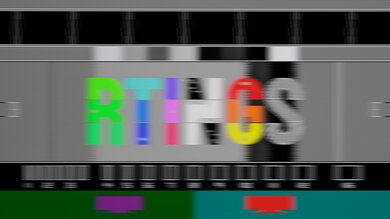
The TV's CAD at its maximum refresh rate of 144Hz is outstanding. Pixels transition to their target RGB level almost instantly, so fast motion is incredibly sharp. Still, the TV does struggle somewhat with pixel transitions from a completely dark state. There's a fair amount of overshoot there, and it's worse in transitions to a near-black state, leading to some minimal inverse ghosting in dark content.
for pictures & test results

for pictures & test results

The TV's CAD at 120Hz is outstanding. Pixels transition to their target RGB level almost instantly, so fast motion is incredibly sharp. Still, like at its maximum refresh rate, the TV does struggle somewhat with pixel transitions from a completely dark state, and it's even more apparent here.
for pictures & test results

for pictures & test results

The TV's CAD at 60Hz is excellent. Transitions from one RGB level to another are very fast, but not quite as fast as 120Hz and 144Hz. It still struggles with transitions from a completely black state, with some minor overshoot present in many other transitions.
for pictures & test results

This TV is fully compatible with everything the PS5 offers, like 1440p @ 120Hz and 4k @ 120Hz, as well as HDMI Forum VRR. It also supports Auto Low Latency Mode, so you don't have to worry about switching to 'True Game' Picture Mode to get the lowest input lag.
for pictures & test results

The Panasonic Z95A is fully compatible with everything the Xbox Series X|S offers, including 1440p @ 120Hz, 4k @ 120Hz, HDMI Forum VRR, FreeSync Premium Pro, and Dolby Vision gaming. It also supports Auto Low Latency Mode, so you don't have to worry about switching to 'True Game' Picture Mode to get the lowest input lag.
Unfortunately, due to the TV's nearly instantaneous pixel response time, there's stutter with low frame rate content, which is most noticeable during slow panning shots.
This TV automatically removes judder from 24Hz sources, like a Blu-ray player or streaming box with a Match Frame Rate feature and the internal apps. To remove judder from 60p and 60i sources, like a cable box, you must enable the Accurate IFC setting. Unfortunately, movies and TV shows aren't judder-free when BFI is enabled because the BFI feature only flickers at 60Hz.
for pictures & test results

for pictures & test results

The Panasonic Z95A OLED TV delivers incredibly clear motion with almost no blur behind fast-moving objects thanks to its nearly instantaneous response time. Due to the sample-and-hold nature of OLED technology, there's still some persistence blur when gaming at 60Hz, but it's not noticeable at higher refresh rates.
for pictures & test results

This TV doesn't have a traditional backlight and doesn't use pulse-width modulation (PWM) to dim each pixel, but it's not completely flicker-free. There's a slight dip in brightness that corresponds to the TV's refresh rate. This differs from the PWM flicker on TVs with LED backlights and occurs on every OLED we've tested. It's not noticeable, but it can still bother people who are extra sensitive to flicker.
The TV does exhibit flicker-like behavior in low-luminance sections of the screen that resembles pulse amplitude modulation (PAM). This means that bright sections of the screen are flicker-free, but darker sections have very minor flicker present. Fortunately, this isn't noticeable with most real content.
for pictures & test results

for pictures & test results
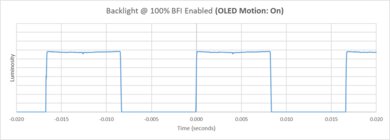
The Panasonic Z95A has an optional black frame insertion (BFI) feature that reduces the appearance of persistence blur caused by the TV's nearly instantaneous response time. Panasonic's implementation of BFI is very strange, though, as unlike any other TV on the market, the screen never goes completely black between frames, it just dims the backlight slightly.
for pictures & test results

for pictures & test results

This TV has an optional motion interpolation feature to improve the clarity of motion. It handles slow-moving shots well, but there are significantly more artifacts in fast-moving scenes.
for pictures & test results

for pictures & test results

The TV has great direct reflection handling. Reflections from direct sources of light, such as a lamp, are dimmed considerably, so they blend in well with the rest of the image.
for pictures & test results

for pictures & test results

The Panasonic Z95A does an okay job of retaining its black levels in a bright room. Blacks become more raised as the amount of light in your room increases due to its MLA layer, but they remain deep enough that they don't look too gray.
for pictures & test results

for pictures & test results

The TV has exceptional reflection handling. Its glossy screen finish significantly reduces the intensity of both direct reflections and indirect reflections. There are also no distracting artifacts caused by the TV's reflection handling.
for pictures & test results

The Panasonic Z95A has mediocre overall color volume in a bright room. Colors displayed at low and medium luminance levels are nice and saturated, but it does struggle a lot more with showing colors at higher levels of brightness due to its reliance on its white subpixel. However, there's not a large difference between color volume in a dark room and a bright room, especially with high-luminance colors, so you don't lose very much color saturation in a well-lit room.
for videos & test results

for pictures & test results

for pictures & test results

for pictures & test results

The viewing angle on this TV is nearly perfect. There's a very subtle color shift at extremely wide angles, but nobody will notice this in practice.


for pictures & test results

for pictures & test results

The TV uses a WOLED panel with a RWBG pixel structure where all four pixels are never lit at the same time. Due to its subpixel layout, it has minor issues with displaying text on Windows since ClearType isn't well optimized to non-RGB subpixel layouts, but most users won't be bothered by this.
The MLA layer on this TV adds a slight haze to the screen coating, but it doesn't impact picture quality, and it's not noticeable in normal viewing conditions.
The white subpixel does an excellent job helping the TV display bright whites, but it dilutes the color purity of greens and reds.
for pictures & test results

for pictures & test results

The Panasonic Z95A supports HDMI 2.1 bandwidth up to 48Gbps on HDMI ports 1 and 2, with both supporting up to 4k @ 144Hz. Unfortunately, the HDMI 2 port is also the eARC port, so you lose a high bandwidth port when you plug a soundbar into the TV. Many soundbars now support HDMI 2.1 passthrough, though, so this isn't an issue unless you have older equipment that doesn't support this. The TV supports both Dolby Vision and HDR10+. ATSC 3.0 support was added with a firmware update (RS8112/2491) in early 2025.
The TV supports eARC, which lets you pass high-quality, uncompressed audio to a compatible receiver or soundbar through an HDMI cable. Unfortunately, it doesn't support DTS audio formats commonly used on Blu-rays.
for pictures & test results

The Panasonic Z95A OLED has a slightly dated look, largely due to the included soundbar and thicker speakers on the back. It doesn't blend in as seamlessly as thinner models, like the LG G4 OLED, do.
for pictures & test results

The round center-mounted stand is rather simple, but it supports the TV well. There's no alternate placement for the stand, but it swivels roughly 15 degrees to either side.
Footprint of the 65" stand: 15" x 13.7". There's about 3.8" between the first visible pixels and the bottom of the stand.
for pictures & test results

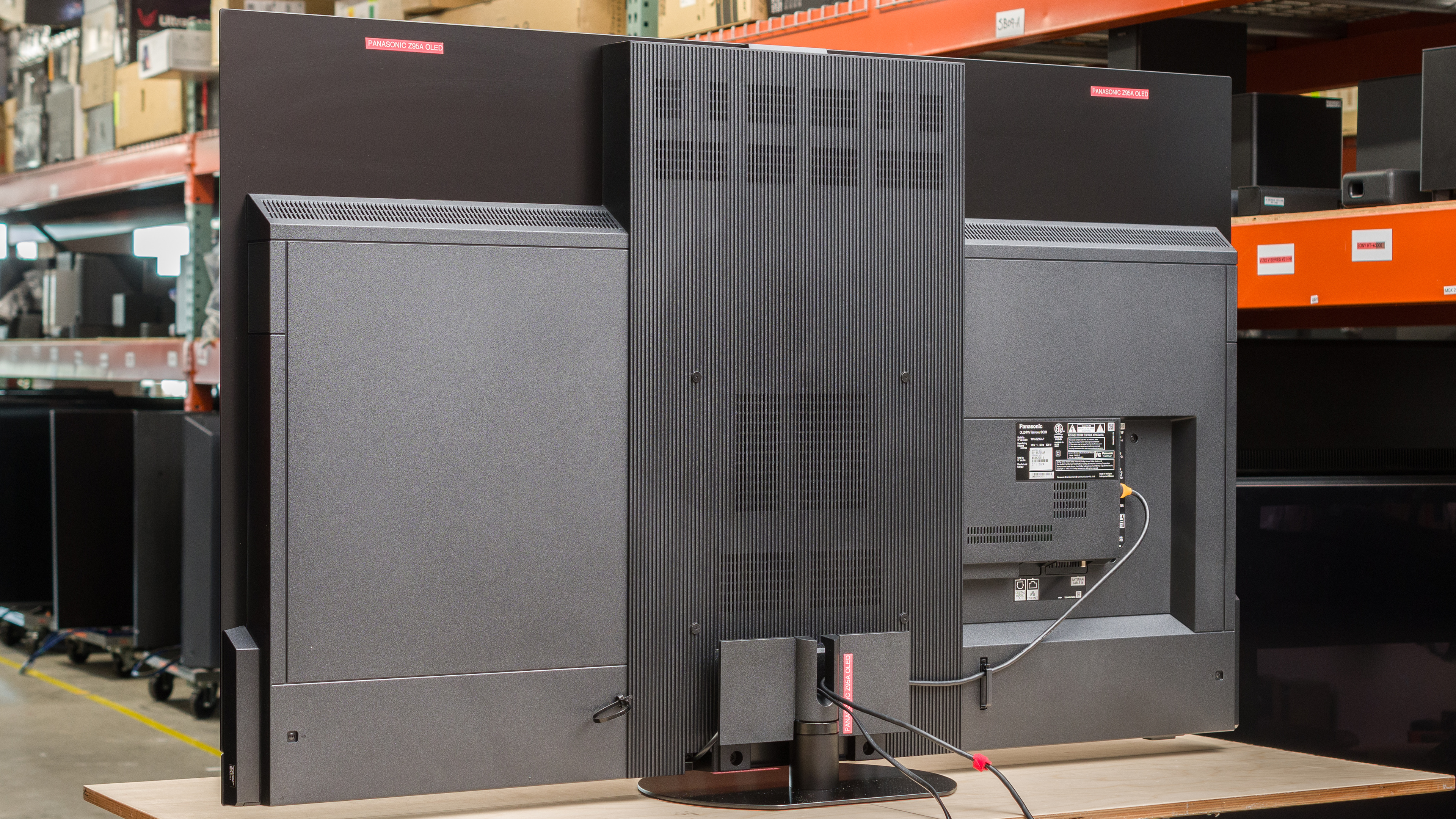
The back section, which houses the inputs and speakers, is quite thick and made of plastic. The inputs are located on the left side of the TV when facing the front, but they're easily accessible even when the TV is wall-mounted. There are clips on the back to help with cable management.

for pictures & test results

The Panasonic Z95A is noticeably thicker than just about any TV on the market. This is due to the inclusion of thicker, higher-quality speakers throughout the TV.
for pictures & test results

The Panasonic Z95 has outstanding build quality. With the exception of the back section that houses the inputs, the TV is made entirely of premium materials and feels well-built.
for pictures & test results

The TV runs the Fire TV OS, which is smooth and easy to use. Unfortunately, there's a bug that prevents certain settings, like motion interpolation, from working despite the settings being turned on. To fix this, you must enter the 'Home' menu and return to the input or internal app you're using.
for pictures & test results

Unfortunately, like almost all TVs on the market, the smart interface contains ads, and you can't disable them.
for pictures & test results

The remote is almost identical to the ones included with other TVs that use the Fire TV OS, with quick access buttons for the most popular streaming services. You can use the built-in microphone to switch inputs, change apps, search within apps, and ask for the weather and time. Unfortunately, you can't use voice commands to change settings.
for pictures & test results

There's a single button on the bottom of the TV that can be used to switch inputs, adjust the volume, change channels, and power the TV on/off. There's also a privacy switch for the built-in microphone.

for pictures & test results

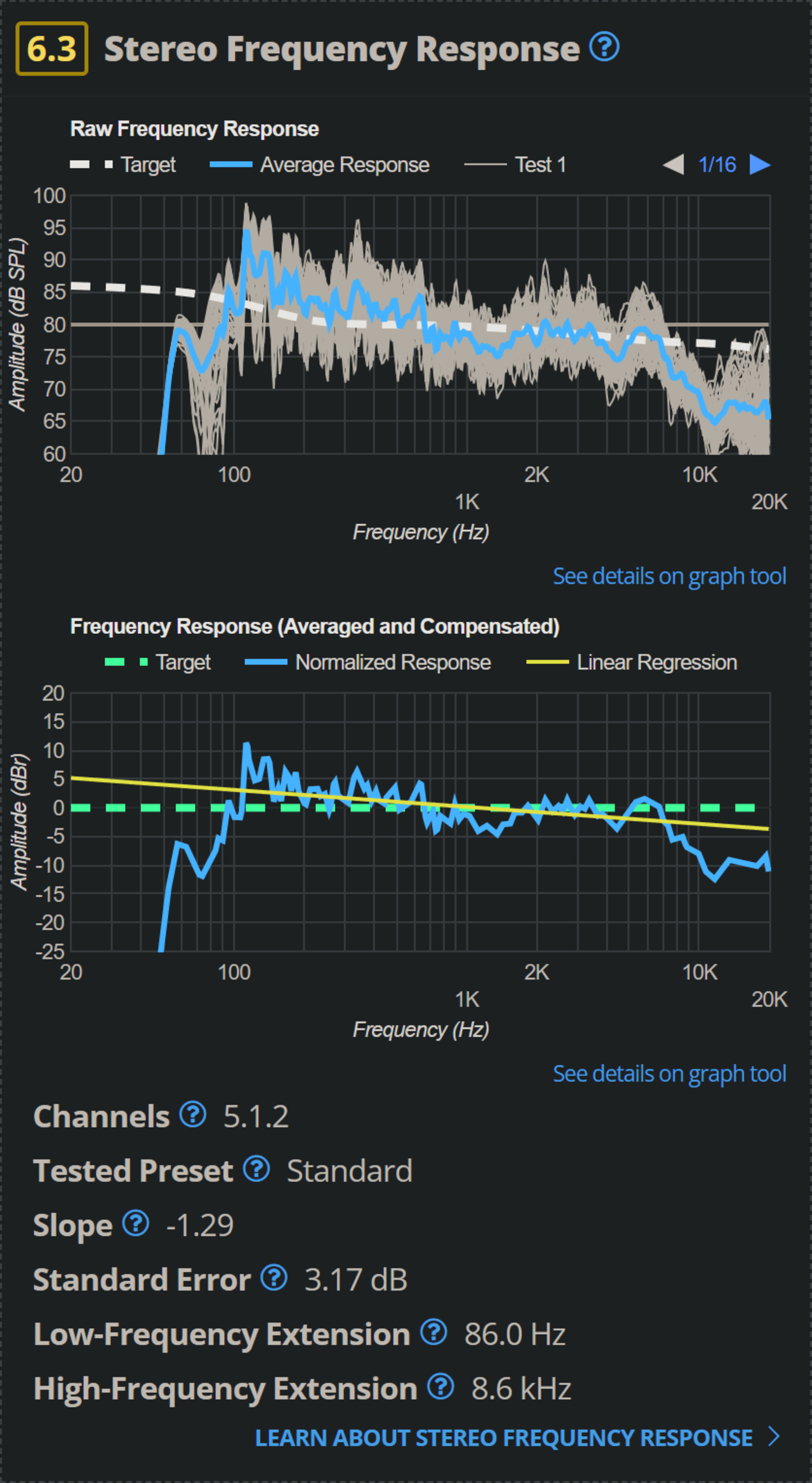
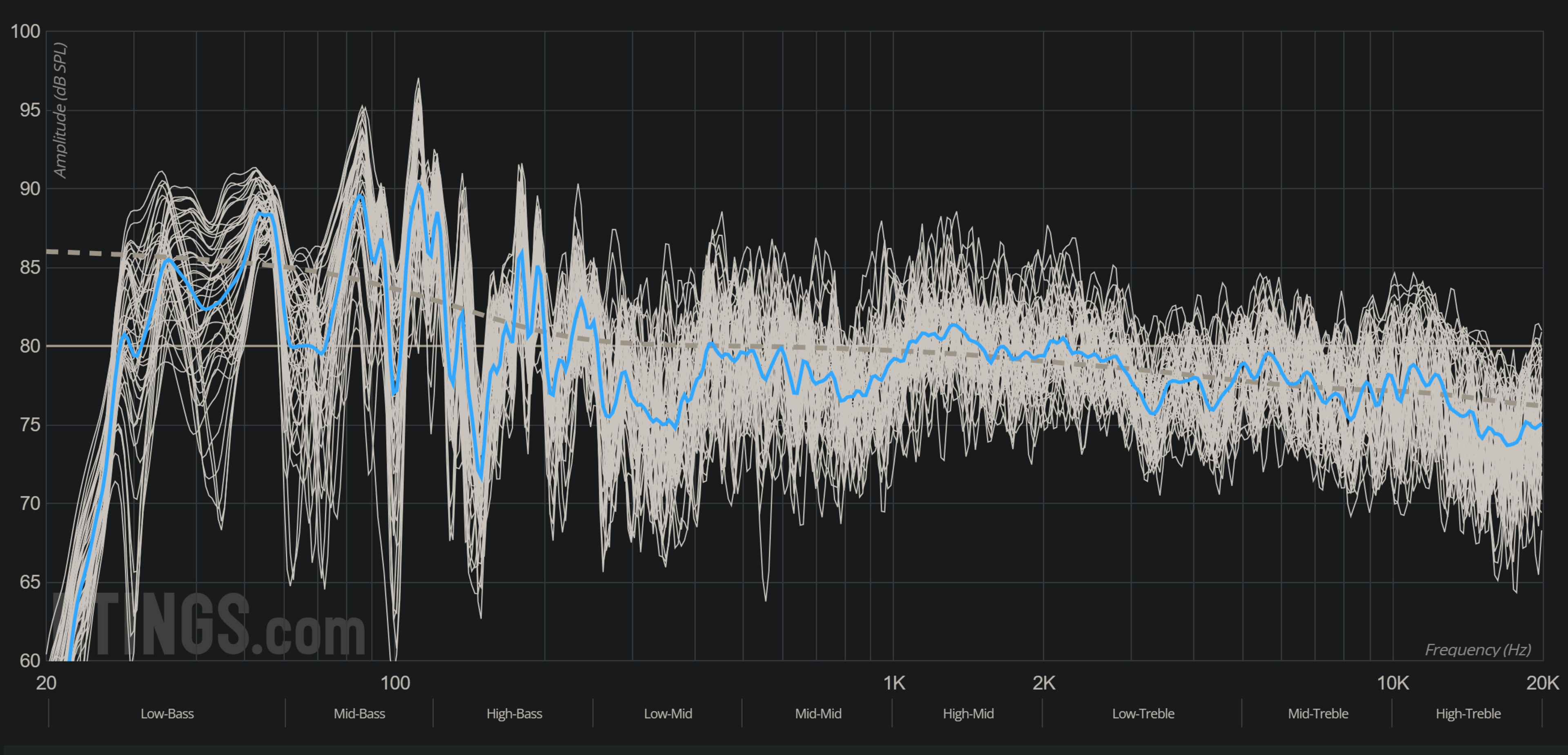
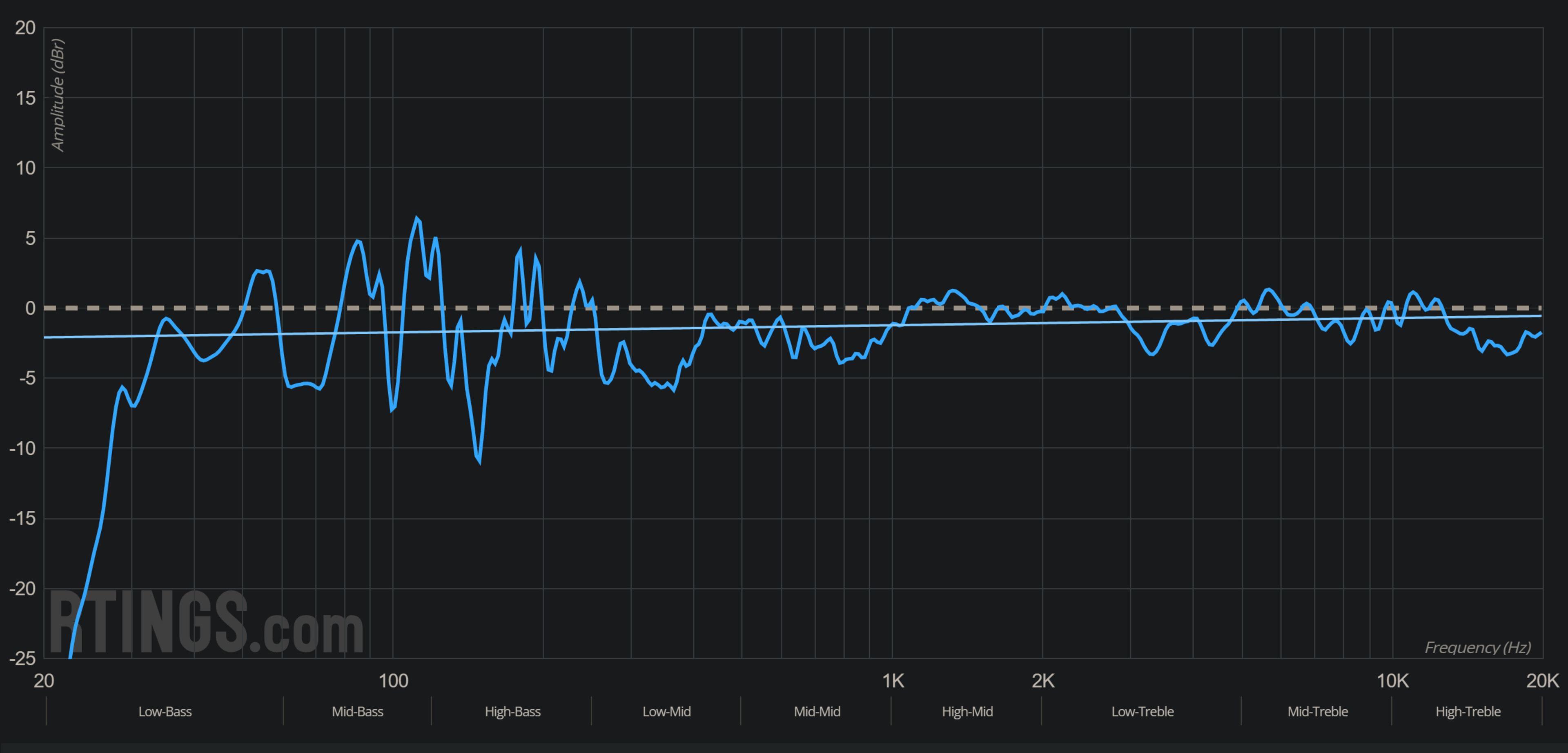
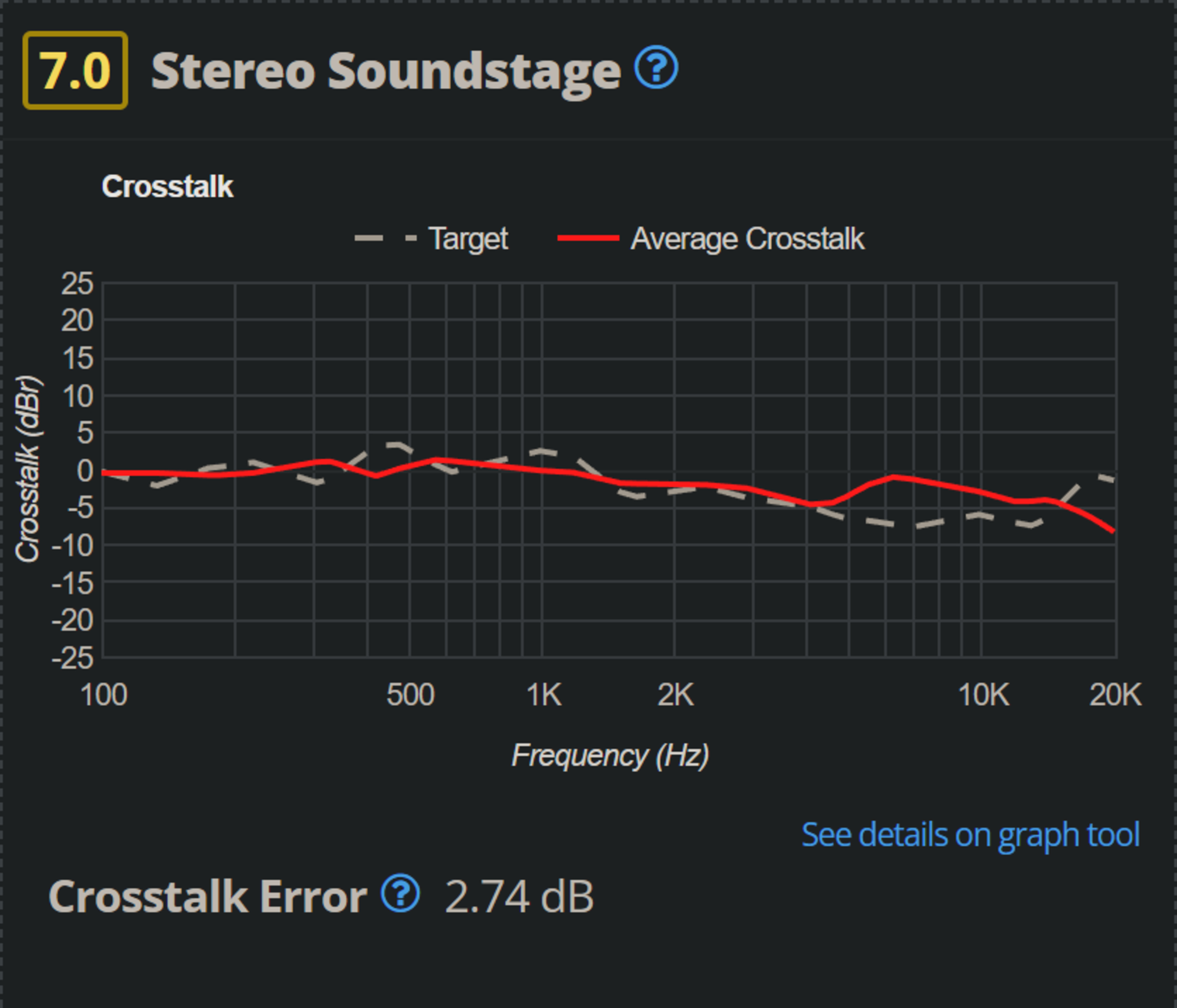
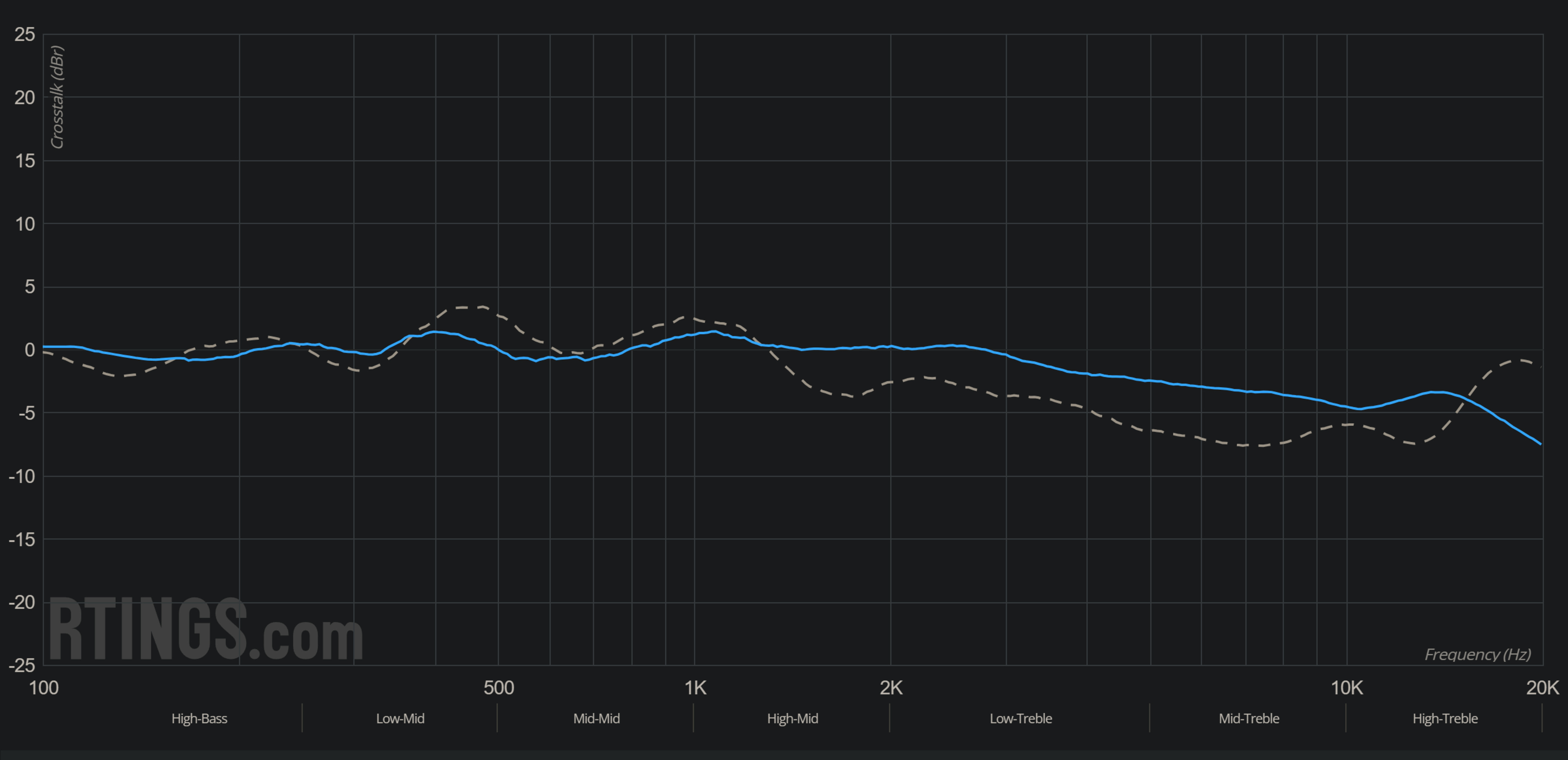
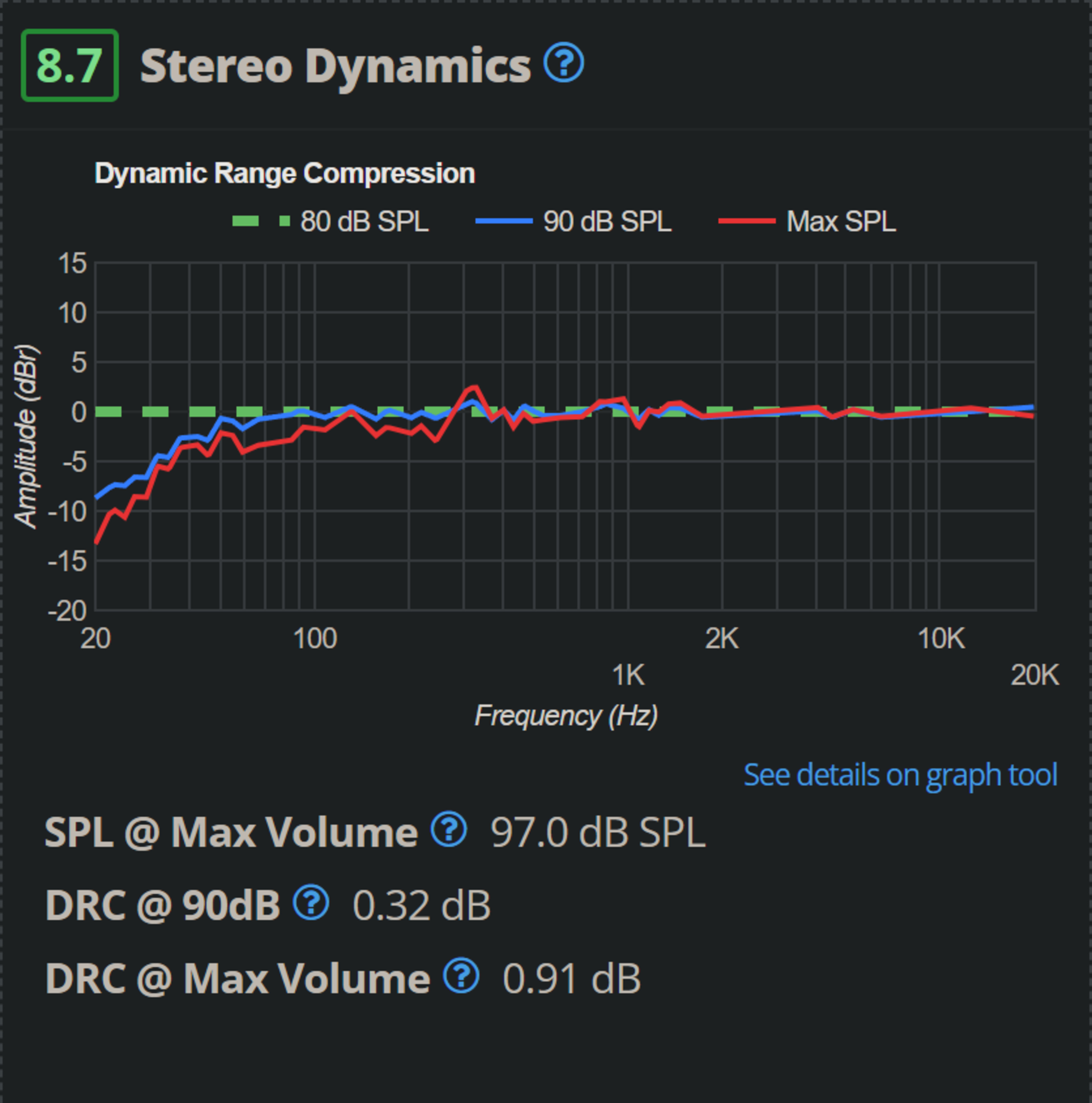
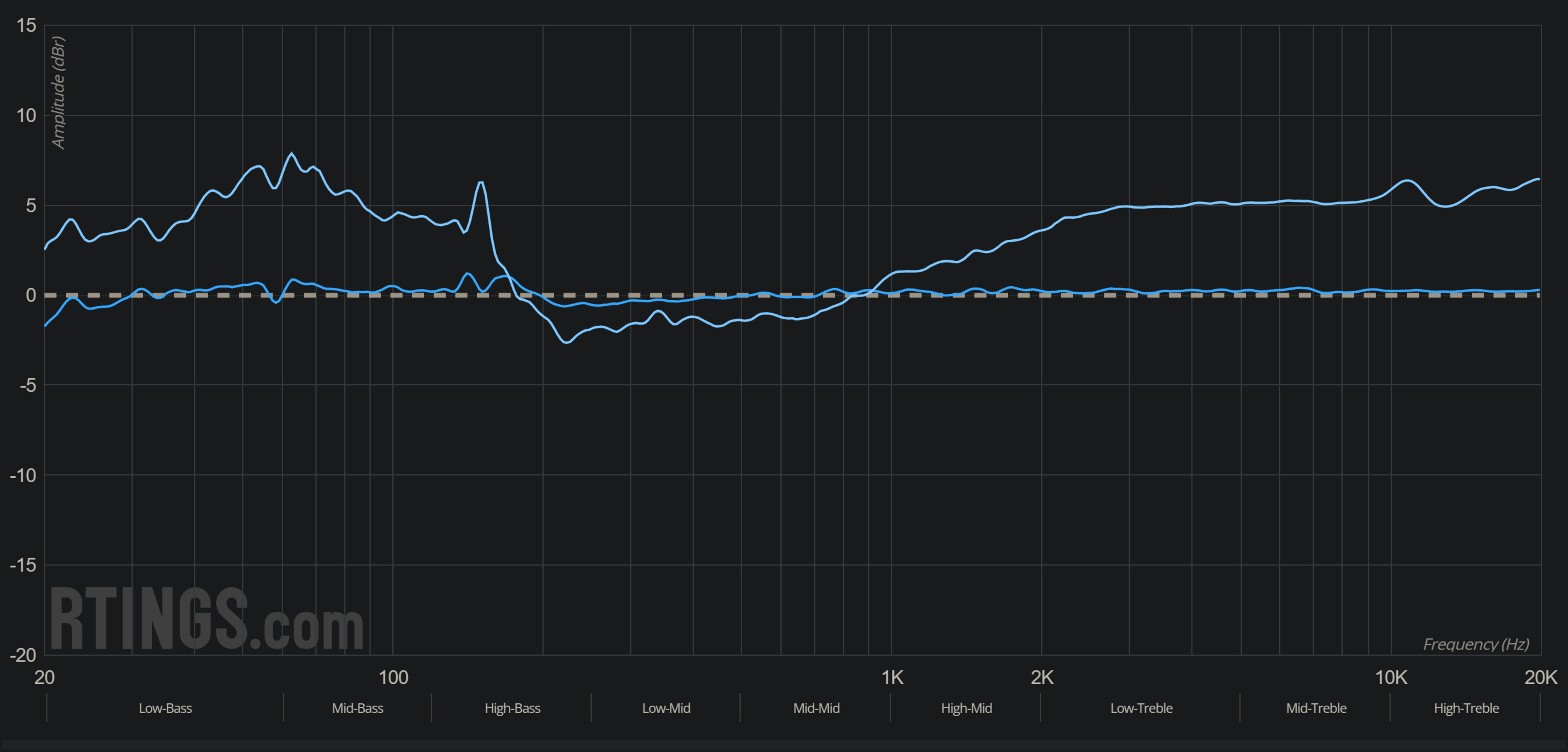
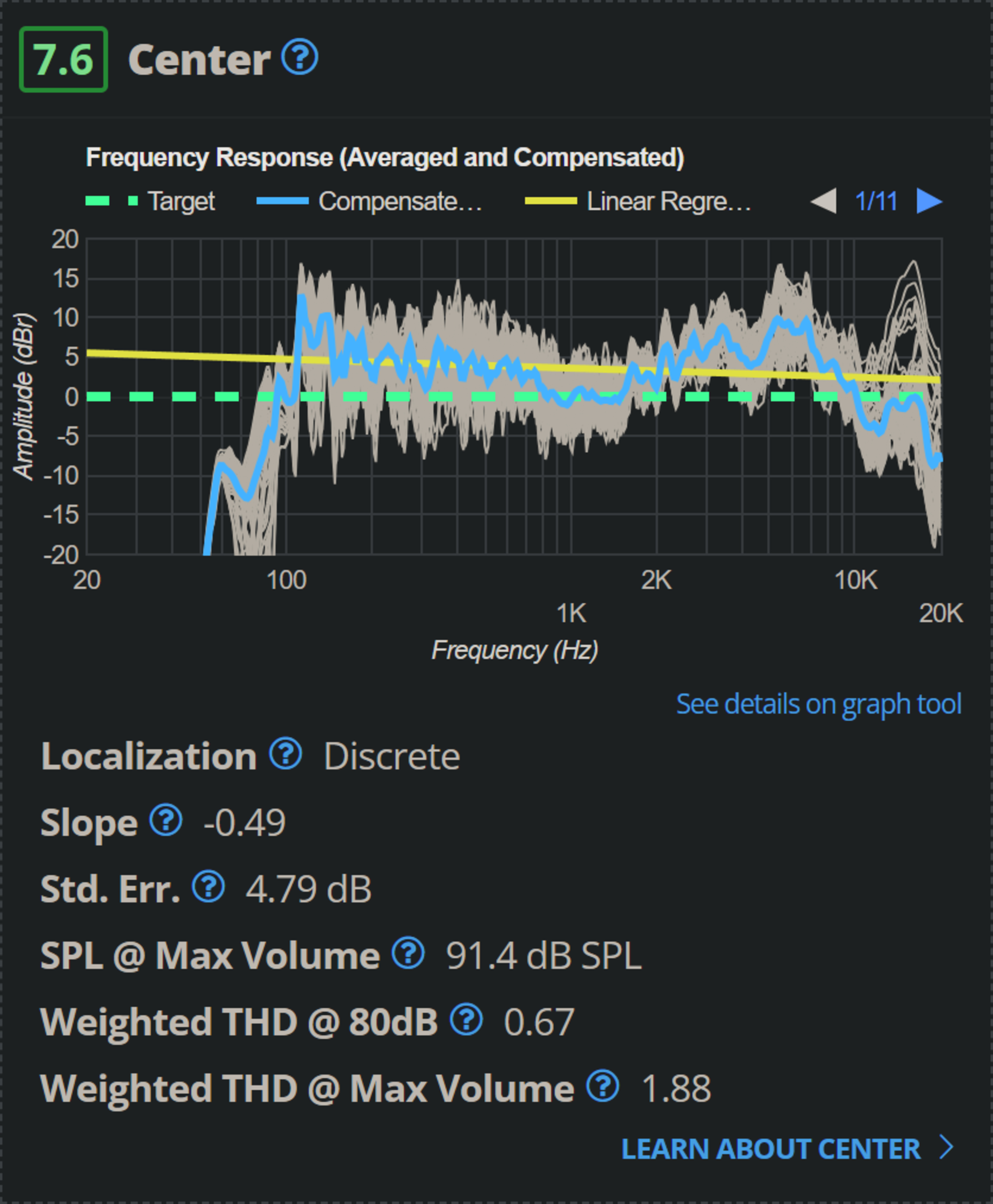
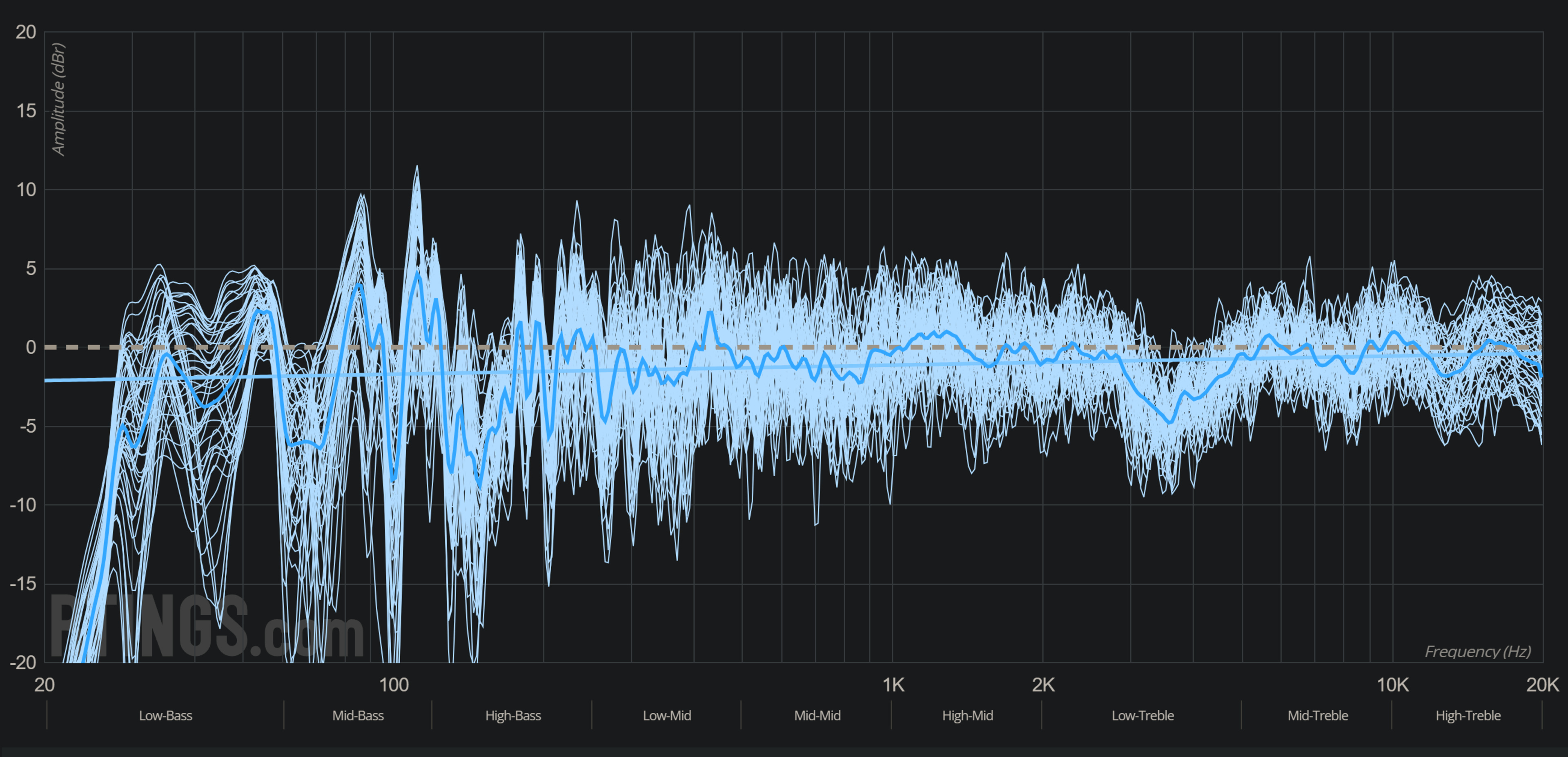
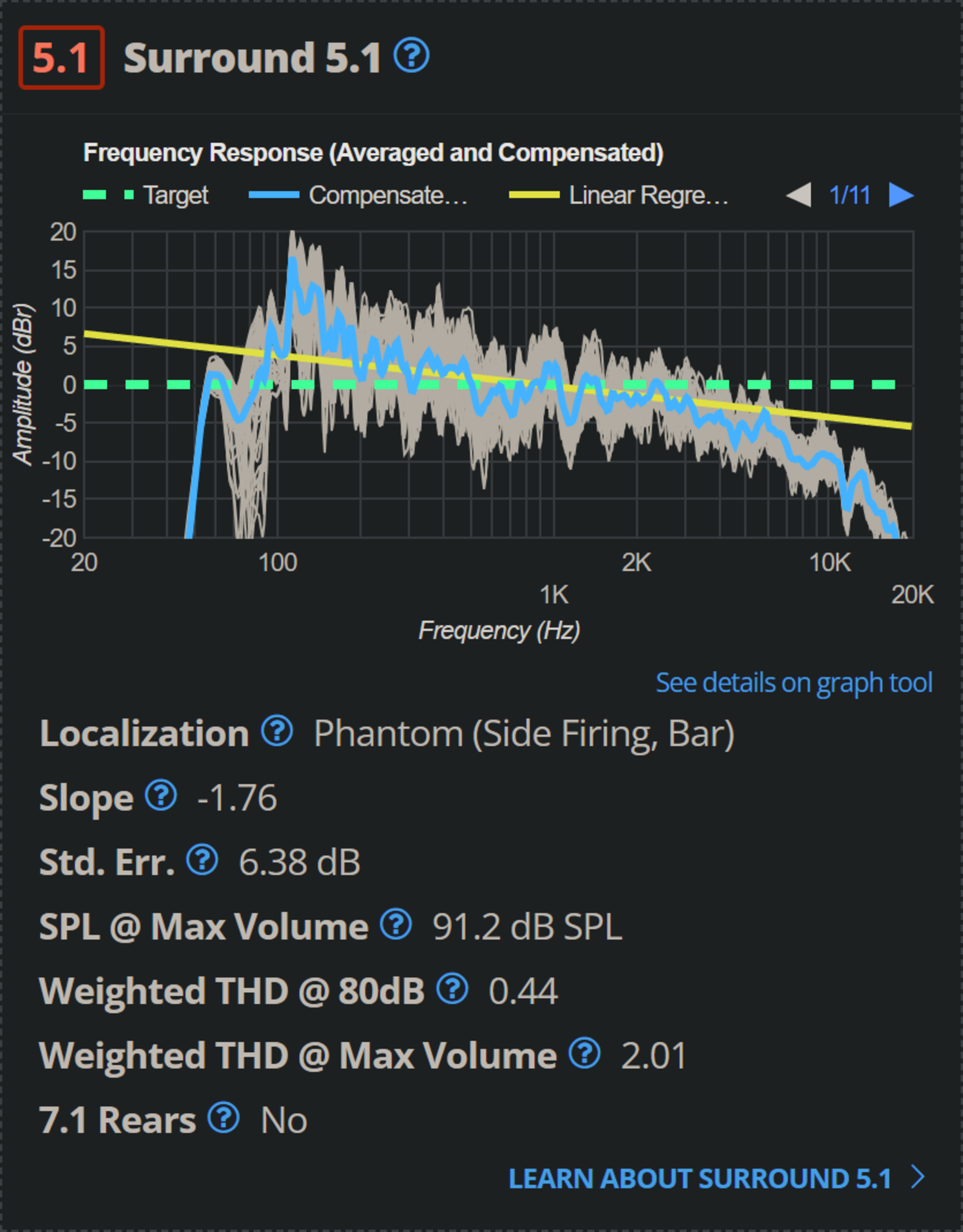
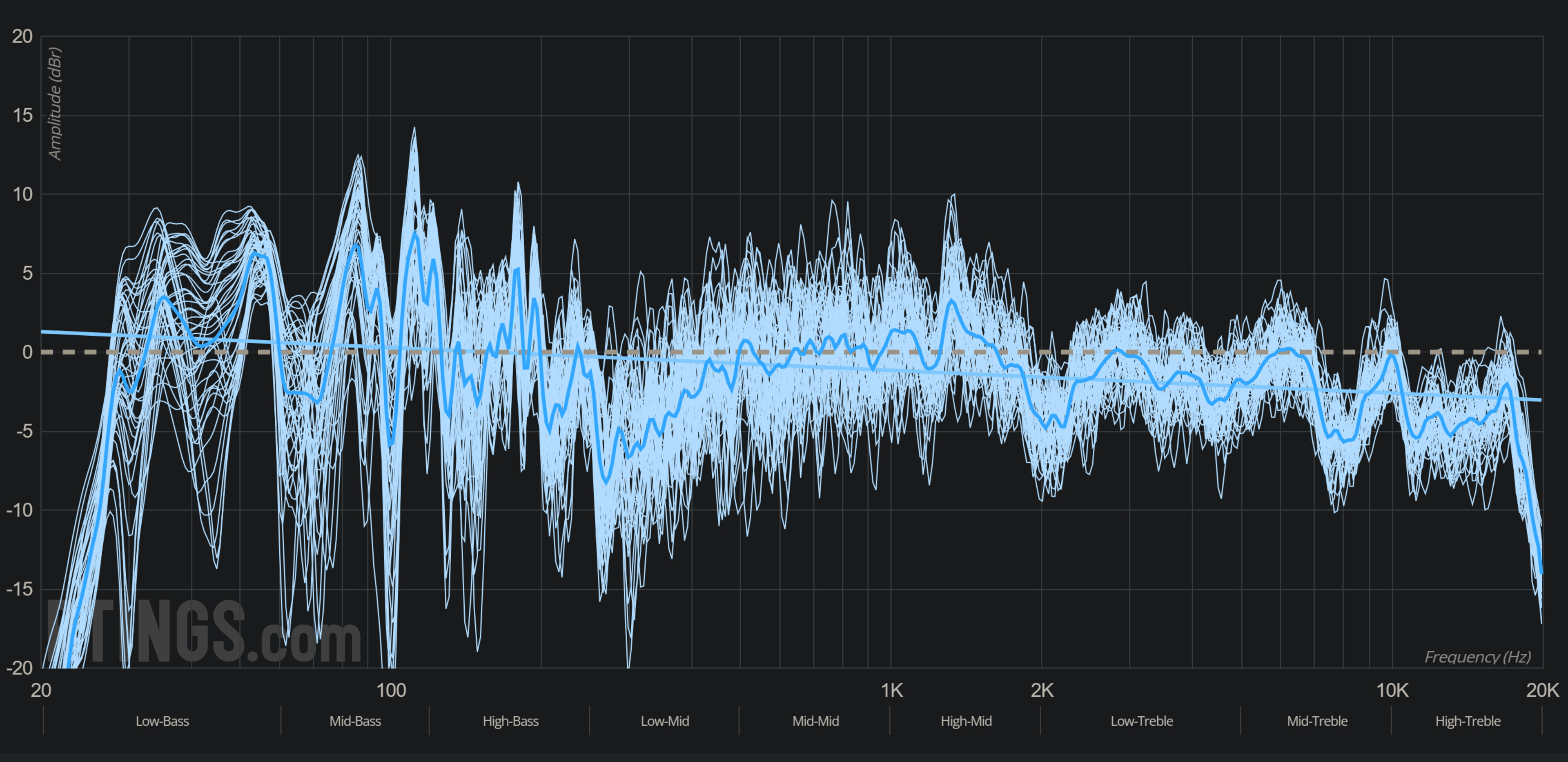
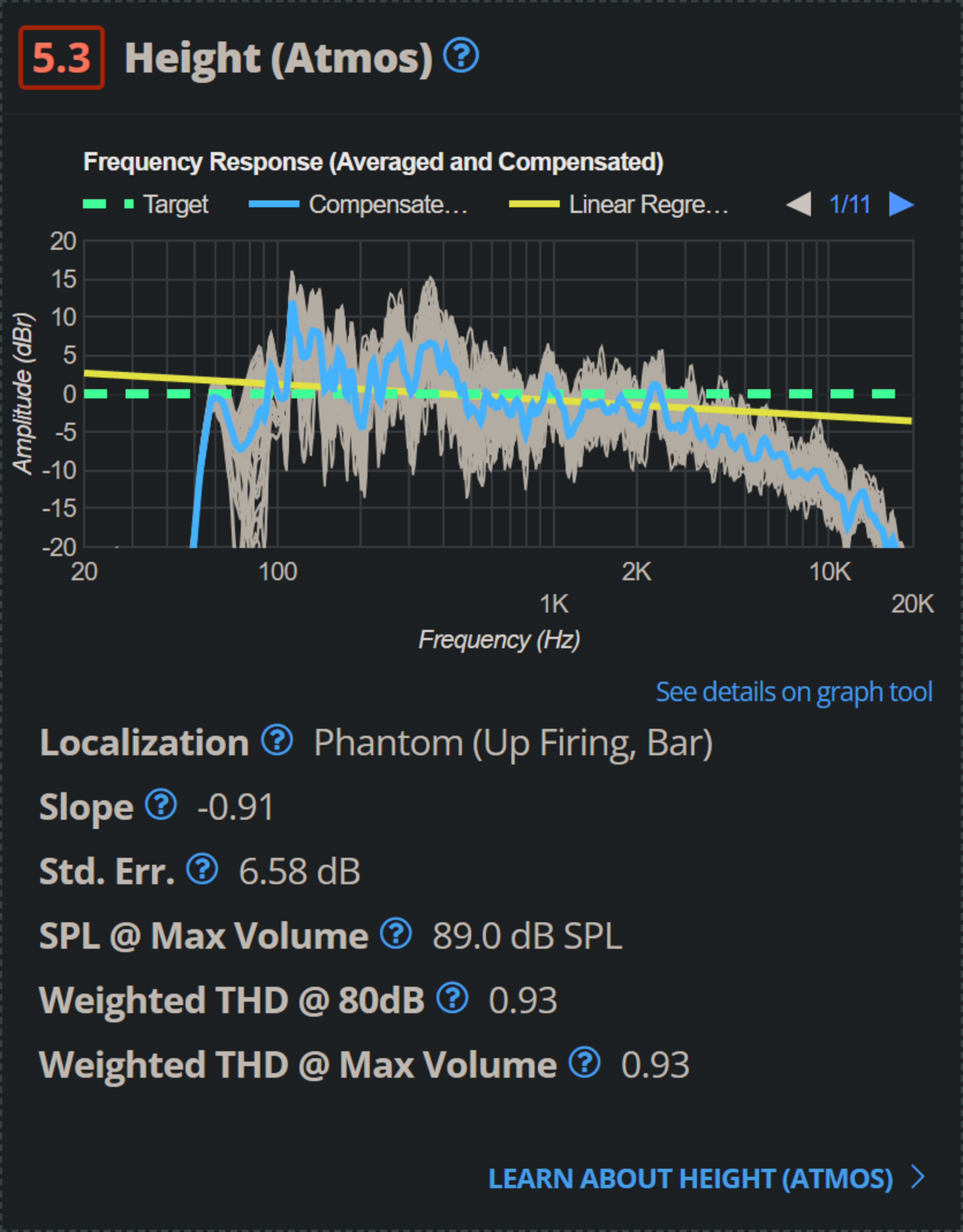
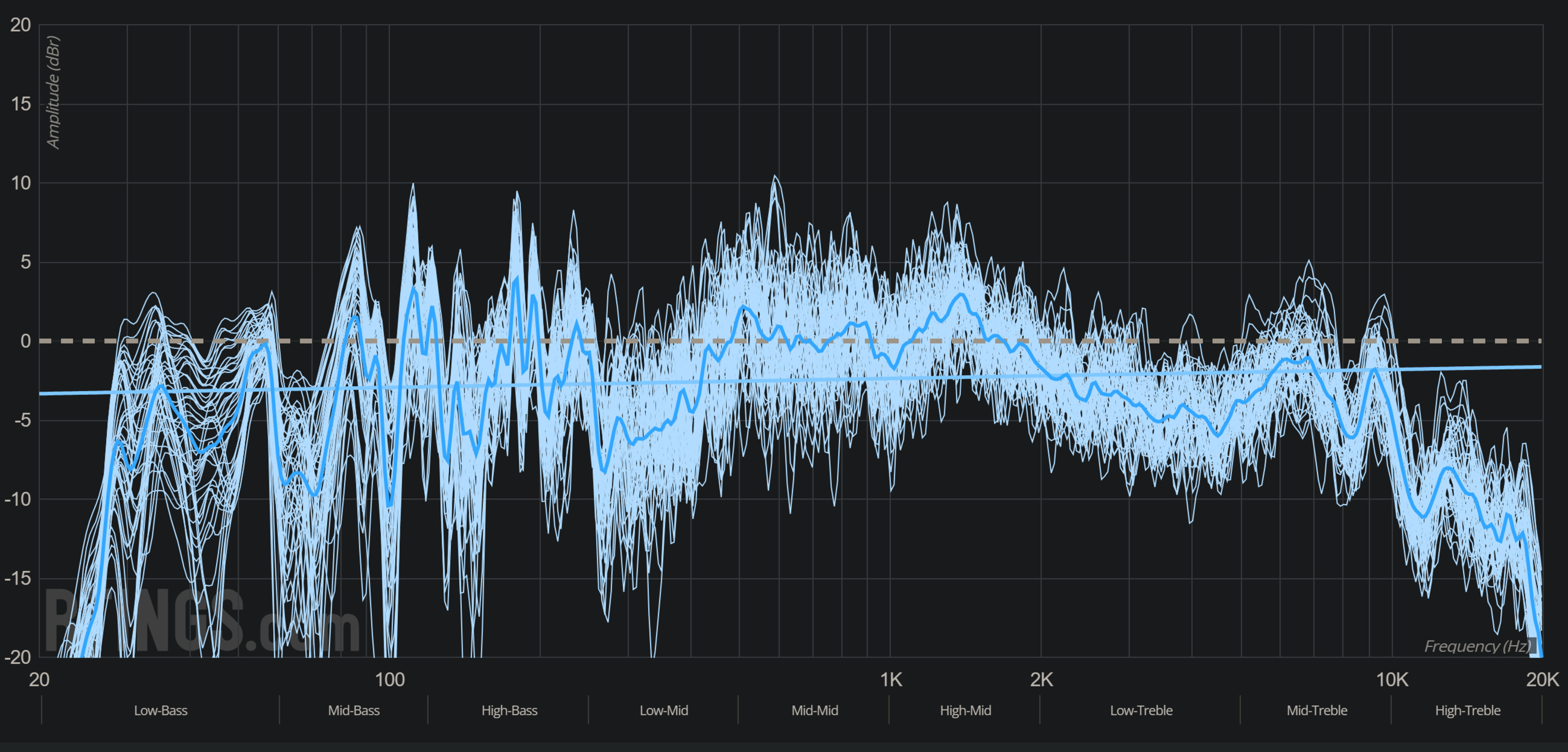
Thanks to the inclusion of a built-in 5.1 speaker system and soundbar, the Panasonic Z95A OLED is one of the best-sounding TVs on the market. It's still not as good as a dedicated home theater system or even a good soundbar, especially when it comes to deep bass, but it's a good starting point. It gets very loud and has an incredibly well-balanced sound profile, but there's some noticeable compression at max volume.
We also ran the speaker system through our gamut of soundbar audio tests, so you can compare the results to an actual soundbar:
| Test | |
|---|---|
| Stereo Frequency Response | Result |
| Raw Stereo Frequency Response | Graph |
| Normalized Frequency Response | Graph |
| Stereo Soundstage | Result |
| Stereo Soundstage Graph | Graph |
| Stereo Dynamics | Result |
| Stereo Dynamics Graph | Graph |
| Center | Result |
| Raw Center | Graph |
| Surround 5.1 | Result |
| Raw Surround 5.1 | Graph |
| Height Atmos | Result |
| Raw Height Atmos | Graph |