Apple AirPods 4  Headphones Review

Reviewed Nov 20, 2024 at 09:53am
Writing modified Nov 27, 2025 at 12:52pm
Tested using Methodology v2.0 
Apple AirPods 4
7.7
Sports And Fitness 
5.5
Travel 
5.4
Office Work 
5.4
Wireless Gaming (In Development) 
5.2
Wired Gaming (In Development) 
7.4
Audio Reproduction Accuracy 
2.6
Noise Isolation 
6.6
Microphone (In Development) 
 7
  1. Recommended in:
  2. Apple

The 2024 model of Apple AirPods 4 are the ear tip-less, one-size-fits-most successor to the Apple AirPods (3rd generation). Once the hub of a single pair of earbuds for all, the Apple headphones range has expanded to include tiers of AirPods depending on your specific needs and budget. Arguably, these are the 'entry-level' AirPods, situated in the tier below the Apple AirPods 4 with Active Noise Cancelling (ANC). The manufacturer has injected plenty of Apple ecosystem exclusives, like the H2 chip for seamless device iCloud device switching, Adaptive EQ, and Personalized Spatial Audio. So, let's see what's changed, what's the same, and if they're the right buds for you.

Black Friday 2025 Deals

Looking for Black Friday savings on your next pair of headphones? We've got you covered! Check out our Early Black Friday 2025 Deals article for what's worthwhile this year.

Our Verdict

7.7
Sports And Fitness 

The Apple AirPods 4 are good for sports and fitness. Their IP54 rating repels dust and water splashes, and their open-back design helps you stay aware during runs outdoors. Although their lack of ear tips can fit people differently, if they suit your ears' shape, they feel comfortable and are stable for most dynamic movements. Your mileage can vary on this, though, because there are reports of them falling out of some people's ears. Still, their lightweight, portable design means they'll fit in your shorts' pocket, and their battery life outlasts most people's exercise routine. Plus, they provide a good amount of low-end to keep you running on the beat. Sadly, they lack direct volume controls, so you'll either need to use your device or enable the Personalized Volume feature that adapts the volume based on your surroundings.

Pros
  • IP54 rating.

  • Call controls on the buds.

  • Doesn't leak a lot of audio.

Cons
  • Open-back design doesn't isolate out noise.

  • No volume controls.

5.5
Travel 

The Apple AirPods 4 are middling for commutes and traveling. Because they lack noise isolation, you'll hear everything in your environment. They lack volume controls, so you need to use your device or enable the Personalized Volume feature to compensate for environmental noise. If they fit your ear shape, they're decently comfortable and lightweight. Their continuous battery life is good for trips to and from work, but they won't necessarily last for intercontinental flights without a recharge. On the upside, they don't leak much noise that'll disturb folks seated next to you on your travels. Their IP54 rating means you don't need to baby them either.

Pros
  • IP54 rating.

  • Call controls on the buds.

  • Doesn't leak a lot of audio.

Cons
  • Open-back design doesn't isolate out noise.

  • No volume controls.

  • Microphone noise handling is only okay.

  • Limited adjustments for changing the sound.

5.4
Office Work 

The Apple AirPods 4 are middling for office use. Their lack of noise isolation makes them more suitable for collaborative offices rather than for work in spaces where you want to focus and block out noise. Fortunately, they don't leak much of your audio. They feel decently comfortable and lightweight with good stability, although this can vary depending on your ear shape. Their continuous battery life won't get you through an entire day, though, but they'll fully charge in half an hour. If you take many calls, their mic is okay, though it's no substitute for a dedicated headset. Depending on your office's computer, you might be able to take advantage of their H2 chip for device switching, but it's limited to Apple devices on the same iCloud account.

Pros
  • IP54 rating.

  • Call controls on the buds.

  • Doesn't leak a lot of audio.

Cons
  • Open-back design doesn't isolate out noise.

  • No volume controls.

  • Microphone noise handling is only okay.

  • Limited adjustments for changing the sound.

5.4
Wireless Gaming (In Development) 

The Apple AirPods 4 are Bluetooth-only earbuds, so they can only connect to devices with Bluetooth, which limits their connectivity for wireless gaming. Their latency is high enough that you'll most likely notice sync issues, which is annoying in fast-paced games. However, the latency may differ with products in the Apple ecosystem.

5.2
Wired Gaming (In Development) 

The Apple AirPods 4 are Bluetooth-only and can't be used wired for gaming.

7.4
Audio Reproduction Accuracy 

The Apple AirPods 4 have decent audio reproduction accuracy. Their always-on Adaptive EQ dynamically adjusts their frequency response, so you'll perceive a similar balance of bass and treble no matter how loud their output is set. If they fit your ears and you place the buds correctly, your audio sounds consistent between wears. They closely adhere to their own warm sound profile and have remarkably well-matched left and right drivers, so objects are correctly placed in the stereo field. That said, their treble is rather de-emphasized, so depending on your tastes, the details of vocals and cymbals can sound dull. They have a few Apple-specific features like Personalized Spatial Audio (with or without head tracking), but volume controls are lacking, and there are only three EQ presets found in a separate Accessibility settings menu.

2.6
Noise Isolation 

The Apple AirPods 4 have bad noise isolation, since they don't form a seal with your ear. As a result, you'll hear everything from the roar of a passing bus engine to the keystrokes of a nearby coworker.

6.6
Microphone (In Development) 

The Apple AirPods 4 have a mediocre microphone. It makes your voice sound a bit boxy and thin, and the mic's noise handling struggles to reject loud background noise that overwhelms your voice. However, it prioritizes your voice well when there are other people speaking in the room.

8.8
Frequency Response Consistency 

The Apple AirPods 4 have an excellent frequency response consistency. Once you get a good fit, they'll sound the same across wears.

  • 7.7
    Sports And Fitness
  • 5.5
    Travel
  • 5.4
    Office Work
  • 5.4
    Wireless Gaming (In Development)
  • 5.2
    Wired Gaming (In Development)

  • Performance Usages

  • 7.4
    Audio Reproduction Accuracy
  • 2.6
    Noise Isolation
  • 6.6
    Microphone (In Development)
  • 8.8
    Frequency Response Consistency
  • Changelog

    1.  Updated Nov 27, 2025: 

      This review has been updated to Test Bench 2.0, which adds the following tests: Stereo Mismatch, Group Delay, Cumulative Spectral Decay, PRTF, Harmonic Distortion, and Electrical Aspects. We've added new performance usages and updated the text throughout the Sound tests.

    2.  Updated Nov 25, 2025: We've converted this review to Test Bench 2.0, which updates our sound tests and adds performance usages. You can read more about this in our changelog.
    3.  Updated Nov 20, 2024: Review published.
    4.  Updated Nov 12, 2024: Early access published.

    Check Price

    WhiteAirPods 4
    SEE PRICE
    Amazon.com
    WhiteAirPods 4
    SEE PRICE
    Walmart.com
    WhiteAirPods 4
    SEE PRICE
    BestBuy.com
    WhiteAirPods 4
    B&H
    WhiteAirPods 4
    SEE PRICE
    Apple.com

    Differences Between Sizes And Variants

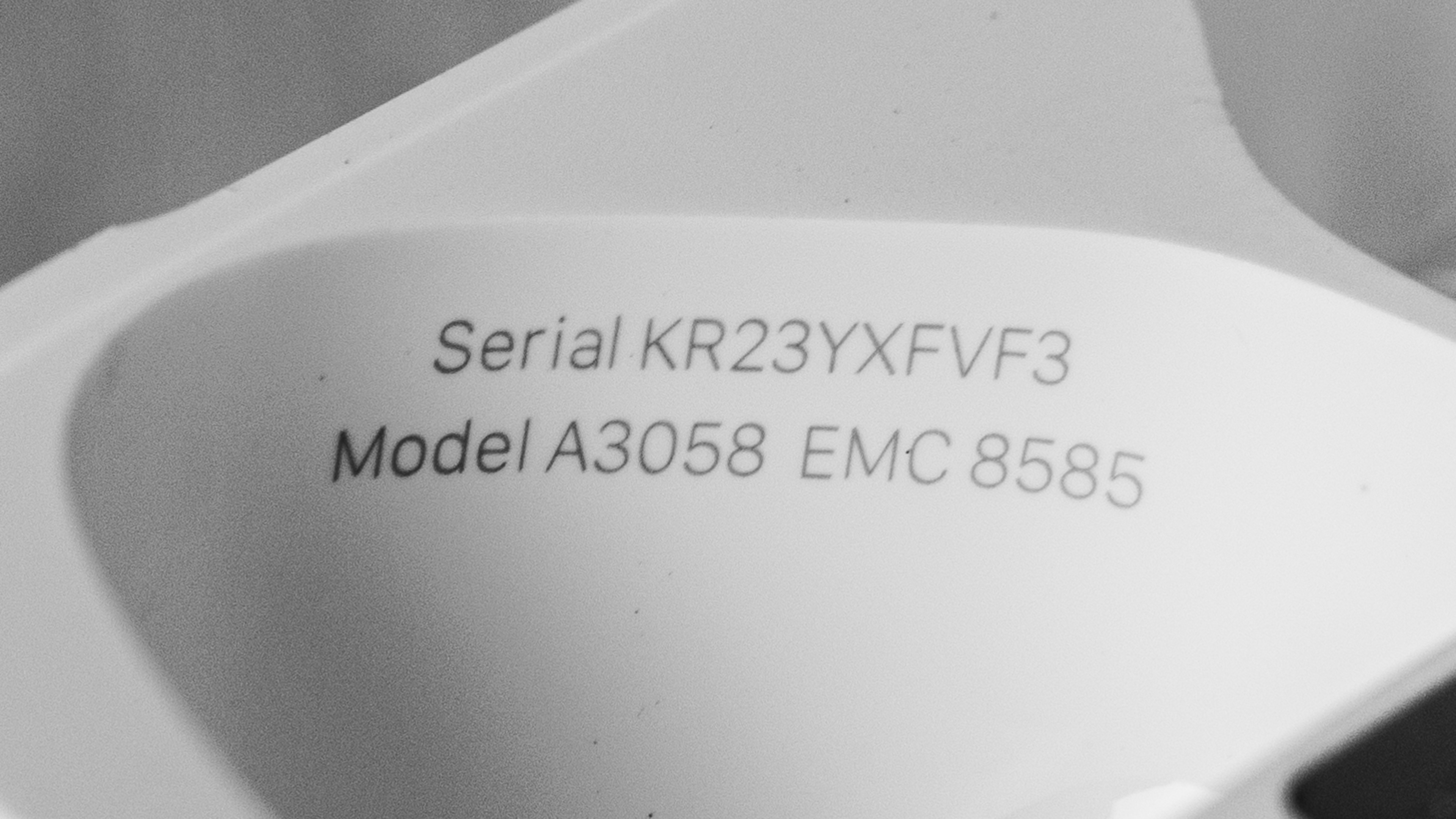
    The Apple AirPods 4 only come in the brand's signature 'White'; you can see our unit's label. They share some similarities with the Apple AirPods 4 with Active Noise Cancellation, but there are still differences that make them distinct products that don't perform the same. If you encounter another variant of these headphones, please let us know in the comments, and we'll update our review.

    Popular Headphones Comparisons

    Apple split its base true wireless range with Apple AirPods 4 and the Apple AirPods 4 with Active Noise Cancellation, and the (unsurprising) main difference between them is the noise isolation performance. Even the previous Apple AirPods (3rd generation) aren't extremely different from the AirPods 4 besides gaining a better IP rating on the AirPods 4 and notably bassier sound. The Apple AirPods Pro 2 have ANC and an in-ear design, unlike the standard AirPods 4 that boast a looser, unsealed fit and lack isolation. However, they both have the H2 chip for seamlessly switching from one iCloud device to another.

    Still, if you're wondering whether you should get the AirPods 4 if you don't have an iPhone, it's worth noting that these rely on their heavy iOS/iPadOS/macOS integration and constant updates to get the most out of them. Otherwise, you might as well consider the best wireless Bluetooth earbuds or the best AirPods alternatives as worthy options. Check out the best wireless earbuds for iPhone if you're uncertain about whether these are the right 'Pods to pair with your iOS device.

    Apple AirPods Pro 2

    The Apple AirPods Pro 2 are better for most people than the Apple AirPods 4 mainly due their more predictable fit and the flexibility of active noise cancellation. On the other hand, if you prefer the environmental awareness of the open-back AirPods 4 and their looser fit, you may prefer that to the transparency mode on the AirPods Pro 2. Both have the H2 chip for switching between iCloud-registered Apple devices and Spatial Audio. However, the AirPods Pro 2 can also charge wirelessly, while the AirPods 4 only charge via USB-C.

    Apple AirPods Pro 3

    The Apple AirPods Pro 3 are better than the Apple AirPods 4 for most people. Thanks to the class-leading noise cancelling onboard the AirPods Pro 3, they're more versatile for use in noisy spaces without prompting you to raise the volume level, which can happen with the AirPods 4. The AirPods Pro 3's ear tips also provide a more secure fit than the one-size-fits-most design of the AirPods 4. That said, the AirPods 4 share a lot of similar features exclusive to the Apple ecosystem, like seamless device switching, pressure-sensitive controls on the stems, spatial audio, and 'Find My' tracking.

    Apple AirPods Pro

    The Apple AirPods Pro are an older model than the Apple AirPods 4 and each have slightly different strengths. If you want noise cancelling and an isolating fit, the AirPods Pro provide a more predictable in-ear fit compared to the loose and open-backed fit of the AirPods 4. The AirPods 4 have a better mic with more powerful noise handling for calls and the newer H2 chip, but they don't isolate you from the environment.

    Apple AirPods 4 with Active Noise Cancellation

    The Apple AirPods 4 with Active Noise Cancellation are more flexible in more situations than the Apple AirPods 4. They're the same generation of earbuds; besides noise cancelling tech, there are slight differences, such as the AirPods 4 with ANC having a speaker on the case for the Find My Network, and the case can charge wirelessly. You get more listening modes, such as Conversation Awareness and Adaptive Audio, too. On the other hand, the standard AirPods 4 lack these features but otherwise perform similarly regarding sound, connectivity, and iOS integration. For most people, it'll come down to whether ANC is desirable or not.
    Show more 

    Test Results

    perceptual testing image
    Sort:
    RATINGS
    Category:
    All
    Sound
    Sound Profile
    See details on graph tool
    Normalization Frequency
    900 Hz
    Bass Amount
    Slightly Underemphasized (-2 dB)
    Treble Amount
    Very Underemphasized (-6 dB)
    Sound Signature
    Warm

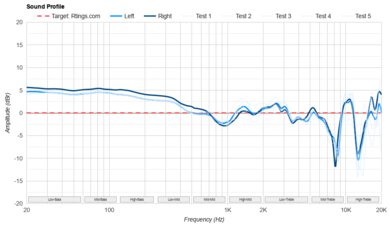
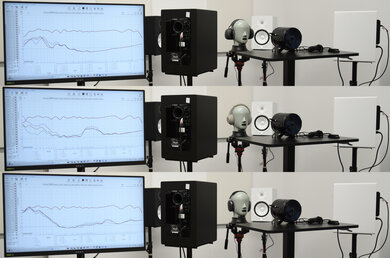
    The Apple AirPods 4 have an always-on Adaptive EQ that alters their sound profile, so you'll perceive bass and treble similarly regardless of how loud your volume is set. You can see how different volume settings affect the treble and bass when using the buds with an iPhone.

    As a result of Apple's Adaptive EQ, we noticed differences between the frequency response obtained via our standard measurement methodology (using SBC) and that obtained over AAC while paired to an iPhone. The measurements we've listed here are taken via SBC, meaning they're not affected by Apple's adaptive EQ.

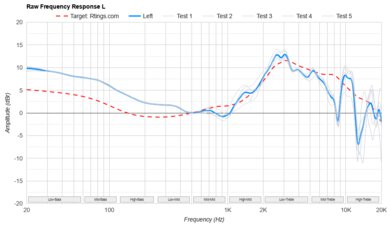
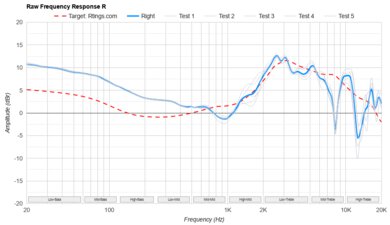
    Via SBC, these earbuds have a generally warm sound. Since they don't form a seal with your ears, they lack a little thump in the low bass, but the rest of the bass and mid-range are virtually flat. A big dip in the treble gives these cans their warm sound. Whether you like it is a matter of taste. Some listeners enjoy this smooth sound; others find it a bit dull.

    For anyone drawing comparisons, their frequency response is very similar to the Apple AirPods 4 with Active Noise Cancellation. It's possible that firmware updates can change the sound profile, which we observed with the ANC version during the review period.

    8.8
    Frequency Response Consistency
    See details on graph tool
    See details on graph tool
    Std. Deviation
    0.53 dB

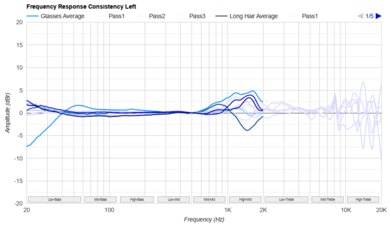
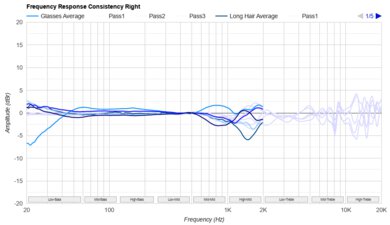
    These have amazing frequency response consistency, which is all the more impressive considering the absence of ear tips that ordinarily ensure a predictable in-ear fit and audio delivery. They sound virtually the same between wears and on different wearers.

    Raw Frequency Response
    See details on graph tool
    See details on graph tool
    8.2
    Bass Profile: Target Compliance
    See details on graph tool
    RMS Deviation From Target
    3.8 dB
    Low-Frequency Extension
    24.84 Hz
    Low Bass
    -5.16 dB
    Mid Bass
    0.06 dB
    High Bass
    0.48 dB

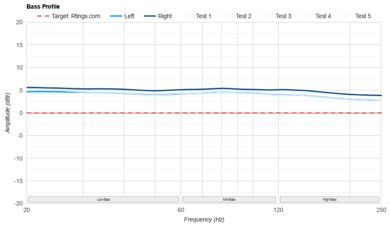
    They have impressive bass target compliance. Basslines sound weighty and punchy, while 808 kicks have a reasonable amount of thump. A roll-off in the lowest frequencies somewhat weakens the deep throb of sub-bass, but these have a solid amount of bass, especially in the context of their veiled treble range. This bass response is one of the most notable upgrades over the Apple AirPods (3rd generation), which struggle to provide a full-sounding low-end like many earbuds without ear tips to seal your ear canals.

    9.6
    Mid-Range Profile: Target Compliance
    See details on graph tool
    RMS Deviation From Target
    0.72 dB
    Low Mid
    0.53 dB
    Mid-Mid
    -0.45 dB
    High Mid
    -0.33 dB

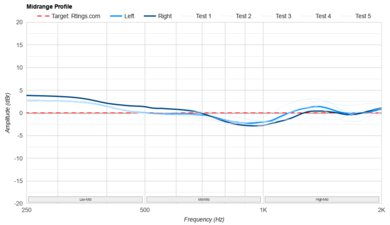
    The earbuds have superb mid-range target compliance. Throughout the range, they match our target closely, rendering lead guitars, rhythmic keys, speech, and percussion as balanced and clear. A very slight tilt in the low-mids adds a bit of extra articulation to bass guitars without sounding busy.

    4.3
    Treble Profile: Target Compliance
    See details on graph tool
    RMS Deviation From Target
    6.63 dB
    Low Treble
    -7.02 dB
    Mid Treble
    -5.37 dB
    High Treble
    -4.03 dB

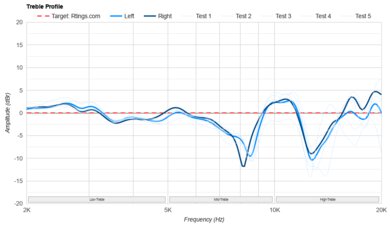
    Their treble does a poor job of complying with our target curve. Virtually the entire treble spectrum lacks details and clarity, resulting in a very warm, muffled tonality. Songs like The Tracks of My Tears by Smokey Robinson & The Miracles lack the detail and articulation of Robinson's falsetto and sound lispy on S and Ts. Meanwhile, the depth of the cymbal and tambourine accents is lost, reduced to somewhat muted splashes. That said, some listeners enjoy this warm sound.

    8.2
    Peaks/Dips
    See details on graph tool
    Peaks
    0.89 dB
    Dips
    1.75 dB

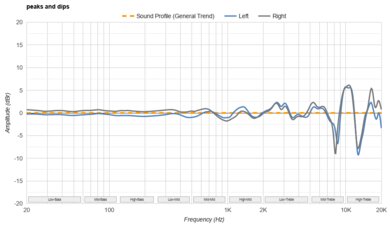
    Their peaks and dips performance is impressive, indicating they follow their own warm sound profile closely, so you can expect bass and mids to sound even relative to each other. The only noteworthy peaks and dips are in the upper parts of the treble range, where your ear anatomy greatly affects what you hear, anyway.

    9.1
    Stereo Mismatch
    See details on graph tool
    See details on graph tool
    Weighted Amplitude Mismatch
    0.13 dB
    Weighted Frequency Response Mismatch
    0.43 dB
    Weighted Phase Mismatch
    0.6°

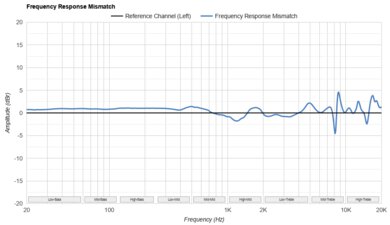
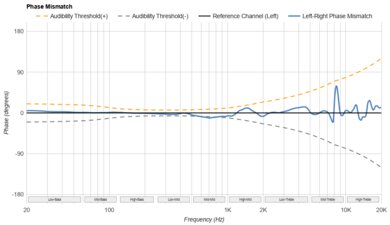
    These earbuds have outstanding stereo matching. The left and right drivers are superbly well-matched in phase and amplitude right across the entire spectrum. Objects are always correctly placed in the stereo field.

    6.4
    Group Delay
    See details on graph tool
    Weighted Group Delay
    1.3 ms

    Although these earbuds only receive a passable group delay score, you won't notice any issues subjectively, since they don't reproduce very low bass, anyway. Bass sounds and transients alike are all reproduced with clarity and precision.

    0.0
    PRTF
    PRTF Accuracy (RMS Deviation)
    N/A
    PRTF Size (Avg.)
    N/A
    PRTF Distance
    N/A
    9.6
    Harmonic Distortion
    See details on graph tool
    See details on graph tool
    WHD @ 94 dB SPL
    0.05%
    WHD @ 104 dB SPL
    0.07%

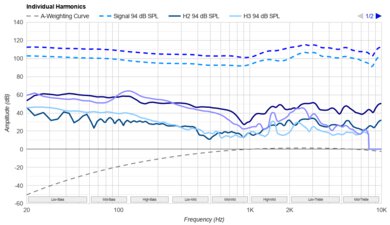
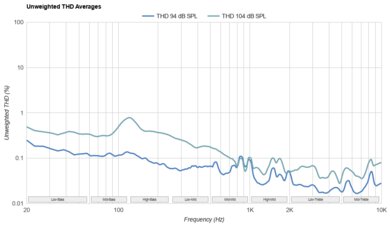
    These headphones have fantastically low harmonic distortion. Even if you push the listening level to the max, you'll hear clean and pure audio reproduction.

    Electrical Aspects
    Sensitivity @1kHz-1V
    N/A
    Bluetooth Max SPL
    98.6 dB
    5.0
    Virtual Soundstage
    Head Modeling
    On/Off
    Speaker Modeling
    On/Off
    Room Ambience
    No
    Head Tracking
    On/Off
    Virtual Surround
    Personalized Spatial Audio

    With your compatible iOS/iPadOS device, you gain access to two types of Apple Spatial Audio in the settings. Personalized Spatial Audio uses your ear shape, obtained via a video you take, to adjust the virtual surround soundstage to your anatomy. You can also use the Spatial Audio without going the Personalized route, and we didn't notice a big difference in terms of subjectiveness. Still, depending on the person's anatomy and media, the adaptive nature of the feature may have more significant results with different people. Plus, it's possible that updates at a later date will make a starker difference between standard and Personalized Spatial Audio.

    You can also select 'Fixed' or 'Head Tracked' so the surround sound spread either stays locked in place or moves around you when you shift your head. You can also use the iOS interface's accessibility settings to set the Spatial Audio to follow the iPhone's position instead of 'Fixed' or 'Head Tracked.'

    Test Settings
    Firmware
    7B19
    Power
    On
    Connection
    Bluetooth
    Codec
    SBC, 16-bit, 48kHz
    Test InstrumentAudio Precision APx517B
    EQ
    Adaptive EQ
    ANC
    No ANC
    Tip/Pad
    Default
    Microphone
    Integrated

    These are the settings we used to test the Apple AirPods 4. Adaptive EQ is always on. Additional features were disabled: Personalized Volume, Automatic Ear Detection, and Personalized Spatial Audio. All tests and measurements were recorded over Audio Precision while the AirPods 4 were connected to an iPhone.

    Design
    Style
    TypeEarbuds
    EnclosureOpen-Back
    WirelessTruly Wireless
    TransducerDynamic

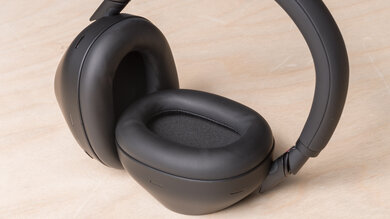
    Apple continues its signature white stemmed design in the open-backed Apple AirPods 4, which look almost indistinguishable from the lineage of the previous Apple AirPods (3rd generation). The main differences are quite subtle, like a vent on the Apple AirPods 4 that's absent on the previous gen. Meanwhile, it's easier to differentiate the Apple AirPods 4 from the Apple AirPods 4 with Active Noise Cancellation by noting that the non-ANC model lacks a speaker at the bottom of the case.

    7.0
    Comfort
    Weight0.02 lbs
    Clamping Force
    N/A

    These are decently comfortable earbuds, but like the previous AirPods models without ear tips, their comfort and fit will depend on how closely your ear shape mirrors the manufacturer's ear modeling. Still, if they fit you, you're treated to a very lightweight, contoured, and unobtrusive-feeling design that leaves your ear canal unsealed. On the other hand, there are reports of the buds falling out, even on users who owned previous models without issue, so the slightly altered shape between generations will influence how comfortable you find them.

    5.8
    Controls
    OS Compatibility
    Not OS specific
    Ease Of UseGreat
    FeedbackGood
    Call/Music ControlYes
    Volume ControlNo
    Microphone ControlMute/Unmute
    Channel Mixing
    No
    Noise Cancelling ControlNo
    Talk-Through
    No
    Additional ControlsVoice Assistant

    The Apple AirPods 4 have virtually identical controls as the AirPods 4 with ANC, except they lack noise cancellation and transparency modes. You can see their default controls, managed by refined pressure-sensitive stems that mitigate accidental commands. They don't require as much force as the Nothing Ear's pressure-sensitive stems, but they can take some getting used to. For better or for worse, the controls are somewhat limited: you can't alter the volume with the buds' controls. Perhaps the manufacturer assumes Personalized Volume (which adjusts the volume to combat how noisy your environment is) addresses loudness, but not everyone enjoys that experience, especially with music. On the bright side, the buds have in-ear detection, emit a light haptic vibration with distinctive chimes when you enter commands, and the commands cover playback and voice assistant Siri.

    Entering Bluetooth pairing mode requires two taps on the case. You can also perform a factory reset by double-tapping the case three times with buds inside.

    When you pair the buds with your iPhone, you're prompted to choose whether you want head gesture controls with Siri. These are pretty rudimentary, but they can be useful when your hands are full of groceries and you receive a call; simply nod your head to accept (or shake your head to reject).

    9.6
    Portability
    L1.3" (3.3 cm)
    W1.0" (2.5 cm)
    H0.7" (1.8 cm)
    Volume0.85 in³ (14.00 cm³)
    Transmitter RequiredNo

    Like most true wireless earbuds, these are remarkably portable. You can easily pocket them, even in that nearly useless coin pocket of your jeans. However, you may want to use their charging case because they're small enough to be misplaced easily.

    8.5
    Case
    TypeHard case
    L1.8" (4.6 cm)
    W2.0" (5.0 cm)
    H0.8" (2.1 cm)
    Volume2.93 in³ (48.00 cm³)

    The charging case is excellent. It's small, well-built, and made of glossy plastic. The hinge is sturdy without feeling loose and the lid's magnet ensures it stays shut when not in use. The internal magnets hold the buds in place so they don't fall out or stop charging, too.

    Unlike the previous Apple AirPods (3rd generation), the case lacks MagSafe, and unlike the Apple AirPods 4 with Active Noise Cancellation, it won't charge wirelessly either, so you're limited to USB-C charging only, but the package doesn't include a charging cable. It also lacks a speaker on the underside of the case to help locate it using the 'Find My' feature found on the ANC AirPods 4.

    8.0
    Build Quality

    The build quality of the Apple AirPods 4 is great. They're rated IP54 against dust and light water splashes. The buds' glossy plastic feels light, smooth, without annoying seams, and somewhat scratch-resistant if you drop them from not too high. However, the case is more prone to scratches than the buds. The case boasts sturdy magnets to hold the buds in place and to keep the lid closed.

    7.5
    Stability

    Their stability is good, but it's contingent on how well they fit your ears. If they fit you well, they'll likely stay put for active workouts thanks to their balanced feather-light weight. However, if you experience in-ear fit issues with most earbuds, the lack of ear tips or stabilizers won't do you any favors. The Apple AirPods Pro 2 can supply a more predictably stable fit for a wider spectrum of ear shapes and sizes due to their ear tips.

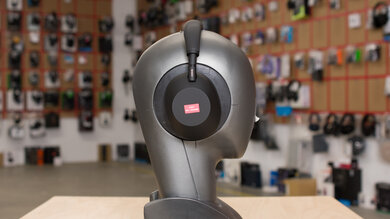
    Headshots 1
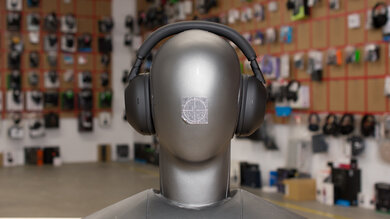
    Headshots 2
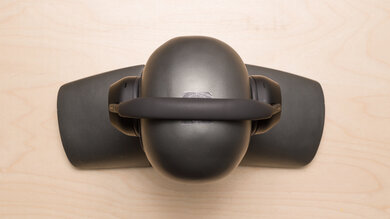
    Top
    In The Box

    • Apple AirPods 4 headphones
    • Charging case
    • Manuals
    Isolation
    1.8
    Noise Isolation - Full Range
    See details on graph tool
    Noise CancellingNo
    Overall Attenuation
    -4.05 dB
    Bass
    0.07 dB
    Mid
    -0.04 dB
    Treble
    -13.49 dB

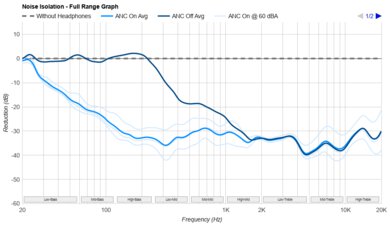
    Their full-range noise isolation is bad, which is expected for open-back earbuds that don't seal your ear canals from the outside world and lack ANC. They block a small amount of very high frequencies from reaching your ears, but not enough to make a meaningful difference. You'll still hear people talking nearby, engine noise on public transit, and HVAC systems, which is fine if you want to stay aware. Rather than cancelling out your environment, enabling the Personalized Volume feature can offset the effects of some noise fluctuations in your environment by adjusting the output volume of the earbuds. This is useful for podcasts and phone calls, although it can strip your music of dynamics with a poorly timed volume change.

    If you want to tame how much you hear of your environment's noise while retaining the open fit, then you'll find the Apple AirPods 4 with Active Noise Cancellation offer more flexibility in this respect. That said, the Apple AirPods Pro 2 and their in-ear design still isolate far more noise.

    2.2
    Noise Isolation - Common Scenarios
    See details on graph tool
    Airplane Noise Attenuation
    -3.75 dB
    Airplane Noise Isolation Audio
    Office Noise Attenuation
    -4.14 dB
    Office Noise Isolation Audio
    Street Noise Attenuation
    -4.13 dB
    Street Noise Isolation Audio

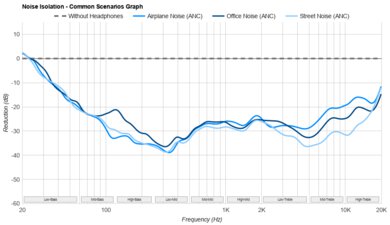
    These earbuds do a poor job of isolating noise in common scenarios. You'll hear every keystroke in the office, traffic driving by on the street, and the low ambient din of an airplane cabin. You can use the Personalized Volume feature with your iOS device so the buds' output volume dynamically adjusts to combat competing external noises, but arguably, this just adds more noise for your brain to parse.

    Noise Isolation - Voice Handling
    Female Voice 1
    Male Voice 1
    Female Voice 2
    Male Voice 2
    ANC Wind Handling
    ANC Wind Noise
    N/A
    8.0
    Leakage
    See details on graph tool
    Leakage Audio
    Overall Leakage @ 1ft
    33.86 dB

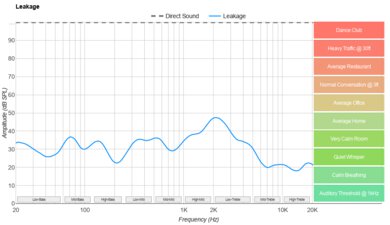
    The earbuds have great leakage performance. Even though they're open-backed and don't seal your ear canal, in most situations, your audio won't disturb those around you. They mainly leak upper frequencies, so what escapes sounds very thin and bright.

    Microphone
    Microphone Style
    Integrated
    Yes
    In-Line
    No
    Boom
    No
    Detachable Boom
    No
    MicYes
    6.4
    Recording Quality
    See details on graph tool
    Recorded Speech
    LFE
    276.97 Hz
    FR Std. Dev.
    5.77 dB
    HFE
    4,902.93 Hz
    Weighted THD
    1.682
    Gain
    28.06 dB

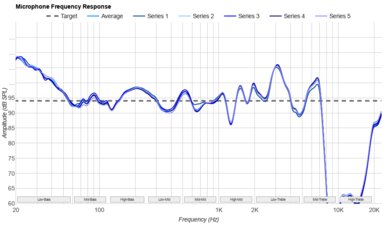
    The mic system's recording quality is passable. The buds use beam-forming microphones, and within iOS settings, you can choose which side you want them to use. We set it to 'Automatic' so that the system will prioritize whichever side yields better mic fidelity. Voices are comprehensible but come across as thin, uneven, and boxy.

    6.7
    Noise Handling
    See details on graph tool
    SpNR
    37.48 dB
    Noise Gate
    No
    Speech + Pink Noise Handling
    7.5
    Speech + Pink Noise Audio Sample
    Speech + Subway Noise Handling
    5.5
    Speech + Subway Noise Audio Sample

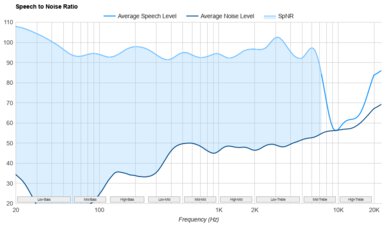
    The microphone system's noise handling is okay. In scenarios with consistent background noise, the sounds are still present, albeit quieter, but the mic still prioritizes your speech without strongly affecting its clarity. With more sporadic background noise, the mic differentiates between you and voices in the backdrop well. However, it's overwhelmed by sudden and overpowering sounds like subway cars. It also doesn't attenuate the volume of these noises well, which can be painful for the caller on the line.

    Active Features
    7.2
    Battery
    Battery Type
    Rechargable
    Continuous Battery Life
    6.7 hrs
    Additional Charges
    4.0
    Total Battery Life
    33.5 hrs
    Charge Time
    0.5 hrs
    Power-Saving Feature
    Standby mode
    Audio While Charging
    Yes
    Passive Playback
    No
    Charging PortUSB-C

    Their battery performance is satisfactory. In testing, they reached 6.7 hours of continuous playback, and they're advertised to last five hours of listening time (or 4.5 hours on a call). Their case holds an extra four recharges—one fewer than the previous Apple AirPods (3rd generation). They fully recharge in 30 minutes, which is pretty quick and possibly helps to offset the middle-of-the-road continuous battery life.

    They have a few useful tools to conserve battery life, such as Optimized Battery Charging, which stops charging at 80% to extend the battery's lifespan by adapting to your usage habits; this was disabled via iOS settings for testing. When you remove the buds (and don't place them back in the case), they enter a standby mode.

    6.0
    App Support
    App NameiOS Interface
    iOSYes
    AndroidNo
    macOSYes
    WindowsNo
    Equalizer
    No
    ANC Control
    No
    Mic ControlNo
    Room Effects
    No
    Playback Control
    No
    Button MappingYes
    Surround Support
    Yes

    The Apple AirPods 4 don't have a dedicated app but instead rely on the iOS interface's settings to access their features and firmware updates. iOS 18 or newer provides mostly on/off features like Personalized Volume, Automatic Ear Detection, Optimized Battery Charging, and Head Gesture Controls. You'll use these settings to configure Personalized Spatial Audio and toggle it on/off. You also have basic control over the call commands—one or two presses. You can control the connections via settings, too. Unlike the Apple AirPods 4 with Active Noise Cancellation, you can't track their case using the 'Find My Network,' and due to the lack of ANC, there aren't additional listening modes on the standard AirPods 4.

    Their Accessibility menu via the iOS settings adds some customization for the earbuds' sensor sensitivity, mic settings, L/R channel balance, and visual aids such as LED flashing for alerts. While they don't have a conventional equalizer, you can use one of the three presets (set to 'Balanced Tone' by default) under the Headphones Accommodations sub-menu. There's also a compressor slider that 'boosts' softer sounds—set to 'Slight' by default. In all, there's a lot of menu diving because some of these features are exclusive to the AirPods 4, while others are settings you can configure within iOS for any headphones.

    Connectivity
    0.0
    Wired Connection
    Analog Audio
    No
    USB Audio
    No
    Detachable
    No
    Length
    N/A
    Connector
    No Wired Option
    Latency - Analog
    N/A
    Latency - USB
    N/A
    Recorded Latency
    N/A
    Recorded Latency ConnectionNo Wired Audio

    These are wireless Bluetooth earbuds only. They don't include a cable, but you'll need to supply your own USB-C cable for charging their case.

    7.4
    Bluetooth Connection
    Bluetooth Version
    5.3+H2 chip
    Multi-Device Pairing
    Yes (Apple Ecosystem)
    Quick Pair (Android)
    No
    Quick Pair (iOS)
    Yes
    Line Of Sight Range
    259.19 ft (79.00 m)
    Latency - SBC
    215 ms
    Latency - aptX
    N/A
    Latency - aptX Adaptive (High Quality)
    N/A
    Latency - aptX Adaptive (Low Latency)
    N/A
    Latency - LDAC
    N/A
    Recorded Latency
    Recorded Latency CodecSBC
    AAC Support
    Yes

    The Apple AirPods 4 have decent Bluetooth connectivity. They're Bluetooth 5.3 with the brand's proprietary H2 chip, which allows seamless device switching between Apple devices on the same iCloud account. If Automatic Ear Detection is enabled, audio can continue playing back even when swapping from your iPhone to MacBook, for instance. However, there's no multi-device pairing with non-Apple devices or if you've not registered an Apple device on the same iCloud account.

    Their codecs include AAC and SBC. In testing, we noted that the range is slightly better with an iPhone than with an Android device. Generally, the Apple ecosystem defaults to the AAC codec, and subjectively, we didn't notice a significant lag between audio and video with an iPhone. However, this can vary with different devices, and we don't measure latency via AAC. In contrast, our SBC latency measurement indicates a high enough lag that your audio will have a noticeable lipsync mismatch, but most people are likely to use an iOS device with these buds.

    0.0
    Wireless Connection (Dongle)
    Line Of Sight Range
    N/A
    Latency - Dongle
    N/A
    Recorded Latency
    N/A
    PC Compatibility
    Analog
    No
    Wired USB
    No
    Non-BT Wireless
    No

    You can only connect the earbuds to your computer via Bluetooth for full audio and mic support.

    PlayStation Compatibility
    PS4 Analog
    No
    PS4 Wired USB
    No
    PS4 Non-BT Wireless
    No
    PS5 Analog
    No
    PS5 Wired USB
    No
    PS5 Non-BT Wireless
    No
    Xbox Compatibility
    Xbox One Analog
    No
    Xbox One Wired USB
    No
    Xbox One Non-BT Wireless
    No
    Xbox Series X|S Analog
    No
    Xbox Series X|S Wired USB
    No
    Xbox Series X|S Non-BT Wireless
    No
    0.4
    Base/Dock
    Type
    Charging Case
    USB Input
    No
    Line In
    No
    Line Out
    No
    Optical Input
    No
    RCA Input
    No
    Dock Charging
    No
    Power Supply
    USB-C

    The carrying case can only charge via its USB-C port, and you'll need to provide your own USB-C cable. It can supply you with an additional four full charges. It's not MagSafe compatible or able to charge wirelessly, though the Apple AirPods 4 with Active Noise Cancellation Truly Wireless can charge wirelessly.