See the previous 2.0 changelog.
Headphone Test Bench 2.1 rebalances the Harmonic Distortion test and removes the Group Delay test. We've also added the JM-1 HRTF (for IEMs) to our Graph Tool.
What's Changed?
| Test Group | Description |
| Group Delay | Completely removed from the review and methodology |
| Harmonic Distortion | Rebalanced scoring without modifying the test |
| Audio Reproduction Accuracy | Redistributed weight resulting from Group Delay removal |
| Sound Profile/Raw FR Graph | Added JM-1 HRTF (IEMs) |
Why Are We Making These Changes?
In our previous test bench, we noted that both Harmonic Distortion and Group Delay are difficult to hear and, as a result, were given a lower weight in usages like Audio Reproduction Accuracy. However, after further research and observation during testing, we concluded that we had previously overestimated the effects of both metrics on practical listening.
Group Delay
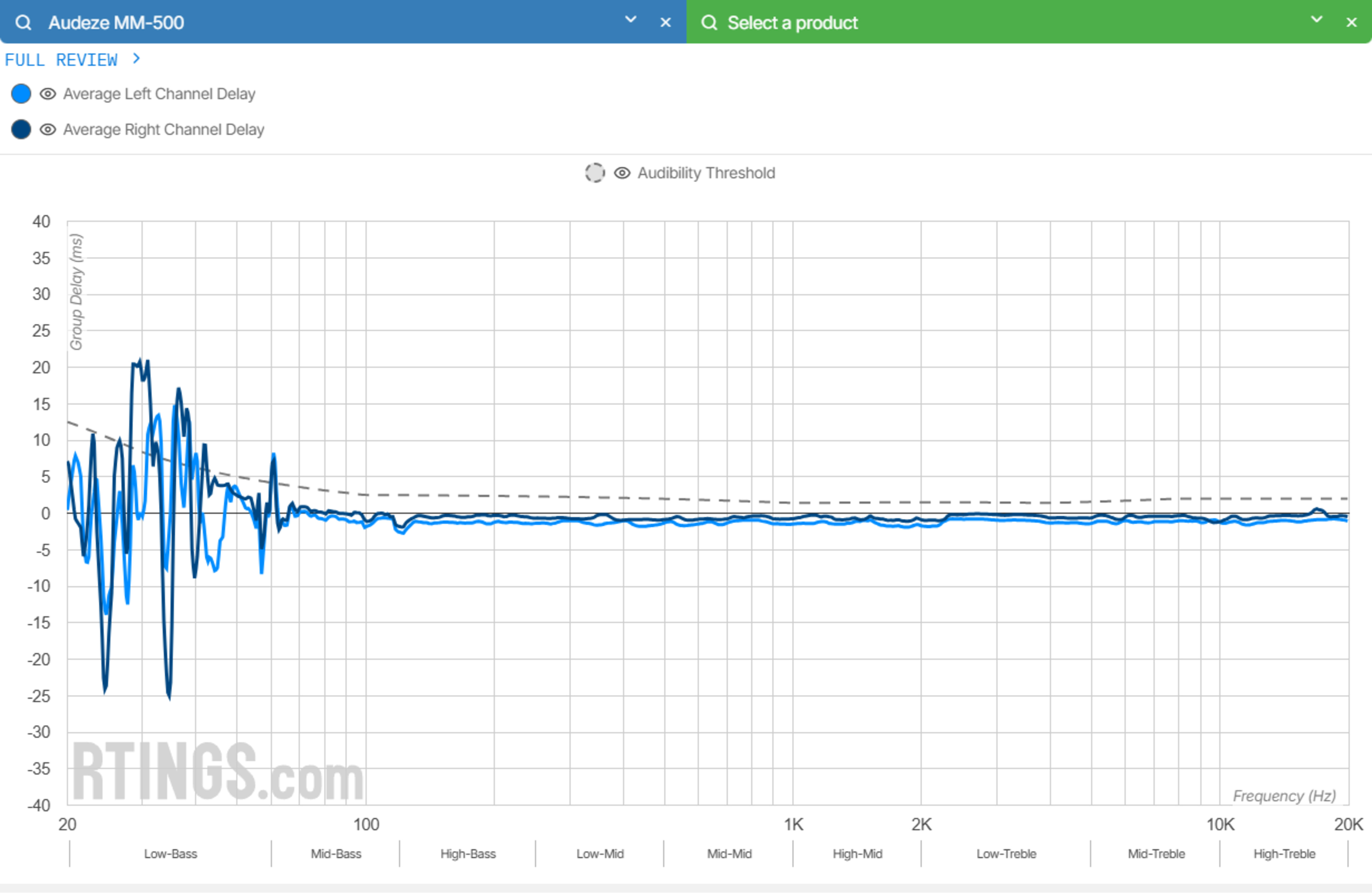
As we tested more products on Headphones Test Bench 2.0, we noticed that headphones (that reproduce audio with high fidelity) had their Audio Reproduction Accuracy weighed down by comparatively low Group Delay. Despite these low scores, we didn't identify any audible issues typically associated with poor group delay after an in-depth subjective assessment of several headphones, casting doubt on the test's ability to meaningfully reflect an impact on the end user.
Test Designer Pierre's Notes: Most headphone acoustic engineers conclude that headphones are essentially minimal-phase devices, meaning any deviation in phase would result in a corresponding deviation in magnitude at these frequencies. In other words, group delay errors were already reflected in our frequency response measurements, making the test and its associated score redundant. This measurement is also quite sensitive to actual delays in the digital pipeline. Since our measurements are an average of many passes, our methodology introduced variations that resulted from the overlay of responses that weren't consistent from one pass to the next; the result was a worse picture when calculated in aggregate compared to on an individual basis.
Harmonic Distortion
Our literature review and our own investigation on distortion, in partnership with Dr. Sean Olive, found that in practical listening at normal levels, distortion is largely inaudible and "even when measurements predict subtle differences, those differences are extremely difficult to detect." As a result, we've modified the Harmonic Distortion scoring to be much more lenient, with most products scoring exceptionally well to better reflect perception rather than performance differences that may not be observable. Still, we've opted to continue measuring (and scoring) THD, since some enthusiasts chase the lowest possible Harmonic Distortion. Because perception is a moving target and varies between individuals, we can't definitively say when most people will notice Harmonic Distortion, but we're confident that you won't notice anything as long as the score is green (above 7.4).
Audio Reproduction Accuracy
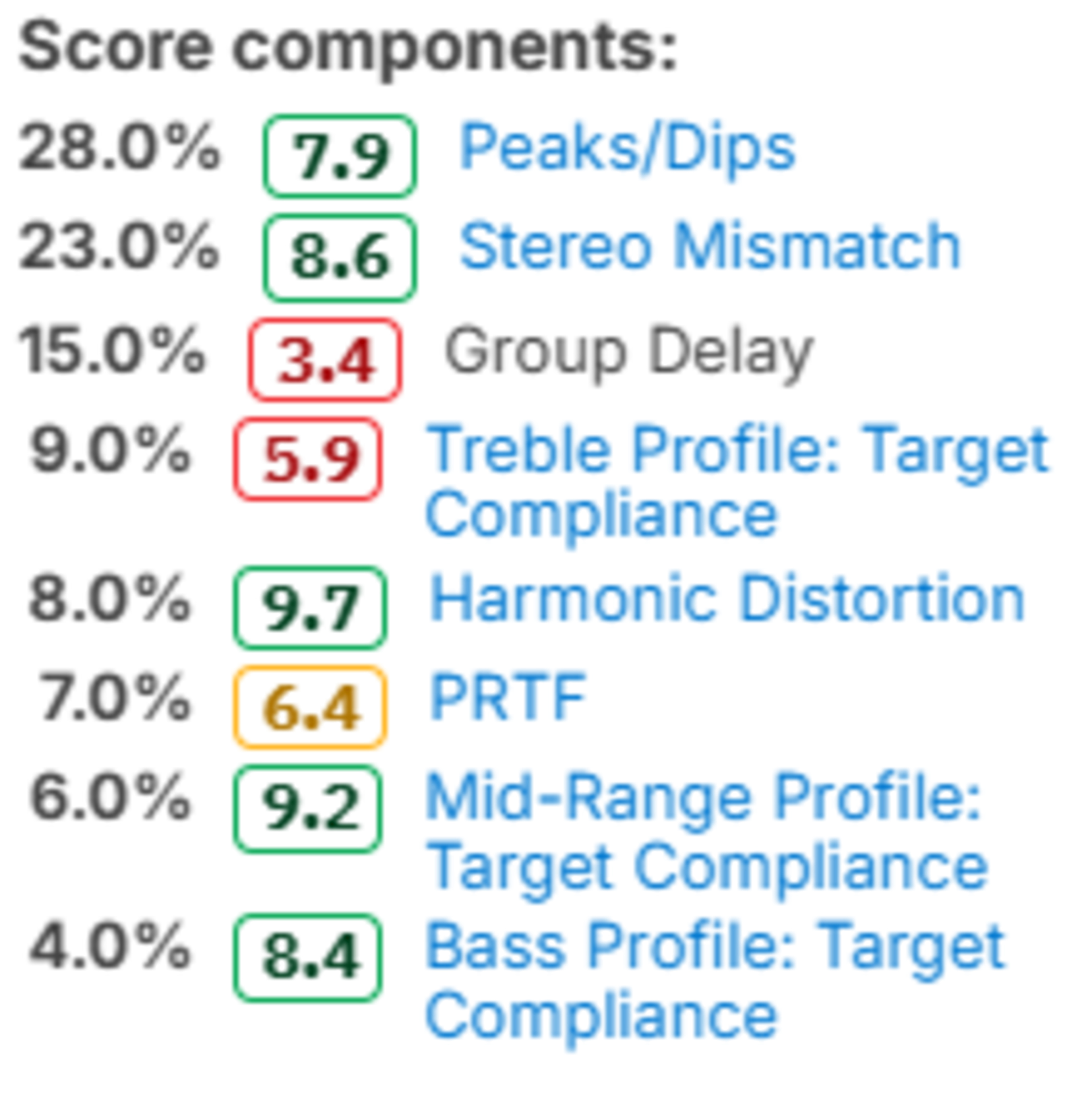
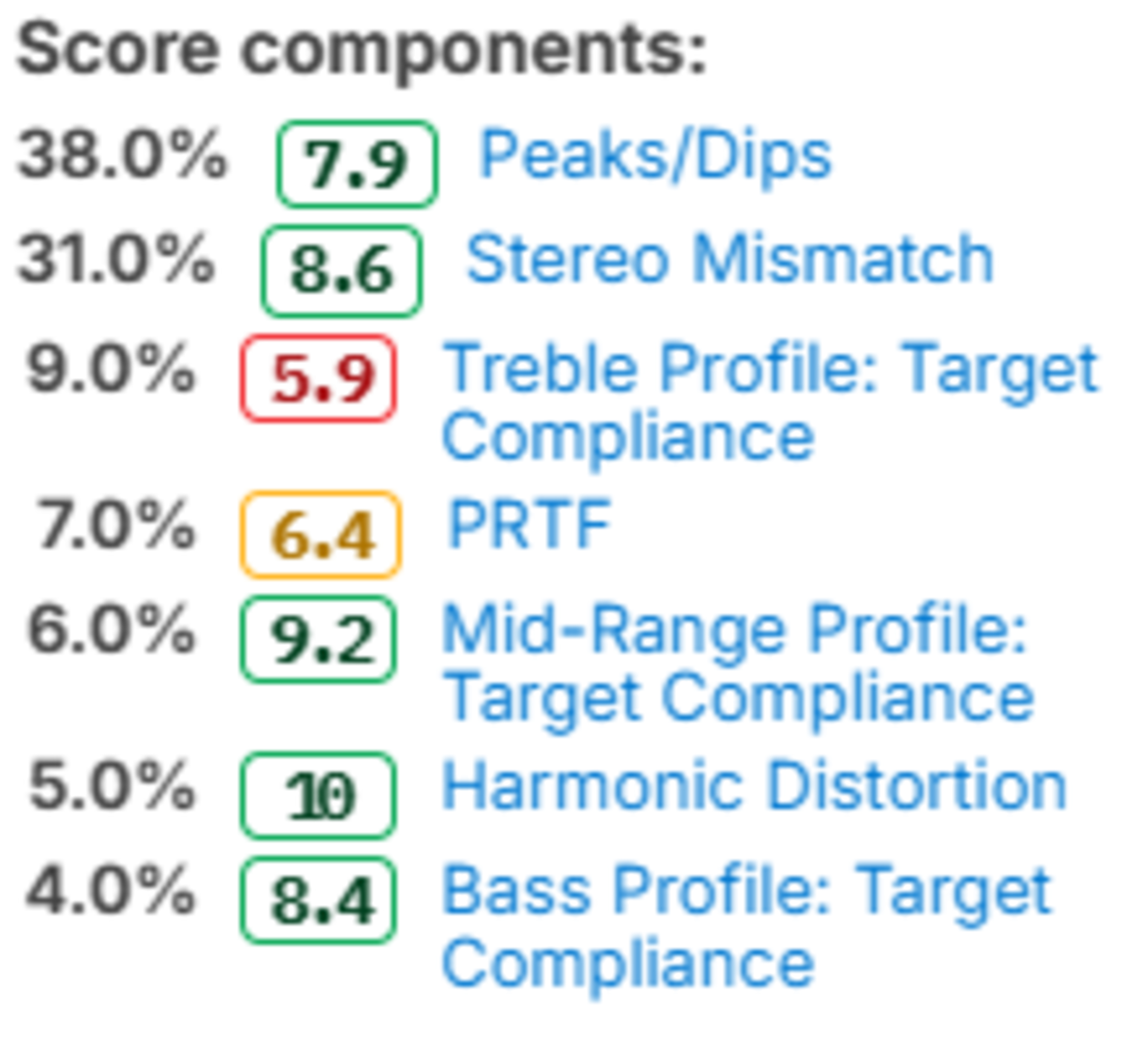
Because of the removal of Group Delay and lower significance of Harmonic Distortion, we rebalanced Audio Reproduction Accuracy with weighting distributed to other components that make up the score (Peaks/Dips and Stereo Mismatch):
| Test Bench 2.0 | Test Bench 2.1 |
 |
 |
Sound Profile/Raw FR Graph
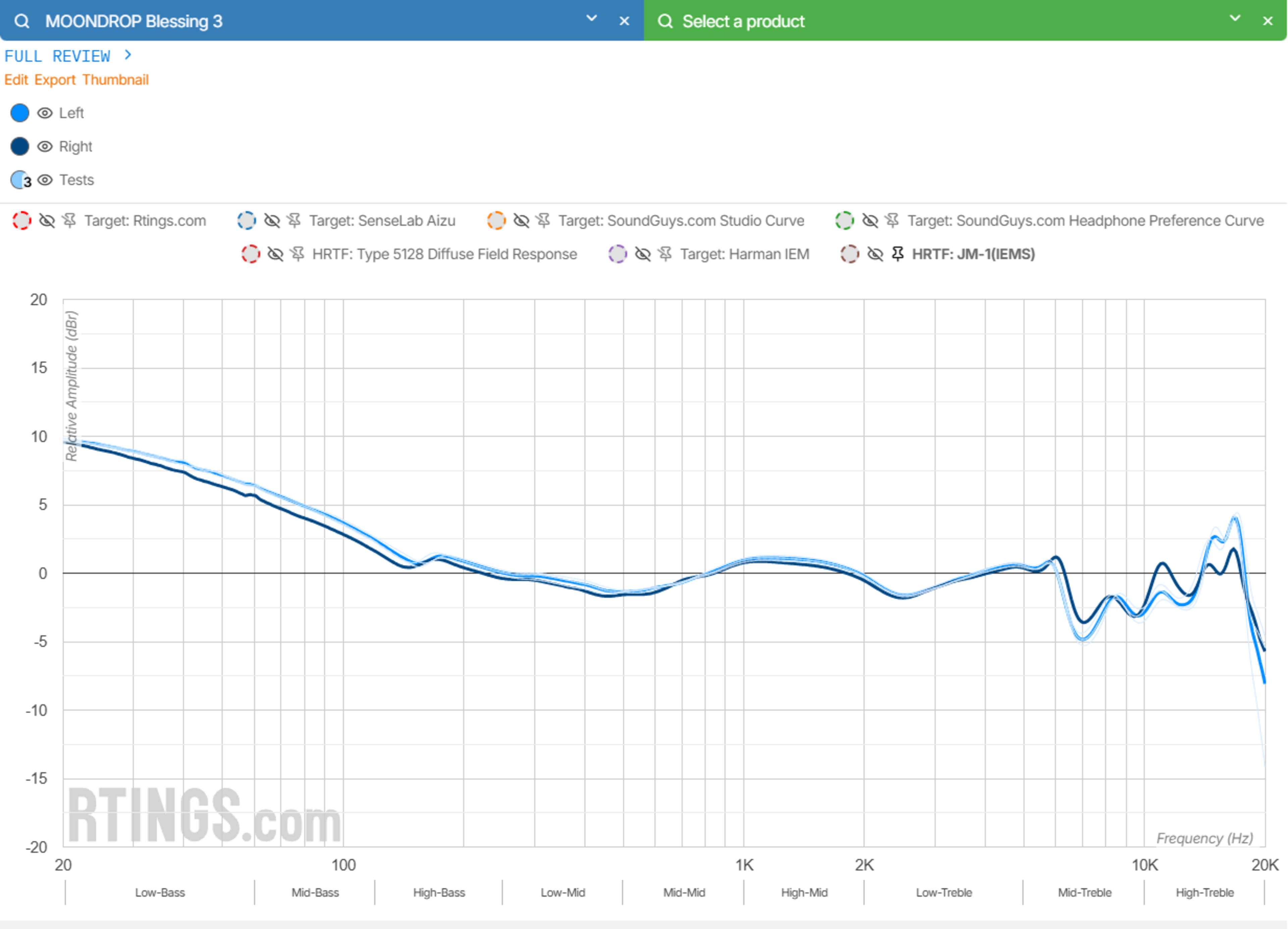
We've added the JM-1 HRTF for in-ear monitors (IEMs) to both the Sound Profile and Raw FR Graph Tool. JM-1, developed by Joel Merrifield, is a modified HRTF that combines the ear canal response portion of the B&K 5128 HRTF and the population-average pinna effects from Hammershøi and Møller's Determination of Noise Immission From Sound Sources Close to the Ears. Though JM-1 isn't a target in itself, portions of the community prefer the JM-1 HRTF over the B&K 5128 HRTF as a baseline for preference curve development and HRTF compensation due to its closer resemblance to how the average human will experience in-ears.
Test Designer Pierre's Notes: This work by Merrifield, adjusting for the B&K 5128's ear gain in IEM measurements that don't reflect the general population, is valuable. Beyond our publication, some manufacturers use these findings in the tuning of IEMs (MOONDROP x Crinacle DUSK [USB]). In addition, other reviewers derive IEM target responses using the JM-1 HRTF as a baseline by applying tilt to the curve or bass elevation based on Harman's research. Being able to compensate measurements to this curve is helpful for our readers, especially since it brings some comparability with other publications that have adopted compensated measurements as their primary visualization (Headphones.com). To avoid confusion, our Graph Tool now displays only in-ear-specific curves when viewing in-ear headphones, so you won't see JM-1 or Harman IEM as options if you're researching over-ears.
Let Us Know What You Think!
We're always improving our testing and methodologies, so if you have any feedback, questions, or suggestions, please leave a comment below or email us.
165 Headphones Updated
We have retested popular models. The test results for the following models have been converted to the new testing methodology. However, the text might be inconsistent with the new results.
- 7HZ Timeless
- AIAIAI TMA-2 DJ
- AKG K361
- AKG K371
- AKG K702
- Anker Soundcore C30i
- Anker Soundcore Liberty 4 NC Truly Wireless
- Anker Soundcore Life Q20 2024
- Anker Soundcore Life Q30 Wireless
- Anker Soundcore P25i
- Anker Soundcore P40i
- Anker Soundcore Space A40 Truly Wireless
- Anker Soundcore Space One Pro
- Anker Soundcore Space Q45 Wireless
- Apple AirPods (3rd generation)
- Apple AirPods 4
- Apple AirPods 4 with Active Noise Cancellation
- Apple AirPods Max
- Apple AirPods Pro 2
- Apple AirPods Pro 3
- Astro A40 TR Headset + MixAmp Pro 2019
- Astro A50 Gen 4
- Astro A50 X
- ASUS ROG Cetra True Wireless SpeedNova
- Audeze LCD-S20
- Audeze LCD-X
- Audeze Maxwell
- Audeze Maxwell 2
- Audeze MM-100
- Audeze MM-500
- Audio-Technica ATH-ADX3000
- Audio-Technica ATH-M50x
- Bang & Olufsen Beoplay H95
- Beats Powerbeats Pro 2
- Beats Solo 4
- Beats Solo Buds
- Beats Studio Pro Wireless
- Beyerdynamic DT 1990 PRO MKII
- Beyerdynamic DT 770 PRO
- Beyerdynamic DT 990 PRO
- Beyerdynamic MMX 300 (2nd Generation)
- Bose 700 Headphones Wireless
- Bose QuietComfort 45/QC45 Wireless
- Bose QuietComfort Earbuds II Truly Wireless
- Bose QuietComfort Headphones Wireless
- Bose QuietComfort Ultra Earbuds (2nd Gen)
- Bose QuietComfort Ultra Earbuds Truly Wireless
- Bose QuietComfort Ultra Headphones (2nd Gen)
- Bose QuietComfort Ultra Headphones Wireless
- Bose Ultra Open Earbuds
- Bowers & Wilkins Px7 S2 Wireless
- Bowers & Wilkins Px7 S3
- Bowers & Wilkins Px8 Wireless
- CMF Buds Pro 2
- Corsair VIRTUOSO PRO
- Creative Outlier Free
- CrinEar Daybreak
- DALI IO-12
- Dan Clark Audio AEON 2 Noire
- Devialet Gemini II True Wireless
- Drop + Grell OAE1
- Drop + Sennheiser/EPOS PC38X
- FIIO FT1
- FIIO FT1 Pro
- Focal Azurys
- Focal Bathys Wireless
- Fostex TH900mk2 Limited Edition
- Fractal Scape
- Google Pixel Buds Pro 2
- HiFiMan Arya
- HiFiMan Arya Organic
- HiFiMan Arya Stealth Magnet Version
- HiFiMan Edition XS
- HiFiMan HE400se
- HiFiMan Sundara 2020
- HyperX Cloud III Wireless
- Jabra Elite 10
- Jabra Elite 10 Gen 2
- Jabra Elite 8 Active
- Jabra Elite 8 Active Gen 2
- JBL Live 670NC
- JBL Live 770NC
- JBL Tune 520BT
- JBL Tune 770NC
- JBL Tune Buds True Wireless
- JBL Vibe Beam True Wireless
- JBL Vibe Buds True Wireless
- Logitech G PRO X 2 LIGHTSPEED Wireless
- Logitech G535 LIGHTSPEED Wireless
- Mark Levinson Nº 5909
- Meze ALBA
- Mojawa Run Plus
- MOONDROP Blessing 3
- MOONDROP x Crinacle DUSK
- Noble FoKus Apollo
- Nothing Ear
- Nothing Ear (3)
- Nothing Ear (a)
- Nothing Headphone (1)
- OnePlus Buds 3
- Philips Fidelio X2HR
- Philips SHP9500
- Philips SHP9600
- Razer BlackShark V2 HyperSpeed Wireless
- Razer BlackShark V3 Pro
- Samsung Galaxy Buds FE
- Samsung Galaxy Buds2 Pro
- Samsung Galaxy Buds3
- Samsung Galaxy Buds3 Pro
- Sennheiser ACCENTUM Plus
- Sennheiser ACCENTUM Wireless
- Sennheiser HD 25
- Sennheiser HD 490 PRO
- Sennheiser HD 560S
- Sennheiser HD 600
- Sennheiser HD 620S
- Sennheiser HD 660S2
- Sennheiser HD 6XX
- Sennheiser HD 800 S
- Sennheiser HDB 630
- Sennheiser IE 200
- Sennheiser MOMENTUM 4 Wireless
- Sennheiser MOMENTUM True Wireless 4
- Shokz OpenComm2 2025
- Shokz OpenFit Air
- Shokz OpenMeet UC
- Shokz OpenRun Pro 2 Bone Conduction
- Skullcandy Dime 3 True Wireless
- Sonos Ace
- Sony INZONE Buds Truly Wireless
- Sony INZONE H9 II
- Sony LinkBuds S Truly Wireless
- Sony MDR-7506
- Sony PULSE Elite
- Sony PULSE Explore Truly Wireless
- Sony ULT WEAR
- Sony WF-1000XM5 Truly Wireless
- Sony WF-1000XM6
- Sony WF-C710N
- Sony WH-1000XM4 Wireless
- Sony WH-1000XM5 Wireless
- Sony WH-1000XM6
- Sony WH-CH720N Wireless
- Sony WH-XB910N Wireless
- SoundPeats PearlClip Pro
- Status Pro X
- SteelSeries Arctis GameBuds
- SteelSeries Arctis Nova 5
- SteelSeries Arctis Nova 7 Wireless [7, 7P, 7X]
- SteelSeries Arctis Nova Elite
- SteelSeries Arctis Nova Pro
- SteelSeries Arctis Nova Pro Wireless [PC, PS, Xbox]
- SteelSeries Arctis Pro Wireless
- Superlux HD 681
- Suunto Wing
- Technics EAH-AZ100
- Technics EAH-AZ80
- THIEAUDIO Monarch MKIII
- TRUTHEAR HEXA
- TRUTHEAR x Crinacle ZERO
- TRUTHEAR x Crinacle ZERO: RED
- Turtle Beach Atlas Air
- Turtle Beach Stealth 500
- Turtle Beach Stealth 600 (Gen 3)
- V-MODA Crossfade 3