The Apple AirPods 4 with Active Noise Cancellation are a 2024 addition to Apple's ubiquitous, monochromatic earbud line. When it comes to appearances, there are no radical departures from the 2021 Apple AirPods (3rd generation), but there's more going on under the hood than meets the eye. For one, they feature the unlikely marriage of an open-back design and noise cancelling technology. While other open-back buds opt to make their lack of noise isolation a selling point, the new AirPods double down in the opposite direction, introducing features like Conversation Awareness and Adaptive Audio into a format that will appeal to those who fear the in-ear fit. At a price point that undercuts the AirPods Pro 2, are these open-back buds worth a gander?
Looking for Black Friday savings on your next pair of headphones? We've got you covered! Check out our Early Black Friday 2025 Deals article for what's worthwhile this year.
Our Verdict
The Apple AirPods 4 ANC are good for sports and fitness. They have a lightweight, portable design that will provide a comfortable and stable fit in most ears. However, there's no scope for adjustment, so some users might find they fall out without much prompting. Their IP54 rating means these buds will survive jogs along dusty trails, even if you find yourself in the odd rain shower. The control scheme, though hampered by a lack of volume control, is intuitive and somewhat impervious to accidental presses. Their ANC does a solid job of blocking out distractions at the gym, and outdoor runners will appreciate the 'Transparency' mode for its ability to keep you aware of your surroundings. While 4.5 hours of continuous battery life won't suffice for longer endurance events, these buds charge quickly in their case, which houses an extra four charges.
Lightweight, portable design.
Well-built and decently comfortable.
Solid ANC performance for open-back buds.
Don't leak very much audio.
4.5 hour continuous battery life lags behind the competition.
No dedicated volume controls.
Mic struggles with loud environmental noises.
The Apple AirPods 4 with Active Noise Cancellation are decent for travel. Their one-size-fits-all design will be comfortable for most people, although those with particularly large or small ears will have no way of adjusting the fit and will find they fall out of their ears all too easily. They're very lightweight and portable, too, with a case that's even smaller than previous iterations. Their noise isolation performance is surprisingly good in common scenarios, considering their open-back design. While they won't hermetically seal you from the external world, they can effectively attenuate against low engine rumbles and nearby conversations. Even though their continuous battery life is on the shorter side, at 4.5 hours, they can fully charge in about 30 minutes, and their case carries an extra four charges.
Well-built and decently comfortable.
Solid ANC performance for open-back buds.
Don't leak very much audio.
4.5 hour continuous battery life lags behind the competition.
No dedicated volume controls.
Mic struggles with loud environmental noises.
The Apple AirPods 4 with Active Noise Cancellation are satisfactory for office use. Most people will find their fit to be comfortable, especially those who dislike in-ear fits. Their open-back design defies expectations, as these buds are able to attenuate well against a variety of common office noises and leak very little audio. It's not quite on par with the Apple AirPods Pro 2 and their passively isolating fit, but enough to relegate sounds like scraping chairs and water cooler talk to the peripheries of your hearing. Their 4.5-hour battery life isn't quite enough to get you through the average workday, but their 30-minute charge time means you can easily re-up on your lunch break.
Lightweight, portable design.
Well-built and decently comfortable.
Solid ANC performance for open-back buds.
Don't leak very much audio.
4.5 hour continuous battery life lags behind the competition.
No dedicated volume controls.
Mic struggles with loud environmental noises.
Limited sound customization options.
The Apple AirPods 4 with ANC aren't a suitable choice for wireless gaming given their high latency performance via Bluetooth.
The Apple AirPods 4 with Active Noise Cancellation can't be used wired, so they're not suitable for this usage.
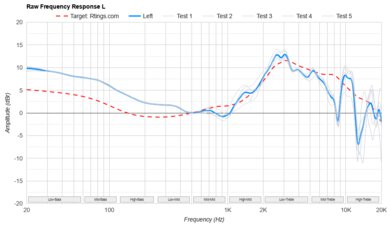
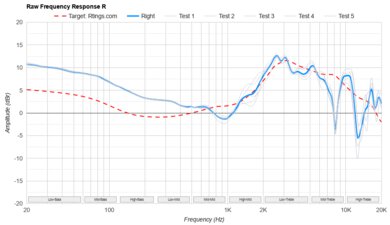
The Apple AirPods 4 ANC have decent audio reproduction accuracy. They generally follow their own warm sound profile well, with few peaks and dips. The left and right drivers are also amazingly well-matched, so objects are accurately placed in the stereo field. Despite their open-back design, they have good bass extension and flat mids, though a large dip in the treble dulls sibilants and the upper harmonics of higher-pitched vocals. There's some scope for adjustment via the 'Accessibility' tab of your iOS device, but nothing resembling a graphic EQ.
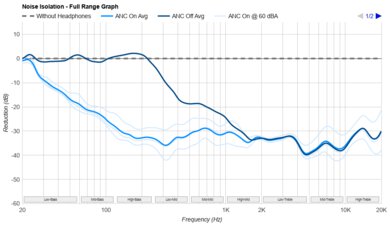
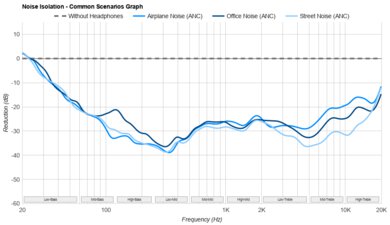
The Apple AirPods 4 with Active Noise Cancellation have a fair noise isolation performance. That said, it's still a tier above the performance we expect from open-back designs, which is a testament to the strength of their ANC. This design offers very little passive attenuation against low- and mid-range frequencies, which is where the ANC is able to offer some improvements. The Apple AirPods 4 with Active Noise Cancellation do a good job of attenuating noise in common scenarios. They filter out much of the low roar of airplane engines and the rumble of passing buses. While they fare worse when it comes to office noises, like scraping chairs and chatting co-workers, they still noticeably tamp down on these frequencies. For a more powerful ANC performance, see the Apple AirPods Pro 3, which provide better noise isolation and ANC.
The Apple AirPods 4 with Active Noise Cancellation have an alright microphone. The mic's recording quality ensures your voice is understandable, though it can sound a little boxy and thin. It also does a good job of blocking out low-level background noise, like the din of a bustling coffee shop. It fares less well with sudden, loud sounds though, so the screeching of a train's brakes can be quite unpleasant for someone on the other of the line.
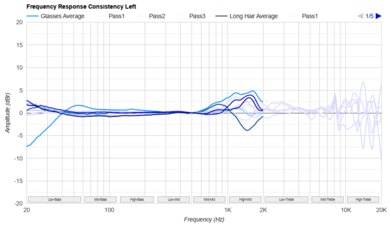
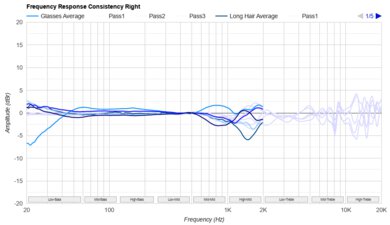
The Apple AirPods 4 with Active Noise Cancellation have great frequency response consistency. Their sound hardly changes across wears and wearers. Once you get a good fit, you can expect consistent audio with every listen.
Performance Usages
Changelog
-
Updated Nov 27, 2025:
This review has been updated to Test Bench 2.0, which adds the following tests: Stereo Mismatch, Group Delay, Cumulative Spectral Decay, PRTF, Harmonic Distortion, and Electrical Aspects. We've added new performance usages and updated the text throughout the Sound tests and side-by-sides.
- Updated Nov 25, 2025: We've converted this review to Test Bench 2.0, which updates our sound tests and adds performance usages. You can read more about this in our changelog.
-
Updated Oct 14, 2025:
This review has been updated to mention the Apple AirPods Pro 3 in the Popular Headphones Comparisons and Noise Isolation - Common Scenarios boxes.
-
Updated Aug 26, 2025:
The Build Quality box was updated with a link on how to clean your AirPods.
Check Price
Differences Between Sizes And Variants
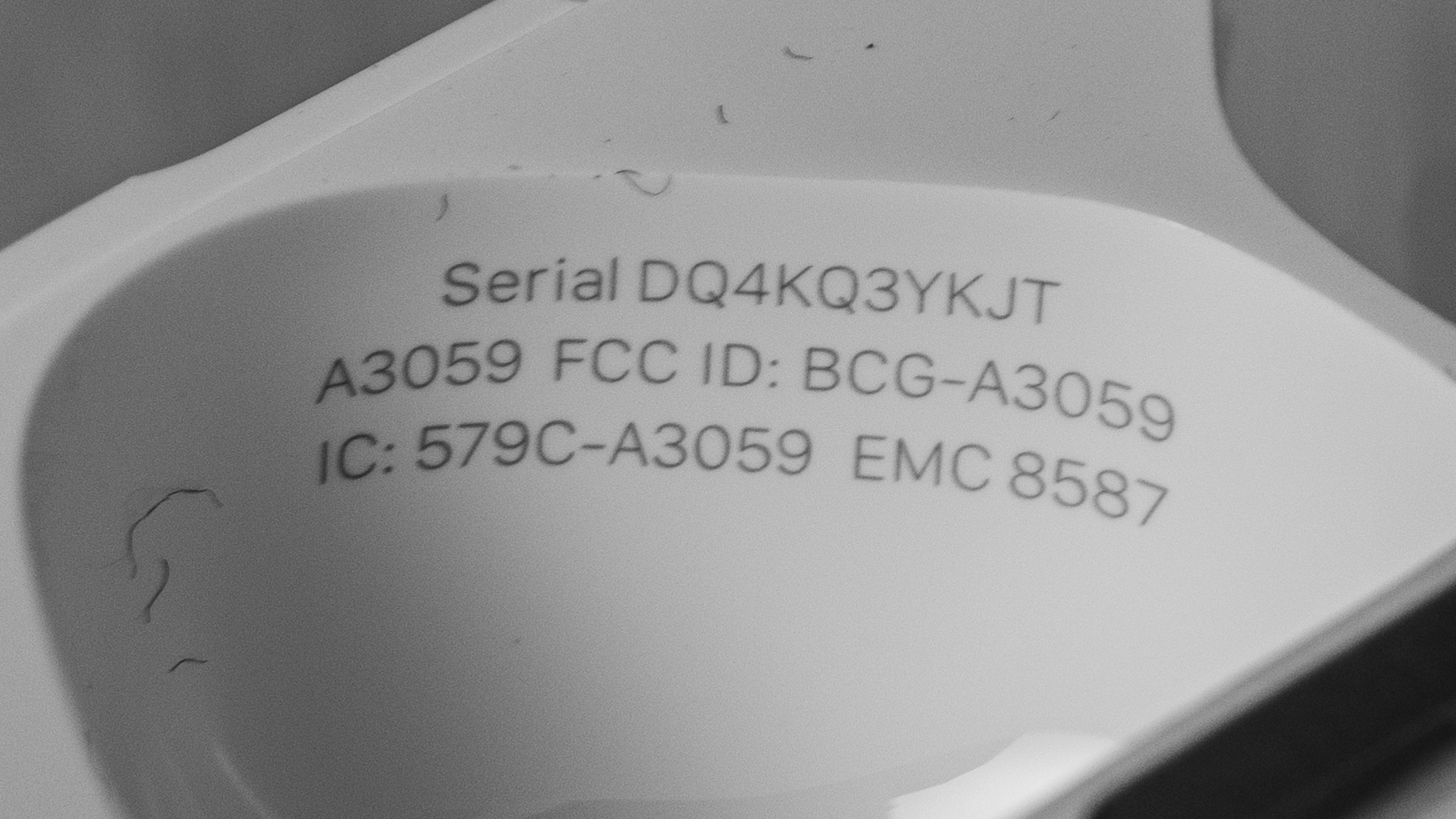
The Apple AirPods 4 ANC come in one color variant: 'White.' See a picture of their label. There's also a variant that doesn't feature ANC: the Apple AirPods 4.
If you encounter a different variant, please let us know in the comments, and we'll update our review.
Popular Headphones Comparisons
The Apple AirPods 4 ANC are a fairly unique product within the current earbud market. While there's a range of open-back earbuds on the market that cater to users who dislike in-ear fits, like the Bose Ultra Open Earbuds or even the Apple AirPods (3rd Generation), very few feature ANC systems that are capable of tamping down on external noise. Consequently, the AirPods 4 ANC are more versatile than any of their open-back competitors. If you need a better isolation performance than what these are able to provide, you'll need to look to in-ear options, like the Apple AirPods Pro 3, the Apple AirPods Pro 2, or the Sony WF-1000XM5 Truly Wireless. Users who don't own an iOS device will want to look elsewhere, too, given that a large portion of the AirPods' features are only available via iOS.
If you're assessing your options, check out our recommendations for the best wireless Bluetooth earbuds, the best wireless earbuds for iPhone, and the best AirPods alternatives.
The Apple AirPods 4 with Active Noise Cancellation are more flexible in more situations than the Apple AirPods 4. They're the same generation of earbuds; besides noise cancelling tech, there are slight differences, such as the AirPods 4 with ANC having a speaker on the case for the Find My Network, and the case can charge wirelessly. You get more listening modes, such as Conversation Awareness and Adaptive Audio, too. On the other hand, the standard AirPods 4 lack these features but otherwise perform similarly regarding sound, connectivity, and iOS integration. For most people, it'll come down to whether ANC is desirable or not.
Although they share many features in the iOS suite, such as Spatial Audio and Live Translation, the Apple AirPods Pro 3 are better earbuds for most people than the Apple AirPods 4 with Active Noise Cancellation. The swappable ear tips for the AirPods Pro 3 ensure a more reliable and stable fit and class-leading isolation. Their continuous battery life is twice as long, too. Still, for the less invasive fit, you might prefer the AirPods 4 with Active Noise Cancellation for the combination of an unsealed fit promoting natural awareness and decent noise filtering. Their mic system sounds a bit better with non-Apple devices offering a more consistent performance, while the AirPods Pro 3 sound better with iOS specifically. However, the AirPods 4 with Active Noise Cancellation's short continuous 4.5-hour battery life is a real detriment for many people's habits.
The Apple AirPods Pro 2 and the Apple AirPods 4 with Active Noise Cancellation have similar feature sets and comparable performance, considering they're very different designs. The AirPods Pro 2 have an in-ear fit, which uses silicone ear tips to secure a seal, while the AirPods 4 ANC have a one-size-fits-all, open-back design that sits in your ear canal without sealing it. You might find either one more comfortable, depending on your preferences. The in-ear fit results in the AirPods Pro 2 having better bass reproduction and a better noise isolation performance due to their tight seal. That said, the AirPods 4 ANC aren't that far behind in both categories, which is quite the feat considering their open design. Otherwise, the AirPods Pro 2 have a slightly longer battery life and support Apple's new hearing aid technology with firmware update 7B19. The AirPods 4 ANC have a better quality mic, though.
The Apple AirPods 4 with Active Noise Cancellation are the newer generation of the Apple AirPods (3rd generation), and they feature improvements across the board. Both buds have a similar, one-size-fits-all, open-back design and a decent build quality, but the AirPods 4 ANC form a more stable fit. The newer version also has a better bass extension and delivers audio more consistently, which is quite the feat for open-back buds. The biggest selling point of the AirPods 4 ANC is their ANC system, which does a solid job of isolating against common scenarios. That said, the 3rd generation have a longer continuous battery life and retail for a little less, so they're still an okay option if you're looking for budget buds and don't care about noise isolation.
Test Results
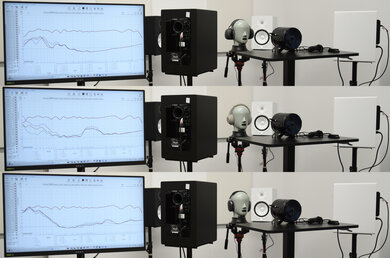
The Apple AirPods 4 with Active Noise Cancellation come with a few proprietary Apple audio features that make for a different listening experience when paired with an iPhone updated to iOS 18. For example, Apple's always-on Adaptive EQ feature means that iPhones apply a loudness contour that alters the sound based on output volume; this is designed to counteract how our brains perceive more bass and treble at higher volumes. This graph shows the difference in sound at three volume levels, normalized at 1kHz.
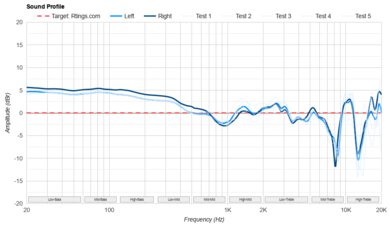
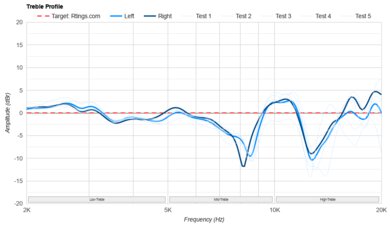
Because of that, we took our measurements using our standard measurement rig, so that Adaptive EQ isn't applied. These earbuds have a warm sound profile. They lack a little low-bass thump, but the rest of the bass and mid-range is flat. A big dip in the treble range can make your audio sound dull or smooth, depending on your tastes.
We also noted slight differences in the frequency response, with marginally more bass with ANC enabled. Similarly, there are slight increases in the bass and mid-range when using the Personalized Volume feature, which dynamically adjusts the output volume based on the volume of your surroundings.
These buds have an impressive frequency response consistency with little deviation in audio delivery between different listening sessions. After a bit of adjustment, you'll be able to enjoy consistent audio delivery with every wear.
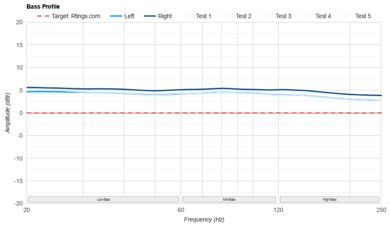
The Apple AirPods 4 with Active Noise Cancellation have great compliance with our target in the bass range. Since they don't form a seal with your inner ear, open-fitting earbuds tend to feature some roll-off in the bass range, but it's limited to just the very lowest part of the range in this case. While the low-bass range is slightly underemphasized, there's still plenty of low-end punch, courtesy of the balanced mid and high-bass response. As a result, kicks and basslines are well-defined, but sub-bass sounds, like 808s and dub-step wobbles, lack a little rumble and boom.
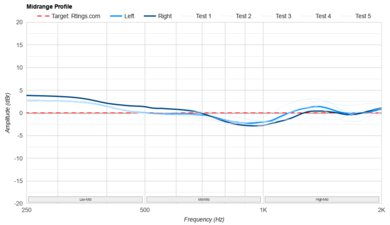
These earbuds do an incredible job of following our mid-range target. The response is balanced across the entire range, meaning vocals, strummed acoustic guitars, and piano melodies alike are all reproduced clearly and with plenty of detail.
The treble range's compliance with our target is poor. The whole range is very recessed, with a considerable dip in the response between the low and mid-treble. In songs like Joni Mitchell's Ladies of the Canyon, Joni's lead vocal line sounds veiled, even when she slips into the top of her range. The upper harmonics of her finger-picked guitars also sound dull and muted. That said, you may enjoy that warmer, smoother sound.
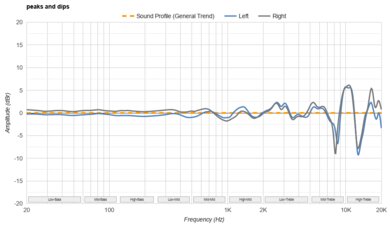
The peaks and dips performance is impressive, meaning these headphones generally adhere to their own warm sound profile. There are almost no deviations in the bass and mid-range, with the most notable peaks and dips occurring in the higher parts of the treble range, where our hearing is weakest and most dependent on our individual anatomy.
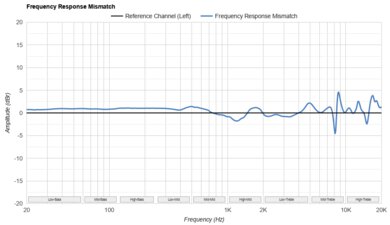
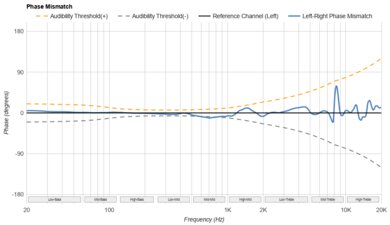
These headphones have amazingly well-matched left and right drivers. Amplitude and phase are closely aligned between the drivers across the whole spectrum, so objects are accurately placed in the stereo field.
There are no issues with group delay, as all group delay falls below the audibility threshold in the areas of the spectrum these headphones can reproduce.
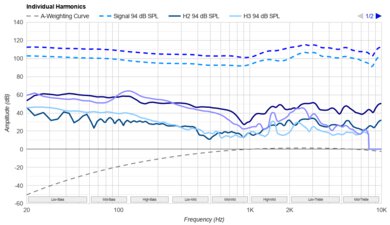
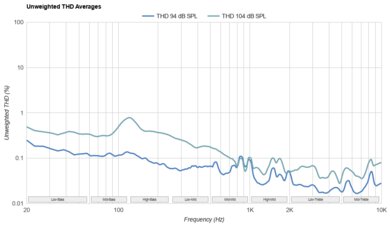
These headphones have remarkably low harmonic distortion, even when pushed to unsafe listening levels. You can expect clean and pure audio reproduction.
You can access the virtual soundstage features through the iOS interface. There are two types of spatial audio at your disposal: 'Fixed' and 'Head Tracked.' The 'Fixed' mode locks the position of the soundstage in one place so the orientation of the stereo field doesn't change when you move your head. 'Head Tracked' will follow the position of your head and shift the soundstage around relative to how your head is angled. There's also a Personalized Spatial Audio feature, which requires you to take a video of your head and both ears. An algorithm then adapts the sound profile and soundstage to your ear shape. Subjectively, we found little difference in the immersiveness of the soundstage from using this feature, but its adaptive nature might mean it improves with repeated use.
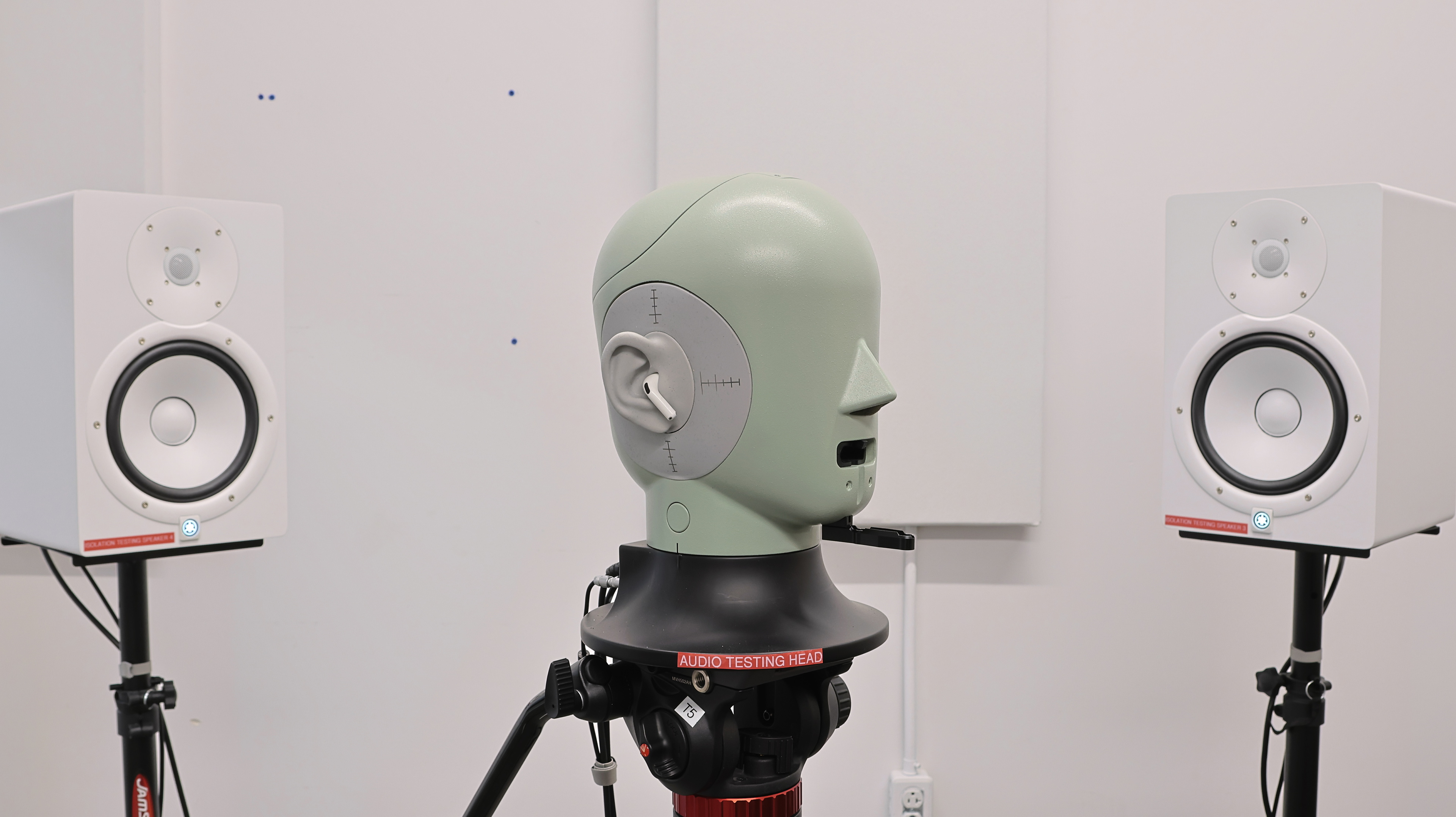
These are the settings we used to test the Apple AirPods 4 with Active Noise Cancellation. These headphones also have wide variety of additional sound modes. Our tests were carried out with Personalized Volume, Conversation Awareness, Automatic Ear Detection, and Personalized Spatial Audio all set to 'off.' As previously noted, all sound tests were carried out over an iPhone, with measurements recorded on Audio Precision.
The Apple AirPods 4 with ANC share more visual similarities with the previous generation Apple AirPods (3rd generation), due to their open design and shortened stems. This iteration forgoes silicone tips, like on the Apple AirPods Pro 2, in favor of a 'one-size-fits-all' approach to the design, which the manufacturer claims is based on studying many different ear shapes. As is the norm for Apple earbuds, they sport a distinctive all-white colorway, with no options for other colors.
These buds are decently comfortable, though this will depend on the shape of your ears. Users who dislike the deep, in-ear fit of buds like the Apple AirPods Pro 2 will appreciate their contoured shape, which rests inside your ear canal without providing a full seal. For some, this results in a snug and extremely comfortable fit, but there are also numerous reports online of the buds falling out while in use, which is also a potential downside to their very lightweight design.
The Apple AirPods 4 ANC have also inherited a control scheme that has much in common with the previous generation. These buds use the same 'Force Sensor' controls, which use an indented area on their surface that can be squeezed to input controls.
Unlike conventional earbud controls, which often employ physical buttons or tactile touch-sensitive surfaces, this input method is more forgiving of the accidental touches and brushes that can produce unwanted results. There are unique chimes depending on the feature engaged, which provide audible feedback and are accompanied by a light vibration. Even the case has controls. With the case open and the earbuds inside, two taps on the front of the case enters pairing mode. You can also double tap three times (which can be tricky to execute correctly) to reset the AirPods to their factory settings.
The control scheme is easy to grasp, too, with some additional explanation provided in the manual. You can even assign some gesture controls via iOS settings that allow you to answer or decline calls with a simple head nod. There's also an automatic ear detection feature that transfers call audio to your buds when you put them in your ears. The only notable oversights are related to volume, as there's no way to adjust the volume via the controls and no max/min volume chimes.
The Apple Airpods 4 with Active Noise Cancellation come with a very handy case. While its design will be familiar to existing AirPods users, its form factor is smaller than previous iterations. It's reassuringly solid, with no loose points in its plastic construction, and there are strong magnets inside to keep the buds fastened in place. There's even a small speaker inside that's used to convey charging status and pairing status, which emits a tone when using the 'Find My' app feature. Sadly, Apple removed MagSafe compatibility with this model, though there's still support for wireless charging to complement the standard USB-C charging. The case is rated IP54, meaning it's protected from dust damage and water splashes.
The build quality is great. Both the case and the buds are made of the same glossy, feather-light plastic that seems resistant to light drops and bumps. They're still susceptible to scratches, though. Both the case and the buds are rated IP54 for protection against water splashes and dust damage. To keep them in good shape for a longer lifespan, check out how to clean your AirPods.
The Apple AirPods 4 with ANC form a good fit, although this will depend somewhat on the exact shape of your ears and the fit you're able to achieve. With a solid fit, they'll stay in place during brisk strolls and moderate headbanging. They could even feasibly be used for running, though their lightweight design runs the risk of them falling out mid-stride.
The Apple AirPods 4 with Active Noise Cancellation have a fair noise isolation performance. That said, it's still a tier above the performance we expect from open-back designs, which is a testament to the strength of their ANC. This design offers very little passive attenuation against low- and mid-range frequencies, which is where the ANC is able to offer some improvements. As a result, their noise isolation falls short of the silicone tip-equipped Apple AirPods Pro 2, but it's still a cut above the Apple AirPods (3rd generation), which don't have an ANC system. We measured some differences in the noise isolation performance with firmware update 7B19, which increased attenuation across the bass and mid-range. However, Apple doesn't usually detail if firmware updates will result in performance-related changes.
This model also features a few different ANC modes that can affect the noise isolation performance. There's Transparency mode, which filters in external noise via the built-in mics. While not as natural-sounding as the second-generation AirPods Pro, it does a good job of keeping you aware of your surroundings. Adaptive Audio will selectively allow more external noise through depending on three pre-selected noise profiles: 'Default,' 'More Noise,' and 'Less Noise.' It helps maintain a consistent balance between ANC and Transparency even if the noise in your environment changes. We were able to measure the performance of these different modes to see how this affected noise isolation.
Finally, there's a Conversational Awareness function that detects when you speak, filtering in a certain amount of external audio to allow you to converse.
The Apple AirPods 4 with Active Noise Cancellation do a good job of attenuating against noise in common scenarios. They filter out much of the low roar of airplane engines and the rumble of passing buses. While they fare worse when it comes to office noises, like scraping chairs and chatting co-workers, they still noticeably tamp down on these frequencies. For a more powerful ANC performance, see the Apple AirPods Pro 3, which provide better noise isolation and ANC.
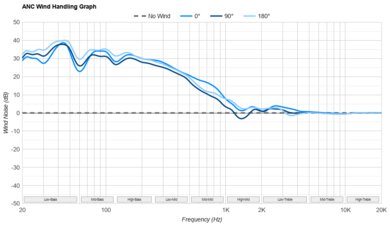
Wind noise interacts with their ANC mics differently compared to other common noises. Even though the sound doesn't reach your ears, the mics attempt to cancel it out. This can create loud, unwanted noise. These buds don't have a wind handling feature that can help mitigate this, so wind noise is very noticeable, though less so at 90-degree angles.
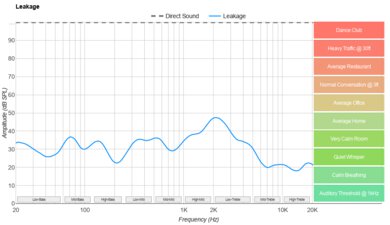
Despite their open-back design, the Apple AirPods 4 ANC don't leak too much audio. Even if you're blasting your favorite tunes in a quiet environment, it's unlikely that anyone around you will be able to hear your audio. Escaping audio is mostly located in the treble range, so it sounds thin and tinny.
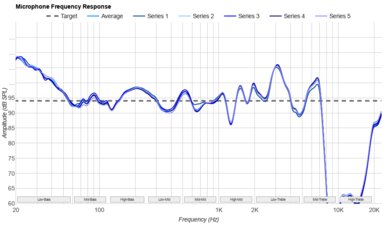
The mic's recording quality is okay. Within the iOS settings, you can adjust which of the left or right microphone gets used, or select 'Automatic,' which automatically chooses the better of the two. Using the 'Automatic' setting, we found that the mic reproduces your voice intelligibly. Recorded speech lacks body and can sound a little boxy, though, given the roll-off in the treble range.
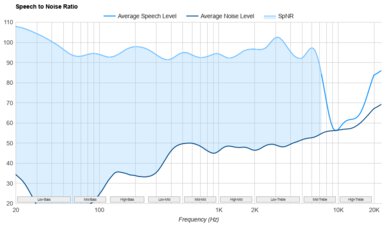
The Apple AirPods 4 with Active Noise Cancellation's built-in mic has an adequate noise-handling performance. It fares quite well in moderately busy environments, so if you're taking a call in a cafe, your voice will still have clarity and detail amidst background conversations. That said, louder sounds, like passing trains or buses, come through very clearly and will easily overpower the sound of your voice. This can make it very unpleasant for the person on the other end.
The battery performance is adequate, though it's a little shorter than previous AirPods models. The manufacturer advertises around four hours of listening time with ANC enabled, which is in line with our measurement of 4.5 hours. We were able to achieve a little over six hours with the ANC disabled.
There are four additional charges available via the case, and it only takes around 30 minutes for the AirPods to fully recharge. There's also a standby feature that turns the buds off after you remove them from your ears. Similar to the iPhone, there's also an optimized battery charging feature that detects the times you most often use your device and pauses charging at 80% until you're most likely to start using the device again.
There's no dedicated app for these earbuds, but you can access their interface via the iOS settings. You'll need iOS 18 installed to take advantage of all the available features, which you can see in this video overview. You can enable audio-related settings, like Personalized Volume, Personalized Spatial Audio, and Automatic Ear Detection. You can also adjust ANC-related features like Adaptive Audio, Conversational Awareness, and Noise Control. You can find more details on these in the Noise Isolation - Full Range box. While there's some scope for sculpting the sound via the the 'Accessibility' tab of your iOS device, you're limited to some basic presets with few parameters for further tuning. You can also enable head gesture control and other call controls and find misplaced buds via the 'Find My Network' feature.
You can't use the Apple AirPods 4 with ANC wired. While you use a USB-C cable to charge the case, there isn't one provided.
The Apple AirPods 4 with Active Noise Cancellation have decent Bluetooth connectivity. Their multi-device connectivity is limited to iOS, meaning Android users won't be able to connect to more than one device at a time. Thanks to their H2 chip, switching works seamlessly between Apple devices registered to the same iCloud account. So if you're playing music on your laptop but start a podcast on your phone, audio playing from your AirPods will switch from one device to another. This plays well with their automatic ear detection system, which transfers audio from other Apple Ecosystem devices when you put them in your ears.
Latency with the SBC codec is high, which isn't ideal if you plan on watching videos on your PC. We noticed a few other differences in Bluetooth connectivity between iOS devices and other operating systems though. While we don't measure latency via AAC, we didn't notice any obvious latency while watching videos on an iPhone. Similarly, the wireless line of sight range increased when using an iPhone instead of our Android testing phone.
These headphones are audio and mic compatible with Bluetooth-enabled PCs. However, they can't connect any other way.
The Apple AirPods 4 with ANC come with a small charging case that holds around four additional charges. It charges via USB-C. The case also supports wireless charging, but support for MagSafe charging has been withdrawn for this model.