Bowers & Wilkins Px7 S3  Headphones Review

Reviewed Jan 20, 2026 at 03:19pm
Retest Feb 04, 2026 at 03:42pm
Tested using Methodology v2.0 
Bowers & Wilkins Px7 S3
7.3
Sports And Fitness 
7.5
Travel 
7.4
Office Work 
5.9
Wireless Gaming (In Development) 
6.9
Wired Gaming (In Development) 
6.9
Audio Reproduction Accuracy 
8.0
Noise Isolation 
7.0
Microphone (In Development) 
 15

The Bowers & Wilkins Px7 S3 is an iterative update to the Bowers & Wilkins Px7 S2 Wireless (and the Bowers & Wilkins Px7 S2e, which were released in between). These over-ears promise 30 hours of battery life and competitive active noise cancelling in a sleek and stylish package, complete with aptX Lossless support for high-quality streaming. Let's see if they've earned their premium status.

Our Verdict

7.3
Sports And Fitness 

The Bowers & Wilkins Px7 S3 are satisfactory for sports and fitness, but it depends on the types of activities you do. They're stable-fitting, for over-ears, but high-intensity workouts will cause them to slide around or even fall off. Similarly, they lack any IP rating or sweat-resistance, limiting the sorts of workouts they can suit. With that said, they can easily join you for a speed walk or upright movements, but they're not very portable compared to sports-oriented earbuds, and obviously less breathable.

Pros
  • Comfortable fit.

Cons
  • No sweat-resistance.

7.5
Travel 

The Bowers & Wilkins Px7 S3 are good for travel. They're comfortable with premium faux leather and plenty of padding, even with glasses. They're fairly portable for over-ears and come with a sturdy case. Their 29-hour battery life easily lasts through multiple trips back-to-back. You can connect via Bluetooth (with two-device multi-pairing), and there's support for USB-C or analog connections, allowing you maximum flexibility with in-flight entertainment. Their ANC is overall very good, although not class-leading, and effectively muffles fellow passengers, even if rumbly engines don't get attenuated as much.

Pros
  • Comfortable fit.

  • 29-hour battery life.

  • Extensive connectivity.

Cons
  • Mic is decent, but can cut out your voice with very loud background noise.

  • Peaks and dips can be difficult to smooth, even with app's EQ.

7.4
Office Work 

The Bowers & Wilkins Px7 S3 are decent for office work. They feel comfortable to wear for extended periods, and their 29-hour battery life means you can do so for several shifts without a recharge. Their microphone is satisfactory for work meetings, and their Bluetooth, USB-C, and analog connectivity make swapping devices a breeze. Their noise isolation is very capable of shushing coworkers, even if it's not the most powerful. That said, they're rather bassy-sounding, which you might like, but if it's not your taste, their app lends you the flexibility of a five-band equalizer.

Pros
  • Comfortable fit.

  • 29-hour battery life.

Cons
  • Mic is decent, but can cut out your voice with very loud background noise.

  • Peaks and dips can be difficult to smooth, even with app's EQ.

5.9
Wireless Gaming (In Development) 

The Bowers & Wilkins Px7 S3 aren't designed for wireless gaming. They can only connect via Bluetooth, and even with their aptX Low Latency codec, most people will find the latency is too high for gaming and too limited.

6.9
Wired Gaming (In Development) 

The Bowers & Wilkins Px7 S3 are alright for wired gaming. You can use their USB-C to USB-C cable for full audio and mic support with PCs and PlayStation consoles. That said, the analog cable limits you to audio-only reception. The mic performance is decent, too, and they offer ANC, which is still unusual in gaming headsets to help block out your surroundings. Their bass-heavy sound can add immersiveness to action-packed games, but won't give metallic sword clashes their due. Stereo matching is okay for a fairly stable image. All in all, these lack game-specific features found on dedicated headsets, though they can do the trick for casual gamers.

Pros
  • Comfortable fit.

  • Extensive connectivity.

Cons
  • Mic is decent, but can cut out your voice with very loud background noise.

  • Peaks and dips can be difficult to smooth, even with app's EQ.

6.9
Audio Reproduction Accuracy 

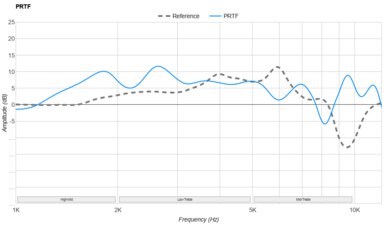
The Bowers & Wilkins Px7 S3 are alright for audio reproduction accuracy. Their sound profile is tuned to deliver a bass-heavy signature with a balanced mid-range and a darker treble, relative to our target curve. While the bass and mids yield few peaks and dips, the treble has several narrow and prominent peaks that can cause some frequencies to jump out in the highs. Their stereo matching is acceptable, but not the tightest, and the same applies to group delay; however, we didn't notice any issues with real-world content. Their PRTF results suggest these don't interact with your outer ear as a reference monitor does.

8.0
Noise Isolation 

The Bowers & Wilkins Px7 S3 have excellent noise isolation performance. Although they're not class-leading in ANC, they perform very well in common noisy scenarios and don't create much noise in windy conditions. However, their passive isolation isn't particularly noteworthy when dealing with trebly sounds.

7.0
Microphone (In Development) 

The Bowers & Wilkins Px7 S3 have a decent microphone. Your voice sounds natural, if a little bright. Their noise rejection is similarly decent, capable of prioritizing your speech, but it doesn't completely eliminate background sounds, and extremely loud sounds, such as trains, will still drown out your voice.

6.0
Frequency Response Consistency 

The Bowers & Wilkins Px7 S3 have fair frequency response consistency. While their earpads provide a comfortable over-ear fit, their shape can compromise the over-ear seal, especially if you have long hair or wear glasses, resulting in an altered mid-range and bass delivery. As a result, you'll want to take your time to ensure a consistent fit for a predictable sound between wears.

  • 7.3
    Sports And Fitness
  • 7.5
    Travel
  • 7.4
    Office Work
  • 5.9
    Wireless Gaming (In Development)
  • 6.9
    Wired Gaming (In Development)

  • Performance Usages

  • 6.9
    Audio Reproduction Accuracy
  • 8.0
    Noise Isolation
  • 7.0
    Microphone (In Development)
  • 6.0
    Frequency Response Consistency
  • Changelog

    1.  Updated Feb 04, 2026: 

      We've updated the Sound Profile box with supplementary measurements of the headphones with different connection types and ANC settings.

    2.  Updated Jan 20, 2026: Review published.
    3.  Updated Jan 13, 2026: Early access published.
    4.  Updated Jan 05, 2026: Our testers have started testing this product.

    Check Price

    Anthracite Black
    SEE PRICE
    Amazon.com
    Canvas White
    SEE PRICE
    Amazon.com
    Indigo Blue
    SEE PRICE
    Amazon.com

    Differences Between Sizes And Variants

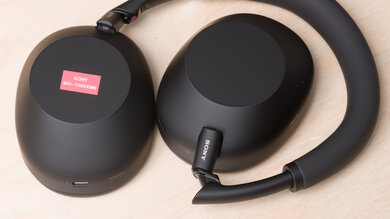
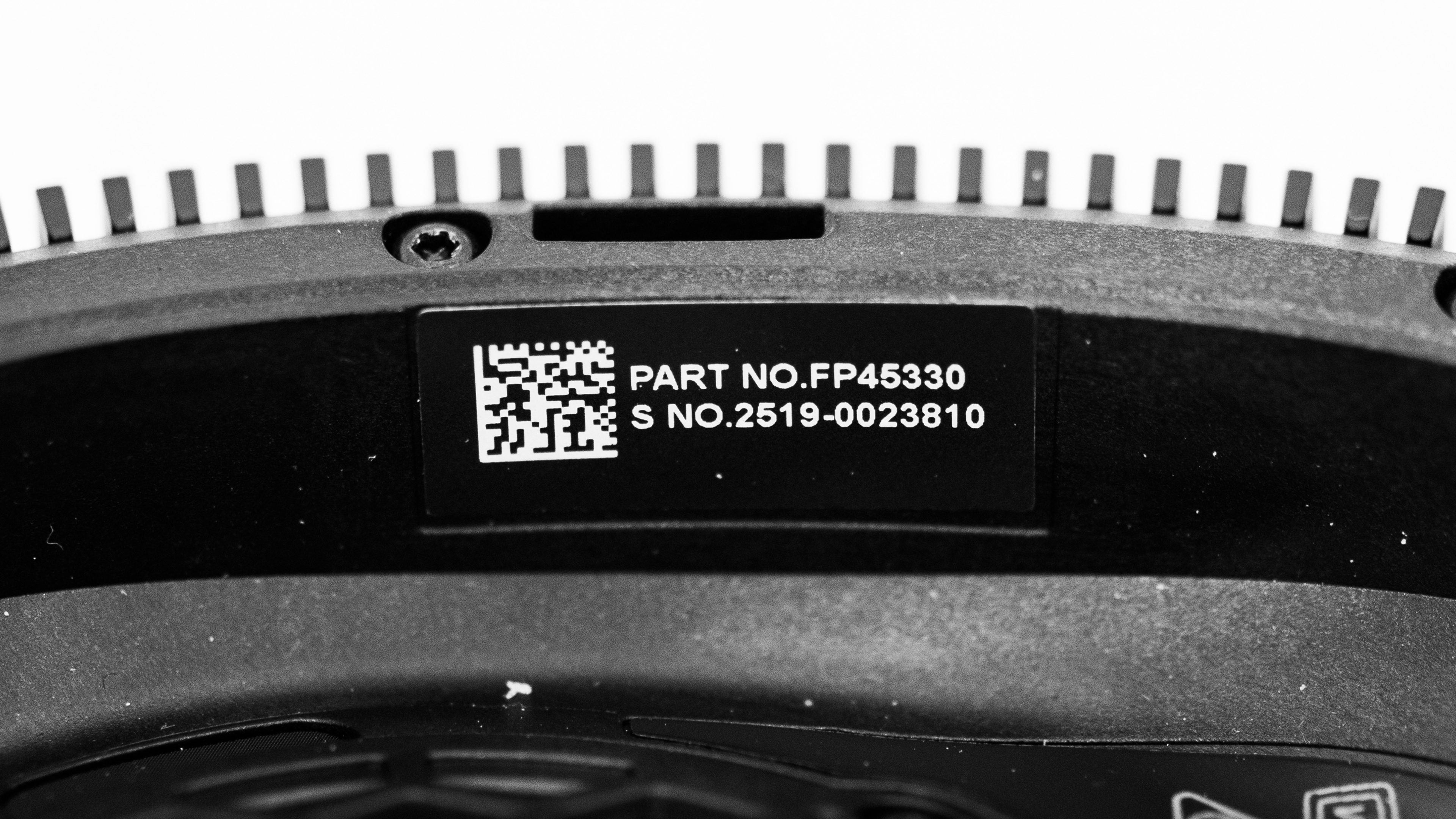
    The Bowers & Wilkins Px7 S3 come in 'Anthracite Black,' 'Canvas White,' 'Indigo Blue,' and 'Frost Blue.' Here's the label for our 'Anthracite Black' unit. We expect all of these colorways to perform similarly.

    If you encounter a variant or additional colorways, please let us know in the comments, and we'll update the review.

    Popular Headphones Comparisons

    The Bowers & Wilkins Px7 S3 are premium over-ears with ANC, much like the earlier Bowers & Wilkins Px7 S2 Wireless, which are arguably their greatest competition, given that not a whole lot has changed. You get a five-band EQ and improved ANC on the S3, with most other changes coming from refinements to the design and drivers. Meanwhile, the Bowers & Wilkins Px8 Wireless are getting a little older and are worth a look for the right price, but similarly, with the actual differences mostly coming down to materials and slight tuning preferences. Besides that, Sony and Bose blow the Px7 S3 out of the water when it comes to overall ANC performance with the Sony WH-1000XM6 and the Bose QuietComfort Ultra Headphones. Still, for fans of the Px7 S3's bass-heavy sound and the aptX suite, they're comfortable and well-made over-ears.

    For more ideas, check out the best wireless headphones, the best USB-C headphones, and the best bass headphones.

    Bowers & Wilkins Px8 Wireless

    Whether you should choose the Bowers & Wilkins Px8 Wireless or the Bowers & Wilkins Px7 S3, both are premium-tier headphones with solid noise isolation performance, even if neither lead the pack. The Px8 are a bit higher-end with Nappa leather padding and a slightly more even response with better stereo matching. However, they're bulkier, which isn't as handy for travel purposes. Meanwhile, the Px7 S3 are slimmer, but their frequency response consistency isn't as tight and can yield a different sound between wears. Still, their ANC is solid, and they feature a five-band EQ.

    Sony WH-1000XM6

    Depending on your priorities, you may choose either the Sony WH-1000XM6 or Bowers & Wilkins Px7 S3. The Sony have much better noise isolation performance, so if silence is your priority, they win out. They also fold down and are a bit lighter. Their app has more features, too. They use LDAC and LE Audio for high-quality streaming, while the Bowers & Wilkins include the aptX codec suite, which includes both aptX Lossless and aptX Low Latency, but compatibility is a bit more limited. They're comfortable to wear, even with glasses, but both headphones have variations in how they sound depending on the fit.

    Bose QuietComfort Ultra Headphones Wireless

    The Bose QuietComfort Ultra Headphones Wireless and Bowers & Wilkins Px7 S3 are high-end headphones. The Bose feel more comfortable and lightweight for most people with much better noise isolation performance. Their sound profile is more excited in the treble by default. The Bowers & Wilkins are comfortable too, even with glasses, but their noise isolation isn't as impressive. Still, their mic is a bit better, and depending on your tastes, the bass-heavy tuning may appeal to you.
    Focal Bathys Wireless

    The Focal Bathys Wireless are better headphones for most people than the Bowers & Wilkins Px7 S3, but they're also in a higher price bracket. Their sound is more balanced with tighter stereo matching. Still, the Bowers & Wilkins weigh less and are a bit slimmer, making them easier to carry, and their bass-heavy tuning may suit your tastes.

    Test Results

    perceptual testing image
    Sort:
    RATINGS
    Category:
    All
    Sound
    Sound Profile
    Normalization Frequency
    500 Hz
    Bass Amount
    Very Emphasized (7 dB)
    Treble Amount
    Slightly Underemphasized (-3 dB)
    Sound Signature
    Boosted Bass

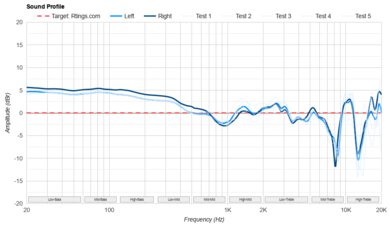
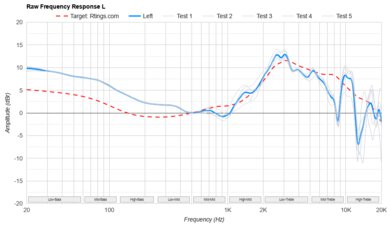
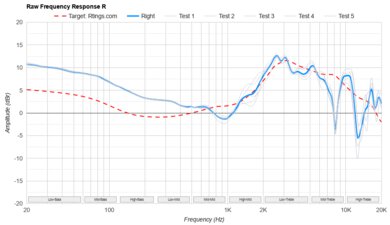
    The Bowers & Wilkins Px7 S3 are bassy headphones. A sizable boost to the low end lends extra thump, punch, and boom to your audio, but it doesn't follow our target (or any of the other targets we use). That said, the mid-range is balanced, matching our curve well. In addition to the weighty bass, the treble is de-emphasized, resulting in a bassy sound with a dark treble that's relatively veiled, but with splashes of detailed emphasis due to a few peaks and dips. While still not aligning with our target, the treble is closer to the warmer frequency response targets by SenseLab Aizu and the SoundGuys.com Headphone Preference Curve.

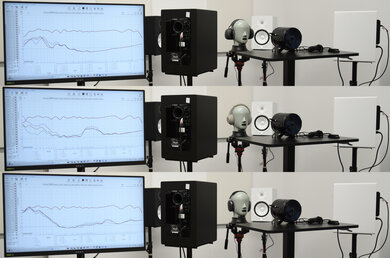
    The headphones' frequency response remains unchanged regardless of their ANC setting. Over various connections, there's some variation in frequency response: analog (active) and USB-C are closer to each other than either is to Bluetooth.

    6.0
    Frequency Response Consistency
    Std. Deviation
    1.28 dB

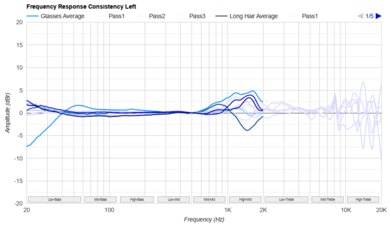
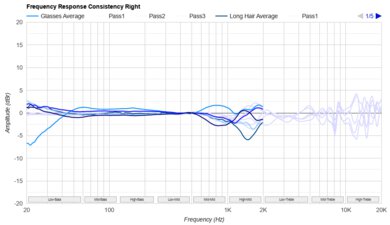
    The frequency response consistency is unremarkable. The smaller ear cups make it difficult to achieve a consistent fit between each session. The mid-range can vary, particularly if you wear glasses. That said, the bass doesn't roll off too drastically if you've got glasses or long hair, which are the usual frequencies affected by these attributes. You'll want to take your time when fitting these over-ears on to ensure a predictable sound.

    Raw Frequency Response
    6.7
    Bass Profile: Target Compliance
    RMS Deviation From Target
    7.3 dB
    Low-Frequency Extension
    20 Hz
    Low Bass
    6.16 dB
    Mid Bass
    9.36 dB
    High Bass
    6.13 dB

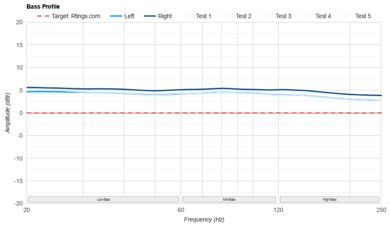
    The Bowers & Wilkins Px7 S3 have okay bass target compliance. The entire range is exaggerated compared to our target curve, leading to extra doses of thump and boom. The tuning lends tracks like the cover of This Town Ain't Big Enough For The Both Of Us by The Last Dinner Party extra boom and warmth on the bass. If you crave low-end emphasis, these may be the ticket, and this bass tuning is very similar to the previous Bowers & Wilkins Px7 S2 Wireless. That said, an inflated bass range affects the clarity of the rest of the frequency spectrum.

    9.1
    Mid-Range Profile: Target Compliance
    RMS Deviation From Target
    1.36 dB
    Low Mid
    1.54 dB
    Mid-Mid
    0.64 dB
    High Mid
    -0.56 dB

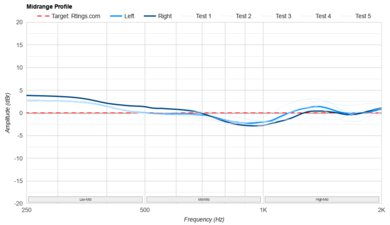
    The mid-range's target compliance is remarkable. The low-mid bump is a continuation of the heavy bass boost, but it tapers off to match our curve tightly. Melodic parts, such as guitars, playback with clarity and balance in songs like Heroes by David Bowie, though the bass can overwhelm this range somewhat, depending on the song.

    6.5
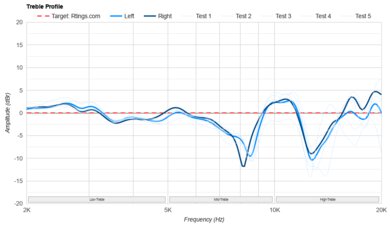
    Treble Profile: Target Compliance
    RMS Deviation From Target
    4.74 dB
    Low Treble
    -4.16 dB
    Mid Treble
    -0.32 dB
    High Treble
    -3.65 dB

    The headphones have an alright treble response target compliance. It's mostly underemphasized compared to our curve, except for peaks in the mid-treble. The low-treble is a bit veiled and warm, while the peak can sound piercing. The top-end is otherwise relatively open-sounding.

    6.6
    Peaks/Dips
    Peaks
    2.02 dB
    Dips
    2.77 dB

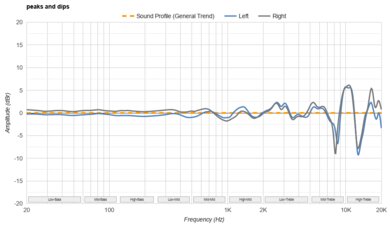
    The Bowers & Wilkins Px7 S3's peaks and dips are okay. There's a slight mismatch in the lower ranges, but it's relatively flat in the bass and mids, which is smooth-sounding overall. That said, the treble has several dramatic peaks and valleys that alternately sound overly bright and harsh, or veiled and dark, depending on the pitch, which can cause some frequencies to jump out in the mix compared to others.

    6.6
    Stereo Mismatch
    Weighted Amplitude Mismatch
    0.76 dB
    Weighted Frequency Response Mismatch
    1.47 dB
    Weighted Phase Mismatch
    1.8°

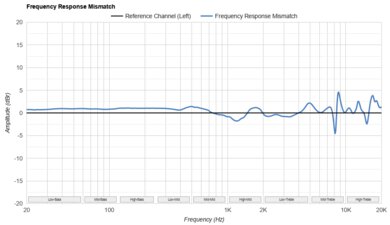
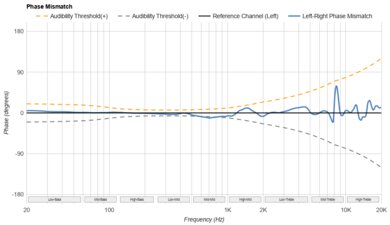
    The Bowers & Wilkins Px7 S3 have alright stereo mismatch performance. The weighted amplitude is decent, as is the weighted frequency response mismatch, which help influence the stereo image's stability and balance. Their weighted phase measurement shows some mismatch, but we didn't notice any effect in real-world listening. However, your results may vary from our unit's.

    0.0
    Group Delay
    Weighted Group Delay
    N/A
    Cumulative Spectral Decay
    4.5
    PRTF
    PRTF Accuracy (RMS Deviation)
    6.1 dB
    PRTF Size (Avg.)
    5.81 dB
    PRTF Distance
    5.76 dB

    The PRTF results of these closed-backs indicate that these don't interact with your outer ear the same way that a reference speaker does.

    9.6
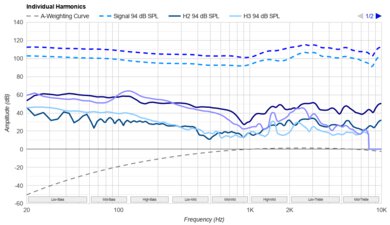
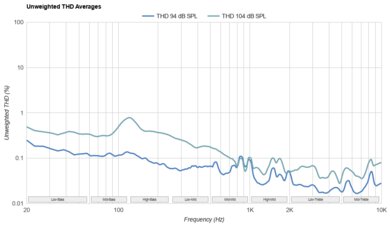
    Harmonic Distortion
    WHD @ 94 dB SPL
    0.03%
    WHD @ 104 dB SPL
    0.08%

    The bio-cellulose drivers have remarkably low harmonic distortion, regardless of whether you push each frequency to 94dB/SPL or 104dB/SPL. As a result, your audio remains uncolored by artifacts in the signal chain.

    Electrical Aspects
    Sensitivity @1kHz-1V
    N/A
    Bluetooth Max SPL
    105.1 dB

    These are battery-powered headphones and don't require additional amplification.

    0.0
    Virtual Soundstage
    Head Modeling
    No
    Speaker Modeling
    No
    Room Ambience
    No
    Head Tracking
    No
    Virtual Surround
    No
    Test Settings
    Firmware
    1.2.0
    Power
    On
    Connection
    Bluetooth
    Codec
    aptX HD, 24-bit, 48kHz
    Test InstrumentAudio Precision APx517B
    EQ
    No EQ
    ANC
    On
    Tip/Pad
    Default
    Microphone
    Integrated

    These are the settings used to test these headphones. Our results are only valid when used in this configuration.

    Design
    Style
    TypeOver-ear
    EnclosureClosed-Back
    WirelessYes
    TransducerDynamic

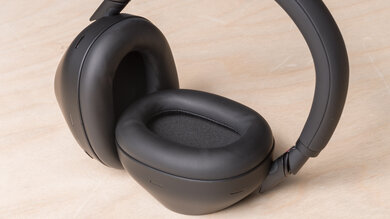
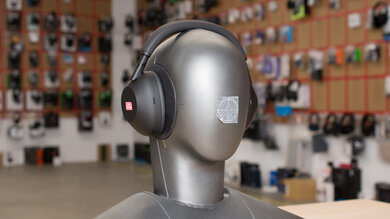
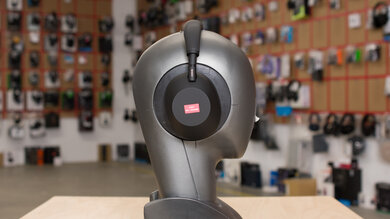
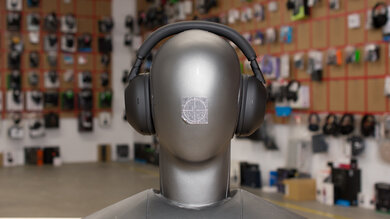
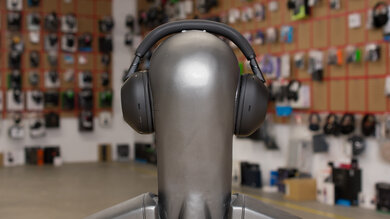
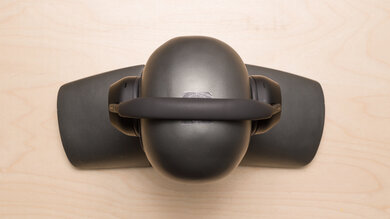
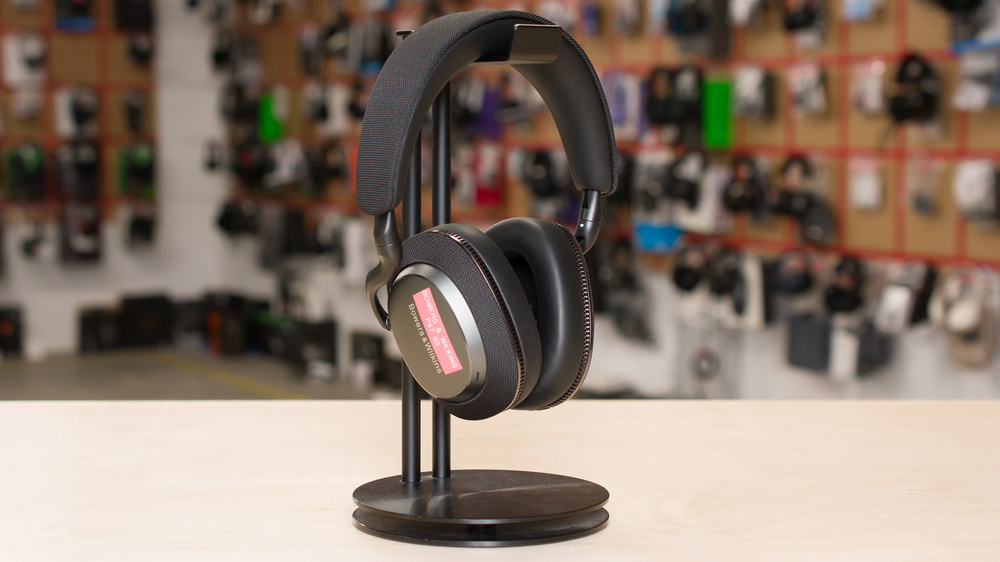
    The Bowers & Wilkins Px7 S3 are an evolution of the previous Bowers & Wilkins Px7 S2 Wireless (and the generation in between, the slightly tweaked Bowers & Wilkins Px7 S2e) with a slimmed-down profile. The over-ears come in several tonal colorways ('Anthracite Black,' 'Canvas White,' 'Indigo Blue,' and 'Frost Blue) with the branding on the outer face of the ear cups. They use a mixture of different textured elements to give them a premium look, such as satin-finish, fabric along the headband, and metallic accents.

    7.5
    Comfort
    Weight0.66 lbs
    Clamping Force
    1 lbs

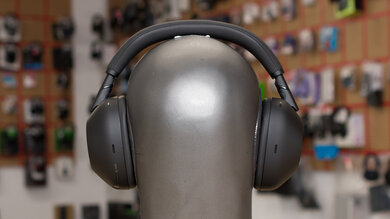
    The Bowers & Wilkins Px7 S3 are comfortable. They're a little lighter than the Bowers & Wilkins Px7 S2 Wireless, but importantly, they don't sit as far forward on your head, offering a comfortable placement across your crown with a fully padded headband. Their faux-leather earpads are soft, with a nice amount of give that doesn't collapse completely, so they don't put too much pressure on your ears, even if you wear glasses. There's enough depth to fit most people's ears without bumping into the drivers. But the space available to fit the headphones over your ears can feel cramped, especially if you have larger ears, and poses a challenge when trying to ensure a good over-ear seal that doesn't press the headphones against your helix or pinna.

    8.1
    Controls
    OS Compatibility
    Not OS specific
    Ease Of UseGood
    FeedbackGood
    Call/Music ControlYes
    Volume ControlYes
    Microphone ControlMute/Unmute
    Channel Mixing
    No
    Noise Cancelling ControlOn/Off
    Talk-Through
    On/Off
    Additional ControlsBluetooth Sync

    The controls for the headphones are great. They use clicky buttons (and one slider) with intuitive placements and textural differences, so you can tell which is which by feel. As you can see, the control scheme is comprehensive, but not overly complicated. Each setting (ANC/Transparency/normal listening mode) has a distinctive chime instantly differentiating the mode. There's no chime for volume changes, but the steps are more granular between volume increments than your phone, which is nice for dialing in exactly the level you want, and the headphones chime when you hit the minimum and maximum volume. The headphones also have on-ear detection and will automatically pause or play your audio, which you can disable in the app.

    6.2
    Portability
    L8.3" (21.0 cm)
    W6.4" (16.3 cm)
    H1.6" (3.9 cm)
    Volume82.06 in³ (1,344.70 cm³)
    Transmitter RequiredNo

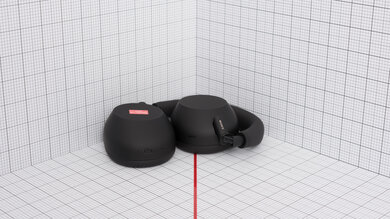
    As over-ear headphones go, these have alright portability. They don't have folding hinges like the Sony WH-1000XM6, but you can fold them flat and carry them around your neck or use their zip case to pack them in a backpack. They're also a little bit slimmer than the Bowers & Wilkins Px7 S2 Wireless.

    8.0
    Case
    TypeHard case
    L9.1" (23.1 cm)
    W6.9" (17.6 cm)
    H2.2" (5.5 cm)
    Volume136.44 in³ (2,235.88 cm³)

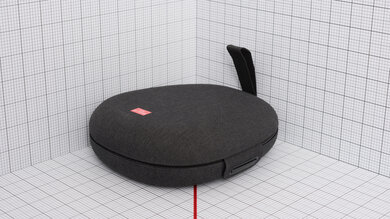
    Their carrying case is great. It zips closed and offers a snug, protective fit for the headphones, featuring a soft felt interior that won't scratch the finish. However, the felt may collect dust if the case is left open for weeks. There's a sizable compartment to keep the cables organized, complete with a sturdy magnetic flap. The zipper is liable to get caught on the case's fabric sometimes, but it's not difficult to fix the snag in a second.

    8.5
    Build Quality

    These have excellent build quality. The materials feel premium, and there aren't any obvious flaws or unsightly seams. The headband is amply padded, more so than the Bowers & Wilkins Px8 Wireless. However, it's worth noting that the design hasn't changed significantly between generations, and there are user reports of other models in this line suffering from the high-quality faux leather separating from the band; while this hasn't occurred during our review period, it's totally possible. The yokes feel sturdy with well-built hinges that don't creak or feel overly loose. You can swap out the earpads, effectively extending the headphones' lifespan. Their ear cups are well-made, but the shape may not be universally ergonomic for individuals with large ears. The accompanying cables also exhibit no flaws. Like most over-ears, these don't have an IP rating for water and dust exposure.

    7.5
    Stability

    These are stable over-ears. Between their relatively high clamping force and the grippiness of the faux leather padding, they'll stay on during moderate tilts and shakes, like a walk or moving about and bending down. They're not meant for exercising, though, so if you try high-intensity workouts, they're more likely to slide around or fall off.

    Headshots 1
    Headshots 2
    Top
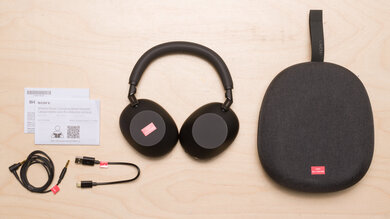
    In The Box

    • Bowers & Wilkins Px7 S3 headphones
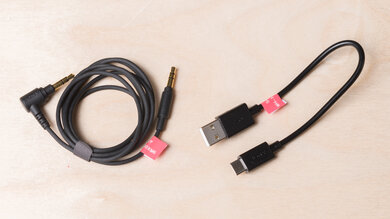
    • USB-C to 3.5 mm (1/8") audio cable (1.2 m/3.9 ft) with loop-and-hook cable wrap
    • USB-C to USB-C charging/audio cable (1.2 m/3.9 ft) with loop-and-hook cable wrap
    • Carrying case
    • Quick Start Guide
    Isolation
    8.2
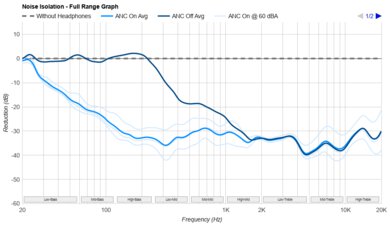
    Noise Isolation - Full Range
    Noise CancellingYes
    Overall Attenuation
    -21.41 dB
    Bass
    -13.54 dB
    Mid
    -22.82 dB
    Treble
    -29.40 dB

    The full range noise isolation performance of the Bowers & Wilkins Px7 S3 is great. Their ANC is most effective against mid-range and high-bass sounds. They filter out a little more bass noise than the previous Bowers & Wilkins Px7 S2 Wireless, but the updated physical design seems to affect the passive isolating properties of the S3, and they block out less trebly noise than their predecessor.

    7.8
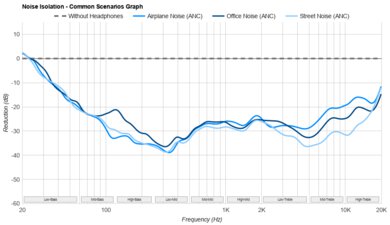
    Noise Isolation - Common Scenarios
    Airplane Noise Attenuation
    -18.20 dB
    Airplane Noise Isolation Audio
    Office Noise Attenuation
    -18.22 dB
    Office Noise Isolation Audio
    Street Noise Attenuation
    -20.32 dB
    Street Noise Isolation Audio

    The ANC's noise isolation performs very well in common scenarios. Street noises, like traffic and people chatting outside, are strongly attenuated. They also do a good job with office and airplane cabin sounds.

    Noise Isolation - Voice Handling
    Female Voice 1
    Male Voice 1
    Female Voice 2
    Male Voice 2
    ANC Wind Handling
    ANC Wind Noise

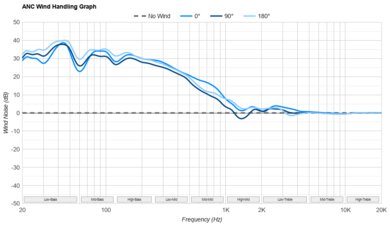
    One upgrade over the previous Bowers & Wilkins Px7 S2 Wireless is that these create less wind noise with their ANC system. That said, there's no dedicated wind noise reduction feature.

    7.6
    Leakage
    Leakage Audio
    Overall Leakage @ 1ft
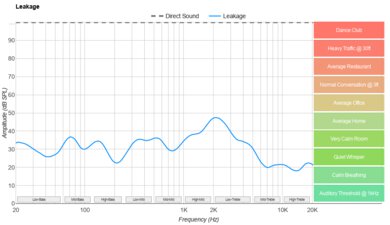
    36.28 dB

    Their leakage performance is good. What little escapes is a somewhat mid-range focused sound that you can only hear in very quiet settings. So, hop on a bus or peruse the library, and your audio will remain private. Still, it depends on how loud your volume level is set and your proximity to others.

    Microphone
    Microphone Style
    Integrated
    Yes
    In-Line
    No
    Boom
    No
    Detachable Boom
    No
    MicYes
    7.0
    Recording Quality
    Recorded Speech
    LFE
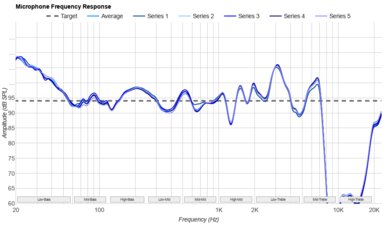
    132.62 Hz
    FR Std. Dev.
    3.32 dB
    HFE
    7,136.96 Hz
    Weighted THD
    N/A
    Gain
    -6.62 dB

    The microphone system sounds decent. It captures your voice clearly and sounds natural for the most part. You can sound a little bright, depending on the pitch of your voice. Previous models have captured somewhat quiet audio, but these are a bit louder.

    7.0
    Noise Handling
    SpNR
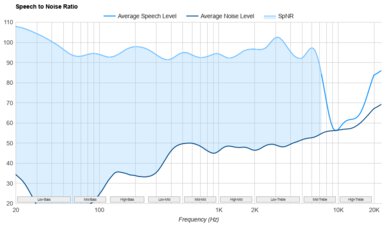
    15.4 dB
    Noise Gate
    Always On
    Speech + Pink Noise Handling
    7.0
    Speech + Pink Noise Audio Sample
    Speech + Subway Noise Handling
    7.0
    Speech + Subway Noise Audio Sample

    The mic system's noise handling is satisfactory. With consistent background noise, it prioritizes your voice, but can't completely filter out the sounds in the backdrop. Occasionally, it'll pick up other people's voices too. While louder sounds, like subway trains, are noticeably reduced in volume, they can still start to overwhelm the microphone, hurting intelligibility.

    Active Features
    8.5
    Battery
    Battery Type
    Rechargable
    Continuous Battery Life
    29.1 hrs
    Additional Charges
    0.0
    Total Battery Life
    29.1 hrs
    Charge Time
    1.9 hrs
    Power-Saving Feature
    Standby mode
    Audio While Charging
    Yes
    Passive Playback
    No
    Charging PortUSB-C

    Their battery performance is impressive. Advertised to last 30 hours with a 15-minute quick charge yielding seven hours of battery life, these lasted slightly over 29 hours in our standard test. They also have a battery-conserving standby mode if you take them off of you, and they will power off if left idle. You can adjust these settings in the companion app. You can use them for wired audio while they charge using the supplied USB-C to USB-C cable.

    7.5
    App Support
    App NameBowers & Wilkins Music
    iOSYes
    AndroidYes
    macOSNo
    WindowsNo
    Equalizer
    Graphic + Presets
    ANC Control
    On/Off
    Mic ControlNo
    Room Effects
    No
    Playback Control
    Yes
    Button MappingYes
    Surround Support
    No

    The Bowers & Wilkins Music app is good, but fairly streamlined as far as features are concerned. Unlike the Sennheiser HDB 630, there aren't Sound Zones, and unlike the Apple AirPods Max, there's no Spatial Audio. However, you get a simple interface (as you can see in this video tour) with listening modes, connection quality selection, and a five-band graphic EQ (but you can't save the settings) with +/-6dB of adjustment available. You can select how sensitive the on-ear sensor is, manage Bluetooth multi-pair connections, and alter the 'Quick Action' button's function. Battery functions include monitoring battery life and the auto standby mode.

    There's limited integration with other streaming platforms (Tidal, Qobuz, Deezer, Amazon Music, TuneIn, SoundCloud, and NTS), and you can view your playlists, see what's now playing, and view recommendations.

    Connectivity
    7.1
    Wired Connection
    Analog Audio
    Yes
    USB Audio
    USB-C
    Detachable
    Yes
    Length
    3.94 ft (1.20 m)
    Connector
    USB-C
    Latency - Analog
    30.3 ms
    Latency - USB
    34.8 ms
    Recorded Latency
    Recorded Latency ConnectionUSB

    These headphones use the USB-C port for wired audio connections. With the headphones, you get two 1.2 m (3.9 ft) cables for either USB-C or 3.5 mm (1/8") audio connections. They're low latency overall, so your visuals and audio will match, but not quite as low as a purely analog audio connection would be.

    7.7
    Bluetooth Connection
    Bluetooth Version
    5.3
    Multi-Device Pairing
    2 Devices
    Quick Pair (Android)
    Yes
    Quick Pair (iOS)
    No
    Line Of Sight Range
    310.04 ft (94.50 m)
    Latency - SBC
    272 ms
    Latency - aptX
    263 ms
    Latency - aptX Adaptive (High Quality)
    350 ms
    Latency - aptX Adaptive (Low Latency)
    86 ms
    Latency - LDAC
    N/A
    Recorded Latency
    Recorded Latency CodecaptX Adaptive (Low Latency)
    AAC Support
    Yes

    These headphones have good Bluetooth performance. They let you connect to two devices simultaneously. The included Bluetooth codecs range from the usual SBC and AAC codecs to aptX Lossless (and the rest of the aptX suite, which covers aptX Low Latency and aptX HD). Your experience is influenced by your device's compatibility, but where supported, the aptX Low Latency codec plays back your audio with tight A/V sync.

    0.0
    Wireless Connection (Dongle)
    Line Of Sight Range
    N/A
    Latency - Dongle
    N/A
    Recorded Latency
    N/A
    PC Compatibility
    Analog
    Audio Only
    Wired USB
    Audio + Microphone
    Non-BT Wireless
    No

    You can use the USB-C to USB-C cable for full mic and audio support with PCs, and the same goes for Bluetooth connections. The USB-C to 3.5 mm (1/8") cable bypasses the microphone, but you can still receive audio.

    PlayStation Compatibility
    PS4 Analog
    Audio Only
    PS4 Wired USB
    Audio + Microphone
    PS4 Non-BT Wireless
    No
    PS5 Analog
    Audio Only
    PS5 Wired USB
    Audio + Microphone
    PS5 Non-BT Wireless
    No

    The Bowers & Wilkins Px7 S3 can use their USB-C to USB-C cable to connect to PS4 and PS5 controllers for full mic and audio compatibility, which is convenient if you're a casual gamer who doesn't need a fully dedicated headset. The analog 3.5 mm connection will only let you receive audio, though.

    Xbox Compatibility
    Xbox One Analog
    Audio Only
    Xbox One Wired USB
    No
    Xbox One Non-BT Wireless
    No
    Xbox Series X|S Analog
    Audio Only
    Xbox Series X|S Wired USB
    No
    Xbox Series X|S Non-BT Wireless
    No

    These only connect via their USB-C to 3.5 mm (1/8") cable to Xbox controllers, but you'll only be able to receive audio. If you need a mic, you'll need an outboard one to chat with friends.

    0.0
    Base/Dock
    Type
    No Base/Dock
    USB Input
    No
    Line In
    No
    Line Out
    No
    Optical Input
    No
    RCA Input
    No
    Dock Charging
    No
    Power Supply
    No Base/Dock