JBL Endurance Peak True Wireless  Headphones Review

Review updated Apr 24, 2020 at 12:16pm
Writing modified Dec 16, 2021 at 05:12pm
Tested using Methodology v1.5 
JBL Endurance Peak True Wireless
7.5
Neutral Sound 
7.5
Commute/Travel 
8.1
Sports/Fitness 
7.0
Office 
5.4
Wireless Gaming 
5.3
Wired Gaming 
6.6
Phone Calls 
 0

The JBL Endurance Peak True Wireless are a truly wireless variant of the JBL Endurance Sprint Wireless. They’re both sporty, well-built in-ear headphones with a durable, rubberized finish that is great for running or use at the gym. They sound very similar, with a neutral and versatile sound profile that lends itself well to a wide variety of music genres. The biggest difference between these two models lies in the battery – since the Endurance Peak are truly wireless, they take a hit to their continuous playtime and last for only 4 hours on a charge compared to the Sprint’s 9 hours of battery life. On the upside, the Peak’s charging case can carry up to 24 hours of additional battery life. Unfortunately, they have a finicky control scheme and aren’t the most comfortable in-ears, but they’re a versatile pair of earbuds that are decent for most uses.

Our Verdict

7.5
Neutral Sound 

The JBL Endurance Peak could be a decent choice for neutral sound listening. They deliver a well-balanced, versatile sound that suits various genres of music, from hip-hop to classical. They’re not the most comfortable, though, and may get fatiguing during longer listening sessions. In addition, like most in-ears, they don’t have an open, speaker-like soundstage.

Pros
  • Well-balanced sound.
  • Low leakage.
  • Stable design for sports.
Cons
  • Finicky touch-sensitive control scheme.
  • Bulkier than other truly wireless in-ears.
  • Poor battery life.
7.5
Commute/Travel 

The JBL Endurance Peak are good wireless in-ears for commuting. They're compact, easy to carry around, and isolate background noise fairly well. Though they don’t block noise as well as headphones with an ANC feature, they barely leak so you can play your music a little louder without bothering those around you. Unfortunately, they aren't the most comfortable truly wireless in-ears and have a relatively short playtime, though it should be long enough to get you to and from work.

Pros
  • Well-balanced sound.
  • Low leakage.
  • Stable design for sports.
Cons
  • Finicky touch-sensitive control scheme.
  • Bulkier than other truly wireless in-ears.
  • Poor battery life.
8.1
Sports/Fitness 

The JBL Endurance Peak are great for sports. They have a very stable twist-to-lock ear-hook design that, once you get figured out, fits nice and secure. Unfortunately, their 3.9-hour battery life isn’t the best and it may be difficult to navigate their control scheme while exercising.

Pros
  • Well-balanced sound.
  • Low leakage.
  • Stable design for sports.
Cons
  • Finicky touch-sensitive control scheme.
  • Bulkier than other truly wireless in-ears.
  • Poor battery life.
7.0
Office 

The JBL Endurance Peak earbuds are satisfactory for office use. They block out office noises like workplace chatter and fan sounds quite well, and hardly leak any sound, so you won’t disturb your coworkers. Unfortunately, they aren't the most comfortable to wear all day, and their 4-hour battery means you'll have to take multiple breaks to charge them up.

Pros
  • Well-balanced sound.
  • Low leakage.
  • Stable design for sports.
Cons
  • Finicky touch-sensitive control scheme.
  • Bulkier than other truly wireless in-ears.
  • Poor battery life.
5.4
Wireless Gaming 

The JBL Endurance Peak are Bluetooth-only headphones that aren't recommended for wireless gaming. Since they're Bluetooth-only, they aren't compatible with PS4 or Xbox One, and though they may be used for PC or mobile gaming, they have a mediocre-at-best microphone and too much latency to be suitable for gaming.

5.3
Wired Gaming 

The JBL Endurance Peak are Bluetooth-only headphones that can't be used wired.

6.6
Phone Calls 

The JBL Endurance Peak are okay for phone calls. While they have an integrated mic that can easily be used to take a phone call while on-the-go, their microphone doesn't perform well overall. While talking on phone calls, your voice is muffled, flat, and difficult to hear in noisy environments.

Pros
  • Well-balanced sound.
  • Low leakage.
  • Stable design for sports.
Cons
  • Finicky touch-sensitive control scheme.
  • Bulkier than other truly wireless in-ears.
  • Poor battery life.
  • 7.5
    Neutral Sound
  • 7.5
    Commute/Travel
  • 8.1
    Sports/Fitness
  • 7.0
    Office
  • 5.4
    Wireless Gaming
  • 5.3
    Wired Gaming
  • 6.6
    Phone Calls
  • Changelog

    1.  Updated Nov 25, 2021: Converted to Test Bench 1.5.
    2.  Updated Feb 13, 2020: Converted to Test Bench 1.4.
    3.  Updated Nov 21, 2019: Converted to Test Bench 1.3.1.
    4.  Updated Nov 21, 2019: Converted to Test Bench 1.3.

    Popular Headphones Comparisons

    The JBL Endurance Peak are great truly wireless in-ears for sports. Their matte, rubberized finish and twist-to-lock ear hook design sets them apart from similar sports headphones. However, their touch-sensitive control scheme can be a bit finicky compared to the physical controls of other truly wireless sports in-ears. If you get easily frustrated by unwanted registered commands, take a look at our recommendations for the best headphones for running, the best wireless earbuds for running, or the best truly wireless earbuds.

    Jaybird Run Truly Wireless

    The Jaybird Run Truly Wireless are better truly wireless in-ears than the JBL Endurance Peak True Wireless. The Jaybird are more comfortable, and have a dedicated companion app that allows you to fully EQ their sound profile. On the other hand, the JBL are better-balanced out of the box, though they don't have any EQ settings. 

    Anker Soundcore Liberty Air

    The JBL Endurance Peak True Wireless and the Anker Soundcore Liberty Air are both decent truly wireless in-ears. They're both decently well-built and have similar batteries, lasting around four hours on a charge and charging in under an hour and a half. However, the Peak's charging is a bit better since they have an auto-off timer. Both headphones also have a well-balanced, neutral sound profile, but the Anker have a more accurate treble response. The JBL have a sportier look with a better control scheme, but the Anker have a more casual look and are more comfortable with better isolation.

    Skullcandy Push Truly Wireless

    The JBL Endurance Peak True Wireless are better truly wireless in-ears than the Skullcandy Push Truly Wireless. The JBL have a more stable fit, thanks to their secure ear-hook design; isolate more noise; and have a more balanced sound profile. However, the Skullcandy are more comfortable and have a better control scheme. The Skullcandy also have a longer battery life but takes longer to charge. On the other hand, their charging case holds fewer additional charges, and they don't have a power-saving feature like the JBL.

    Sony WF-SP700N Truly Wireless

    The JBL Endurance Peak True Wireless are better truly wireless in-ears than the Sony WF-SP700N Truly Wireless. The Peak have a more stable fit, better battery life, much better isolation, and a better-balanced sound profile out-of-the-box. On the other hand, the sound profile of the Sony can be customized through their dedicated companion app to match your personal tastes. The Sony WF-SP700N are also more comfortable and have a better build quality. 
    Skullcandy Push Ultra Truly Wireless

    The JBL Endurance Peak True Wireless are better for mixed usage than the Skullcandy Push Ultra Truly Wireless. The JBL have a more portable case and do a better job of staying on your ears while also providing a far more neutral, consistent listening experience. The JBL are also more effective in reducing the volume of ambient noise. That said, the Skullcandy have a more intuitive control scheme and a case that generates a longer total battery life, and they last longer off a single charge.

    JBL Endurance Peak II True Wireless

    The JBL Endurance Peak True Wireless and the JBL Endurance Peak II True Wireless are very similarly-performing headphones, but the newest edition has a few improvements. The Peak II have a better noise isolation performance, a longer continuous battery life, and a better microphone recording quality. Their sound profile is a bit more bass-heavy, which some listeners may prefer. However, the Peak have a better charging case.

    Overhauling Our Audio Measurements And A New Multi-Curve Graphing Tool

    We've upgraded our Headphones Test Bench to 2.0! This update brings several key changes to our tests and usages, making it easier than ever to interpret our sound results based on your personal preferences. You'll also find a brand-new interactive graph tool featuring multiple targets (including our own!) for you to explore and compare.

    For a full breakdown, check out our changelog, which includes detailed commentary from our test designer explaining the rationale behind our update.

    We'd also love to hear your thoughts: your feedback helps us keep improving, so join us in the comments!

    Test Results

    perceptual testing image
    Sort:
    RATINGS
    Category:
    All
    Design
    Style
    TypeIn-ear
    EnclosureClosed-Back
    WirelessTruly Wireless
    TransducerDynamic

    The JBL Endurance Peak have a very sporty and well-built look, with dense, rubberized earbuds and thick ear hooks. They have a magnetic base behind each earbud that the ear-hooks snap onto, allowing you to easily clip the headphones on a bag or keychain. They have a flashy design and, like the JBL Endurance Sprint Truly Wireless, are available in red, blue, or black.

    6.5
    Comfort
    Weight0.05 lbs
    Clamping Force
    0 lbs

    The JBL Endurance Peak True Wireless are decently comfortable. The ear hooks are fairly malleable and fit well behind your ears, but it can take a couple of tries to get the twist-to-lock wearing style right. They come with three different tip sizes and are comfortable enough for sports and most casual uses, but won’t be ideal for longer listening sessions. However, the in-ear fit may not be as comfortable for everyone and some may feel ear fatigue after a while.

    6.0
    Controls
    OS Compatibility
    Not OS specific
    Ease Of UseSubpar
    FeedbackOkay
    Call/Music ControlYes
    Volume ControlYes
    Microphone ControlNo
    Channel Mixing
    No
    Noise Cancelling ControlNo
    Talk-Through
    No
    Additional ControlsNo

    Their control scheme is identical to that of the JBL Endurance Sprint Wireless. The right earbud manages all call and music controls through touch gestures. Swiping up and down controls the volume and you can take or end calls, pause, skip, or rewind tracks by tapping the touch-sensitive surface. Unfortunately, this surface is rather small and feels overly sensitive – it can be difficult for commands to register accurately, and sometimes commands will activate by simply repositioning the earbuds, which is annoying. On the bright side, they turn on/off automatically when putting them on or taking them off, which is convenient.

    9.2
    Breathability
    Avg.Temp.Difference0.8 °C

    These headphones have excellent breathability. Like most in-ears, they don't cover the outer ear, which remains relatively cool when exercising and working out. They do cover a bit more surface area than typical in-ears due to their bulkier ear-hook design, but it's a negligible difference and they shouldn't make you sweat like on-ears or over-ears do.

    9.2
    Portability
    L1.9" (4.8 cm)
    W1.5" (3.8 cm)
    H1.1" (2.8 cm)
    Volume3.10 in³ (50.80 cm³)
    Transmitter RequiredNo

    The Endurance Peak are very easy to carry around on your person. Even though they have ear hooks that are quite large in comparison to other models like the Anker SoundBuds Curve, the Peak are quite compact and should still easily fit into most pockets and bags. They also have a clip mechanism that makes them easy to attach to a bag or keychain.

    7.5
    Case
    TypeHard case
    L3.3" (8.4 cm)
    W2.1" (5.3 cm)
    H1.3" (3.3 cm)
    Volume9.00 in³ (147.48 cm³)

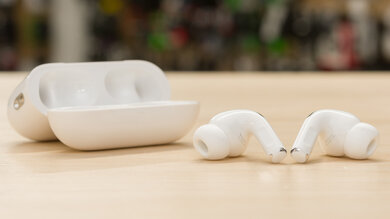
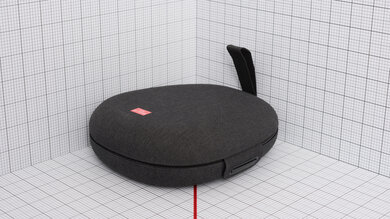
    The JBL Endurance Peak have a good hard charging case, though it's a bit larger than the case for most truly wireless in-ears. It seems sturdy enough to protect the headphones from accidental damage, but it doesn’t lock, so it may pop open upon impact. It also doesn’t have the same rubberized finish as the earbuds and feels plasticky when compared to the headphones.

    7.5
    Build Quality

    The Endurance Peak feel well-built and durable. They're made from a dense, rubberized plastic build that feels solid and relatively durable. Like the JBL Endurance Sprint Wireless, they have an IPX7 rating for sweat and water resistance, though we don't test for this.

    8.0
    Stability

    These headphones have a very stable fit thanks to their large ear hooks that twist and 'lock' into place. However, there’s a bit of a learning curve, and if you don’t get the twist-to-lock procedure exactly right, the earbuds may pop out of your ears. They also come with 'Stability Enhancers' that help them fit snug and stable in the ear. Once you get a good fit they're stable enough for working out and running, especially since their truly wireless design means they have no cables that can get snagged or tugged.

    Headshots 1
    Headshots 2
    Top
    In The Box

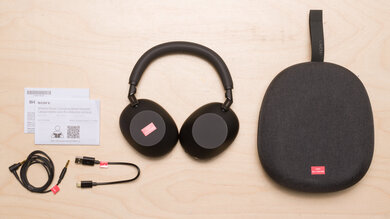
    • JBL Endurance Peak headphones
    • 3 Earbud tips
    • Stability Enhancer
    • USB charging cable
    • Charging case
    • Manual
    Sound
    Sound Profile
    See details on graph tool
    Bass Amount
    2.71 dB
    Treble Amount
    -0.82 dB

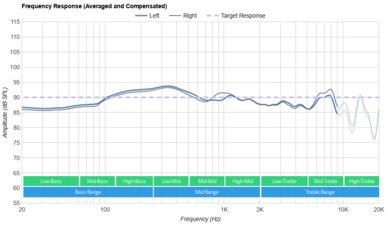
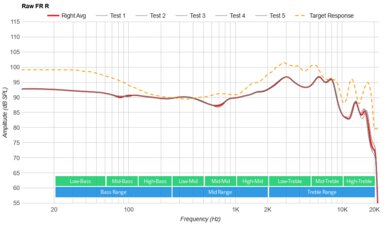
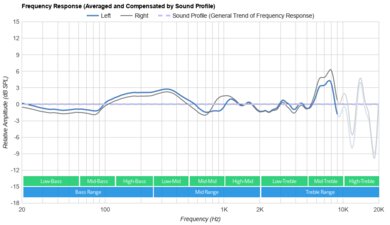
    The sound profile of these headphones is very well-balanced. While they have a bit of extra thump and kick, it isn't overpowering, and they're well-suited for a very wide range of genres and content, from hip-hop to audiobooks.

    8.8
    Frequency Response Consistency
    See details on graph tool
    See details on graph tool
    Avg. Std. Deviation
    0.24 dB

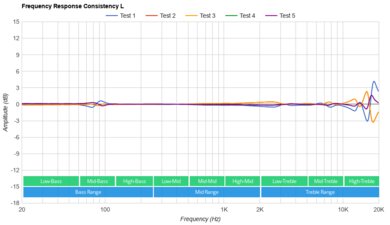
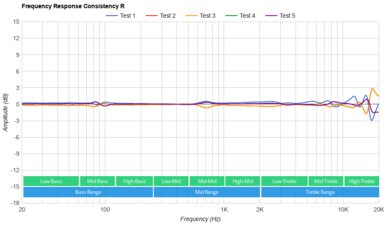
    The frequency response consistency of the JBL Endurance Peak is excellent. Once you get a proper fit and seal using the different tips provided, you should be able to get consistent bass and treble delivery every time you use these headphones.

    Raw Frequency Response
    See details on graph tool
    See details on graph tool
    7.8
    Bass Accuracy
    See details on graph tool
    Std. Err.
    3.18 dB
    Low-Frequency Extension
    10 Hz
    Low-Bass
    4.35 dB
    Mid-Bass
    3.89 dB
    High-Bass
    1.54 dB

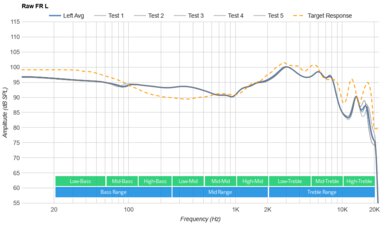
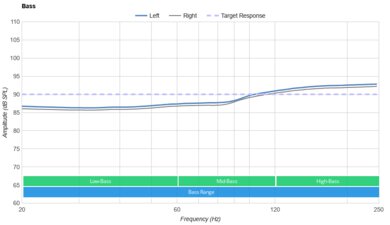
    These headphones have good bass accuracy. The entire range is quite flat, though it's slightly over-emphasized. This results in a punchy bass with a bit of extra thump that feels warm without sounding boomy or muddy.

    9.3
    Mid Accuracy
    See details on graph tool
    Std. Err.
    0.92 dB
    Low-Mid
    0.01 dB
    Mid-Mid
    -0.7 dB
    High-Mid
    0.63 dB

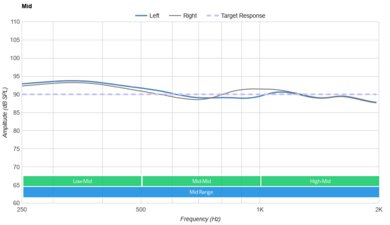
    The mid accuracy of these headphones is remarkable. The response throughout the range is quite even and follows our target very closely. This results in accurate and near-perfectly-balanced vocals and leads.

    8.9
    Treble Accuracy
    See details on graph tool
    Std. Err.
    1.65 dB
    Low-Treble
    0.69 dB
    Mid-Treble
    0.55 dB
    High-Treble
    -4.23 dB

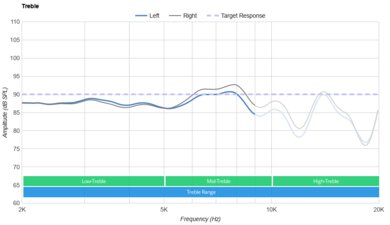
    The JBL Endurance Peak True Wireless' treble accuracy is excellent. The response is quite even throughout the low and mid-treble ranges and is overall well-balanced. Low-treble is very even and accurate, ensuring that vocals and instruments are articulate, present, and detailed. High-treble is quite recessed, which may cause some sounds to appear lifeless and dull.

    8.5
    Peaks/Dips
    See details on graph tool
    Peaks
    1.04 dB
    Dips
    0.62 dB

    These headphones have excellent peaks and dips performance. Most of the frequencies are flat and well-balanced with minor peaks or dips that shouldn't be too noticeable to most people. While the large dip in high-treble may reduce the airness of their sound, they still produce a good amount of brightness and detail overall.

    9.0
    Imaging
    See details on graph tool
    See details on graph tool
    Weighted Group Delay
    0.16
    Weighted Phase Mismatch
    2.17
    Weighted Amplitude Mismatch
    0.57
    Weighted Frequency Mismatch
    1.49

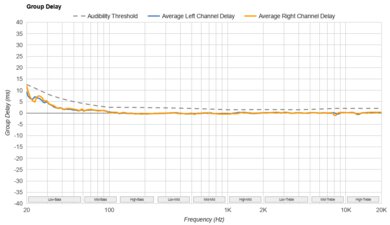
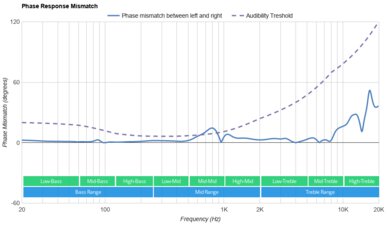
    The Endurance Peak have excellent imaging. The weighted group delay is very good and the GD graph shows that the group delay response never crosses the audibility threshold, resulting in tight bass and transparent treble. Additionally, both the left and right drivers of our test unit are very well-matched in amplitude, frequency, and phase response, which is important for the accurate placement and localization of objects (voices, instruments, video game effects) in the stereo image. It's worth noting that these results are only valid for our unit and yours may perform differently.

    0.7
    Passive Soundstage
    PRTF Accuracy (Std. Dev.)
    N/A
    PRTF Size (Avg.)
    N/A
    PRTF Distance
    N/A
    Openness
    2.4
    Acoustic Space Excitation
    0.8

    The soundstage of these headphones is very poor. Creating a large and speaker-like soundstage is dependent on having a speaker-like activation of the outer ear. Because in-ear headphones bypass the pinna (the outer ear) and don't interact with it, their soundstage is perceived to be small and located inside the listener's head. The JBL Endurance Peak also have a closed-back design, which means that their soundstage doesn't feel as open as that of open-back earbuds like the Apple AirPods (1st generation) Truly Wireless, Google Pixel Buds, or the Bose SoundSport Free.

    0.0
    Virtual Soundstage
    Head Modeling
    No
    Speaker Modeling
    No
    Room Ambience
    No
    Head Tracking
    No
    Virtual Surround
    No App

    These headphones don't have any virtual soundstage features.

    8.6
    Weighted Harmonic Distortion
    See details on graph tool
    WHD @ 90
    0.148
    WHD @ 100
    0.059

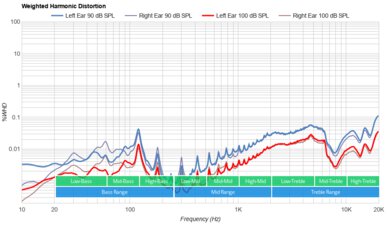
    The weighted harmonic distortion of these headphones is excellent. Even at higher volumes, you should notice clean and pure sound reproduction.

    Test Settings
    Firmware
    Unknown
    Power
    On
    Connection
    Unknown
    Codec
    SBC, 16-bit, 48kHz
    EQ
    No EQ
    ANC
    No ANC
    Tip/Pad
    Silicone (small)
    Microphone
    Integrated

    These are the settings used to test these headphones, therefore, our results are only valid at these settings.

    Isolation
    7.4
    Noise Isolation
    See details on graph tool
    Isolation Audio
    Overall Attenuation
    -21.08 dB
    Noise CancellingNo
    Bass
    -10.28 dB
    Mid
    -19.81 dB
    Treble
    -34.01 dB

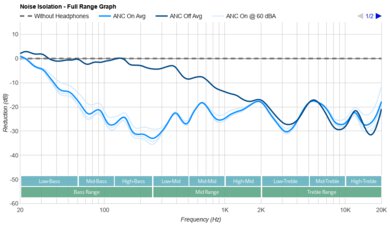
    The JBL Endurance Peak do a good job at isolating noise. While they don't have an active noise cancelling (ANC) feature, their in-ear fit helps physically block out background noise. While they won't help too much with the low rumble of bus or plane engines, they do an excellent job at blocking out background chatter. For similar headphones with better noise isolation, check out the JBL Endurance Peak II True Wireless.

    9.3
    Leakage
    See details on graph tool
    Leakage Audio
    Overall Leakage @ 1ft
    25.39 dB

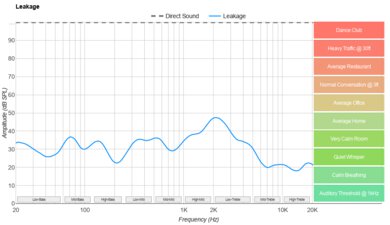
    The leakage performance of these headphones is excellent. Their leakage sounds very thin and the overall level of the leakage isn't very loud. Even at higher volumes, you likely won't bother those close to you.

    Microphone
    Microphone Style
    Integrated
    Yes
    In-Line
    No
    Boom
    No
    Detachable Boom
    No
    MicYes

    These headphones have an integrated microphone in the earbuds.

    5.6
    Recording Quality
    See details on graph tool
    Recorded Speech
    LFE
    386.08 Hz
    FR Std. Dev.
    3.04 dB
    HFE
    2,451.46 Hz
    Weighted THD
    11.816
    Gain
    35.46 dB

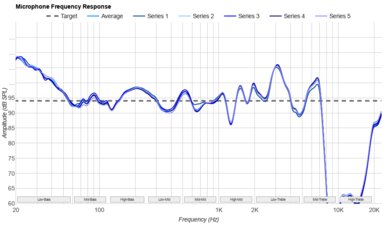
    Like most Bluetooth truly wireless in-ears, the JBL Endurance Peak's microphone has poor recording quality. Speech recorded or transmitted with this mic sounds thin, lacking in detail and noticeably muffled. On the upside, the gain is very high, so the mic will pick up your voice well even when you speak very quietly.

    7.0
    Noise Handling
    See details on graph tool
    SpNR
    16.99 dB
    Noise Gate
    Always On
    Speech + Pink Noise Handling
    8.0
    Speech + Pink Noise Audio Sample
    Speech + Subway Noise Handling
    5.5
    Speech + Subway Noise Audio Sample

    Update 12/16/2021: These headphones have been updated to test bench 1.5. In this update, we made changes to the way we test noise handling. We now use a subjective evaluation of our audio clips. This new method has resulted in different results than what we had reported in our previous test bench. As a result, the scoring of this box has changed, and we have updated our results.

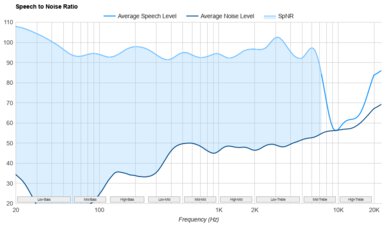
    The noise handling of the microphone is satisfactory. While your voice is easy to hear in quiet situations, it gets completely lost in noisy environments. If you're taking an important call, it's best to speak in a quieter environment to ensure your voice is heard clearly.

    Active Features
    6.2
    Battery
    Battery Type
    Rechargable
    Continuous Battery Life
    3.9 hrs
    Additional Charges
    5.0
    Total Battery Life
    23.4 hrs
    Charge Time
    1.4 hrs
    Power-Saving Feature
    Auto-Off Timer
    Audio While Charging
    No
    Passive Playback
    No
    Charging Portmicro-USB

    The JBL Endurance Peak have mediocre overall battery performance. Although the battery only lasts for about 4 hours, there's an auto-off timer that switches off the earbuds after a short period of inactivity to help conserve battery, as well as turns them off automatically when you remove them from your ear, which is convenient. According to JBL, the Endurance Peak also have a quick charge mode that gives an hour of playback for 10 minutes of recharging, though we don't test this.

    0.0
    App Support
    App NameNo App
    iOSNo
    AndroidNo
    macOSNo
    WindowsNo
    Equalizer
    No
    ANC Control
    No
    Mic ControlNo
    Room Effects
    No
    Playback Control
    No
    Button MappingNo
    Surround Support
    No

    These headphones don't have a dedicated companion app.

    Connectivity
    6.8
    Bluetooth
    Bluetooth Version
    4.2
    Multi-Device Pairing
    No
    NFC Pairing
    No
    Line Of Sight Range
    272.00 ft (82.91 m)
    PC Latency (SBC)
    386 ms
    PC Latency (aptX)
    N/A
    PC Latency (aptX HD)
    N/A
    PC Latency (aptX-LL)
    N/A
    iOS Latency
    259 ms
    Android Latency
    308 ms

    The JBL Endurance Peak don't support multi-device or NFC pairing. Their latency is quite high, though it's worth noting that some devices and apps appear to offer some sort of compensation though, so your mileage may vary in real-life usage. They also have one of the highest line of sight ranges we've measured to date, though again, this will vary greatly in real-life usage.

    0.0
    Non-Bluetooth Wireless
    Non-BT Line Of Sight Range
    N/A
    Non-BT Latency
    N/A

    These headphones are Bluetooth-only.

    0.0
    Wired
    Analog Audio
    No
    USB Audio
    No
    DetachableNo
    LengthN/A
    Connection
    No Wired Option
    Analog/USB Audio Latency
    N/A

    The JBL Endurance Peak are Bluetooth-only headphones that can't be used wired. If you want a pair of wired headphones with a well-balanced sound profile, check out the 1More Triple Driver In-Ear.

    PC Compatibility
    Analog
    No
    Wired USB
    No
    Non-BT Wireless
    No
    PlayStation Compatibility
    PS4 Analog
    No
    PS4 Wired USB
    No
    PS4 Non-BT Wireless
    No
    PS5 Analog
    No
    PS5 Wired USB
    No
    PS5 Non-BT Wireless
    No
    Xbox Compatibility
    Xbox One Analog
    No
    Xbox One Wired USB
    No
    Xbox One Non-BT Wireless
    No
    Xbox Series X|S Analog
    No
    Xbox Series X|S Wired USB
    No
    Xbox Series X|S Non-BT Wireless
    No

    These headphones are Bluetooth-only and aren't compatible with Xbox One.

    2.2
    Base/Dock
    Type
    Charging Case
    USB Input
    No
    Line In
    No
    Line Out
    No
    Optical Input
    No
    RCA Input
    No
    Dock Charging
    Yes
    Power Supply
    USB

    The JBL Endurance Peak come with a charging case that charges over micro-USB but has no additional inputs.