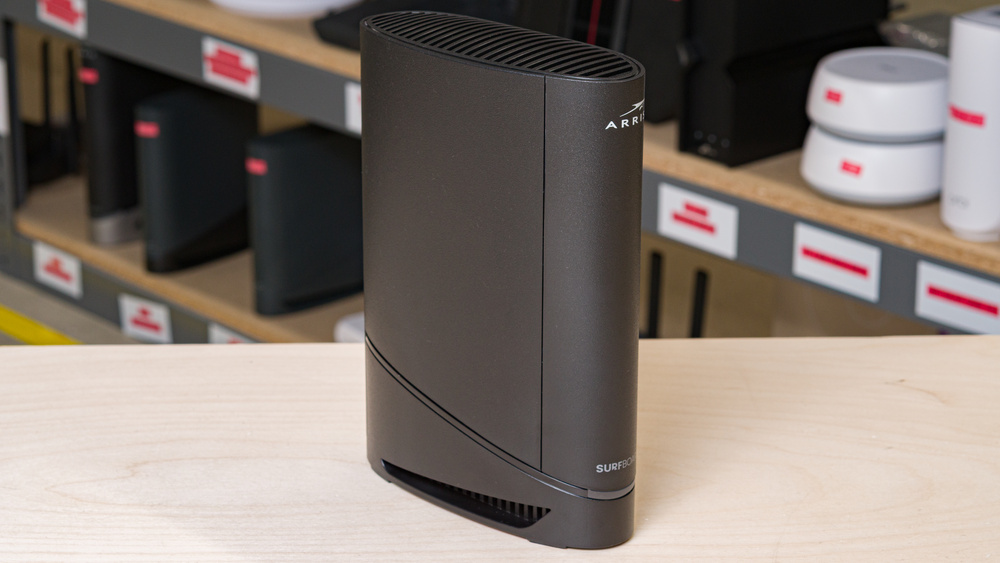
The ARRIS SURFboard G18 is a dual-band, two-in-one DOCSIS 3.1 cable modem and Wi-Fi 6 router. It features a matte-black vertical tower design with ventilation grilles along the top and bottom, and an LED status light on its front. The gateway comes equipped with internal 2.4GHz and 5GHz antennas, one coaxial cable connection, and two 1Gbps LAN ports on its rear. You can configure the router through its web interface or by using the SURFboard Central companion app.
Note: We only test the Wi-Fi capabilities of this unit and don't evaluate its performance as a DOCSIS 3.1 modem.
Our Verdict
The ARRIS G18 is decent for an apartment or condo, maintaining good top speeds for streaming 4k video or downloading files quickly over Wi-Fi. Dynamic Frequency Selection (DFS) support lets it access additional channels to manage congestion in crowded areas, such as an apartment complex. Its slim, vertical chassis makes it easy to tuck unobtrusively into smaller spaces, and the G18's combined modem functionality eliminates the need for a second networking device entirely. Its port selection is limited, however, with just two 1Gbps ports, leaving little room for wired connections.
Good speeds.
Decent range.
Slim design with no external antennas.
Built-in DOCSIS 3.1 cable modem.
Wi-Fi 6 doesn't take full advantage of new Wi-Fi 6E or 7 devices.
Only two LAN ports, neither rated for more than 1Gbps.
The ARRIS G18 is satisfactory for multi-level homes, with decent range and good speeds for browsing, streaming, and video conferencing across larger floor plans. While its coaxial port technically supports speeds up to 10Gbps, its two 1Gbps Ethernet ports are limiting if you pay for multi-gig internet and want to plug in more than two devices. It also lacks native mesh support, so you can't add access points to increase your signal range further.
Good speeds.
Decent range.
Built-in DOCSIS 3.1 cable modem.
Wi-Fi 6 doesn't take full advantage of new Wi-Fi 6E or 7 devices.
Only two LAN ports, neither rated for more than 1Gbps.
The ARRIS G18 is a decent choice for gaming over Wi-Fi. It delivers wireless latency and jitter levels broadly in line with standalone Wi-Fi routers, making it suitable for fast updates and casual gaming throughout the home. For the smoothest and most stable experience, especially for competitive gaming, you'll still want to connect your console or PC directly to one of its two LAN ports.
Satisfactory latency levels for everyday use and casual gaming.
Good speeds.
Decent range.
Not recommended for competitive gaming over Wi-Fi.
The ARRIS SURFboard G18 is completely impractical for travel. As a modem-and-router combo built for stationary home use, it has a tall chassis and a bulky power adapter that aren't designed with portability in mind. It doesn't have essential travel features like a WISP or repeater mode, VPN functionality, cellular tethering, or support for power over USB-C.
Slim design with no external antennas.
Tall and impractical for travel.
No WISP/repeater mode or LTE support.
No VPN support.
Not compatible with portable power banks.
The ARRIS G18 delivers good overall wireless speeds and is suitable for internet plans up to ~600Mbps. This two-in-one device supports DFS channels to help reduce congestion, but it doesn't have a 6GHz band for newer Wi-Fi 6E and 7 devices to take advantage of.
Good speeds.
Wi-Fi 6 doesn't take full advantage of new Wi-Fi 6E or 7 devices.
The ARRIS G18 has decent range. Its performance remains relatively stable at longer distances, though speeds naturally drop off as you move away from the unit. The G18 lacks native mesh support, so you can't expand your range by connecting it to mesh access points.
Decent range.
No mesh support.
The ARRIS G18 delivers adequate wireless latency and jitter performance that's on par with other Wi-Fi 6 routers on the market. It's a capable choice for everyday web browsing, video calls, and casual online gaming, although a wired connection is still preferable for competitive games and other latency-sensitive applications.
Satisfactory latency levels for everyday use and casual gaming.
Not recommended for competitive gaming over Wi-Fi.
The ARRIS SURFboard G18 offers decent configurability for your home network. You can manage it using a web browser or an optional mobile app, giving you easy control over basic settings like guest networks, traffic monitoring, channel selection, and surprisingly robust parental controls. Keep in mind that it lacks some advanced features, like VPN support and QoS.
Can be managed from the web or mobile app.
Good network configurability for everyday use.
Mediocre selection of advanced network tools.
Performance Usages
Changelog
- Updated Sep 11, 2026: We've updated this review to Test Bench 0.10! This update adds Portability and Configurability testing to evaluate how suitable routers are for travel and to show how configurable their settings are. Read the changelog for more info.
- Updated Jun 22, 2026: We've updated this review to Test Bench 0.9.1! This is a minor change that makes the router type easier to see at the top of each review. Read the changelog for more info.
-
Updated Jun 10, 2026:
We've added a link to the newly reviewed ARRIS SURFboard G20 in the Interior Long Range section of the review.
- Updated Jun 03, 2026: Review published.
Check Price
Differences Between Sizes And Variants
We bought and tested the ARRIS SURFboard G18, a Wi-Fi 6 cable modem/router combo from ARRIS' SURFboard lineup.
Popular Router Comparisons
The ARRIS SURFboard G18 is an entry-level dual-band Wi-Fi 6 router and DOCSIS 3.1 cable modem for those who want to cut down on their networking devices or save on ISP rental fees. It packs good wireless speeds and decent range into a slimline package, but its limited ports and lack of mesh support make it less flexible than many standalone routers. The G18's wired utility is limited to two 1Gbps Ethernet ports, making options like the GL.iNet Flint 2 (GL-MT6000) or TP-Link Archer AX55 more practical choices if you plan on wiring more than two devices. While the G18 offers compelling convenience as a two-in-one device, it's less practical for larger spaces due to its lack of mesh expansion support. This is a feature that's increasingly common on standalone routers, and central to dedicated mesh systems like the eero 6. The SURFboard is a smart choice for simplifying your cable internet setup, but households that need expandable whole-home reach will likely get more from a mesh-capable option.
For more recommendations, see our picks for the best Wi-Fi routers, the best routers for Spectrum, and the best routers for streaming.
The ARRIS SURFboard G34 is slightly better than the ARRIS SURFboard G18 overall. Both are DOCSIS 3.1 cable modems and Wi-Fi 6 router combos, but the G34 has a slight edge in speed, range, and wired flexibility, with four 1Gbps LAN ports compared to the G18's two. The G18 is smaller and does a bit better for wireless latency, so it's still a solid choice for simpler setups or casual gaming over Wi-Fi. However, the G34 is the more practical choice if you need stronger long-range coverage or more room for wired devices. Neither model supports native mesh expansion, so both are less ideal for homes that need expandable coverage.
The ARRIS SURFboard G20 sits alongside the ARRIS SURFboard G18 in ARRIS' lineup of DOCSIS 3.1 modem/router combos, with the same compact design, Wi-Fi 6 standard, and limited two-port gigabit wired connectivity. Despite an identical appearance, the G20 offers modest improvements across the board with faster top speeds, a wider range, and lower latency. While the G20 has the edge overall, its advantages over the G18 are fairly incremental. It's also worth noting that neither model supports mesh expansion.
The TP-Link Archer AX55 is a standalone Wi-Fi 6 router, while the G18 combines a DOCSIS 3.1 cable modem and Wi-Fi 6 router into one device. Compared to the G18, the AX55 delivers slightly better speeds and range, plus two additional gigabit LAN ports and mesh support. The SURFboard counters with the convenience of an all-in-one, space-saving design and slightly lower wireless latency. The AX55 remains the better pick if you already have a modem and could use the extra ports, while the G18 makes sense for cable internet users looking to simplify their setup without compromising on performance.
The eero 6 is a whole-home Wi-Fi 6 mesh system, while the ARRIS SURFboard G18 is a DOCSIS 3.1 modem with a built-in Wi-Fi 6 router. The former delivers faster top speeds and better range with an expandable mesh ecosystem, while the latter packs the functionality of two network devices into one stylish chassis with notably lower latency. While the G18 is best for cable internet users looking to free up space and save on equipment rentals, the eero 6 is the better pick if you need coverage that can scale to fill larger spaces.
Test Results
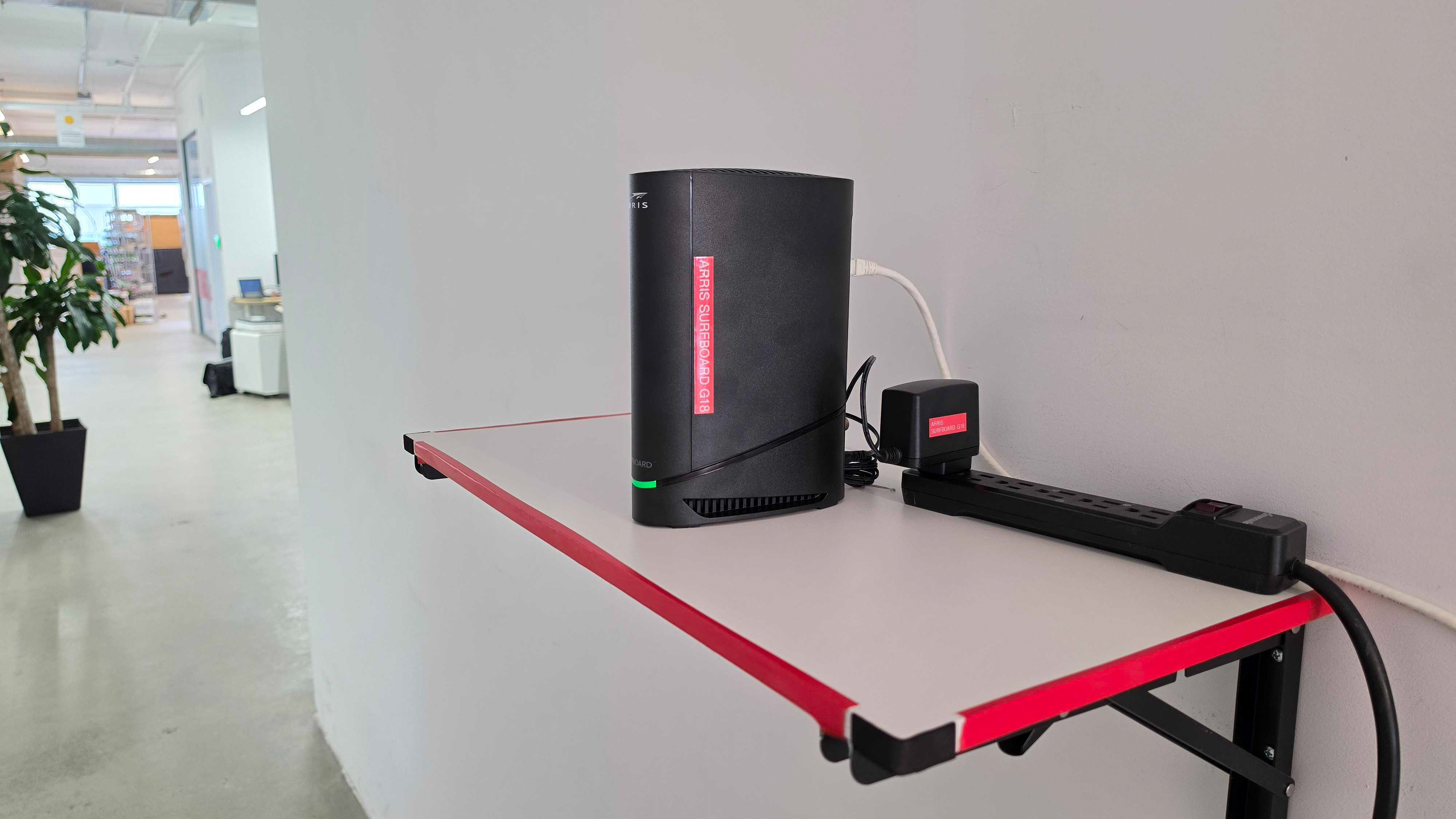
for pictures & test results

for pictures & test results
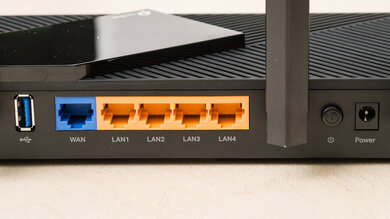
While the ARRIS G18's coaxial port technically supports speeds up to 10Gbps, we tested its routing performance by configuring one of its two 1Gbps Ethernet ports as the WAN port.
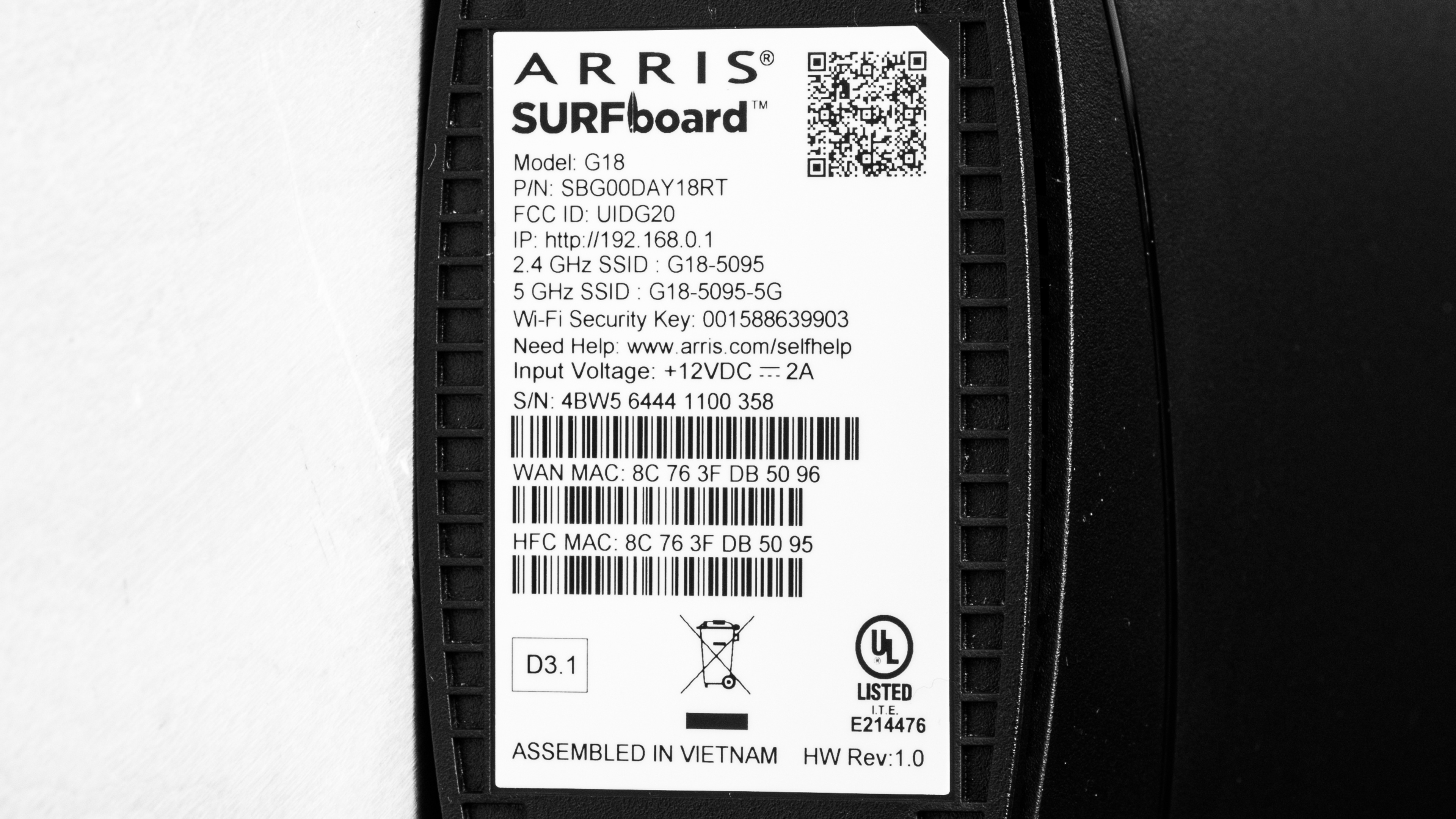
The ARRIS SURFboard G18's parental controls don't include preset filter categories (such as for gambling, adult content, etc.), so you'll need to add those items manually to block them. Notably, you can block just about anything: sites, apps, keywords, port ranges, and even protocols.
for pictures & test results

for pictures & test results

If you're looking for a modem/router combo with better range and speeds, check out the ARRIS SURFboard G20.
for pictures & test results
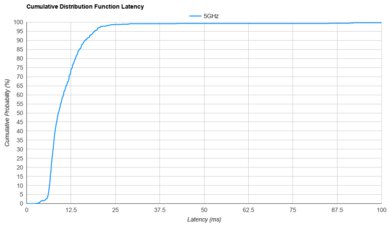
The G18's wireless latency and jitter levels are consistent with other standalone Wi-Fi 6 routers we've tested. It's suitable for everyday browsing and calling over Wi-Fi, but a wired connection is recommended for competitive games and latency-sensitive applications.