
The Ploopy Adept Trackball is a finger-operated trackball mouse that you can buy as a prebuilt or 'do-it-yourself' kit. It uses a PixArt PMW3360 sensor (a high-performance flagship sensor used on previous-generation gaming mice) and ball bearings that allow the trackball to roll in its housing. This trackball is an open-source project with all design and production files available on GitHub, and it uses VIA software and QMK firmware for configuration.
Our Verdict
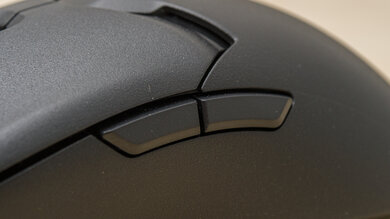
The Ploopy Adept has a comfortable finger-operated shape with a distinct DIY look and design approach. It uses 3D-printed plastic parts, some of which may have small imperfections and a rougher finish. However, the overall build feels very sturdy, and the fit and finish are good. While it lacks a dedicated scroll wheel, it uses a drag scroll feature that requires you to hold a button and use the ball to scroll. This scrolling technique is very precise, and you can intuitively control scrolling speed. That said, it may take some getting used to and can slow your workflow somewhat as you can't scroll and move your cursor at the same time. Using the VIA configuration software, you can reprogram all buttons and change other settings. For more advanced customization, you can flash custom firmware using QMK. This is a wired-only trackball, so it isn't well-suited for multi-device setups.
- Supports VIA software and QMK firmware for in-depth customization.
- Acceptable build quality.
- While they're quite accurate and smooth, its ball bearings are noisier than the static bearings commonly found on other trackballs.
- Somewhat rough 3D printed case design with visible printing imperfections.
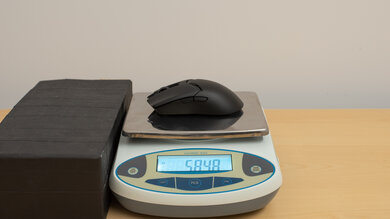
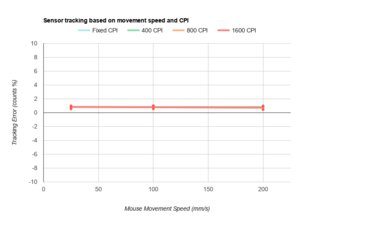
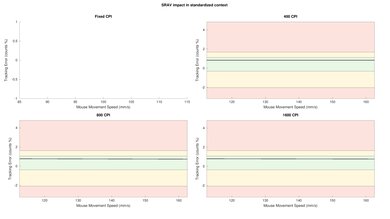
Though not designed explicitly for FPS gaming, the Ploopy Adept is more than performant enough for playing FPS titles at any competitive level. It may take some time to get used to if you normally use a conventional mouse. Due to the limitations of our methodology (primarily designed to test conventional mice), we can't evaluate the sensor latency. However, it uses a reliable flagship gaming sensor we've tested in other mice. For more details, see the Sensor Latency section. Also note that this trackball uses click-and-drag scrolling since it doesn't have a dedicated scroll wheel, which may be relevant if your playstyle depends heavily on scroll wheel binds. Lastly, it's worth pointing out that as a stationary trackball, its weight doesn't matter. However, the ball itself is lightweight, and while it makes noise moving in its housing, it feels very quick and consistent in-game.
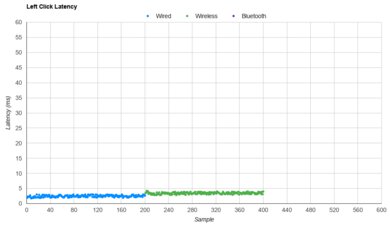
- Impressive click latency.
- 1000Hz polling rate, which is rare for trackball mice.
- Supports VIA software and QMK firmware for in-depth customization.
- Acceptable build quality.
- While they're quite accurate and smooth, its ball bearings are noisier than the static bearings commonly found on other trackballs.
- Somewhat rough 3D printed case design with visible printing imperfections.
The Ploopy Adept isn't designed specifically for MMO gaming, but it has six buttons, all of which you can reprogram using VIA configuration software. It also has impressive click latency and acceptable overall build quality, though the materials are somewhat rougher and have a clear DIY aesthetic compared to dedicated MMO gaming mice. Lastly, it uses a drag scroll since it doesn't have a dedicated scroll wheel, which can be an issue if you rely heavily on a scroll wheel for your play style.
- Impressive click latency.
- Supports VIA software and QMK firmware for in-depth customization.
- Acceptable build quality.
- While they're quite accurate and smooth, its ball bearings are noisier than the static bearings commonly found on other trackballs.
- Somewhat rough 3D printed case design with visible printing imperfections.
The Ploopy Adept delivers superb raw performance. It's suitable for playing games at any competitive level. It has excellent click latency and a 1000Hz polling rate, which is rare for trackballs, and helps, in part, to maintain consistent low latency performance. We can't test the sensor latency using our current test methodology, which is primarily geared toward testing conventional mice. However, its sensor model, PixArt PMW3360, is a previous-generation gaming sensor with an excellent performance record. For more details, see the Sensor Latency section.
- Impressive click latency.
- 1000Hz polling rate, which is rare for trackball mice.
Changelog
-
Updated Apr 13, 2026:
We've added a link to the Ploopy Thumb Trackball in the Style section.
- Updated Mar 31, 2026: We've converted this review to Test Bench 1.5.2. This update removes the Delay To Start Of Movement and Delay To End Of Movement measurements from the Sensor Latency test. See our full 1.5.2 changelog for details.
- Updated Aug 19, 2025: We've converted this review to Test Bench 1.5.1. This update removes less relevant or redundant elements, including several videos. We've also adjusted our Sensor Latency testing, resulting in minor score changes. See our full 1.5.1 changelog for details.
- Updated Jul 24, 2024: Review published.
Check Price
Differences Between Sizes And Variants
The Ploopy Adept Trackball is available in several colorway options, either as a prebuilt or DIY kit configuration that you need to build yourself. We bought and tested a prebuilt model in the red colorway with a yellow ball.
| Configuration | Top Color Options | Ball Color Options | Notes |
|---|---|---|---|
| Ploopy Adept (Fully Assembled) | Black, Red, Blue, Purple, Yellow | Red, Yellow, Brown | Fully prebuilt, no assembly required |
| Ploopy Adept (Full Kit) | Black, Red, Blue, Purple, Yellow | Red, Yellow, Brown | Includes all necessary components but needs assembly |
| Ploopy Adept (Print-it-Yourself) | N/A | Red, Yellow, Brown | Includes all internal components + ball but requires you to 3D-print plastic parts and needs assembly |
Popular Mouse Comparisons
The Ploopy Adept Trackball is a wired, finger-operated trackball with a distinct 'do-it-yourself' design approach. It uses 3D printed parts and is a fully open-source project, with all its design files available online. It also supports VIA software for configuration and supports flashing custom firmware with QMK. While its DIY design makes it look and feel rougher compared to other trackballs from major brands, it provides significantly more flexibility for customization. Another noteworthy design difference between the Ploopy Adept and most other trackballs is that it uses ball bearings. While they're noticeably noisier, they provide good overall smoothness and accuracy and reduce the risk of static friction or "sticktion," an issue that can arise with static bearings used by many other popular trackballs, including the Kensington SlimBlade Pro Trackball, the ELECOM HUGE M-HT1DRBK, and the Logitech MX ERGO.
If you appreciate its DIY approach and aren't bothered by its noisier ball-bearing system, the Ploopy Adept is a performant option with a significantly higher customizability ceiling than its competitors. For more recommendations, see our picks for the best mouse, the best work mouse, and the best trackballs.
The Kensington Expert Mouse Wireless Trackball and the Ploopy Adept Trackball are both finger-operated trackballs. On the one hand, the Kensington has better overall build quality and includes a wrist rest, a feature the Ploopy lacks. It uses static bearings, which can create stiction issues. Comparatively, the Ploopy uses ball bearings, which typically don't suffer from stiction issues but are noisier. It also offers significantly better raw performance and much deeper customization potential with VIA software and QMK firmware support.
The Logitech MX ERGO is a thumb-operated trackball with a conventional scroll wheel. It's likely more comfortable to use for extended periods owing to its ergonomic shape and included tilt plate. It also has better build quality and wireless connectivity. However, it uses static bearings, which are quiet but can suffer from stiction issues. The Ploopy Adept Trackball, on the other hand, is a wired-only, finger-operated model. It offers significantly better raw performance and deeper customizability options with VIA software and QMK firmware. It uses ball bearings, which are loud but are less prone to stiction issues.
The ELECOM HUGE M-HT1DRBK is a wireless thumb-operated trackball. Unlike the Ploopy Adept Trackball, it uses static bearings, which are virtually silent but can suffer from stiction issues. It also has a dedicated scroll wheel, better overall build quality, and more programmable buttons. On the other hand, the Ploopy is a wired-only finger-operated model with a distinctly DIY look and feel. It uses ball bearings, which are noisier but typically don't suffer from stiction issues. It also offers significantly better raw performance and much deeper customization options with VIA configuration software and QMK firmware support.
The GameBall Mouse and Ploopy Adept Trackball are both wired-only, finger-operated trackballs. The GameBall has a somewhat better build quality and a more accommodating shape that's likely more comfortable for most users to use for long periods. It uses static bearings, which are quiet but can suffer from stiction issues. The Ploopy offers significantly better raw performance with a higher polling rate and better click latency. It uses ball bearings, which are noticeably louder but typically don't suffer from stiction issues.
Test Results
for pictures & test results
for pictures & test results
for pictures & test results

for videos & test results
