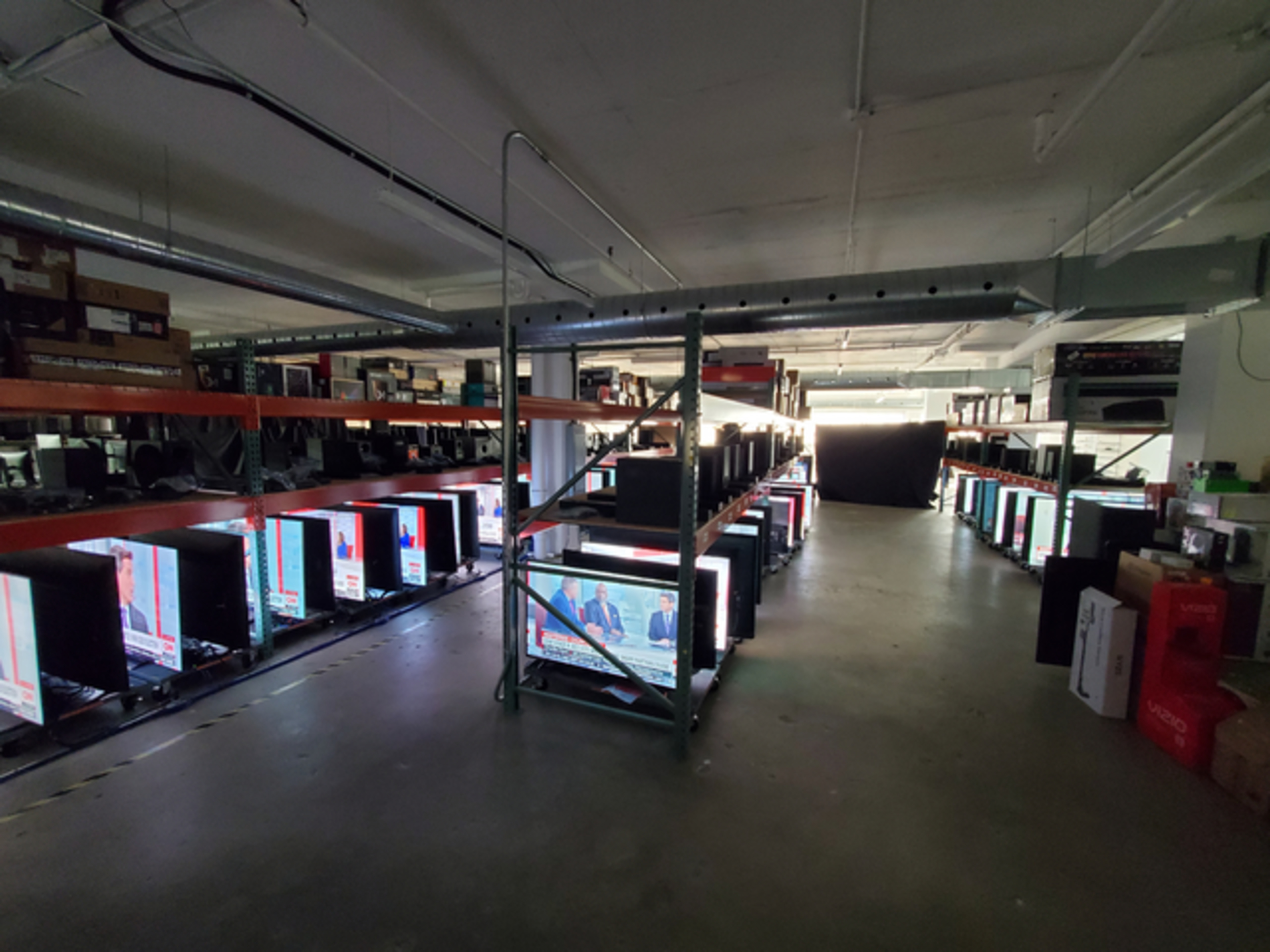
The main goal of the accelerated longevity test is to push TVs to their limits so we can better understand how long a TV should last. So it's normal that as part of that process, some TVs will fail. The accelerated longevity test ran for nearly three years, from November 2022 to September 2025. During that time, 20 out of 100 TVs encountered complete failures during the test, and 24 additional TVs experienced partial failures. In this article, we'll break down those failures, what happened to those TVs, and whether or not the TV was reparable. We'll also break down these failures by failure point, panel technology, brand, and price to look for potential trends in failure rates. We'll also be posting other deep dives into specific failure points later.
Failures
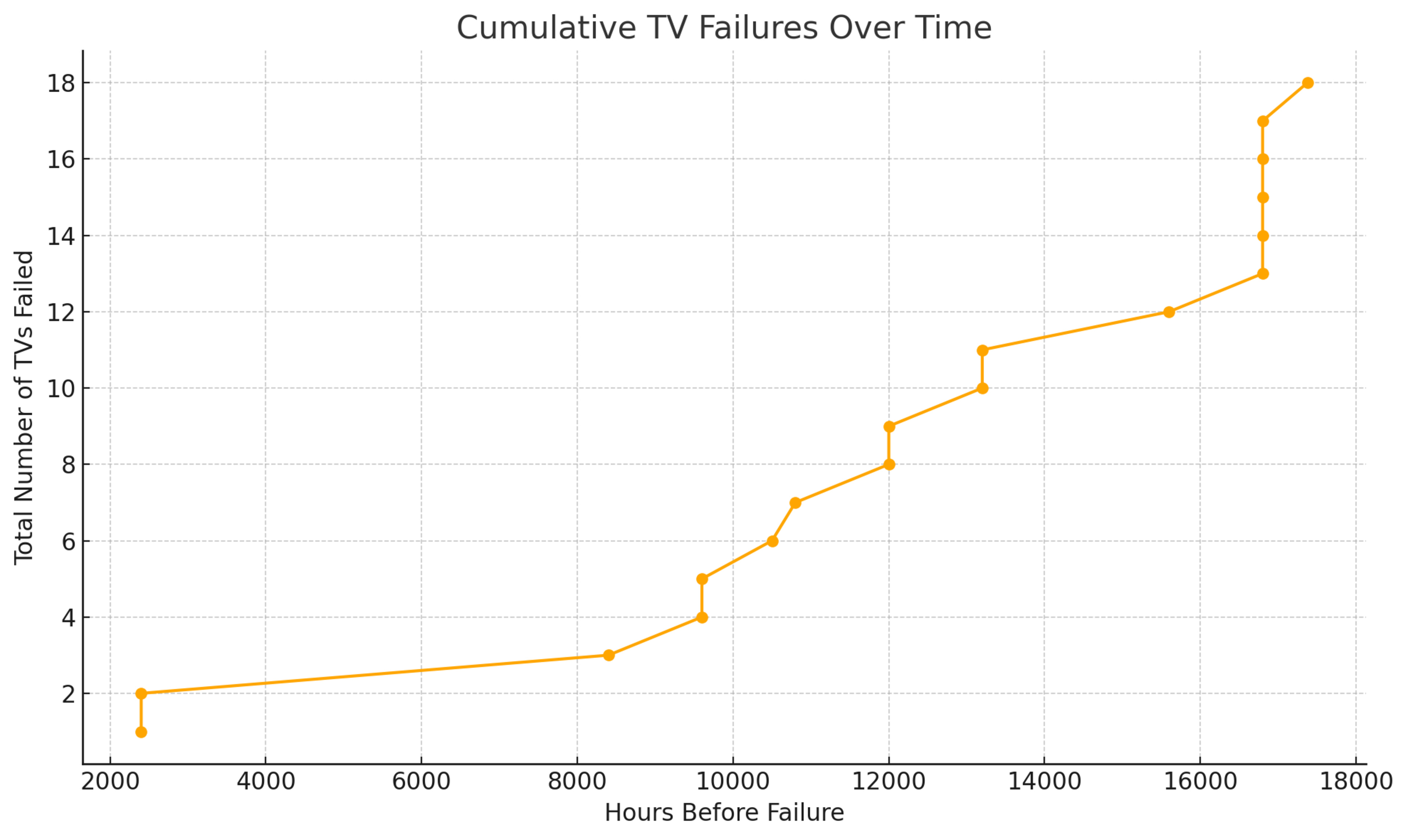
During our nearly three-year accelerated longevity test involving 102 TVs, a total of 20 TVs failed outright and had to be removed from the test. If we plot those failures by the number of hours the TV lasted until failure, we can see the right side of the bathtub curve that we expected at the beginning of the test. There were very few early failures, but this was expected as the TVs used in this test were already used for hundreds of hours as part of the review process, so most early failures would have failed before we started the test. The great news here is that the vast majority of TVs were relatively free from issues for the first 10,000 hours or so, which is roughly 10 years of usage for the average American household.
Complete Failures
Below is the list of all failures we encountered over the three-year test, which required a TV to be removed from the test, even temporarily.
| Model | Reviewed Size | Type | Sub-Type | Backlight | Issue First Appeared (Month) | Failed After (Month) | Failure Type | Additional Notes |
|---|---|---|---|---|---|---|---|---|
| Amazon Fire TV 4-Series | 55" | LED | VA | Direct | 22 | 22 | Backlight failure | |
| Amazon Fire TV Omni Series | 65" | LED | VA | Direct | 4 | 28 | Backlight failure | |
| Hisense U7G | 65" | LED | VA | Full Array | 4 | 4 | Backlight failure | Replaced power supply and LED driver and returned to test. |
| Hisense U8H | 65" | LED | VA | Full Array | 10 | 16 | Color shift | |
| Hisense A6H | 65" | LED | IPS | Direct | 20 | 20 | Backlight failure | |
| Hisense A6G | 65" | LED | IPS | Direct | 22 | 22 | No longer powers on | |
| Hisense H8G | 55" | LED | VA | Full Array | 14 | 26 | Backlight failure | |
| Insignia F50 | 65" | LED | VA | Direct | 2 | 18 | Backlight failure | |
| LG G2 | 65" | OLED | WOLED | N/A | 24 | 24 | Dead subpixels | Started randomly shutting off March 2025, returned to test in June. |
| Samsung S95B | 65" | OLED | QD-OLED | N/A | 4 | 4 | Power supply failure | Replaced power supply and returned to test. |
| Samsung QN900A | 65" | LED | VA | Full Array | 4 | 4 | Power supply failure | Replaced power supply and returned to test. |
| Samsung AU8000 | 65" | LED | VA | Edge | 4 | 14 | Backlight failure | |
| Samsung The Frame 2022 | 65" | LED | VA | Edge | 6 | 16 | Diffusor warped from heat | |
| Sony X95J | 75" | LED | VA | Full Array | 2 weeks | 4 | Uniformity issues, panel broke during teardown | |
| Sony A80K | 65" | OLED | WOLED | N/A | 4 | 4 | Internal component failure | |
| Sony X800H | 55" | LED | IPS | Direct | 18 | 18 | Backlight failure | |
| Sony X90J | 55" | LED | VA | Full Array | 28 | 28 | No longer powers on | |
| TCL S546 | 65" | LED | VA | Full Array | 6 | 28 | xQDEF layer failure | |
| Toshiba C350 2021 | 55" | LED | IPS | Direct | Backlight started failing month 2 | 22 | No longer powers on | |
| Vizio M6 Series Quantum 2021 | 65" | LED | VA | Direct | Backlight started failing month 22 | 28 | No longer powers on |
One interesting thing to note is that of the 20 failures, we were only able to repair and return two of them to the test. Many TVs simply aren't designed to be repaired, and while a certified repair center may have had better success repairing them, for most consumers, it wouldn't be worth doing. Almost all of these failures would've occurred outside of the normal warranty window under normal viewing conditions.
Partial Failures
The above TVs failed in such a way that they could no longer be tested on the longevity test. But they're not the only TVs that experienced issues during the test. Below is a short list of the partial failures on the test. Many of these TVs are bad enough that if you experience these issues at home, you would most likely replace the TV, but they're still able to display an image from an external source, so we didn't remove them.
| Model | Type | Sub-Type | Backlight | Local Dimming | Issue First Appeared (Month) | Issue Type |
|---|---|---|---|---|---|---|
| Hisense H9G | LED | VA | Full Array | Yes | 30 | LEDs failing |
| Hisense U8G | LED | VA | Full Array | Yes | 30 | LEDs failing |
| Hisense U9DG | LED | IPS | Full Array | Yes | 30 | LEDs failing |
| LG NANO75 2021 | LED | IPS | Direct | No | 30 | LEDs failing |
| LG NANO75 2022 | LED | IPS | Direct | No | 22 | LEDs failing |
| LG NANO85 2020 | LED | IPS | Edge | No | 26 | LEDs failing, light guide plate cracking |
| LG NANO85 2021 | LED | IPS | Edge | No | 26 | LEDs failing, light guide plate cracking |
| LG NANO90 2021 | LED | IPS | Full Array | Yes | 2 | Uniformity issues |
| LG QNED80 2022 | LED | IPS | Edge | Yes | 18 | LEDs failing, light guide plate cracking |
| LG QNED99 8k | LED | IPS | Full Array | Yes | 10 | Color shift |
| LG UP8000 | LED | IPS | Direct | No | 24 | LEDs failing |
| Samsung Q60B | LED | VA | Edge | No | 18 | LEDs failing, light guide plate cracking |
| Samsung Q70A | LED | VA | Edge | No | 10 | Color shift |
| Samsung Q900TS 8k QLED | LED | VA | Full Array | Yes | 6 | Color shift |
| Samsung QN900A 8k QLED | LED | VA | Full Array | Yes | 6 | Color shift |
| Samsung TU7000 | LED | VA | Direct | No | 12 | Color shift |
| Samsung TU8000 | LED | VA | Direct | No | 6 | Color shift |
| Sony X80J | LED | IPS | Direct | No | 20 | LEDs failing |
| Sony X80K | LED | IPS | Direct | No | 12 | LEDs failing |
| Sony X85K | LED | VA | Direct | No | 16 | LEDs failing |
| Vizio M7 Series Quantum 2021 | LED | VA | Full Array | Yes | 16 | Uniformity issues |
| Vizio P Series Quantum 2020 | LED | VA | Full Array | Yes | 26 | LEDs failing |
| Vizio P Series Quantum 2021 | LED | VA | Full Array | Yes | 28 | LEDs failing |
| Vizio V Series 2022 | LED | VA | Direct | No | 12 | Color shift |
Failure Breakdown
From all of the above data, we can start breaking it down into different categories to look at trends. Keep in mind that this is a relatively small sample size, and some results aren't necessarily statistically relevant.
By Brand
| Brand | Total TVs | Complete Failures | Partial Failures | Most Common Failure Point |
|---|---|---|---|---|
| Amazon | 2 | 2 | 0 | Backlight failure |
| Hisense | 13 | 5 | 3 | Backlight failure |
| Insignia | 1 | 1 | 0 | Backlight failure |
| LG | 24 | 1 | 8 | Backlight failure |
| Samsung | 23 | 4 | 6 | Power supply failure |
| Sony | 18 | 4 | 3 | Electronics failure |
| TCL | 10 | 1 | 0 | Backlight failure |
| Toshiba | 1 | 1 | 0 | Electronics failure |
| Vizio | 10 | 1 | 4 | Electronics failure |
Every brand encountered some failures during the test, and both LG and TCL fared incredibly well overall. LG TVs experienced a very high number of partial LED failures, but very few TVs failed outright. Only one TCL TV failed during the test, which is especially impressive, as it occurred only a few weeks before the end of the test. Every Amazon, Insignia, and Toshiba TV on the test failed, but the sample size is very small, so it's not indicative of the overall longevity of those brands.
By Backlight Type
| Backlight Type | Total TVs | Complete Failures | Partial Failures |
|---|---|---|---|
| Direct - No Local Dimming | 28 | 8 | 8 |
| Edge - No Local Dimming | 10 | 2 | 4 |
| Edge - With Local Dimming | 1 | 0 | 1 |
| Full Array | 43 | 7 | 8 |
| OLED | 20 | 3 | 0 |
By breaking the data down by the backlight type, we see that both direct and edge-lit TVs with no local dimming encountered significant issues during our test, with almost 60% of them experiencing either a partial or complete failure. The vast majority of these TVs had at least one LED fail during the test, and the light guide plate was also a common point of failure for edge-lit TVs. This isn't a surprise, as we established very early on in our test that thin LCD TVs break faster. Another problem with these TVs is that the LEDs are often wired in series, so if one goes out, the entire series goes out. On some TVs, this results in an entire row or column going out; in others, the TV enters a safe mode and the entire backlight goes out, or the TV fails to turn on.
Higher-end TVs with full-array backlights handled the wear a bit better, but approximately 25% of them experienced LED failures. More interesting is how these LED failures are presented on the TV. The individual LEDs in a TV's backlight are almost always wired in groups, with multiple LEDs in each individual dimming zone. This means that when one fails, you're usually not going to see a small dark spot on the screen; instead, it'll take out a larger group made up of multiple LEDs. For example, on the Hisense H8G, 62 out of 72 zones failed, but when we took it apart, we discovered that less than half of the LEDs had failed (71/144). Because the LEDs were wired in pairs, a single failed LED would take out an entire zone. Another example is the Vizio M6 Series Quantum 2021; we discovered that even though the entire backlight stopped working and we couldn't see anything on the screen, only three of the backlight LEDs failed. Due to the way the LEDs were wired, though, this relatively small failure took out the entire backlight array.
By Panel Type
| Panel Type | Total TVs | Complete Failures | Partial Failures |
|---|---|---|---|
| VA | 58 | 13 | 13 |
| IPS | 24 | 4 | 11 |
| WOLED | 17 | 2 | 0 |
| QD-OLED | 3 | 1 | 0 |
Breaking the failures down by panel type doesn't really expose anything new. IPS panels appear to perform the worst, but this is a bit of a red herring. Of the 24 IPS TVs on the test, 16 of them are entry-level models that are either edge-lit or use direct lighting, and those TVs tend to break down quicker than other backlight types. As for OLEDs, both types seem to perform exceedingly well, and outside of OLED burn-in, which isn't really an issue under mixed usage, there were relatively few failures.
By Price
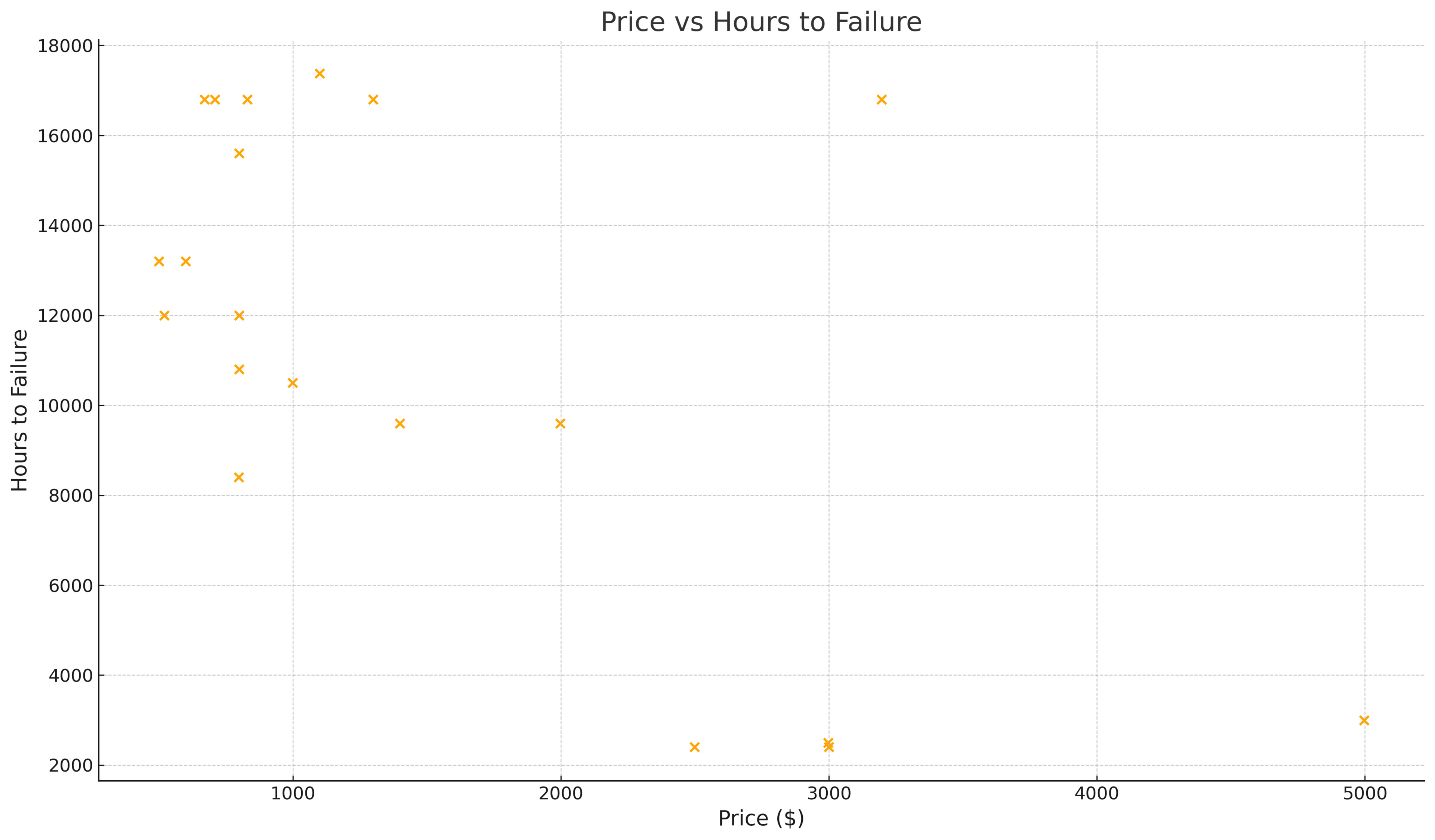
One common question we get is whether cheap TVs really don't last as long as high-end models. From this test, we can see that there's really no clear direct link between price and longevity; some of the cheapest models on this test have performed incredibly well with no issues, and some of the more expensive units were the first to fail. Price is no guarantee of repairability, either. While some cheaper TVs seemed to use a simpler assembly, almost all units use glue to assemble key components of the panel. This makes it very difficult to repair most issues.
Conclusion
After running for almost three years, most of the TVs on our accelerated longevity test have accumulated around 18,000 hours of runtime. This far exceeds how long most people will keep their TVs, and we've learned a lot about the types of failures people should expect from their TV. Backlight issues are by far the most common point of failure, with 34% of all LED models tested experiencing at least one failed LED. Uniformity issues are also extremely common, as heat causes the internal layers of a TV to delaminate over time, leading to a patchy image and even discoloration over time.
Every OLED tested also experienced burn-in within the first few months of the test. This is an expected outcome, though, as this torture test is meant to push these TVs to their limits. Previous burn-in tests have shown that with varied content, this won't be an issue. We also encountered a few issues with internal electronics. Two TVs had power supply failures that were fairly easy to fix, and multiple TVs simply stopped working at some point, likely due to random component failures in the TVs' circuitry.
So, overall, what should you look for and what should you avoid when shopping for a new TV? Well, despite the small chance of burn-in, OLEDs tend to last the longest and experience the fewest issues of any display technology. LED TVs tend to break faster, especially thin edge-lit models or entry-level models with a direct backlight, so look for full-array models instead, as these tend to have the fewest issues. Price isn't an issue, so don't worry about getting a cheaper model or something from a lesser-known brand. Those models may have more early issues due to less intensive quality assurance at the factory, an issue this test didn't explore, but if you get a good unit, it should last you for many years.