Sony WI-C300 Wireless  Headphones Review

Reviewed Jun 28, 2018 at 11:52am
Test bench update Nov 21, 2019 at 11:26am
Tested using Methodology v1.3.1 
Sony WI-C300 Wireless
6.6
Mixed Usage 
6.3
Neutral Sound 
7.0
Commute/Travel 
7.6
Sports/Fitness 
6.4
Office 
4.9
Wireless Gaming 
4.9
Wired Gaming 
6.1
Phone Call 
 0
The Sony WI-C300 are average wireless in-ears for most use cases. They have a simple and easy-to-use design, although their control scheme doesn't have the best feedback. They're compact enough to fit in your pockets and sufficiently stable for running, which makes them a good option for sports. They also sound moderately well-balanced, although they won't be ideal for more critical listeners. Unfortunately, they have a weak build quality that doesn't feel as durable as some of the other in-ears in their price range. They also have a slightly bulky module on their cable which may be bothersome for certain listeners.

Our Verdict

6.6
Mixed Usage 

The Sony WI-C300 are an average mixed usage wireless in-ear. They have a passable sound quality that would be good enough for most but not ideal for more critical listeners. They also have a decent battery life and wireless range but lack a few features compared to similarly designed headphones. They do not have as many tip sizes and lack stability fins but should be stable enough to run with. Unfortunately, their build quality is mediocre at best and the thin cables do not seam very durable. They also do not block noise as well as typical in-ears, so they won't be the best headphones for commuting.

Pros
  • Simple and compact design.
  • Breathable and stable enough for sports.
  • Very low leakage.
Cons
  • Mediocre-at-best noise isolation.
  • Weak build quality.
  • Poor microphone quality.
  • Bass delivery varies significantly across users.
6.3
Neutral Sound 

Passable for neutral listening. These headphones have a decently well-balanced frequency response although they can sound a bit sharp on already bright tracks and their bass range tends to be a little boomy and cluttered. On the upside, they should sound good enough for most listeners but they do not have a large and spacious soundstage due to their small closed back earcups which won't be ideal for more neutral listening.

7.0
Commute/Travel 

Decent for commuting. They're compact and fit into most pockets. They also have a decent control scheme that you can use on the go with your phone. Unfortunately, the in-ear fit does not block as much noise as typical in-ear headphones but should be fine if you're playing your music at higher than average volumes.

7.6
Sports/Fitness 

Good for sports. The Sony WIC300 have a decently stable in-ear fit, they're wireless and small enough to carry around on your person wherever you go. Unfortunately, though functional, their in-line remote doesn't have the best feedback and the module on the back of the cable may cause the earbuds to slip out of your ears during more intense physical exercises.

6.4
Office 

Decent for office use. The Sony WI-C300 don't leak, so you can mask the ambient noise of a lively office by playing your audio at higher than average volumes.

4.9
Wireless Gaming 

Sub-par for gaming. They have a mediocre-at-best mic, lack customization options and have a bit too much latency to be suitable for gaming. They're also Bluetooth only headphones that will not pair with your Xbox One or PS4.

4.9
Wired Gaming 
6.1
Phone Call 
  • 6.6
    Mixed Usage
  • 6.3
    Neutral Sound
  • 7.0
    Commute/Travel
  • 7.6
    Sports/Fitness
  • 6.4
    Office
  • 4.9
    Wireless Gaming
  • 4.9
    Wired Gaming
  • 6.1
    Phone Call
  • Changelog

    1.  Updated Nov 21, 2019: Converted to Test Bench 1.3.1.
    2.  Updated Nov 21, 2019: Converted to Test Bench 1.3.
    3.  Updated Jun 28, 2018: Review published.
    4.  Updated Jun 27, 2018: We've purchased the product and are waiting for it to arrive in our lab.

    Popular Headphones Comparisons

    Comparison picture

    The Sony WI-C300 are basic wireless in-ears, decent enough for most use cases. They have a moderately balanced sound, a decent battery life and wireless range, and a simple design that's easy to use but doesn't have the best feedback. They're also a bit more comfortable than typical in-ears thanks to their small buds. Unfortunately, they do not come with a lot of tip options, and their build quality doesn't feel as durable as some of the other wireless in ears in their price range compared below. They also do not block noise as well as more conventional in-ear designs. Check our recommendations for the best sounding wireless earbuds, the best Bluetooth earbuds under $50 and the best wireless earbuds.

    JBL E25BT Wireless

    The JBL E25BT are better headphones overall than the Sony WI-C300. The JBLs also have a higher-end build quality and a flatter battery module with better cable management. The E25BT also have longer battery life and a more balanced sound with deeper bass. The WI-C300, on the other hand, support NFC, which makes them slightly easier to pair with mobile phones.
    Overhauling Our Audio Measurements And A New Multi-Curve Graphing Tool

    We've upgraded our Headphones Test Bench to 2.0! This update brings several key changes to our tests and usages, making it easier than ever to interpret our sound results based on your personal preferences. You'll also find a brand-new interactive graph tool featuring multiple targets (including our own!) for you to explore and compare.

    For a full breakdown, check out our changelog, which includes detailed commentary from our test designer explaining the rationale behind our update.

    We'd also love to hear your thoughts: your feedback helps us keep improving, so join us in the comments!

    Test Results

    Sort:
    RATINGS
    Category:
    All
    Design
    Style
    TypeIn-ear
    EnclosureClosed-Back
    WirelessYes
    TransducerDynamic

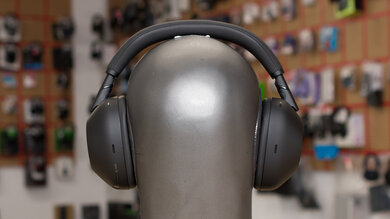
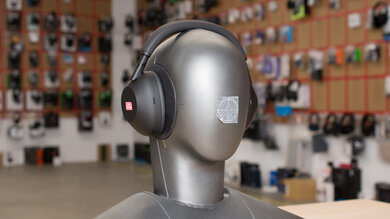
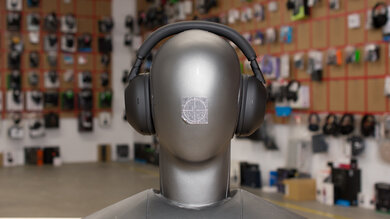
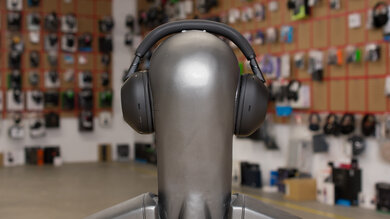
    The Sony WI-C300 have a basic wireless in-ear design. They have small earbuds that look a bit cheap and a thin cable that has an additional compartment to house the battery. They look fairly similar to the Mee audio M9B, except for the extra module, which some may prefer as it reduces the size of the in-line remote. Unfortunately, this design choice won't be for everyone, but on the upside, they come in a couple of color schemes to match your taste.

    7.0
    Comfort
    Weight0.06 lbs
    Clamping Force
    0 lbs

    The Sony WI-C300 are lightweight in-ear headphones with a decently comfortable fit. The earbuds are very small and do not have many points of contact with the outer parts of your ear canal like conventional in-ears, which makes them a bit less fatiguing to wear for long listening sessions. However, they do not come with as many tip options as some of the other in-ears we've tested like the 1More Triple Driver or the Mee audio M6 Pro, which could have improved their overall comfort level. Also, they have a rather bulky module on the back of the cable which will bounce up and down when working out or running, (unless tucked into a shirt) which may be a bit bothersome.

    6.1
    Controls
    OS Compatibility
    N/A
    Ease Of UseOkay
    FeedbackMediocre
    Call/Music ControlYes
    Volume ControlYes
    Microphone ControlNo
    Channel Mixing
    N/A
    Noise Cancelling ControlNo
    Talk-Through
    N/A
    Additional ButtonsN/A

    These headphones have a simple 3 button set up that's decently easy to use but does not provide the best feedback. They deliver all the necessary functions; track-skipping, call/music and volume controls. Unfortunately, the buttons do not have much travel and are quite flush with the in-line remote, which makes them a bit difficult to find by touch alone.

    9.2
    Breathability
    Avg.Temp.Difference0.8 °C

    The Sony WI-C300 have good breathability. They do not touch any parts of your outer ear, so they will not make your ears warmer than usual. They're also a bit smaller than typical in-ears, so they barely cause any temperature difference even during more strenuous activities. They're a good option for sports and working out (see our recommendations for the best headphones for running and working out).

    8.6
    Portability
    L3"
    W1.9"
    H1"
    Volume6 in³
    Transmitter RequiredN/A

    The Sony WI-C300 are portable headphones that will easily fit into your pockets. Their earbuds are smaller than typical in-ears, but they have an additional module on their cable that makes them slightly bulkier than some of the other wireless in-ears we've tested like the Jaybird Freedom. Unfortunately, they also do not come with a case.

    0.0
    Case
    TypeN/A
    LN/A
    WN/A
    HN/A
    VolumeN/A

    These headphones do not come with a case.

    6.0
    Build Quality

    The WI-C300 have a mediocre-at-best build quality with thin cables. The earbuds are lightweight but look a bit cheap. The in-line remote feels a bit plasticky, and the audio cables are thin and not as rubberized as more premium in-ears. The cable is also not removable so they won't last as long as some of the more high-end in-ears we've reviewed so far.

    7.0
    Stability

    The Sony WI-C300 have decently stable wireless in-ear design but do not come with any additional stability tips or ear hooks like the Powerbeats3 Wireless. They also have a fairly bulky module on their audio cable that bounces around if not tucked under your shirt. It pulls slightly on the earbuds making them a bit less stable than other wireless in-ears with a similar design. They will be stable enough for running but may occasionally slip out of your ears during more strenuous workouts. I

    Headshots 1
    Headshots 2
    Top
    In The Box

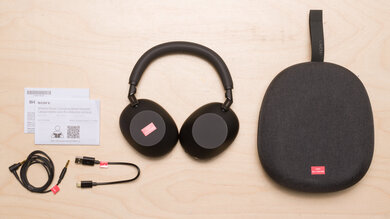
    • Sony WI-C300 Headphones
    • Earbud tips (x3 sizes)
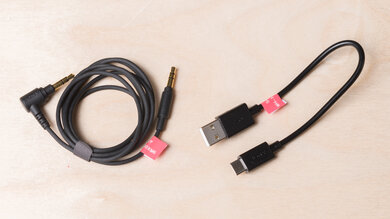
    • USB charging cable
    • Manual
    Sound
    Sound Profile
    See details on graph tool
    Bass Amount
    -3.17 dB
    Treble Amount
    -2.35 dB
    6.4
    Frequency Response Consistency
    See details on graph tool
    See details on graph tool
    Avg. Std. Deviation
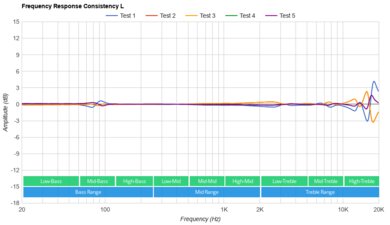
    0.79 dB

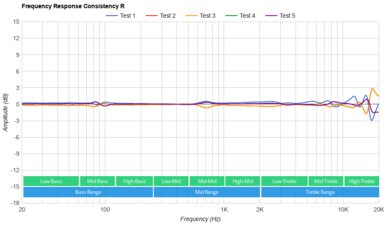
    The frequency response consistency of the Sony WI-C300 is about average. If the user is able to achieve a proper fit and an air-tight seal using the assortment of tips that come with the headphones then they should be able to get consistent bass and treble delivery every time they use the headphones. However, it seems these in-ears are more sensitive to placement than usual and if they are not positioned deep enough in the canal, the user may experience a drop in bass.

    Raw Frequency Response
    See details on graph tool
    See details on graph tool
    7.5
    Bass Accuracy
    See details on graph tool
    Std. Err.
    3.38 dB
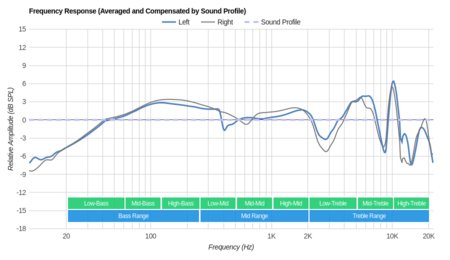
    Low-Frequency Extension
    41.17 Hz
    Low-Bass
    -4.59 dB
    Mid-Bass
    0.35 dB
    High-Bass
    4.36 dB

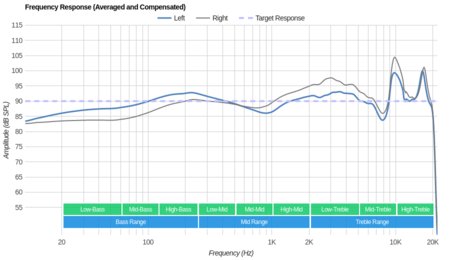
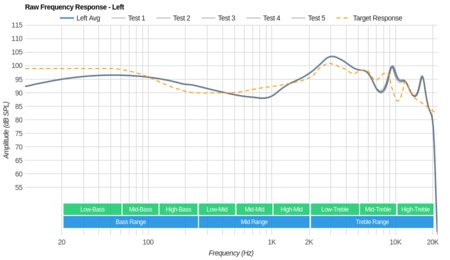
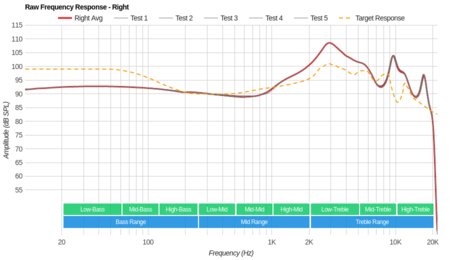
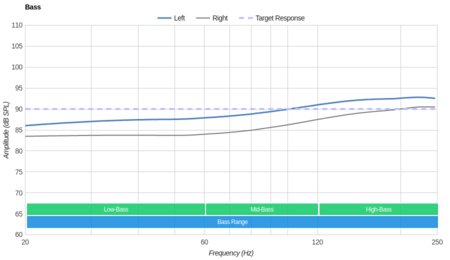
    The bass of the Sony WI-C300 is good. LFE (low-frequency extension) is at 41Hz, which is good. However, low-bass which is responsible for the thump and rumble common to bass-heavy tracks is lacking by 5dB. Mid-bass, responsible for the body of bass guitars and the punch of kick drums is within 0.3dB of our target, but with a tilt favoring higher frequencies. High-bass, responsible for warmth, is overemphasized by more than 4dB. This makes the overall sound noticeably boomy and muddy. Also, their bass delivery varies noticeably across users, and is sensitive to the quality of fit and seal. The response here represents the average bass response and your experience may vary.

    8.3
    Mid Accuracy
    See details on graph tool
    Std. Err.
    2.24 dB
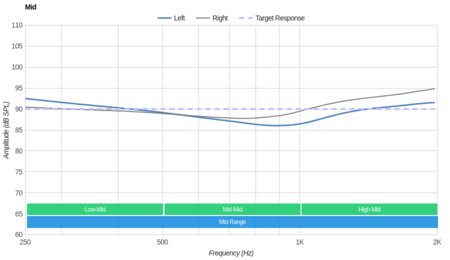
    Low-Mid
    2.76 dB
    Mid-Mid
    -0.61 dB
    High-Mid
    1.86 dB

    The mid-range is great. The overall response is quite even and decently balanced. The 3dB bump in low-mid is actually the continuation of the high-bass overemphasis. This tends to thicken the vocals a bit and add some clutter to the overall mix. Mid-mid is quite well-balanced, but high-mid is slightly overemphasized. This could make the mid-range a bit forward.

    7.6
    Treble Accuracy
    See details on graph tool
    Std. Err.
    3.83 dB
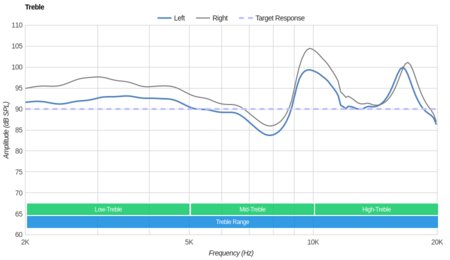
    Low-Treble
    2.6 dB
    Mid-Treble
    -1.49 dB
    High-Treble
    -3.52 dB

    The treble range performance is good. Low-treble is even and flat but overemphasized by more than 2.5dB. This brings a bit of excess brightness to the overall sound. Mid-treble is relatively uneven. The dip around 8KHz could make some sibilances (S and Ts) a bit lacking, and the peak around 10KHz could make some other sibilances noticeably sharp.

    7.1
    Peaks/Dips
    See details on graph tool
    Peaks
    1.83 dB
    Dips
    1.57 dB
    7.2
    Imaging
    See details on graph tool
    See details on graph tool
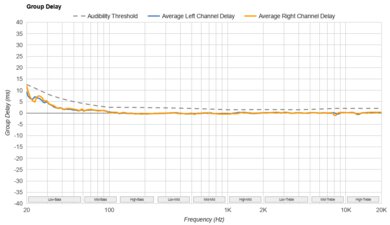
    Weighted Group Delay
    0.16
    Weighted Amplitude Mismatch
    3.33
    Weighted Frequency Mismatch
    2.88
    Weighted Phase Mismatch
    3.15

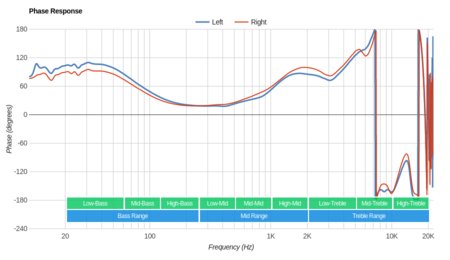
    The imaging performance of the Sony Sony WIC300 is decent. Weighted group delay is at 0.16 which is very good. The GD graph also shows that the entire group delay response is below the audibility threshold. This suggests a tight bass and a transparent treble reproduction. However, our test unit showed an audible level mismatch between the L/R drivers, which skews the stereo image and makes one side heavier.

    It should be noted that this mismatch could be unique to our test unit and the one you buy may not have this issue. However, this could be considered as a metric for manufacturing tolerance of these headphones.

    1.0
    Soundstage
    PRTF Accuracy (Std. Dev.)
    N/A
    PRTF Size (Avg.)
    N/A
    PRTF Distance
    N/A
    Openness
    3.5
    Acoustic Space Excitation
    1.4

    The soundstage is poor. This is because creating an out-of-head and speaker-like soundstage is largely dependent on activating the resonances of the pinna (outer ear). The design of in-ears and earbuds is in such a way that fully bypasses the pinna and doesn't interact with it. Also, because these headphones have a closed-back enclosure, their soundstage won't be perceived to be as open as that of open-back earbuds like the Apple AirPods (1st generation) Truly Wireless or the Bose SoundSport Free Truly Wireless.

    6.6
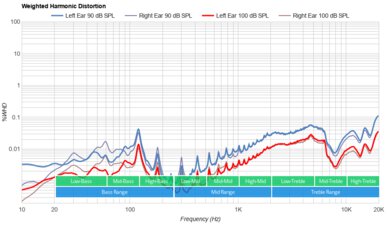
    Weighted Harmonic Distortion
    See details on graph tool
    WHD @ 90
    0.663
    WHD @ 100
    0.412
    Isolation
    6.3
    Noise Isolation
    See details on graph tool
    Isolation Audio
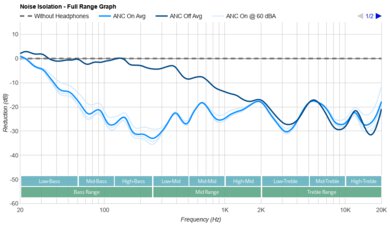
    Overall Attenuation
    -18.63 dB
    Noise CancellingNo
    Bass
    -1.44 dB
    Mid
    -13.88 dB
    Treble
    -41.56 dB

    The Sony WI-C300 have a mediocre isolation performance. In the bass range, where the rumble of bus and airplane engines sit, they achieve about 1dB of isolation, which is barely noticeable. In the mid-range, important for cutting out speech, they isolate by more than 14dB, which is above-average. In the treble range, occupied by sharp S and T sounds, they isolate by about 42dB, which is excellent.

    8.8
    Leakage
    See details on graph tool
    Leakage Audio
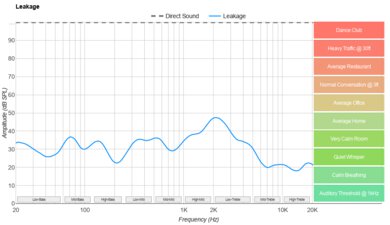
    Overall Leakage @ 1ft
    28.22 dB

    The leakage performance is great. Similar to most other closed-back in-ears, these headphones don't leak in the bass and mid ranges. The significant portion of their leakage is in the treble range and between 3KHz and 6KHz, which is quite a narrow range. The overall level of the leakage is not loud either. With the music 100dB SPL the leakage at 1 foot away averages at 28dB SPL and peaks at around 48dB SPL, which is just below the noise floor of an average office.

    Microphone
    Microphone Style
    Integrated
    No
    In-line
    Yes
    Boom
    No
    Detachable Boom
    N/A
    MicYes

    The in-line microphone of the Sony WI-C300 has a sub-par quality. In quiet environments, speech recorded or transmitted with this mic will sound full-bodied, but quite muffled and lacking in detail. They are also prone to pops and low-rumbling noises, and won't be the ideal choice for making calls. In noisy environments, they will struggle to separate speech from background noise even in moderately loud situations, like a busy street.

    5.8
    Recording Quality
    See details on graph tool
    Recorded Speech
    LFE
    162.33 Hz
    FR Std. Dev.
    4.25 dB
    HFE
    2,061.43 Hz
    Weighted THD
    4.975
    Gain
    42.89 dB

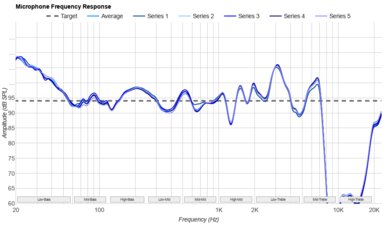
    The microphone has a sub-par recording quality. The bump in low-bass makes this mic prone to pops and low-rumbling noises. The rest of the response in the bass range is not too bad, so voice will sound relatively full-bodied. The HFE (high-frequency extension) of 2.1KHz is quite poor and results in speech that is muffled and lacking in detail. It also negatively affects the intelligibility of speech.

    6.1
    Noise Handling
    See details on graph tool
    Speech + Pink Noise
    Speech + Subway Noise
    SpNR
    13.77 dB

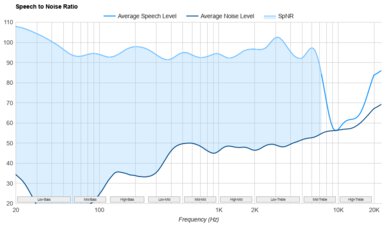
    The microphone is mediocre at noise-handling. In our SpNR test, they achieved a speech-to-noise ratio of 14dB, indicating they are best suited for quiet environments and will struggle to separate speech from ambient noise in moderate and loud situations.

    Active Features
    5.6
    Battery
    Battery Type
    Rechargable
    Continuous Battery Life
    8.1 hrs
    Additional Charges
    0
    Total Battery Life
    8.1 hrs
    Charge Time
    1.7 hrs
    Power Saving Feature
    No
    Audio While Charging
    No
    Passive Playback
    No
    Charging Portmicro-USB

    These headphones have a decent 8-hour battery life but do not have a lot of power saving features. You can't use them while they are charging, they have no auto-off feature once connected to a Bluetooth source, and no passive playback since they are Bluetooth only headphones. On the upside, they charge decently quickly at 1.7 hours.

    0.0
    App Support
    App NameN/A
    iOSN/A
    AndroidN/A
    macOSN/A
    WindowsN/A
    Equalizer
    N/A
    ANC Control
    N/A
    Mic ControlN/A
    Room effects
    N/A
    Playback Control
    N/A
    Button MappingN/A
    Surround SoundN/A

    The Sony WIC300 headphones do not come with a compatible app for added customization options.

    Connectivity
    7.4
    Bluetooth
    Bluetooth Version
    4.2
    Multi-Device Pairing
    No
    NFC Pairing
    Yes
    Line of Sight Range
    79 ft
    Default Latency
    237 ms
    aptX Latency
    N/A
    aptX(LL) Latency
    N/A

    The Sony WI-C300 do not have multi-device pairing but do support NFC. Their hold-to-pair procedure is also not too difficult to use or not as frustrating as some Bluetooth headphones we've tested.

    Disappointing latency performance. The Sony WI-C300 have about 237ms of latency which is on the high side of most Bluetooth headphones making them even less suitable for watching movies and gaming.

    0.0
    Non-Bluetooth Wireless
    Non-BT Line of Sight Range
    N/A
    Non-BT Latency
    N/A
    0.0
    Wired
    Analog Audio
    N/A
    USB Audio
    N/A
    DetachableNo
    LengthN/A
    ConnectionN/A
    Wired Latency
    N/A

    The Sony WI-C300 are Bluetooth-only headphones with no wired option. If you want a decent sounding, wired design with a universal in-line remote, then check out the 1More Triple Driver In-Ear.

    PC / PS4 Compatibility
    PC / PS4 Analog
    No
    PC / PS4 Wired USB
    No
    PC / PS4 Non-BT Wireless
    No
    Xbox One Compatibility
    Xbox One Analog
    No
    Xbox One Wired USB
    No
    Xbox One Wireless
    No
    0.0
    Base/Dock
    Type
    N/A
    USB Input
    N/A
    Line In
    N/A
    Line Out
    N/A
    Optical Input
    N/A
    RCA Input
    N/A
    Dock Charging
    N/A
    Power Supply
    N/A

    These in-ear buds do not have a dock. If you want a headphone that's versatile and has a dock, try the SteelSeries Arctis 7. However, it won't be as compact and easy-to-carry around on your person.