
Our Verdict
Very good all-round TV. The OLED panel has great picture quality for movies and TV shows. Unfortunately it doesn't get very bright.
- Perfect blacks
- Perfect motion (although flicker free)
- Great viewing angle (but with a yellow tint)
- Not ideal in a bright room (purple reflections and doesn't get very bright)
- Varying luminosity depending on the scene (ABL)
- Poor dark colors uniformity
- Prone to temporary image retention after displaying static images
Great movie performance. Lots of details in the shadows and perfect blacks. Unfortunately there is some vignetting in dark scenes.
Excellent for watching TV shows in a living room. Great picture quality, even when viewed from the side and deals well with reflections. Unfortunately can't get very bright to compete with a light room.
Very good sports performance. Almost perfect motion handling for fast plays. Unfortunately for hockey the ABL changes the screen luminosity.
Very good video game performance. Input lag should not be an issue for most people. Excellent motion handling for fast paced games.
Disappointing HDR performance. Highlights cannot get very bright and average-good color gamut.
Pretty good PC monitor. Great picture quality and displays crisp, clear text at 1080p. Unfortunately there is some temporary image retention.
Check Price

We buy and test dozens of TVs yearly, taking an objective, data-driven approach to deliver results you can trust. Our testing process is complex, with hundreds of individual tests that take over a week to complete. Most of our tests use specially designed test patterns that mimic real content, but we also use the same sources you have at home to ensure our results match the real-world experience. We use two main tools for our testing: a Colorimetry Research CR-100 colorimeter and a CR-250 spectroradiometer.
Test Results
Older Test Bench: We tested this product using an older TV test methodology before a major update. Some of the test results below aren't directly comparable with other TVs. Learn more
for pictures & test results

The LG EC9300 OLED TV has a curved screen. The borders are very small, and the stand is stable, with a small footprint.


Our luminance meter (Minolta LS-100) gave us a perfect 0.000 cd/m2 reading on a checkboard pattern, resulting in an infinite contrast ratio.
for videos & test results

Of course, it doesn't have a backlight, so there is no local dimming. But for the sake of comparison, we ran our local dimming test. As expected, there is no blooming.
When HDR arrives, one of the elements that will distinguish the performance of TVs is how bright it can make the highlights of a picture. Like plasma TVs, OLEDs have an automatic brightness limiter (ABL). The less whites the TV needs to display, the brighter those whites will be. We measured the luminosity of a 2% white window at 342.7 cd/m2, which isn't particularly impressive. Due to the ABL, a white fullscreen is even less, at only a maximum luminosity of 94.6 cd/m2. See here for a full table of the luminosity of different window sizes.
for pictures & test results

The darker the color, the worse the uniformity gets. It is also constantly changing. More detailshere.
for videos & test results
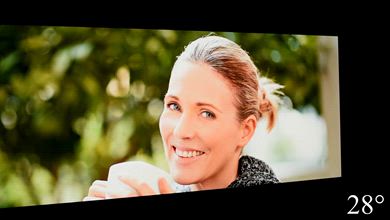
The viewing angle is great, better than every LCD TV. We measured a drop of half the luminosity at 82 °, which is excellent. However, there is a yellow tint at an angle, something that our current test doesn't factor in.
Update 01/06/2017: We have changed the methodology of testing. Since this is an old TV which we don't have anymore, we extrapolated the results from 2016 TVs.
for pictures & test results

The blacks are also perfectly uniform. Note that this is only for a pure black. The uniformity isn't perfect for solid colors (more on this later).


for pictures & test results

Standard TV content or DVDs looks good without any major image quality problems.
for pictures & test results

Upscaled cable and other 720p content looks good and is in line with other 1080p TVs.
for pictures & test results

Blu-rays and other 1080p looks good without any image quality problems.
for pictures & test results
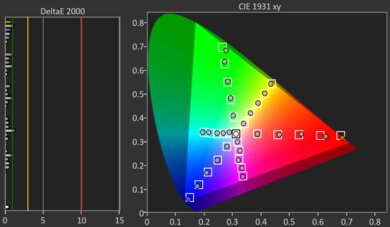
You can increase the color gamut by changing 'Color Gamut'.
for pictures & test results

for pictures & test results
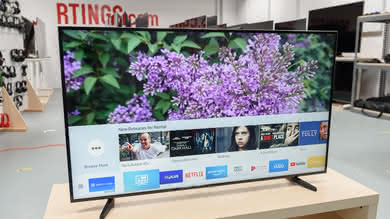
The glossy finish is very aggressive. It is actually very good at cutting the ambient reflections, but gives everything a purple tint. The curve of the TV also zooms in on the reflections. If you have a window directly behind you (facing the TV), it is really bad.
The maximum brightness of the screen varies depending on the scene you are watching, due to the ABL. At a 50% window, the luminosity is lower than what you would get from an LED TV.
for pictures & test results
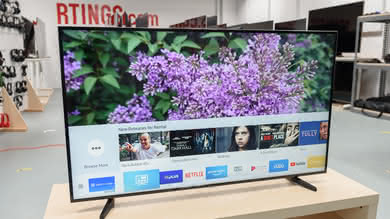
Its passive 3D has no crosstalk issue, but it comes at the cost of half the vertical resolution. This is a bit more noticeable than on LED passive 3D TVs, due to the smaller pixel sizes (see pixel close up picture at the end of the review).

for pictures & test results

for pictures & test results
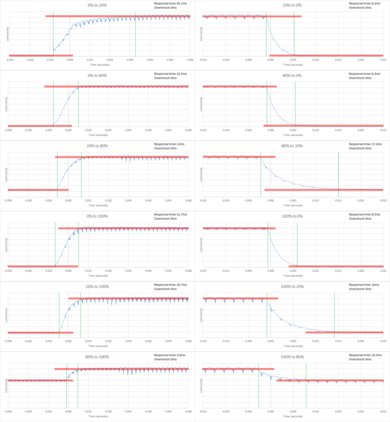
That does not mean it is blur free, though. See here for more details.

It handles a direct 24 fps input without judder, which is good for movies outputted via a Blu-ray player. For 24p via 60i or 60p though, it couldn't consistently do the reverse 3:2 pulldown. Of course, if you enable 'TruMotion' it removes the judder, but at the cost of introducing the soap opera effect.


Under game mode, the input lag is 47.5 ms. If you label the HDMI input to PC, you can further reduce it to 40.7 ms.
Update 07/25/2016 We've received a report that the input lag is now 29.6 ms after the firmware update 04.01.00. We don't have that TV anymore to confirm this unfortunately.
Chroma 4:4:4 is enabled if you set the HDMI input to PC.


for pictures & test results

Good frequency response at all levels and no pumping seems to be present either. However it doesn't produce a lot of bass.
for pictures & test results

Very good distortion results at all levels, but the TV doesn't get loud.
for pictures & test results

WebOS is a great smart TV platform and it is very easy to use. The remote can control the on-screen pointer, but it doesn't have a dedicated number pad.


