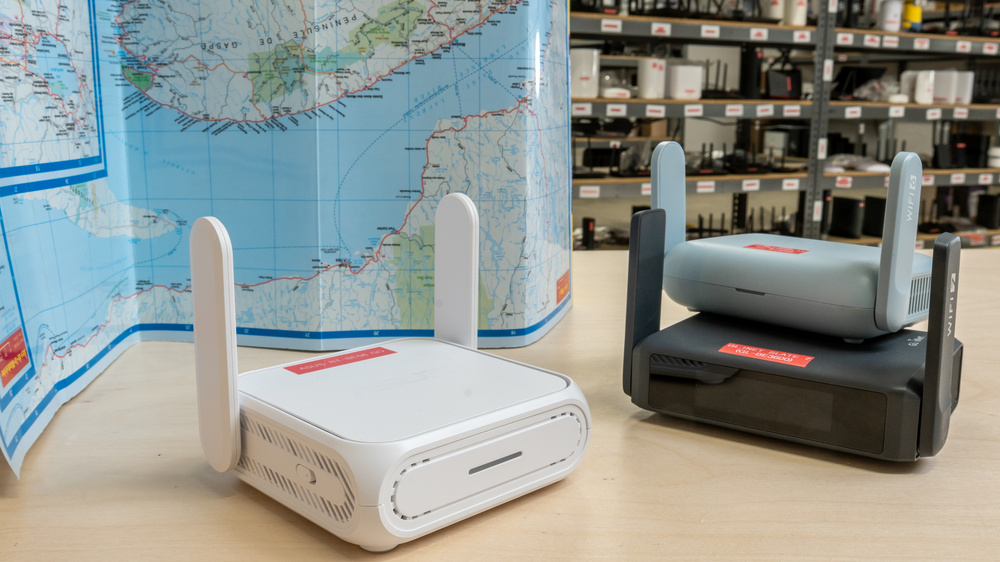
Whether you're catching up on work abroad or kicking back at a café, staying connected has become a crucial part of daily life. It's easy to take fast, frictionless internet for granted until you're faced with the frustrations of public Wi-Fi: sluggish speeds, sign-in screens, security risks, and connection fees. Worse still, even when public Wi-Fi is free, you might be paying indirectly with your personal data. Enter the portable travel router: a pocket-sized solution to simpler, safer, and potentially cheaper access to public Wi-Fi.
By connecting to a shared network and creating its own secure hotspot, a portable router can help get all your devices online through a single login while limiting their exposure to less secure networks. Most models also support VPNs for added privacy and secure remote access to your home or work network. For frequent travelers, that convenience can be well worth the investment.
Travel routers can vary considerably in size, performance, and features. The best model for you depends on how you plan to use it: portability and ease of use might matter more on solo trips, while speed and coverage may take priority if you're working remotely or sharing the connection.
We've tested over 80 routers and selected the best travel routers based on ease of use, price, and performance. Need a router for home use? Don't miss our recommendations for the best Wi-Fi 7 routers and the best mesh systems. If you're looking for a VPN to pair with your travel router, check out our recommendations for the best VPNs, both free and paid. You can also read our comparison of WireGuard and OpenVPN to learn more about the common protocols supported by many travel routers.

Since we started reviewing them in 2024, we've tested over 80 routers. We maintain complete editorial independence and impartiality by purchasing each router ourselves, which ensures we aren't testing specially selected review units. Rather than casually assessing performance by throwing on Netflix and seeing if it works, we rigorously evaluate each router on a standardized testing platform, providing you with all the data you need to compare different models.
-
Best Travel Router
 TravelSpeedRangeConfigurabilityWeight:lbs ( g)See all our test resultsStored Volume:in³ ( cm³)
The GL.iNet Slate 7 (GL-BE3600) is the best travel router we've tested. It packs impressive speeds, coverage, and networking tools into a carry-on-friendly design, with foldable antennas that make it easy to stow. It's equipped to comfortably handle 4k streaming with strong enough range for a hotel room or vacation rental, and its open-source software offers precise control over just about every setting you could want in a router. You can power it with a standard USB-C PD battery bank and share your phone's cellular data over USB. Even its compact 30W power adapter is easy to pack, and the included EU, UK, and AU plug converters make it ready for international travel.
It's worth noting that this model doesn't have a 6GHz band, so it can't deliver the highest possible Wi-Fi 7 speeds, but it's still fast enough for demanding tasks while traveling. With built-in VPN support to protect your traffic on public Wi-Fi, dual 2.5Gbps Ethernet ports, and a handy touchscreen, this router manages to squeeze some serious networking chops into a remarkably compact design.
-
Best Mid-Range Travel Router
TravelSpeedRangeConfigurabilityWeight:lbs ( g)See all our test resultsStored Volume:in³ ( cm³)If you value easy setup and flexible connectivity over maximum range, the ASUS RT-BE58 Go is our mid-range pick. It's a more approachable alternative to GL.iNet routers, offering many of the same conveniences: foldable antennas, USB cellular tethering, VPN support, and the ability to run from a USB-C PD power bank. It's also compatible with ASUS' proprietary mesh standard, so you can pair it with compatible devices to form a wider mesh network. Its included USB-C adapter is reasonably compact, and it comes conveniently with a set of interchangeable travel adapters. Much like our top pick, the GL.iNet Slate 7 (GL-BE3600), it's a Wi-Fi 7 router without a 6GHz band.
The RT-BE58 Go is equipped with a 2.5Gbps WAN port and 1Gbps LAN port, and though its software isn't quite as configurable as a GL.iNet router's, it offers a gentler learning curve for everyday users who don't care to tinker. Range is the router's main compromise, falling well short of the coverage you'd get from the Slate 7 or even the GL.iNet Beryl AX (GL-MT3000) below. You'll need to stay fairly close to maintain a reliable connection, limiting its utility to hotel rooms, café tables, and similarly small spaces. It makes the most sense if you already own a compatible ASUS router or prefer its simpler interface. Otherwise, it's hard to justify: the Beryl AX is a better all-around option that's generally available for less, while our top pick, the Slate 7, delivers significantly better performance.
-
Best Budget Travel Router
TravelSpeedRangeConfigurabilityWeight:lbs ( g)See all our test resultsStored Volume:in³ ( cm³)Few travel routers offer as much capability for the money as our budget pick, the GL.iNet Beryl AX (GL-MT3000). It delivers impressive speeds and a range that rivals the GL.iNet Slate 7 (GL-BE3600), easily blanketing a hotel room or small vacation rental with strong coverage. Foldable antennas, an ultra-light chassis, and included European and UK plug adapters further add to its travel-friendly design, making it well-suited to life on the road.
Its lower price doesn't come at the expense of the essentials. This router runs the same highly configurable software as the Slate 7, complete with built-in VPN support and a USB 3.0 port to accommodate cellular tethering or external storage. It includes a 2.5Gbps WAN port alongside a 1Gbps LAN port, stepping down slightly from the Slate 7's dual 2.5Gbps configuration. It sticks to the older Wi-Fi 6 standard, but with neither router supporting 6GHz, the only things you're really giving up are the Slate 7's faster peak speeds and some negligible features like Multi-Link Operation (MLO). If you can live without those extras, this model delivers much of the performance, range, and flexibility of a more expensive travel router for less.
-
Best Cheap Travel Router
TravelSpeedRangeConfigurabilityWeight:lbs ( g)See all our test resultsStored Volume:in³ ( cm³)If you don't need Wi-Fi 7, the TP-Link Roam 6 TL-WR3002X is a great choice if you're looking for an affordable travel router that's lightweight and easy to pack. It slips easily into a bag or pocket without extra parts to fold away, thanks to its internal antennas. Despite its small size, it delivers excellent close-range speeds that nearly match our top pick, the GL.iNet Slate 7 (GL-BE3600), making it well-suited for streaming, video calls, and downloads from a hotel room. It also offers many of the same travel features as our more expensive picks, including public Wi-Fi sharing, USB cellular tethering, and VPN support. The Roam 6 comes equipped with a 2.5Gbps WAN port and a 1Gbps LAN port.
Its biggest drawback is range. While it's very fast when you're nearby, speeds drop sharply over longer distances, making it a better choice for hotel rooms and similarly small spaces than larger vacation rentals. Our budget pick, the GL.iNet Beryl AX (GL-MT3000), provides significantly better range and more flexible software, making it worth the extra money if you want better coverage or more control over your network. However, if you usually stay close to your router and prioritize portability, the Roam 6 offers excellent speeds and impressive overall value.
-
Best Ultra-Compact Travel Router
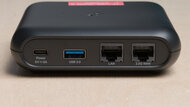
At roughly the size of a deck of cards, the UniFi Travel Router (UTR) is easily the most portable travel router we've tested so far. It weighs less than half as much as the GL.iNet Beryl AX (GL-MT3000) and slips readily into a pocket. Despite its diminutive dimensions, it packs in two 1Gbps Ethernet ports, a small status display, and the flexibility to connect via Wi-Fi, Ethernet, or USB phone tethering. Drawing just 5W over USB-C, it can comfortably run from a portable power bank or standard phone charger (helpful, given that there isn't an included AC adapter with the device).
Setup is straightforward through the UniFi app, and you can use the router without an account in its standalone mode. It makes the most sense if you already run a UniFi setup at home, since you can copy over your existing network's settings and use its Teleport feature for one-click access to your home network. The UTR's tiny design comes with substantial performance compromises, though: limited to the older Wi-Fi 5 standard, it topped out at just 286Mbps in our speed tests, with connection quality that quickly deteriorated beyond 50 feet. With the price being very similar to our budget pick, the Beryl AX, the Beryl makes more sense as a considerably faster, newer, and more capable router for most people. However, if portability is paramount and the performance is good enough for you, the UniFi is the best ultra-compact option.

















Notable Mentions
-
GL.iNet Slate AX (GL-AXT1800):
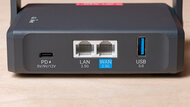
The GL.iNet Slate AX (GL-AXT1800) is worth considering if you need a second LAN port or a microSD slot for sharing files on the road. However, the much cheaper GL.iNet Beryl AX (GL-MT3000) nearly matches its speeds, delivers significantly better range, and is smaller and lighter, making it a better choice for most people.
See our review -
TP-Link Roam 7:
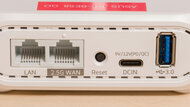
The TP-Link Roam 7 is a compact Wi-Fi 7 travel router with foldable antennas, VPN support, and included international power adapters. However, the cheaper TP-Link Roam 6 TL-WR3002X is smaller, lighter, and delivers better speeds and range in our tests, making it a more sensible choice for most travelers.
See our review
All Reviews
Our recommendations reflect what we believe are the best portable routers for a variety of uses. In addition to performance in our tests, we consider each router's features, price, availability, and community feedback.
If you'd rather compare the options yourself, you can browse all of our router reviews, or use the table tool below for a more direct comparison. Try not to let any single specification decide your purchase; every travel router makes compromises, so the right choice comes down to what matters most to you: portability, range, speed, wired connectivity, or deep configurability.