See the previous 0.9 changelog.
Projector Test Bench 0.10 is live! This update is our biggest step forward for projectors since we initially launched them. It adds deep-dive Gaming (input lag, supported resolutions), brand-new Imaging and Optics sections, plus checks for audio passthrough, HDR format support, and 3D.
This release is also a stepping stone: we're already hard at work on the next projector update, with more tests, better tooling, and broader coverage on the way. If there's something you want us to prioritize, tell us! Drop your requests in the comments on our projector pages or send feedback through our contact form. Your input helps decide what we work on next.
What's New In 0.10
-
New Imaging section
- Spectral Power Distribution (SPD) graph for every unit.
- Optics box (zoom/focus/keystone, throw ratios, lens shift, and practical throw-distance ranges).
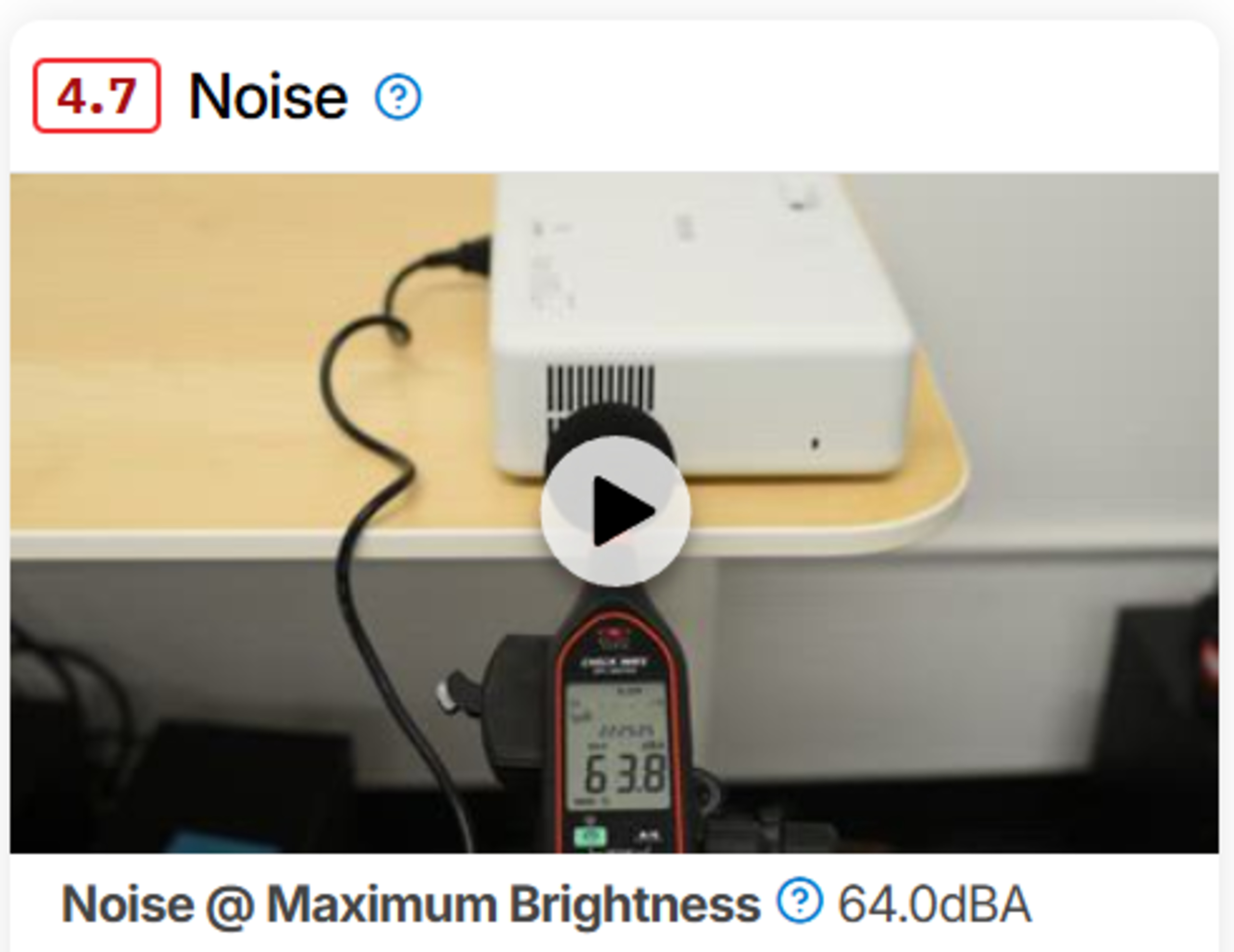
- Noise box with measured sound pressure level at maximum brightness.
-
New Input/Format tests
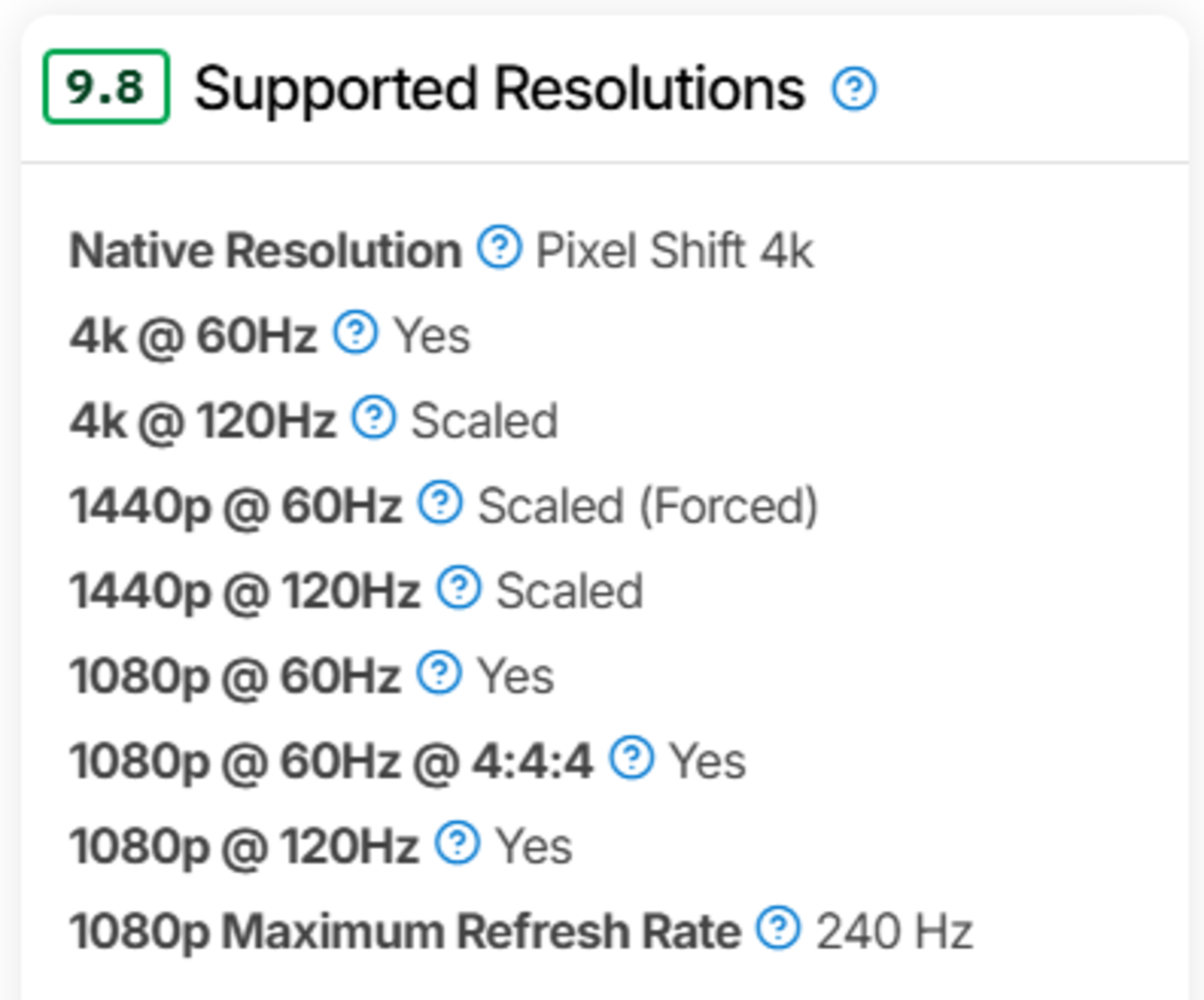
- Supported Resolutions (PC & console refresh/format matrix).
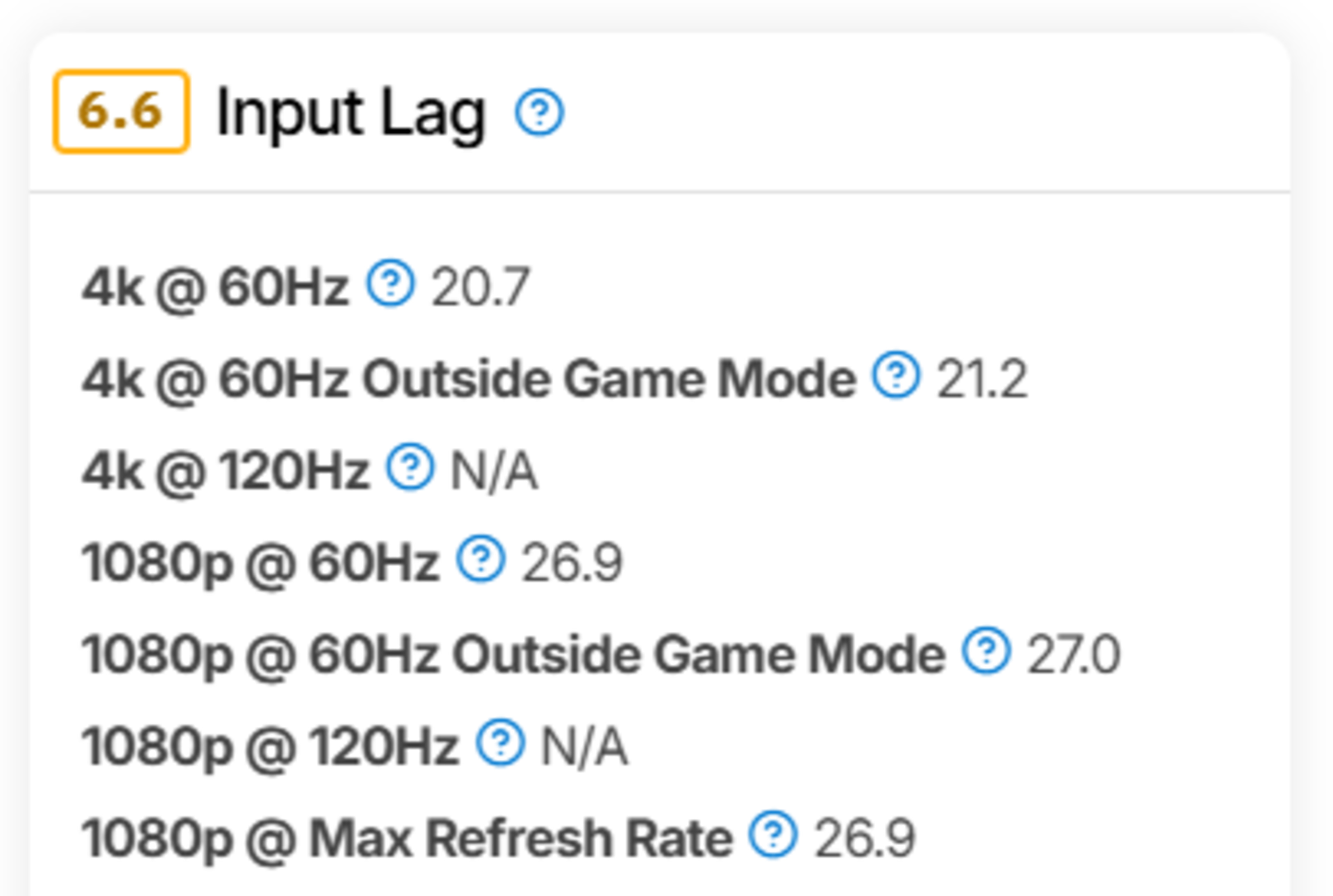
- Input Lag at common resolutions/refresh rates and inside/outside Game Mode.
- HDR Format Support (what the projector actually accepts/uses).
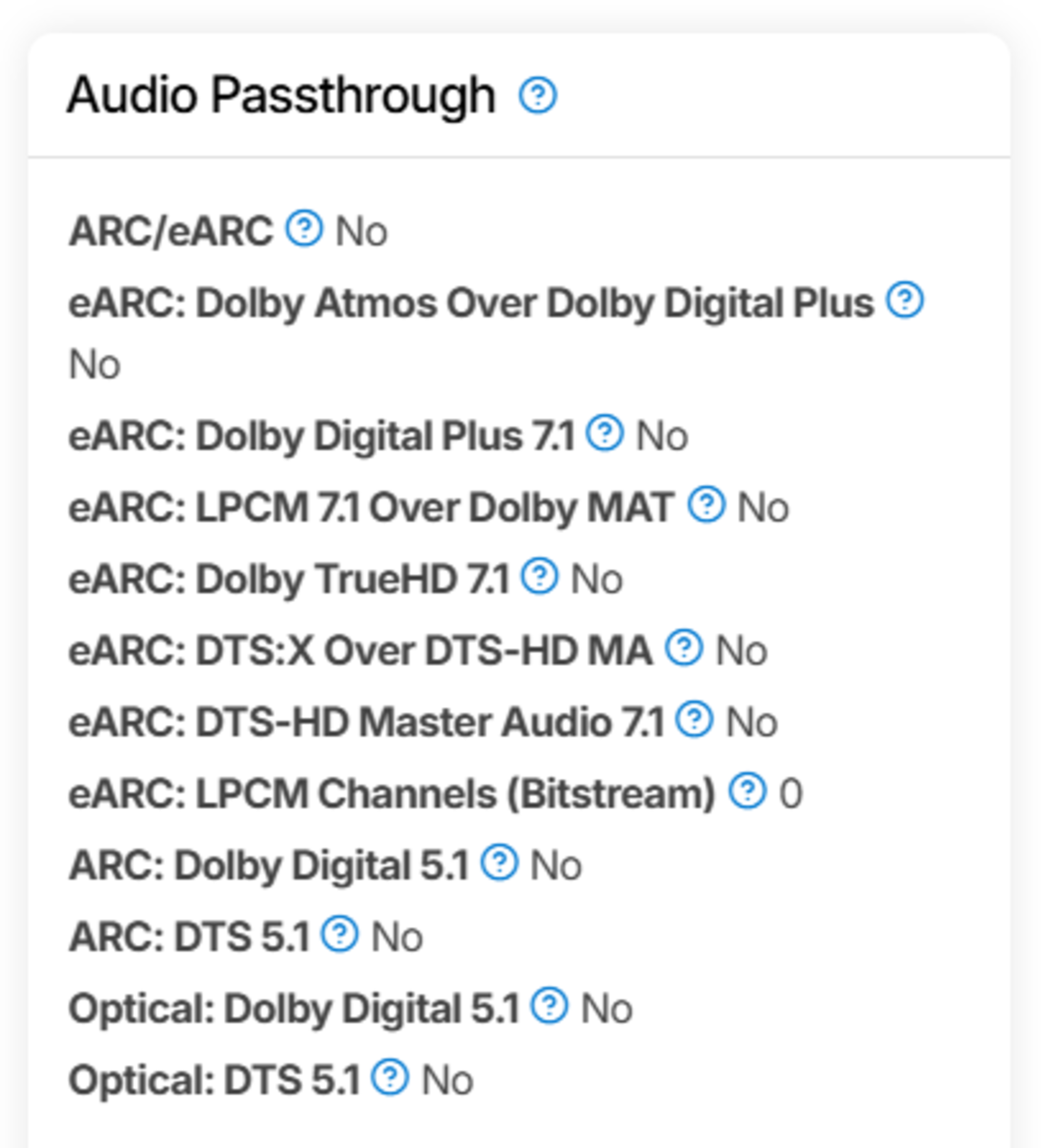
- Audio Passthrough (eARC/ARC and optical behavior, including object-based formats).
- 3D Support (modes and caveats).
-
New usage box
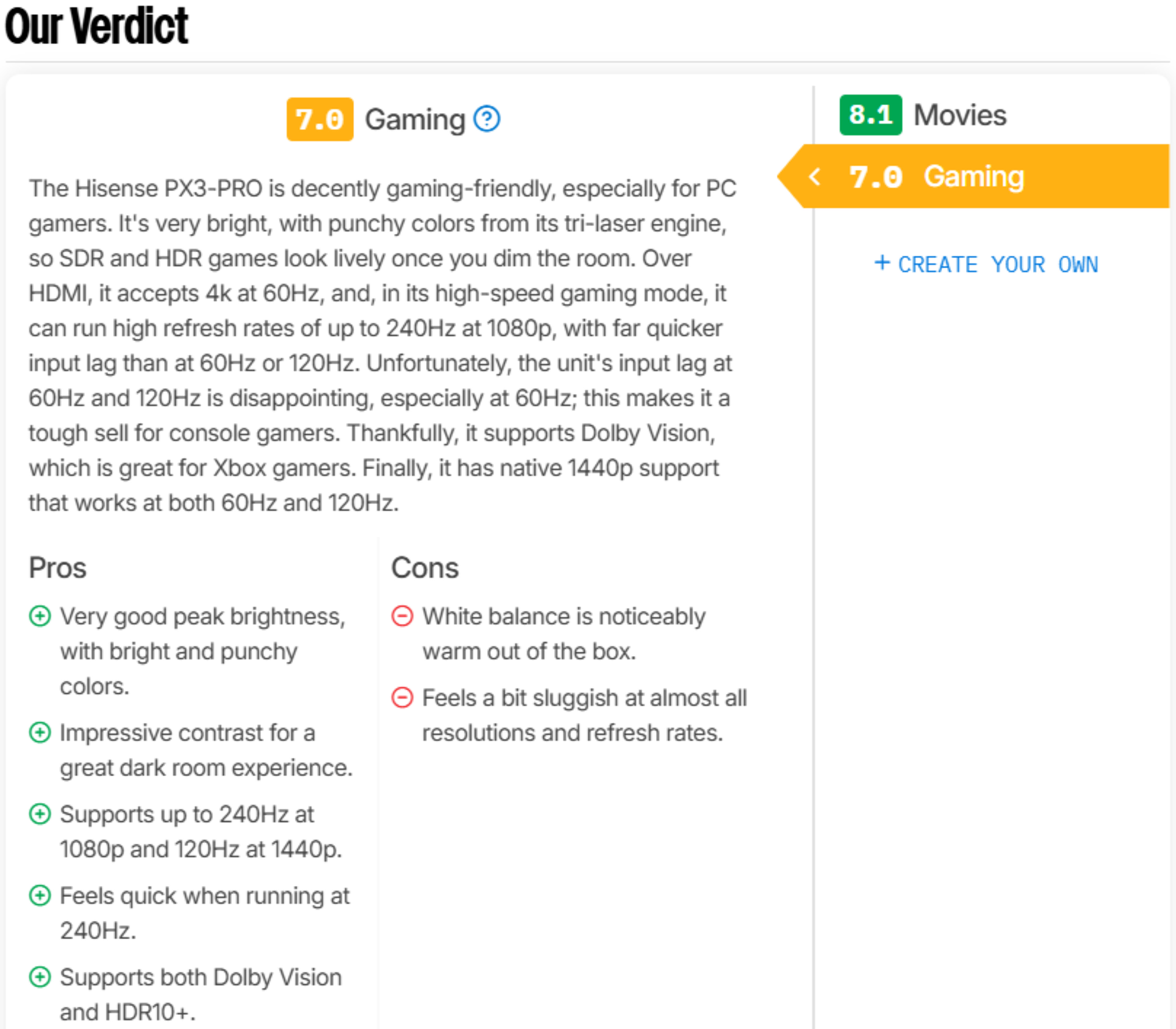
- Gaming: overall experience when gaming (image quality + responsiveness).
You'll see new boxes, new charts, and updated score pop-ups that explain how each result contributes to a usage score.
Imaging
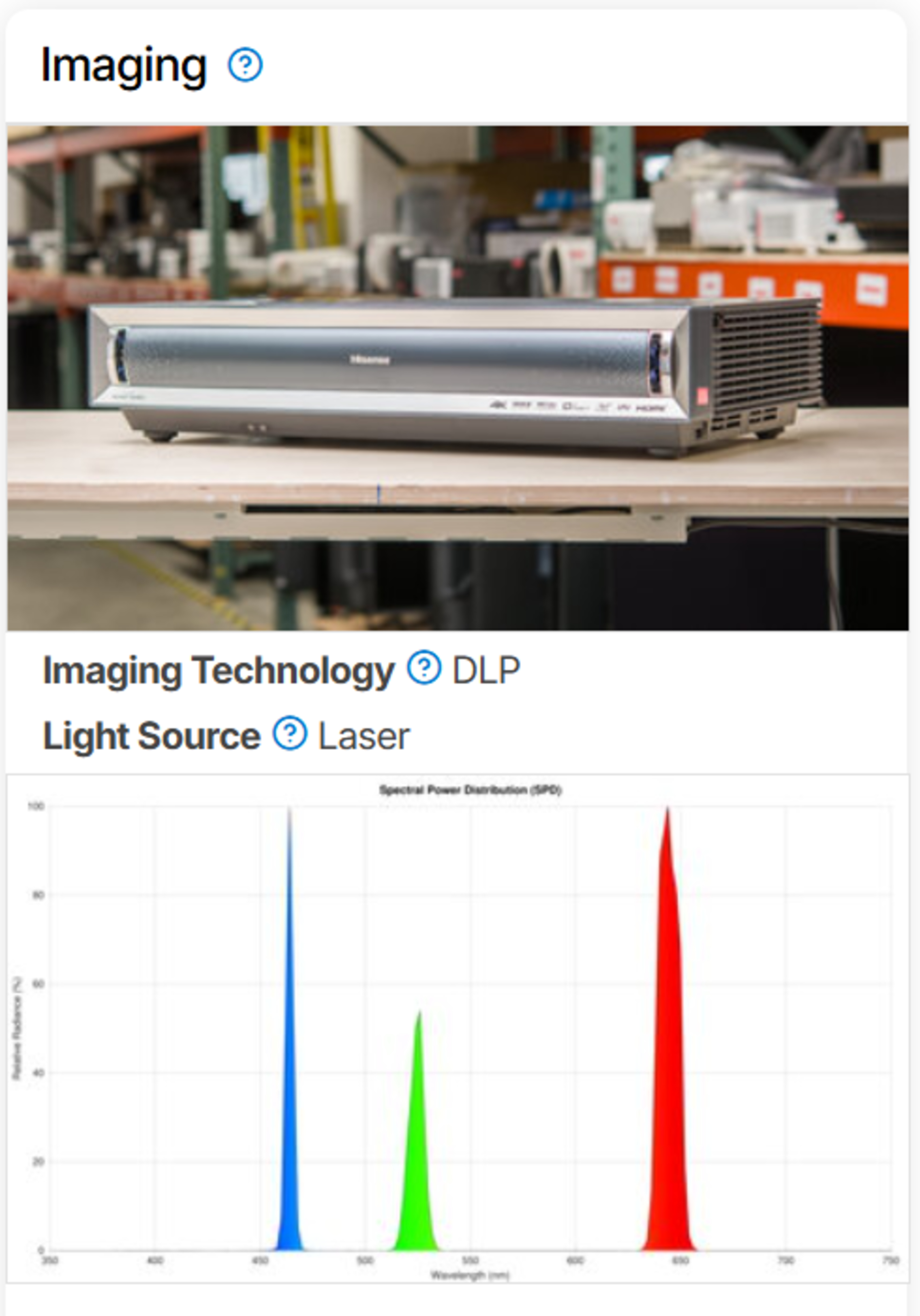
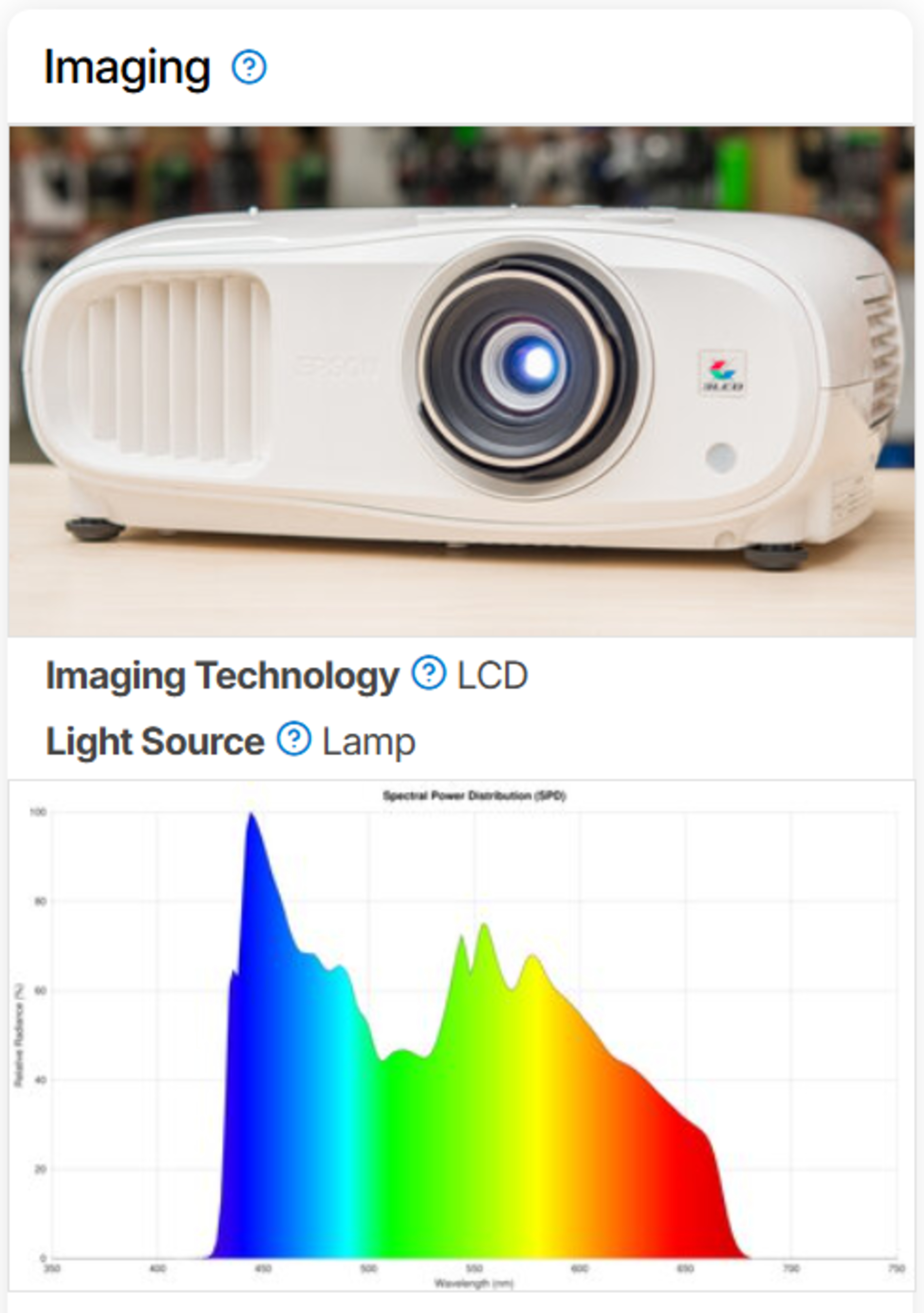
Spectral Power Distribution (SPD)
- We now publish an SPD plot for every projector.
- What it means for you: Narrow peaks (typical of laser/LED) can produce very saturated primaries; broader, continuous energy (lamps) generally means more uniform spectral coverage. The SPD helps explain measured color gamut, skin tones, and metameric quirks that users may perceive differently across light sources.
 |
 |
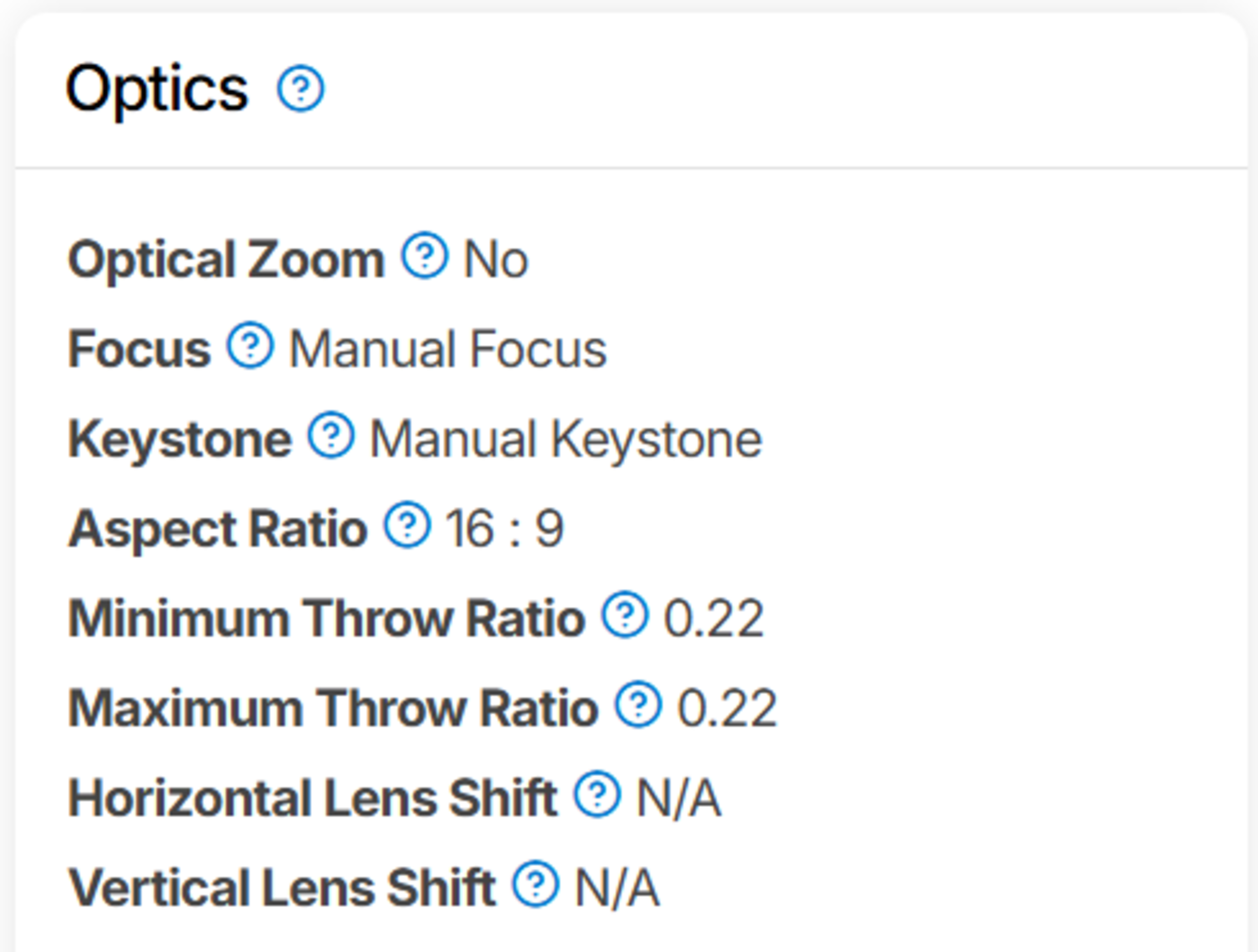
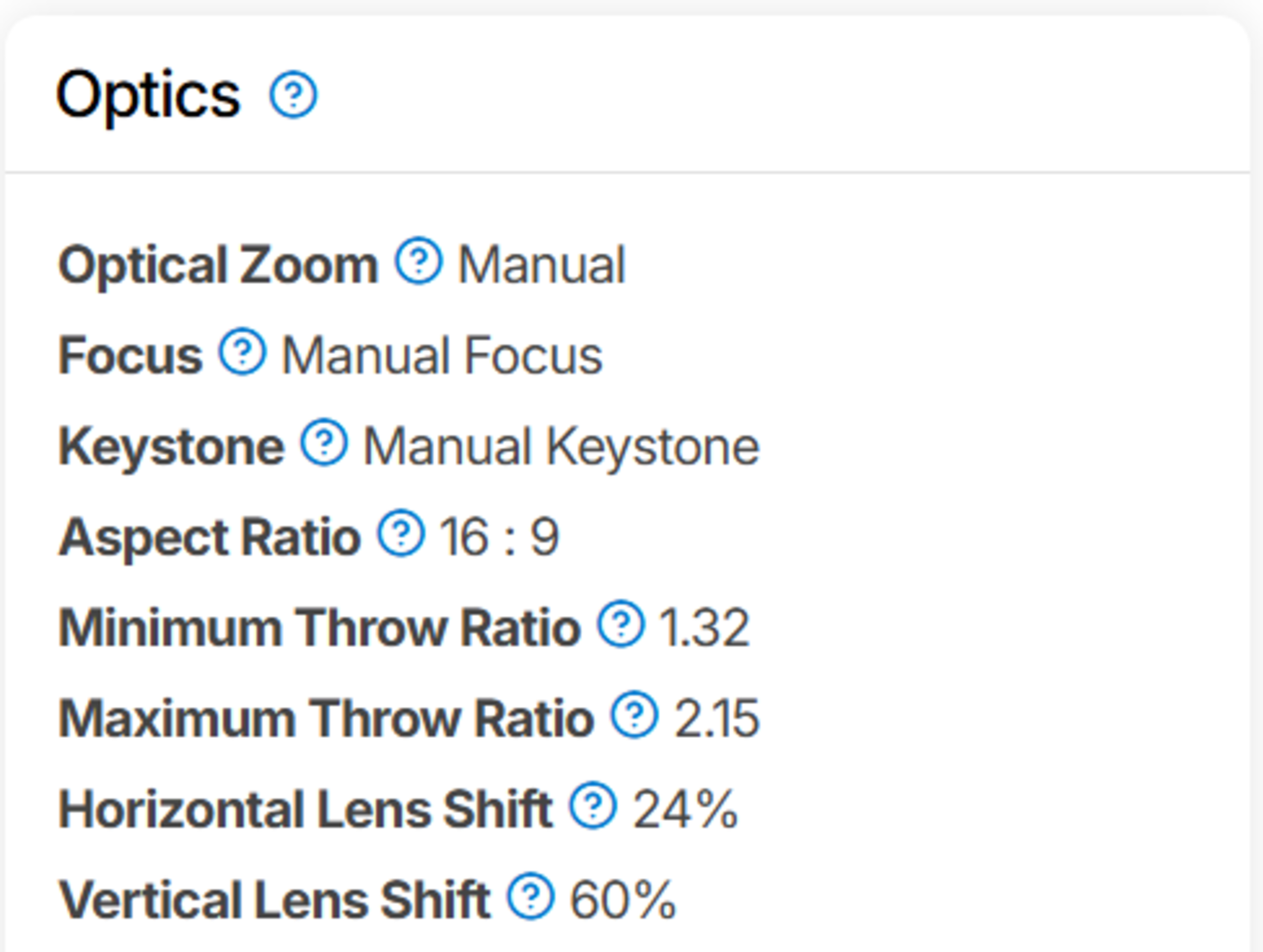
Optics
- Reports optical zoom, focus type, keystone, throw ratio range, and lens shift (with practical throw-distance examples for common screen sizes).
- What's New: This wasn't previously summarized; you can now quickly check if a unit fits your room without hunting through manuals.
 |
 |
Noise
- We measure SPL (dBA) at max brightness at a fixed distance and orientation.
- What's New: a simple score plus the raw number, with guidance on audibility in quiet rooms.
 |
Inputs & Formats
Supported Resolutions
- A consolidated matrix of the projector's native resolution, its max supported refresh rate at 1080p, and what the HDMI input will accept (e.g., 4k60, 4k120, 1440p60, 1440p120, 1080p60, 1080p120, 1080p 4:4:4).
- We call out downscaled or frame-skipped cases and any toggles required in the OSD (e.g., "Enhanced/High Refresh" modes).
- Learn more about supported resolutions on projectors.
Input Lag
- Measured at key combinations (4k60, 1080p60/120, and max supported refresh rate), both in Game Mode and outside it.
- We note dependencies such as "Game Mode: Auto/On" and features that alter latency (noise reduction, motion interpolation, "Turbo" modes, etc.).
- Learn more about input lag on projectors.
HDR Format Support
- Verifies which HDR formats are accepted and used (HDR10, HDR10+, HLG, and Dolby Vision, where applicable to projector ecosystems).
- We clarify mapping behavior (e.g., tone-mapping only in certain picture modes).
Audio Passthrough
- Tests eARC/ARC/optical for Dolby Atmos (DD+ MAT or TrueHD), DTS family, and multi-channel LPCM.
- We note common projectors' limitations (e.g., down-mixing 7.1 LPCM to 5.1, or no audio when a lossless bitstream is selected).
3D Support
- Lists whether the projector supports 3D or not. We also mention any quirks, like when a 3D feature is disabled by high-refresh modes.
New usage boxes
Gaming
- Interprets both image quality and performance during gaming.
- Factors include brightness/contrast in Game Mode, color performance, imaging technology, and the most meaningful input metrics for current consoles and PCs.
- The weight breakdown is shown in the Gaming pop-up on each product page.
Score Impact & Migration Notes
- Models originally tested under Test Bench 0.8 and 0.9 receive updated Gaming-related scores once re-evaluated with the new 0.10 input suite.
- Non-gaming movie/TV usage scores are unchanged; however, the presence of the Noise and Optics boxes gives extra context that can influence buying advice in our text.
- Anywhere we previously reported "supports 4k/120," we now verify whether that's true 120Hz, downscaled, or frame-skipped, and reflect that in the responsiveness score. None of our projectors currently support true native 4k @ 120Hz.
What Didn't Change
Our core picture-quality measurements (contrast, brightness, color gamut/volume, grayscale/gamma tracking) and how we calibrate remain consistent with prior versions, so results remain comparable across versions for movie/TV use.
40 Projectors Updated
We have retested popular models. The test results for the following models have been converted to the new testing methodology. However, the text might be inconsistent with the new results.
- Anker Nebula Capsule 3 Laser
- Anker Nebula Mars 3
- Anker Nebula X1
- AWOL Vision LTV-3000 Pro
- BenQ HT2060
- BenQ TH671ST
- BenQ TK700STi
- BenQ X3100i
- BenQ X500i
- Epson EpiqVision Flex CO-W01
- Epson EpiqVision Mini EF12
- Epson EpiqVision Ultra LS300
- Epson EpiqVision Ultra LS800
- Epson EX3280
- Epson Home Cinema 1080
- Epson Home Cinema 2350
- Epson Home Cinema 3800
- Epson Home Cinema 5050UB
- Formovie THEATER
- Hisense C1
- Hisense C2 Ultra
- Hisense PX3-PRO
- JMGO N1S Ultimate
- LG CineBeam Q
- NexiGo Aurora Pro
- NexiGo PJ40 (Gen 3)
- Samsung The Freestyle 2nd Gen
- Valerion VisionMaster Pro 2
- VANKYO Leisure 470
- ViewSonic PX701-4K
- XGIMI AURA 2
- XGIMI Elfin
- XGIMI Halo+
- XGIMI HORIZON Pro
- XGIMI Horizon S Max
- XGIMI HORIZON Ultra
- XGIMI MoGo 2
- XGIMI MoGo 2 Pro
- XGIMI MoGo 3 Pro
- XGIMI MoGo 4