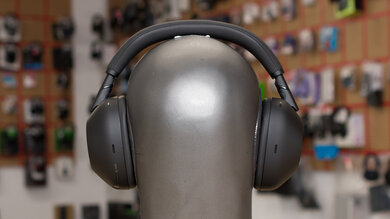
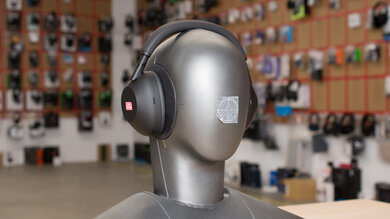
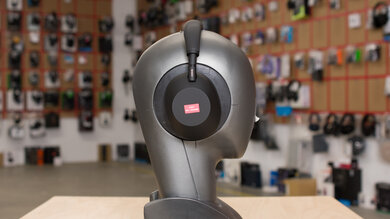
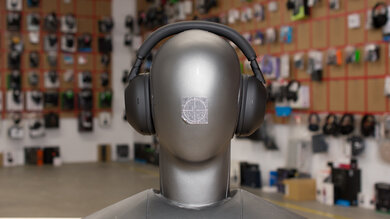
The Corsair HS60 are above-average gaming headphones, with a good sound for critical listening. They also have a simple yet sturdy and premium-looking design that will work for most. They're also comfortable, well-built and have a good detachable boom mic. They're a wired headset, which means they have console support when plugged into the PS4 or Xbox One controllers and no latency when gaming. Unfortunately, they do not have a detachable cable, and they're not as suitable for outdoor use as some of the other gaming headphones we've tested.
Our Verdict
Average for mixed usage. The Corsair HS60 are gaming headphones with a simple and well-built design that's suitable for outdoor use. They won't be the ideal option for more noisy environments like when commuting, but they have an above average sound, a good build quality, and a comfortable over-ear fit. Also, they have a good microphone and since they're wired, they have very negligible latency which makes them suitable for gaming and watching videos.
- Good sound.
- Great build quality and cool design.
- Slightly bulky and cumbersome.
- Poor noise isolation.
- Bass delivery varies noticeably across users. Sensitive to glasses.
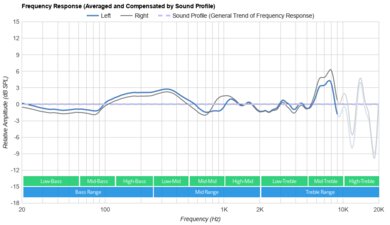
Good for neutral listening. The Corsair HS60 have a well-balanced sound that delivers a good bass, a great mid-range and satisfying treble reproduction. The bass tends to be a bit boomy overall, the mid-range is slightly recessed which may push some instrument and vocals to the back of the mix, and treble can sound slightly sharp on some tracks. However, they sound good enough for most listeners and even have a decent soundstage for a closed back headphone. They won't be the perfect option for neutral listeners but they deliver a good sound that should please most.
Below average for commuting. They have an outdoor-friendly design with a detachable mic, a good build quality, and a comfortable design. However, they do not block enough noise to be ideal to use on public transit.
Mediocre for sports. Although the HS60 are a bit more stable than typical gaming headsets, they do not have a detachable cable, they're still a bit too bulky and unstable for high-intensity sports and they do not have a control scheme for mobile devices.
Average-at-best for office use. They do not block a lot of noise so you will still be able to hear the ambient chatter if you're not playing any music. They also leak a bit at high volumes which may be distracting to the people around you.
Good for wired gaming. The Corsair HS60 have a low latency, wired, USB connection, a decently well-balanced audio reproduction, and a good noise filtering mic. They're comfortable enough to wear for a long gaming session and have decent app support on PC. Unfortunately, they do not have the most breathable design, their USB adapter will not work for Xbox and their app is passive so you can't save any presets to the headphone.
Changelog
- Updated Dec 04, 2020: We've updated the USB Audio test results.
- Updated Jun 30, 2020: Updated Weight, Clamping Force, and Portability Measurements.
- Updated Feb 11, 2020: Converted to Test Bench 1.4.
- Updated Nov 21, 2019: Converted to Test Bench 1.3.1.
Check Price
Popular Headphones Comparisons
The Corsair HS60 are above average gaming headphones with a good build quality and a simple classy looking design. They also have a well-balanced sound and a comfortable over-ear fit that make them a good option for critical listening. They have a casual design you can use outdoors however compared to some of the gaming headphones below, they're a bit more cumbersome and the lack of a detachable cable make them less stable overall. On the upside, their understated look and sturdy build quality make them stand out especially considering their price. See our recommendations for the best gaming headsets for PC, the best gaming headsets under $50 and the best over-ear headphones under $50.
The Corsair HS50 and Corsair HS60 are basically the same headset, but the HS60 come with a USB adapter for you to use the Corsair iCUE software on PC. If you are a console gamer, save a few bucks and grab the HS50, but if you are playing on PC, the customization available on the app might be worth the extra few dollars.
The Corsair HS70 Wireless is the wireless variant of the Corsair HS60, so these two headsets are very similar. Both have the same durable design, but the HS70 seems to have slightly better audio reproduction. However, the HS60 is more versatile, since they can be used wired with any device, while you’ll need the USB dongle to make the HS70 work, which means you can’t use it with your phone and it doesn’t work with Xbox.
The Corsair HS60 is a better-wired gaming headset than the Corsair HS35. The HS60 have a more neutral, accurate sound profile and feel much more durable. They also come with a USB adapter so you can customize them on your PC, unlike the HS35 which only have a standard audio jack.
The HyperX Cloud 2/Cloud II are better gaming headphones than the Corsair HS60. The HyperX are more comfortable and slightly better built. They also have a much better microphone and control scheme and come with more accessories than the Corsair like a carrying pouch, an airline adapter, and extra pads. On the other hand, the Corsair sounds a lot better balanced than the HyperX. The Corsair also benefit from the iCUE software supports which gives them a bit more customization options than the HyperX.
Test Results
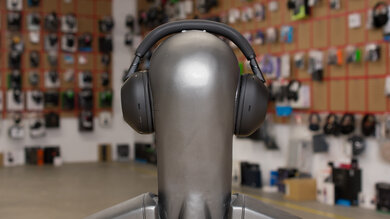
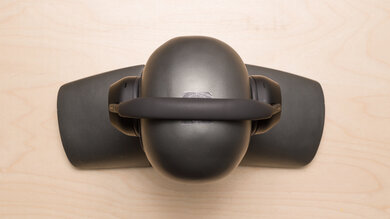
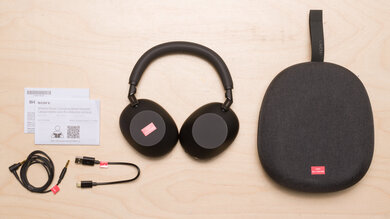
The Corsair HS60 have a straightforward, over-ear gaming headset design, that looks great and feels decently premium, especially for their price. They do not come in flashy color schemes like most gaming headphones, they also do not have any RGB, LED lighting since they are completely passive. On the upside, they have a classy look and feel with a heavily padded headband, that has a stitch-like pattern on the padding that looks great. The headband has a metal frame, and yokes are also metal and somewhat reminiscent of the HyperX Cloud II's design. The ear cups are relatively flat and low profile, and they have metal grills that make the cups look somewhat like an open-back design, but they are still closed-back headphones. The HS60, like most gaming headsets, are a little too bulky for outdoor use, but the understated and high-end look and feel of these headphones will work for most.
Update 06/30/2020: We previously listed the incorrect weight and clamping force. While the comfort score hasn't changed, this review has been updated to state the correct measurements.
The Corsair HS60 are comfortable gaming headphones. They have a well-padded headband that doesn't feel too tight on the head, and the ear cups are large and will easily fit around most ears. The cups are also well-padded although not as much as the headband. Unfortunately, the swiveling joints/hinges don't have a wide angle of motion much so these headphones will still give you a slight clamping sensation over time. On the upside, they're still comfortable enough to wear for long gaming marathons without much pain, soreness, or fatigue.
The Corsair HS60 have a simple gaming control scheme. They have a volume dial on the left ear cup, and a mute button to enable and disable the boom mic. Unfortunately, they do not have a channel mixing dial or a cable with an in-line remote for use with your phone which is a little disappointing. On the upside, the controls are all very easy to use and deliver good tactile feedback.
These headphones will make your ears fairly warm during long listening sessions and would not be suitable for more intense workouts. They have a closed back over-ear design that fully encapsulates the ears and obstructs airflow. Unfortunately, they do not come with more breathable pads like the Logitech G433 or the Astro A50. They won't be ideal if you often have long uninterrupted gaming sessions, but they should be okay if you take a couple of breaks from time to time.
The Corsair HS60, like most gaming headphones such as the Turtle Beach Recon 200 Gen 2, they aren't very portable headphones. They have fairly large ear cups and do not fold which makes them less portable than some of the other over-ears we've tested. They'll be a hassle to carry around on your person without a bag.
The Corsair HS60 are impressively well-built gaming headphones, especially compared to the Corsair HS35 or Cooler Master MH630. They have a sturdy metal build with a well-padded headband and ear cups. The most fragile point of their design would be their swiveling hinges, which don't have a very wide range of motion. They also lack a detachable cable. That said, they're easily as well-built as some of the significantly more premium gaming headsets we've tested, like the HyperX Cloud Alpha.
These headphones are surprisingly stable but unfortunately, do not have a detachable cable. This means that if the cable gets hooked to your desk chair while you're gaming, it may yank the headphones off your ears, which is not ideal and might damage the headphones in the long run. On the upside, they're stable enough for most casual activities, despite their bulky design. The ear cups do not protrude much, their fit is just tight enough to stay on your head, and the swiveling hinges do not have the widest range of motion so the headphones will stay in place even when jogging. However, since they are not sports-oriented headphones, they will still occasionally slip off if you tilt your head too far back, but it's not a big deal for especially for the gaming use case.
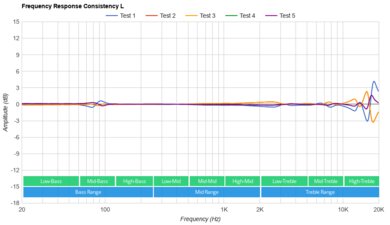
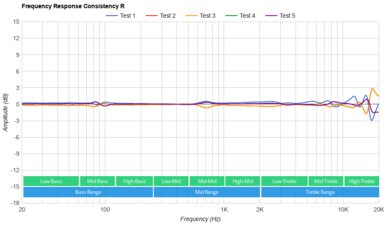
The frequency response consistency is about average. Depending on the shape and size of your head, and whether you wear glasses, their bass delivery varies noticeably across different users by as much as 5dB at 100Hz, which is noticeable. Their treble delivery, however, is pretty consistent across multiple re-seats, which is good.
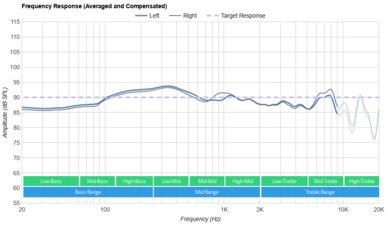
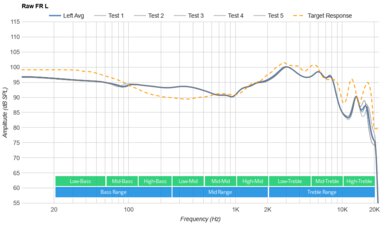
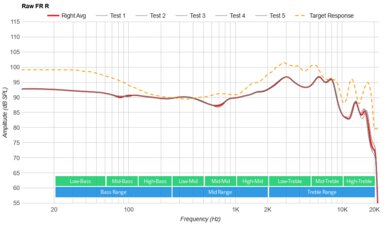
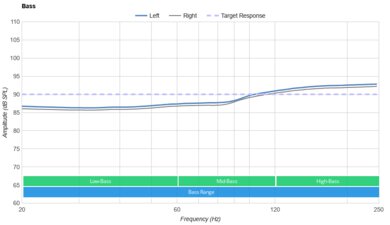
The Corsair HS60 have a very good bass. LFE (low-frequency extension) is at 10Hz, which is excellent. Low-bass, responsible for the thump and rumble common to bass-heavy music and sound effects is within 1dB of our neutral target. Mid-bass, responsible for the body of bass guitars and the punch of kick drums in hyped by more than 3dB. High-bass, responsible for warmth, is overemphasized by 3dB. Overall, the bass of the Corsair is deep and punchy, but a little hyped.
Also, their bass delivery varies noticeably across users, and is sensitive to the quality of fit, seal, and whether you wear glasses. The response here represents the average bass response and your experience may vary.
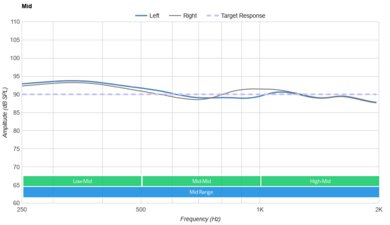
The mid-range is great. The response throughout the range is flat and even, but slightly underemphasized. This results in a clear and well-balanced reproduction of vocals and lead instruments.
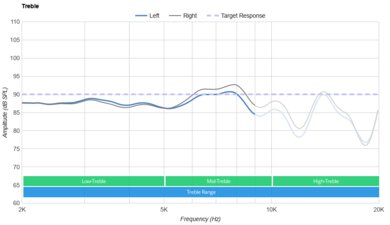
The Corsair HS60 have a good treble range performance. Low-treble is well-balanced and even with a dip around 4KHz, but it won't be very noticeable due to the narrow and shallow range of it. Mid-treble, which is mostly responsible for sharp sounds like S and Ts (sibilances) is rather uneven but decently balanced. This means that depending on their frequency, some of the sibilances will be underemphasized and some other will be overemphasized.
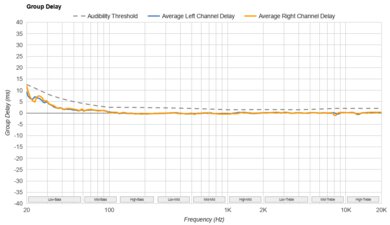
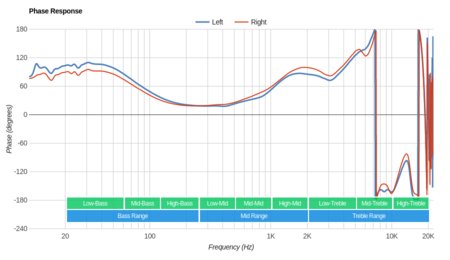
The imaging is great. Weighted group delay is at 0.28, which is within very good limits. The GD graph also shows that the entire group delay response is below the audibility threshold. This ensure a tight bass and a transparent treble reproduction. Additionally, the L/R drivers of our test unit were very well-matched. This is important for the accurate localization and placement of objects (voices, instruments, video game effects) in the stereo image.
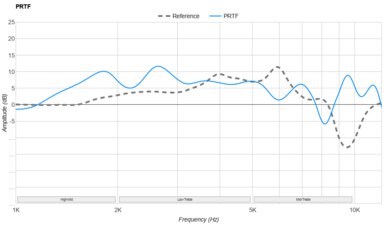
The Corsair HS60 have a mediocre soundstage. The PRTF graph shows a decent amount of pinna interaction and activation, however, the accuracy of the activation is low. Also, there is not a notch present at the 10KHz region either. This, and the closed-back design of these headphones, results in a soundstage that may be perceived as small and located inside the listener's head.
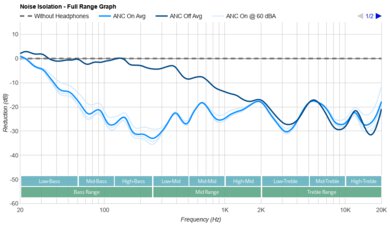
The Corsair HS60 have a sub-par isolation performance. These over-ear headphones don't have active noise cancellation (ANC), and therefore don't provide any isolation in the bass range. This means they will let in all the low rumbling noises of airplane and bus engines. Also, in the mid-range, important for blocking out speech they achieve less than 3dB of isolation, which is inadequate. In the treble range, occupied by air conditioning noise and sharp sounds like S and Ts, they provide 29dB of isolation, which is above-average.
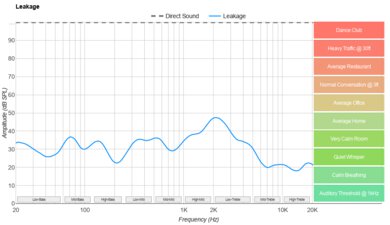
The leakage performance of the HS60 is mediocre. The significant portion of their leakage is spread between 400Hz and 5KHz, which is a relatively broad range. This results in a leakage that is fuller sounding than that of in-ears and earbuds. The overall level of the leakage is not very loud though. With the music at 100dB SPL, the leakage at 1 foot away averages at 45dB SPL and peaks at 55dB SPL, which is just above the noise floor of an average office.
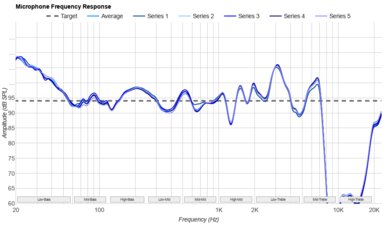
The recording quality of HS60's microphone is decent. Recorded/transmitted speech sounds noticeably thin and bit bright due to an overemphasis in the treble range. However, your voice is still intelligible and detailed to whoever is on the other end of the line. If you're looking for gaming headphones with a better recording quality, check out the Razer Kraken Ultimate.
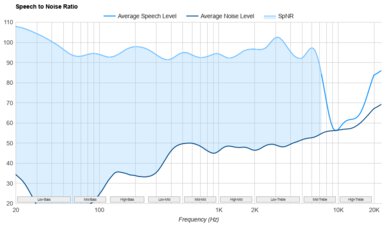
The boom microphone of the HS60 is great at noise handling. It achieved a speech-to-noise ratio of 29dB in our SpNR test. This means it is able to fully separate speech from ambient noise in most environments. However, they may struggle a little bit is extremely loud places like a loud subway station.
These headphones are passive and have no battery life.
The Corsair Utility Engine (now iCUE) offers different options depending on the headphone. With the HS60, you get a good graphic equalizer as well as mic control and a simple surround sound option. You can choose between preset EQ or make your own, however, since the headphones are passive they will not keep your settings if you connect them to a different device except your PC. Also, you have to plug them into your PC with the USB adapter to use the software. If you don't mind much for customization and the EQ, you can look at the Corsair HS50, which is the non-USB, cheaper variant of the HS60.
These headphones are wired and do not have a Bluetooth connection. If you want a gaming headset that supports Bluetooth, check out the Turtle Beach Stealth 700 or the Corsair HS70 Bluetooth.
Update 12/04/2020: We've updated the USB Audio results from 'Analog to USB Adapter' to 'USB Type-A' to improve clarity. These headphones can receive audio when connected to a PC or PS4 with a USB Type-A port. The scoring of this test hasn't changed.
The Corsair HS60 have a wired connection that provides volume control and microphone compatibility support for consoles as long as you plug them into the Xbox One or PS4 controllers. They also come with a USB adapter for PCs that gives them access to a better surround sound and also works with the PS4 but not the Xbox One (see our recommendations for the best Xbox One headsets). However, the default 1/8" TRRS cable will work with both consoles.
This gaming headset does not have a dock. If you need a headset with a dock that also has a wired connection for gaming or watching movies, then consider the SteelSeries Arctis 7.