
Our Verdict
Good TV for a wide range of usages. Best suited for a bright room with wide seating. Low native contrast ratio but image remains accurate when viewed at an angle. Average for watching movies in a dark room.
- Picture remains accurate when viewed at an angle
- WebOS smart platform works well
- Poor dark scene performance
- Peak brightness is below average
Average for watching movies in a dark room. Poor dark scene performance due to low native contrast ratio and poor local dimming.
Good for watching TV in a bright room. When viewed at an angle, picture remains accurate. Whole screen gets quite bright to combat glare. Handles reflections well. WebOS smart platform works well for casual watching.
Good sports performance. Picture quality is good, and is retained when viewed at an angle. Uniformity is below average resulting in some dirty screen effect. Motion blur is better than average.
Good for gamers. Picture quality is good. Motion handling is better than average, but a short trail may be seen following fast movement. SDR input lag is low, which is good.
Good HDR performance. Supports HDR10 and Dolby Vision. Can produce a wide range of saturated colors. Unfortunately the local dimming doesn't work well to brighten highlights. Dark scene performance is poor.
Average for HDR gaming. Supports a wide color gamut and 10 bit gradient. Input lag in HDR is quite high. Can't get bright highlights.
Good for a PC monitor. Input lag is low, and supports a wide range of resolutions. Motion blur is better than average. Supports chroma subsampling for clear text across all backgrounds.
Check Price
Differences Between Sizes And Variants
We tested the 65" (65UH9500). For the most part, we expect our review to be valid for the 86" (86UH9500).
If someone comes across a different type of panel or if their LG UH9500 doesn't correspond to our review, let us know and we will update the review.
| Size | Model |
| 65" | 65UH9500 |
| 86" | 86UH9500 |
Popular TV Comparisons
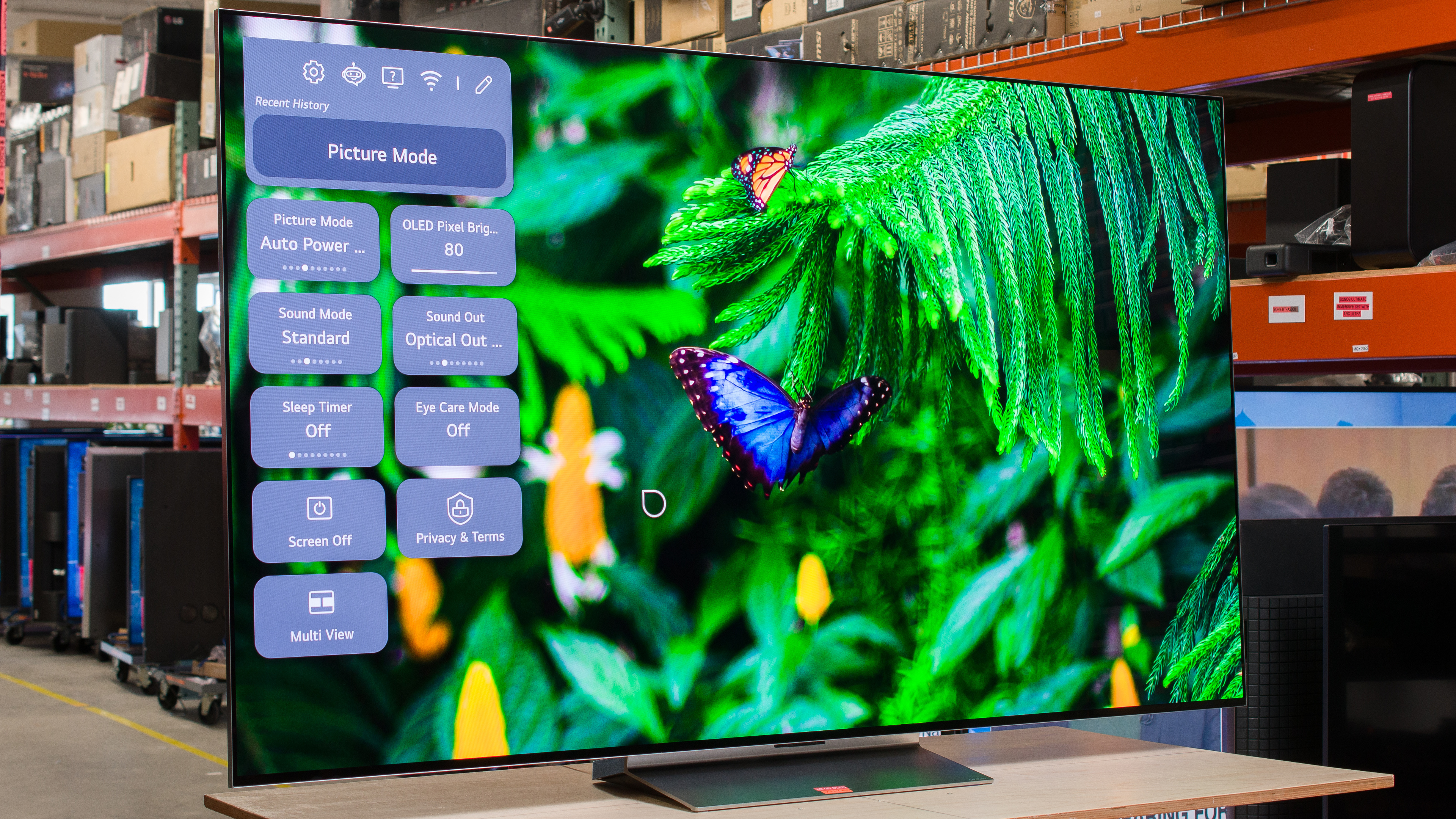
The LG UH9500 is a good all-round TV, but can be hard to recommend for those looking at the 65" variant due to its similar performance to the cheaper LG UH8500. In some cases, the LG UH8500 actually performs better due to the lower response time and higher peak brightness. For those interested in the 86" variant there is very little competition and it could be a good choice depending on your usage. Keep this in mind when viewing our recommendations below.

We buy and test dozens of TVs yearly, taking an objective, data-driven approach to deliver results you can trust. Our testing process is complex, with hundreds of individual tests that take over a week to complete. Most of our tests use specially designed test patterns that mimic real content, but we also use the same sources you have at home to ensure our results match the real-world experience. We use two main tools for our testing: a Colorimetry Research CR-100 colorimeter and a CR-250 spectroradiometer.
Test Results
Older Test Bench: We tested this product using an older TV test methodology before a major update. Some of the test results below aren't directly comparable with other TVs. Learn more
for pictures & test results

The UH9500 has a sleek design, which is very similar to the slightly lower model LG UH8500. The biggest notable difference is the thinness of the top 2/3 of the screen. Unfortunately for a large TV the center stand doesn't provide as much support as the dual supports on the cheaper LG models.
for pictures & test results

The stand is made of stainless steel, and looks great. Unfortunately it feels a bit wobbly with only center support.
Footprint of the 65" TV stand: 11.2" x 38.3"
for pictures & test results

The back looks good, with a brushed metal finish. This is the biggest difference when compared to the slightly bulkier UH8500. The stand also includes a hollow area for cable management. If wall mounted some of the inputs may be difficult to access.
for pictures & test results

The borders are quite thin, and have a metal surround. There is a black space before the image begins.
for pictures & test results

The TV is extremely thin for the top 2/3, and even at the widest point where the inputs are it is thinner than average. This looks very similar to the LG B6 2016.
for pictures & test results

The contrast ratio is below average, which is to be expected from an IPS TV. In a dark room the blacks appear gray, but for a brighter room this is not an issue.
for videos & test results

The UH9500 is an edge lit TV that features local dimming. Like most edge lit TVs, the local dimming is not as effective as some other full-array LED TVs. Blooming can be seen in large vertical bands where small highlights are situated.
When set on 'High', the smaller highlights in the video can be seen getting darker and brighter every time a zone gets turned on and off. We recommend that you set it on a lower setting if you notice this behavior when playing video games, or when watching normal TV shows and movies.
The UH9500 SDR peak brightness is average. The local dimming dim too much the smaller highlights, making the overall score just average. Highlights 10% and bigger are brighter and are good for SDR though.
The peak brightness is below average. These measurements are consistently lower than the lower end UH8500, which is a bit surprising. Although the whole screen can get quite bright, the local dimming significantly reduces the peak brightness of smaller windows. This test is performed with a HDR10 signal.
for pictures & test results

The gray uniformity is below average for the LG UH9500. A multitude of vertical bands can be seen throughout the screen. Also, the color on the right side of the screen is also a lot warmer. Dirty screen effect is visible when watching sport or any other media with large panning shots over a uniform color surface.
for videos & test results
for pictures & test results
for pictures & test results
for pictures & test results
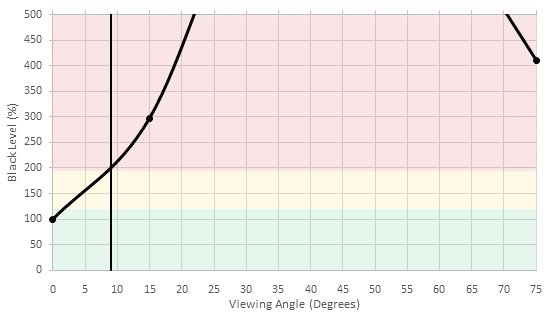
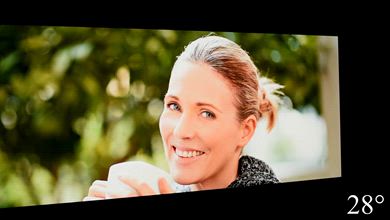
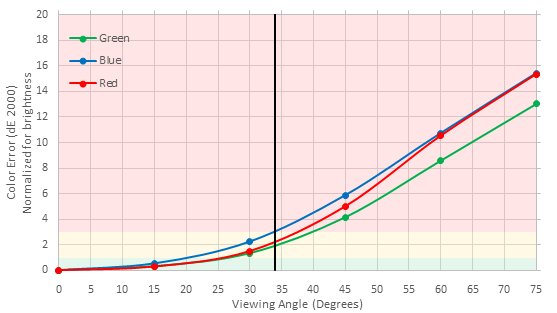
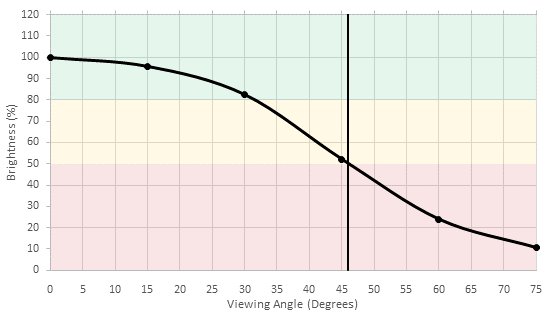
When viewed at an angle, the contrast decreases a little bit but the colors remain quite accurate. This is about the same result as the LG UH8500 which is good for an LED TV.
for pictures & test results

The black uniformity of the UH9500 is good. Like most IPS TVs, some clouding can be seen on our test picture, but luckily it is very hard to notice when watching normal content.
for pictures & test results
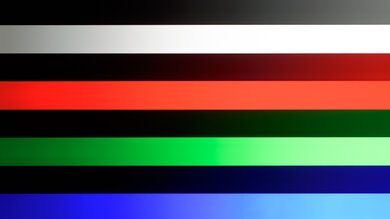
The LG UH9500 can display a 10 bit gradient pretty well. There are no particular banding or shade problems when analyzing our test picture.


for pictures & test results

for pictures & test results

for pictures & test results

Calibration is performed with the 2 and 20 point system on the TV. It works well to remove small errors in the white balance. Even with the color space settings, the blue was undersaturated. You can see our recommended settings here.
for pictures & test results

As with other LG TVs, upscaling of low quality content is good. Some halo effect can be seen along straight edges, but overall a good result.
for pictures & test results

Upscaling of 720p content is good, and details are preserved well. Image remains sharp.
for pictures & test results

1080p content such as blurays appear crisp and clear.
for pictures & test results

Content at native 4k resolution looks very good. No issues can be seen.
for pictures & test results
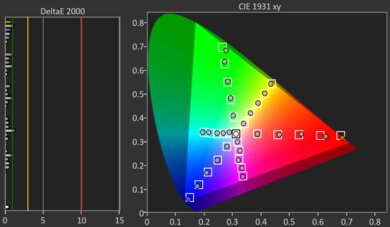
The UH9500 supports a wide color gamut, which works well to produce very saturated colors. This is a good result for those who want to watch HDR content.
for pictures & test results
for pictures & test results
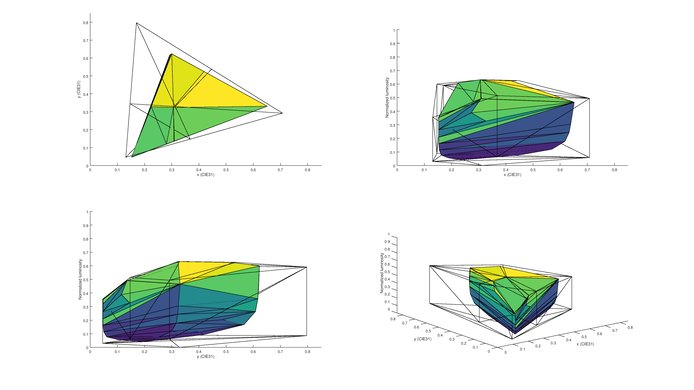
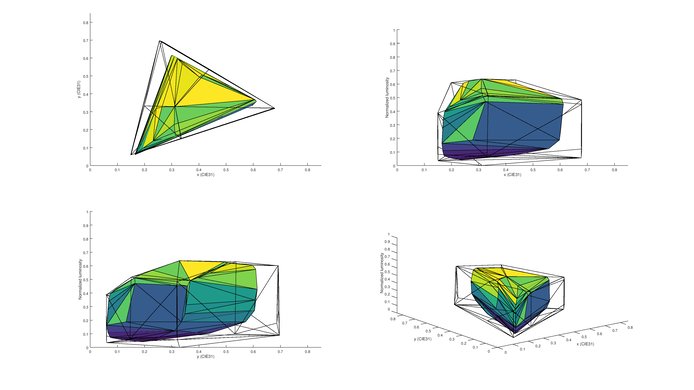
The UH9500 can cover almost all of the DCI-P3 color volume but colors lose saturation at high or low luminosities.
for pictures & test results

The LG UH9500 do have some image retention, but the retention is present only right after the static scene of the test video. After 2 minutes of recovery, the LED screen is back to normal, without any image retention at all. When compare to others LG high end LED TVs like the UH8500, this is much better and should not be too much a annoyance when watching normal TV content.
for pictures & test results

for pictures & test results
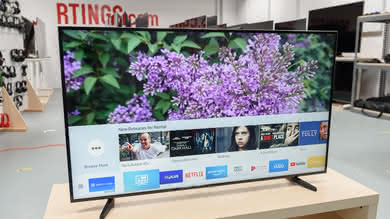
The higher end UH9500 has a slightly more glossy screen than the UH8500, but it is still semi-gloss. It should be fine for a room with a few windows. Some faint rainbowing can be seen around direct reflections.
for pictures & test results
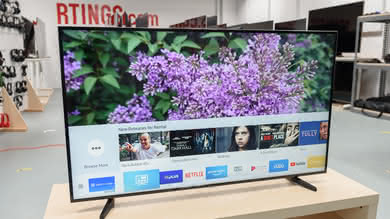
The TV supports passive 3D which means that although there is no noticeable flicker, the number of lines of horizontal resolution is decreased. Due to the size of the TV, this can be noticeable from up close. There is a little bit of crosstalk visible when viewing off-axis.

for pictures & test results

for pictures & test results
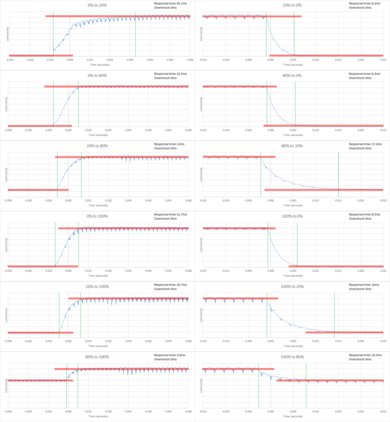
The motion blur is better than average, but noticeable worse than the slightly lower model LG UH8500. This shouldn't be an issue for most people, however. The backlight uses PWM flicker to dim, and so duplicating images can be seen behind the logo.

Movies playing from DVDs, Blu-rays or from streaming apps play without judder when the 'Real Cinema' option is turned on. Movies playing from 60p/60i sources like cable/satellite/set-up boxes or a computer do have some judder. For most people this is not an issue.
Judder can be removed by setting 'TruMotion' to 'User' and setting 'De-Judder' to a low value. Note that even at a low value, it will introduce a bit of soap opera effect.
for pictures & test results

for pictures & test results

The UH9500 has a 120Hz panel, and is able to interpolate lower frame rate content. For those that enjoy the soap opera effect, enable motion interpolation with the 'TruMotion' setting.
Input lag is good for SDR content, but more competitive gamers may notice a slightly delay when playing HDR games. For most people, this should not be an issue.
Update 12/08/2016: With the newest firmware update (04.30.19) there has been the addition of a HDR gaming mode. In this mode the HDR input lag is lower, and should be fine for HDR gaming. Note that although the TV accepts a 4k @ 60Hz @ 4:4:4 + HDR signal, it can't accurately display the chroma subsampling in any HDR mode, even with the 'PC' icon selected.
To enable chroma subsampling support, change the input icon to 'PC'. It is also necessary to enable 'HDMI ULTRA HD Deep Color' in the 'General' settings menu to allow 4k @ 60Hz @ 4:4:4. Although it has a 120Hz panel, like other LG TVs it is not able to support a 120 fps input.


for pictures & test results

Average performance. Frequency response is good at lower volumes. However, under heavier loads compression and pumping will be present. Additionally, this TV does get quite loud and does produce a decent amount of bass, for a TV.
for pictures & test results

Average harmonic distortion performance. The overall amount of harmonic distortion at 75 is relatively low. The rise in distortion at 85 and maximum volume isn't too much either, and the values remain within decent limits.
for pictures & test results
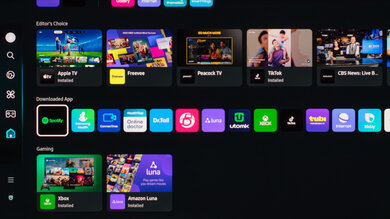
Included with the TV are the most popular apps, such as Spotify, Netflix, Amazon Video and Hulu. It is also possible to download a wide range apps from the 'LG Content Store'.
for pictures & test results

The UH9500 features LG's latest iteration of WebOS (3.0). It is very intuitive and easy to use, especially with the included smart remote. It also includes support for popular streaming services such as Netflix and Amazon Video out of the box, with many more applications available from the 'LG Content Store'. It is one of the most stable smart platforms, and is always fast to navigate or load apps.
for pictures & test results

The controls are located behind the bottom left of the TV. They may be a little bit harder to access if wall mounted but are easy to use.

for pictures & test results

- Manual
- Cable management strap
- Batteries
- Remote
- Composite adapter
- Component adapter
- 2 x 3D glasses


