The Samsung DU7200 is an entry-level model in Samsung's D Series lineup. It sits above the Samsung DU6900 and below the Samsung DU8000. It's a pretty basic model without local dimming, and it only has HDMI 2.0 bandwidth and a 60Hz panel. However, it still has some basic features like VRR, motion interpolation, black frame insertion, AirPlay, and HDR10+. It runs a stripped-down version of Samsung's Tizen OS, but it's still loaded with a ton of streaming apps and comes with Samsung's TV Plus, which has a ton of free channels. It also has a built-in 20W 2.0 channel speaker system. We bought and tested the 65-inch model, but it's also available in 43, 50, 55, 60, 70, 75, and 85-inch models.
Our Verdict
The Samsung DU7200 is inadequate for mixed usage. In a dark room, it has bad black levels, muted colors, and dim highlights, so SDR and HDR content is unimpressive. Since this is a very dim model with inadequate reflection handling, visibility is an issue in well-lit rooms. The TV lacks modern gaming features, so it doesn't pair well with modern consoles. Finally, its narrow viewing angle means it's unsuitable for large living rooms.
Black levels are barely affected by ambient lighting.
Not bright enough in SDR to overcome glare in well-lit rooms.
Too dim in HDR for highlights to stand out.
Poor contrast and no local dimming means blacks look grayish.
Doesn't support modern gaming features like HDMI 2.1 and 120Hz.
Inadequate reflection handling means visibility is an issue in a bright room.
The Samsung DU7200 is sub-par for a home theater. It lacks a local dimming feature, so blacks look gray during most scenes. Furthermore, colors are muted, and highlights don't pop out much at all in HDR movies, which leads to an unimpressive HDR experience. It does a decent job upscaling low-resolution content, but low-bitrate content has very noticeable artifacts. Due to the TV's relatively slow response time, there's not much stutter, but that doesn't make up for the TV's poor image quality.
Very little stutter.
Very good HDR brightness accuracy.
Too dim in HDR for highlights to stand out.
Poor contrast and no local dimming means blacks look grayish.
Dark colors in HDR lack depth and bright colors are dim.
Poor low-quality content smoothing leads to distracting artifacts in low-bitrate content.
The Samsung DU7200 is disappointing for a bright room. Its SDR brightness and reflection handling are inadequate to fight glare in a well-lit room, so visibility is an issue. Colors are even more muted in a bright room than they are in a dark one. Even though black levels are mostly unaffected by ambient lighting, you have a hard time even seeing the screen during dark scenes, since reflections are so visible.
Black levels are barely affected by ambient lighting.
Not bright enough in SDR to overcome glare in well-lit rooms.
Colors in SDR are a bit muted and dull.
Inadequate reflection handling means visibility is an issue in a bright room.
The Samsung DU7200 is sub-par for watching sports. Unfortunately, this is a very dim TV with inadequate reflection handling, so glare is an issue even in moderately lit rooms. It's best suited for a dimly lit setting. Even then, colors a bit muted, so the jersey of your favorite team isn't as vivid as the one you're wearing while watching the game. Due to the TV's relatively slow response time, fast sports like racing are a bit blurry. Finally, the TV's mediocre viewing angle means image quality degrades as you move off center, so it's not a good option for wide seating arrangements.
Colors in SDR are a bit muted and dull.
Inadequate reflection handling means visibility is an issue in a bright room.
Poor low-quality content smoothing leads to distracting artifacts in low-bitrate content.
Noticeable dirty screen effect and uneven brightness due to its mediocre gray uniformity.
The Samsung DU7200 is a disappointing gaming TV. It doesn't have many modern gaming features, so you're limited to 4k @ 60Hz. The TV does support VRR, but its range is very narrow, which limits its usefulness. The TV has low enough input lag at 60Hz for a responsive feel, but you miss out on the additional input lag benefits that higher refresh rates offer. Pixel transitions are also a bit slow, so fast motion is noticeably blurry. Finally, the TV's image quality is lackluster; blacks look gray, colors are muted, and highlights in HDR don't stand out.
Low input lag at 60Hz.
Too dim in HDR for highlights to stand out.
Poor contrast and no local dimming means blacks look grayish.
Dark colors in HDR lack depth and bright colors are dim.
Slow pixel transitions in Game Mode leads to blurry motion.
Doesn't support modern gaming features like HDMI 2.1 and 120Hz.
The Samsung DU7200 has bad brightness capabilities. Its inadequate SDR brightness means it doesn't overcome glare in a room with ambient lighting. It has poor HDR brightness as well, so highlights don't pop out at all in most scenes, and entirely bright scenes look quite dim.
Not bright enough in SDR to overcome glare in well-lit rooms.
Too dim in HDR for highlights to stand out.
The Samsung DU7200 has bad black levels. The TV does have superb black uniformity, but that doesn't save the image from its bad contrast, so blacks look grayish, and the image looks washed out.
Superb black uniformity.
Poor contrast and no local dimming means blacks look grayish.
The Samsung DU7200 has sub-par colors. It has decent color accuracy out-of-the-box, so colors mostly look the way they should, but color enthusiasts will be disappointed since the cost of calibrating this TV isn't worth it for most people. Unfortunately, the TV has inadequate color volume in both SDR and HDR, so colors look muted in all content.
Colors in SDR are a bit muted and dull.
Dark colors in HDR lack depth and bright colors are dim.
Note: We're in the process of improving our tests related to image processing, but this score should give you a general idea of how a TV performs overall with its image processing capabilities.
The Samsung DU7200 has reasonable image processing. Its upscaling is satisfactory, so you don't have to look at an overly soft image when watching low-resolution content, but it still lacks some details. Unfortunately, the TV's low-quality content smoothing is poor, so low-bitrate content has visible artifacts. The TV's gradient handling is alright, so even though there's some banding in most color gradients, it's not too distracting. It does a very good job overall of displaying HDR content at the brightness level intended by the filmmaker, but it's not perfect, and blacks are raised.
Very good HDR brightness accuracy.
Poor low-quality content smoothing leads to distracting artifacts in low-bitrate content.
The Samsung DU7200 has adequate responsiveness in its dedicated gaming mode. It has low input lag for a responsive feel, but since the TV is limited to 60Hz, you don't get the very low input lag that comes with gaming in higher refresh rates. The TV supports VRR, but its range is very narrow, which limits its effectiveness when your frame rate is inconsistent. The speed of pixel transitions is mediocre, so fast motion has noticeable blur behind it. Since the TV is limited to 4k @ 60Hz and is light on gaming features, it's not a good option to pair with a modern console.
Low input lag at 60Hz.
Slow pixel transitions in Game Mode leads to blurry motion.
Doesn't support modern gaming features like HDMI 2.1 and 120Hz.
We're in the process of fixing the way we evaluate a TV's overall motion handling. This section is currently broken, and the score isn't indicative of how well a TV handles motion overall.
Performance Usages
Changelog
-
Updated Sep 16, 2025:
We bought and tested the Samsung U8000F, and added a comparison in the Black Uniformity section.
- Updated Jul 09, 2025: Converted to Test Bench 2.0.1. We did this to fix an issue with our scoring in the Supported Resolutions section, since TVs with a refresh rate higher than 144Hz were being penalized for not supporting 144Hz.
-
Updated Jul 09, 2025:
We wrote text for the new tests and rewrote text throughout the review after updating pre-existing tests and scores for Test Bench 2.0.
- Updated Jul 09, 2025: We converted the review to Test Bench 2.0. With this new methodology, we've added new tests to expand the scope of our testing, adjusted our scoring to better align with current market conditions, and added performance usages that group related tests together to give more insight into specific aspects of a TV's performance. You can find a full list of changes in the TV 2.0 changelog.
Check Price
Differences Between Sizes And Variants
We've bought and tested the 65-inch Samsung DU7200, which is also available in 43, 50, 55, 60, 70, 75, and 85-inch sizes. All sizes offer the same picture quality and overall performance. Note that with Samsung TVs, the four letters after the short model code (FXZA in this case) vary between different retailers and regions, but there's no difference in performance.
Costco and Sam's Club sell a variant of this TV known as the Samsung DU7200D. This variant performs the same but comes with an extended warranty and other store-specific perks. Some retailers, like Walmart, sell the TV as the Samsung DU7200B, but it performs the same.
| Size | US Model | Costco Model (US) |
| 43" | UN43DU7200FXZA | UN43DU7200DXZA |
| 50" | UN50DU7200FXZA | UN50DU7200DXZA |
| 55" | UN55DU7200FXZA | UN55DU7200DXZA |
| 60" | UN60DU7200FXZA | UN60DU7200DXZA |
| 65" | UN65DU7200FXZA | UN65DU7200DXZA |
| 70" | UN70DU7200FXZA | UN70DU7200DXZA |
| 75" | UN75DU7200FXZA | UN75DU7200DXZA |
| 85" | UN85DU7200FXZA | UN85DU7200DXZA |
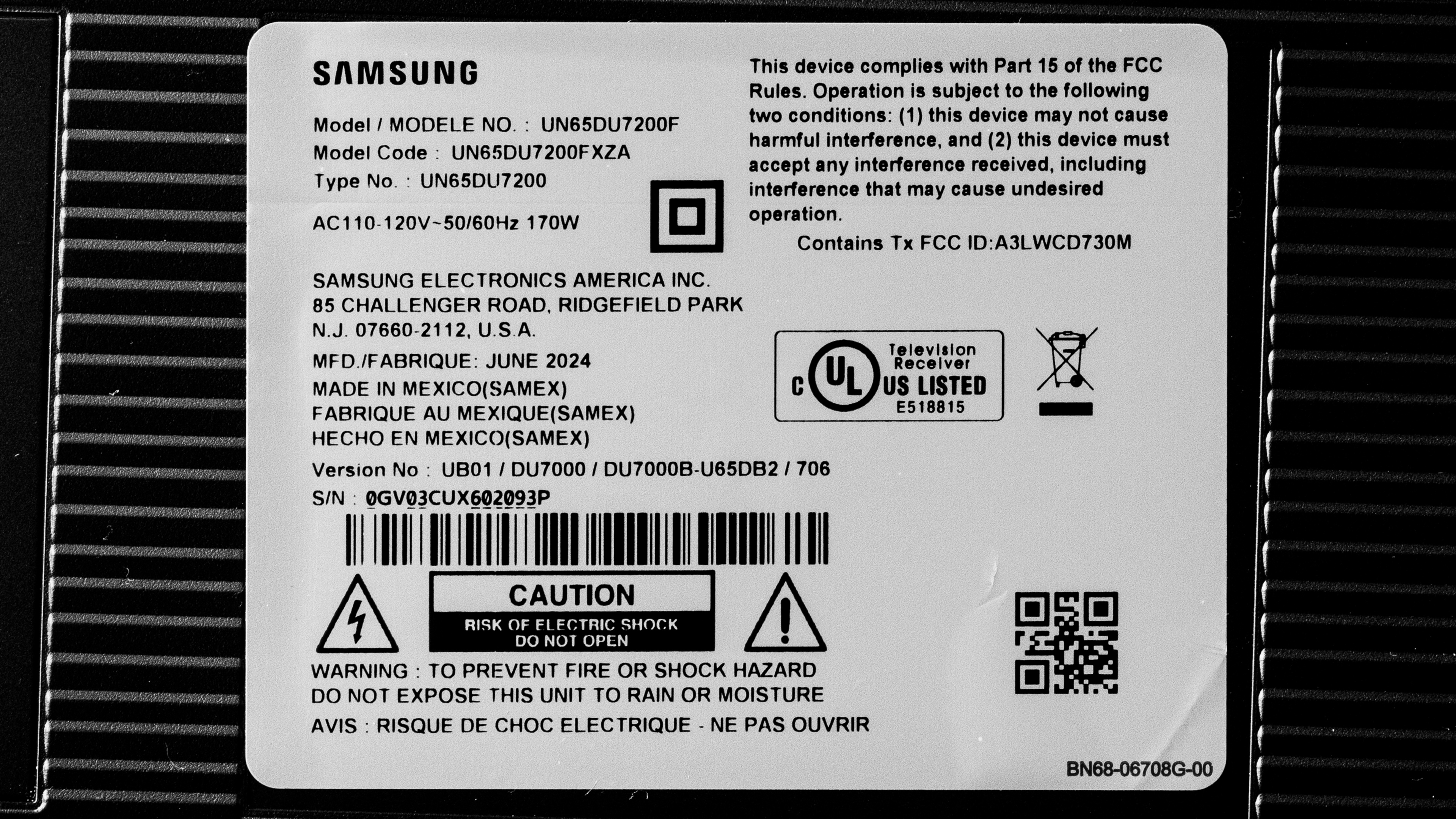
Our unit was manufactured in June 2024, as seen on the label.
Popular TV Comparisons
The Samsung DU7200 is a sub-par TV overall, and it doesn't stand out in many ways. Since it lacks local dimming, doesn't get very bright at all in HDR, and has a narrow color gamut, it doesn't provide an impactful HDR viewing or gaming experience. It's also dim in SDR, so it's not suitable for use in a bright room. It's a pretty basic 60Hz TV, and for less money, you can get better overall picture quality from a TV like the Hisense A7N. You can even get a TV with superior image quality and modern gaming features like the Hisense U65QF for around the same cost as this Samsung.
For more options, take a look at our recommendations for the best budget TVs, the best TVs under $500, and the best TVs for watching sports.
The Samsung DU7200 and the Samsung U8000F offer nearly identical performance, and there's absolutely no clear winner between the two. The U8000F is more accurate out of the box and it has slightly better EOTF tracking.
The Samsung DU8000 and the Samsung DU7200 are very similar overall. The DU7200 has an edge with contrast, displaying slightly deeper blacks. The DU7200 is also brighter overall, meaning it fights a bit more glare in a bright room and displays brighter highlights in HDR. On the other hand, the DU8000 displays a wider range of colors, so you get a slightly more vibrant image on it.
The Hisense U65QF is much better than the Samsung DU7200. The U65QF is brighter overall, so it handles more glare in a well-lit room and delivers a more impactful HDR experience. Blacks are significantly deeper on the Hisense, since it has effective local dimming, and colors are also a lot more vibrant. If you're a gamer, the Hisense is also the better option due to its modern gaming features.
The Samsung DU7200 and Samsung CU7000/CU7000D are closely matched, with the older CU7000 having a slight edge when it comes to image quality, but the DU7200 has more features. The DU7200 is a bit brighter in HDR and SDR, but this is hardly noticeable, while the CU7000 has noticeably deeper contrast. Still, the CU7000 has slightly better reflection handling, giving it the edge in brighter rooms. The DU7200 is the most accurate TV of the two out-of-the-box and has a basic VRR feature in the 48-60Hz range, making it a bit more interesting for gamers. Ultimately, these two TVs are similar enough that you should get the cheapest one you can find.

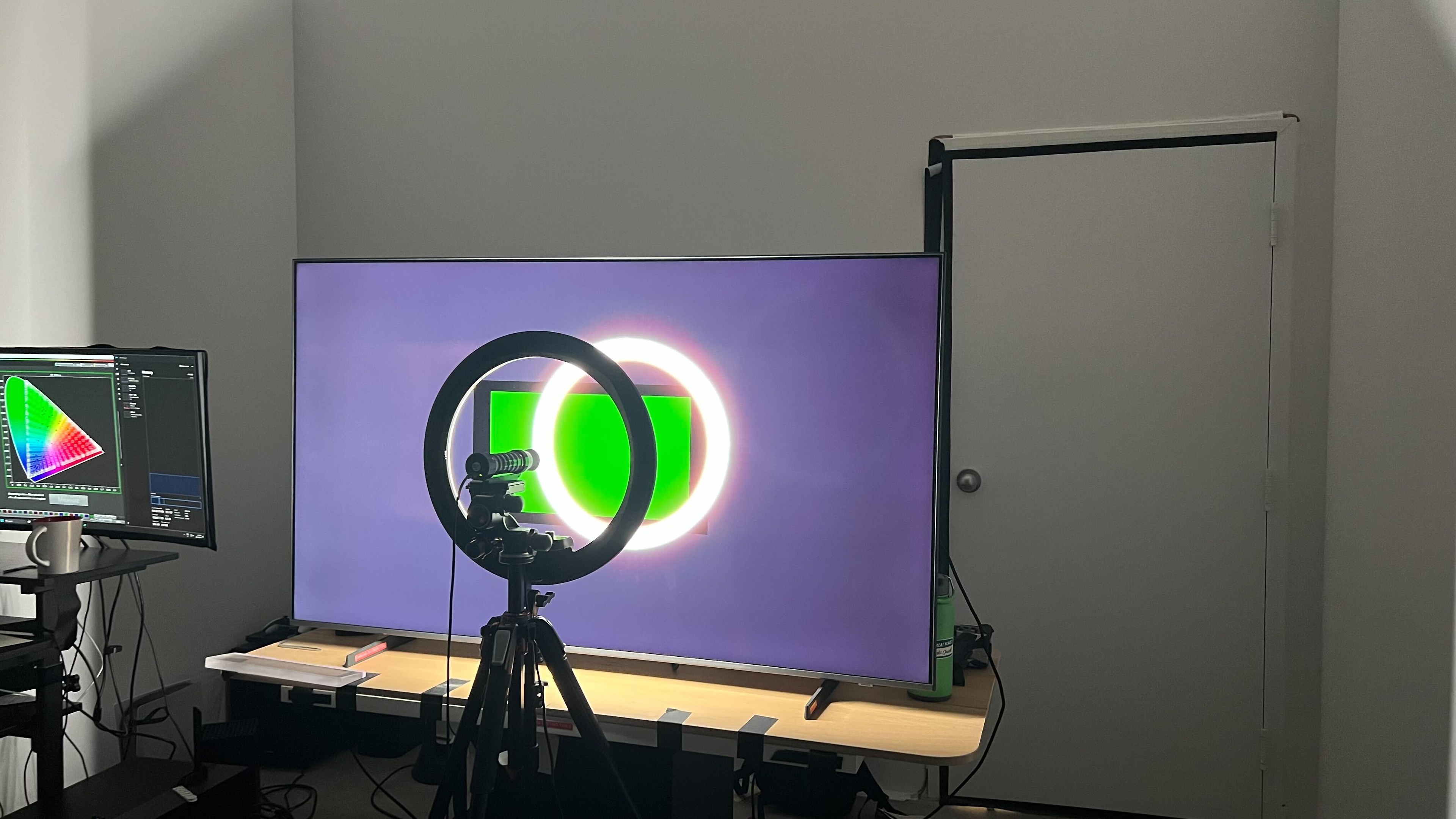
We buy and test dozens of TVs yearly, taking an objective, data-driven approach to deliver results you can trust. Our testing process is complex, with hundreds of individual tests that take over a week to complete. Most of our tests use specially designed test patterns that mimic real content, but we also use the same sources you have at home to ensure our results match the real-world experience. We use two main tools for our testing: a Colorimetry Research CR-100 colorimeter and a CR-250 spectroradiometer.
Test Results
for pictures & test results

for pictures & test results

for pictures & test results

The Samsung DU7200 has poor HDR brightness. Combined with the TV's bad contrast, it doesn't deliver an impactful HDR viewing experience.
Our results are with HDR Tone Mapping set to 'Static.' Below are the results with HDR Tone Mapping set to 'Active':
- Hallway Lights: 248 cd/m²
- Yellow Skyscraper: 229 cd/m²
- Landscape Pool: 187 cd/m²
for pictures & test results

for pictures & test results

for pictures & test results

Although the TV is a tiny bit dimmer in Game Mode, it's not noticeable. Our results are with HDR Tone Mapping set to 'Static.' Below are the results with HDR Tone Mapping set to 'Active':
- Hallway Lights: 240 cd/m²
- Yellow Skyscraper: 215 cd/m²
- Landscape Pool: 186 cd/m²
The Samsung DU7200 has inadequate SDR brightness. It's not bright enough to overcome glare in a well-lit room, so it's best suited for dark or dimly lit environments.
for pictures & test results

The Samsung DU7200 has bad contrast. Its native contrast ratio is okay, so blacks are somewhat deep during purely dark scenes. Unfortunately, since the TV lacks local dimming, blacks become raised and grayish when brighter elements are also on screen.
for pictures & test results

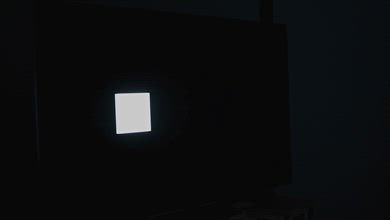
This TV doesn't have a local dimming feature, so there's no haloing around bright objects or subtitles in dark scenes. However, as the TV can't brighten highlights without impacting the rest of the image, dark scenes look washed out.
for videos & test results

This TV doesn't have a local dimming feature, so it doesn't adjust the backlight of individual areas to brighten up highlights without impacting the rest of the image. This means that there are no distracting flickers or brightness changes as bright highlights move across the screen.
for pictures & test results

for videos & test results
for videos & test results

Switching to Game Mode doesn't result in any noticeable difference in dark scene performance. Our local dimming transition video looks different here than it did outside of Game Mode due to a bug; the TV maxes out its brightness whenever you turn on VRR.
for pictures & test results

The TV has superb black uniformity. There's a bit of cloudiness due to the lack of local dimming, but it's very minor. Relative to newer models like the Samsung U8000F, blacks aren't as deep, but they're far more uniform, with less variation across the screen.
for pictures & test results

for pictures & test results

The Samsung DU7200 has poor SDR color volume. It just covers the full range of colors in the narrow BT.709 color space, and its coverage of the wider DCI-P3 color space is sub-par. It has bad coverage of the widest BT.2020 space, where it covers less than half of the possible colors. This lack of coverage means colors looked muted in SDR content that utilizes these wider spaces, and it's a poor choice if you like to increase the saturation of colors by forcing the TV into a wider color space.
| Volume ΔE³ | DCI-P3 Coverage |
BT.2020 Coverage |
|---|---|---|
| L10 | 82.56% | 59.60% |
| L20 | 81.75% | 58.02% |
| L30 | 80.45% | 56.95% |
| L40 | 76.80% | 54.92% |
| L50 | 74.13% | 53.22% |
| L60 | 69.83% | 49.59% |
| L70 | 63.71% | 41.05% |
| L80 | 63.30% | 39.04% |
| L90 | 64.08% | 39.39% |
| L100 | 64.33% | 41.89% |
| Total | 69.71% | 46.96% |
for pictures & test results

for pictures & test results

The Samsung DU7200 has inadequate HDR color volume. It's not nearly bright enough to display colors at high luminance levels, and it struggles with displaying darker colors due to its unremarkable contrast.
for pictures & test results

for pictures & test results

for pictures & test results

The TV has decent pre-calibration SDR accuracy. Greens and reds are underrepresented in darker shades of gray, while blues are underrepresented in all shades of gray. This makes the color temperature warmer than our target of 6500K, but it's still pretty close. Its color accuracy is very good overall, but whites, lighter colors, and saturated reds, blues, and greens are a bit inaccurate. Gamma is close to 2.2, but dark scenes and very bright scenes are noticeably darker than they're supposed to be.
for pictures & test results

for pictures & test results

for pictures & test results

The TV has outstanding SDR accuracy after calibration. Reds, blues, and greens are still underrepresented in dark shades of gray, but brighter shades are almost perfect, so the color temperature is now very close to the 6500K we aim for. The inaccuracies with lighter colors are mostly gone, but there are still some minor inaccuracies with some saturated colors. The gamma is the same as it was prior to calibration.
Unfortunately, the TV is a bit difficult to calibrate, as more aggressive changes in the 10–30 point range ended up making the image worse.
See our full calibration settings.
for pictures & test results

for pictures & test results

This TV has okay HDR color accuracy out of the box. Its white balance is decent overall, but there's too much blue and not enough red in most shades of gray, which makes the TV's color temperature noticeably cooler than the industry standard 6500K. The overall accuracy of colors is alright, but there are noticeable mapping errors throughout, especially with well-saturated colors.
for pictures & test results

for pictures & test results

After calibration, the TV has great HDR color accuracy, but it's not perfect. Its white balance and color temperature are now outstanding, and the image no longer looks too cool. Unfortunately, the accuracy of colors has only improved a bit, and there are still mapping errors with well-saturated colors.
for pictures & test results

The Samsung DU7200 has great PQ EOTF tracking. Since the TV lacks local dimming, blacks are displayed brighter than intended, and some darker shadows are also a bit brighter than they're supposed to be. However, the TV follows the curve incredibly closely until there's a roll-off near its peak brightness to maintain details in highlights that are brighter than its capabilities.
for pictures & test results

The Samsung DU7200 has poor low-quality content smoothing. It does an outstanding job at preserving details, but barely any actual smoothing is done, so low-bitrate content still has noticeable macro-blocking.
for pictures & test results

The Samsung DU7200D does a satisfactory job at upscaling low-resolution content like DVDs or lower-resolution streams. Details are mostly clear, but finer details are very hard to make out.
for pictures & test results
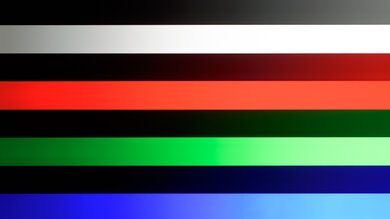
The Samsung DU7200D has alright HDR gradient handling. There's some noticeable banding in dark grays, dark reds, dark blues, and greens. Fortunately, there's minimal banding in other color gradients.
The TV has incredibly low input lag when used in Game Mode. To have low input lag while transmitting a chroma 4:4:4 signal, you need to set the input to 'PC' and enable Game Mode.
The TV supports all common resolutions at 60Hz. Unfortunately, 1440p doesn't work in Game Mode.
The TV supports every VRR technology to reduce screen-tearing. Unfortunately, its usefulness is limited since it has a very narrow VRR range and doesn't support sources with Low Framerate Compensation (LFC), so you get screen-tearing when your frame rate dips below 48 fps. Unfortunately, Game Mode doesn't work in 1440p @ 60Hz, so you can't use VRR and game in 1440p.
for pictures & test results
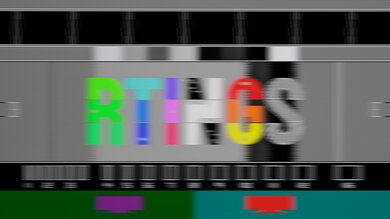
for pictures & test results

The TV's CAD at 60Hz is mediocre, and most transitions are pretty slow. Combined with the persistence blur that's present in 60Hz games, fast motion looks blurry.
This TV doesn't support 120Hz.
for pictures & test results

for pictures & test results

The TV's CAD at 60Hz is mediocre, and most transitions are pretty slow. Combined with the persistence blur that's present in 60Hz games, fast motion looks blurry.
for pictures & test results

The Samsung DU7200B is limited to 60Hz with all resolutions, so it only supports up to 4k @ 60Hz on the P55. It has Auto Low Latency Mode, so it'll automatically switch to Game Mode when the TV detects a game console as its input device, which gives you the lowest possible input lag for games. Unfortunately, 1440p doesn't work while in Game Mode, so you can't game in 1440p with low input lag.
for pictures & test results

The Samsung DU7200B is limited to 60Hz across all resolutions, so it only supports up to 4k @ 60Hz on the Xbox Series X|S. It has Auto Low Latency Mode, so it'll automatically switch to Game Mode when the TV detects a game console as its input device, which gives you the lowest possible input lag for games. Unfortunately, 1440p doesn't work while in Game Mode, so you can't game in 1440p with low input lag. The TV also doesn't support Dolby Vision.
Due to this TV's quicker response time, it does a decent job with stutter in 24p content like movies and shows, but there's still some minor stutter with slower camera movements.
The Samsung DU7200D removes judder from native 24p signals, like DVD or Blu-ray players, as well as from native apps. Unfortunately, it doesn't remove judder from 60i or 60p sources, so movies played from satellite/cable boxes aren't judder-free.
for pictures & test results

for pictures & test results

The TV has an okay response time when watching movies, shows, and sports. Most content looks clear enough to enjoy, but motion in faster sports is a bit blurry.
for pictures & test results

The TV uses pulse-width modulation (PWM) to dim its backlight, which introduces flicker that can bother people who are sensitive to it. The amount of flicker varies depending on what picture mode the TV is set to and what settings you're using. When using 'Filmmaker Mode,' the TV flickers at 120Hz with all brightness levels. It flickers at 480Hz in all other picture modes with the brightness set above '19' and flickers at 120Hz with the brightness set to '19' and below.
for pictures & test results
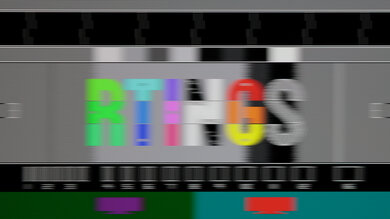
for pictures & test results
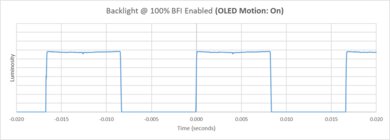
The TV supports backlight strobing, more commonly known as black frame insertion (BFI). The feature is designed to improve the appearance of motion by strobing its backlight and reducing the amount of persistence blur. The BFI feature on the TV flickers at 60Hz, and there's noticeable image duplication present.
for pictures & test results

The TV has optional motion interpolation to help smooth out low-frame-rate content. It does an okay job with smoothing slower-moving scenes, but it struggles so much with faster scenes that there are noticeable artifacts and a screen-tearing type effect. At times it stops interpolating altogether, which causes motion to look inconsistent and is distracting.
for pictures & test results

for pictures & test results

The Samsung DU7200D has poor handling of direct reflections. The intensity of light sources facing the screen are barely reduced, so any lamps or windows opposite the screen are visible and distracting.


for pictures & test results

for pictures & test results

The total reflected light of this TV is sub-par. You easily see reflections on your screen during dark scenes when viewed in a bright room, and there's some obvious light banding present, which is distracting.
for pictures & test results

The TV has sub-par color saturation when used in a well-lit room. There’s barely any difference with the vibrancy of colors whether you’re in a dark room or a bright one, although darker colors look slightly more washed out. Still, the TV has limited color volume to begin with, so colors lack vibrancy regardless of your lighting conditions.
for videos & test results
for pictures & test results

for pictures & test results

for pictures & test results

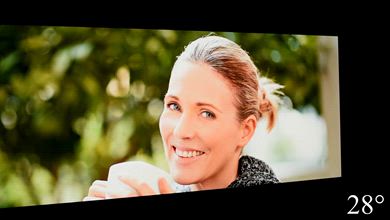
The Samsung DU7200D has a mediocre viewing angle, so it's not suitable for a wide seating arrangement. It's not too bad from a slight angle, but there's significant gamma shifting, color shifting, and color washout that worsens the further you move to the sides of the screen.
for pictures & test results

for pictures & test results

The TV has mediocre gray uniformity overall. There's some dirty screen effect towards the center of the screen, and the sides are quite a bit darker than the center. On a near-black screen, its uniformity is good, with only the sides and bottom edge being a bit lighter than the rest of the screen.
for pictures & test results

for pictures & test results

The TV uses a BGR (Blue-Green-Red) subpixel layout instead of the traditional RGB layout. This doesn't cause any issues for video or gaming content, but it can be a problem for PC monitor use as it impacts the text clarity, although not everyone notices this.
The panel doesn't use any KSF phosphor or Quantum Dot enhancement film to achieve better color separation, which contributes to its relatively narrow color gamut.
for pictures & test results

for pictures & test results

The TV has HDMI 2.0 bandwidth on all three of its ports. It supports HDR10, HDR10+, and HLG, but it doesn't support Dolby Vision.
The TV has eARC support, which allows it to pass uncompressed high-quality audio from a connected source to your home theater system or soundbar. Unfortunately, it doesn't support any DTS formats that are commonly used on many Blu-rays.
7.1 channel LPCM only works with sources that allow you to manually override the EDID, like a PC. If you can't override the EDID, it's limited to 5.1.
for pictures & test results

The Samsung 65DU7200D looks pretty good for a cheaper model. Its bezels are thin enough that they don't stand out when watching the TV, but they aren't as thin as what you get from more premium models.
for pictures & test results

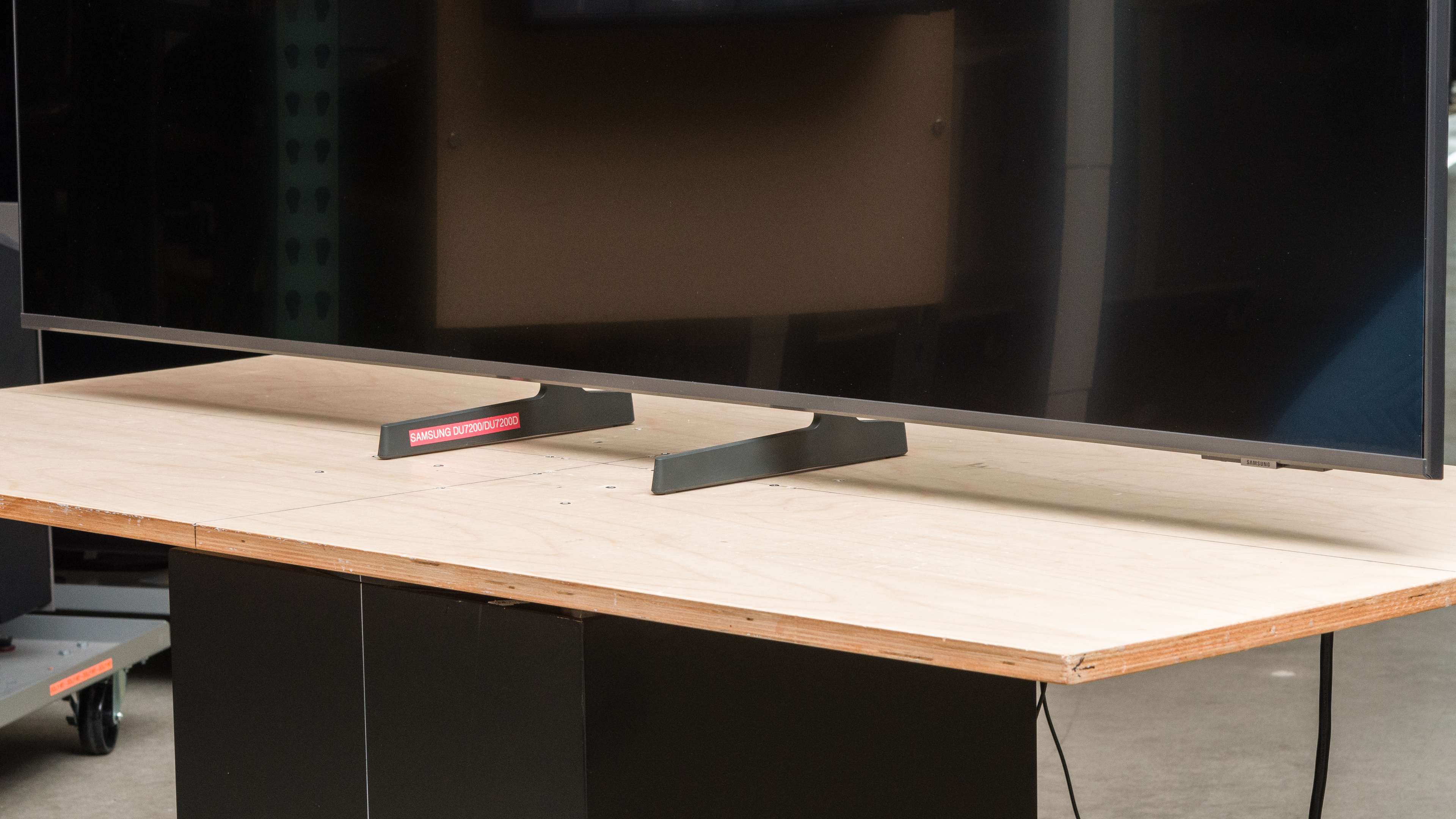
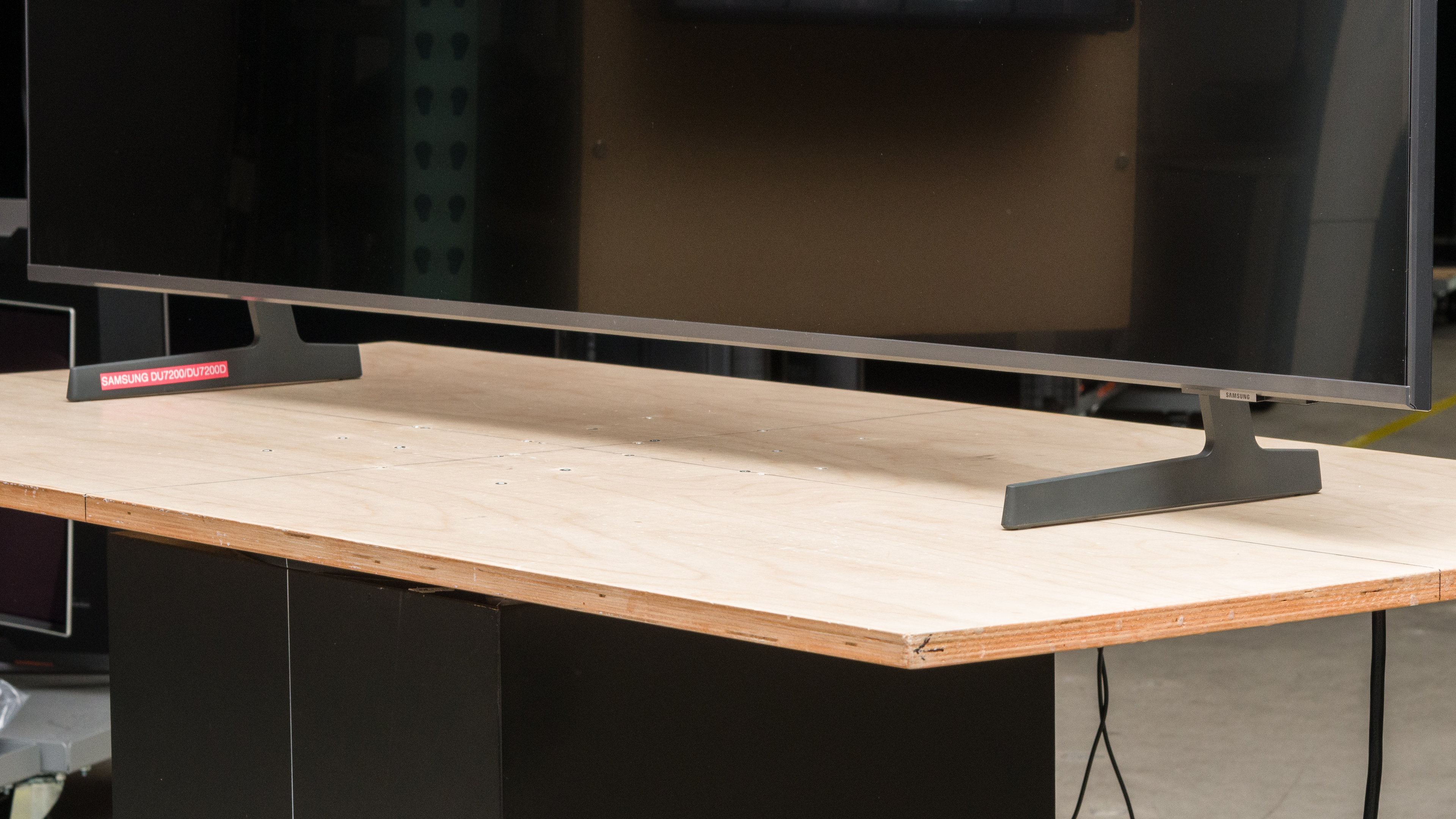
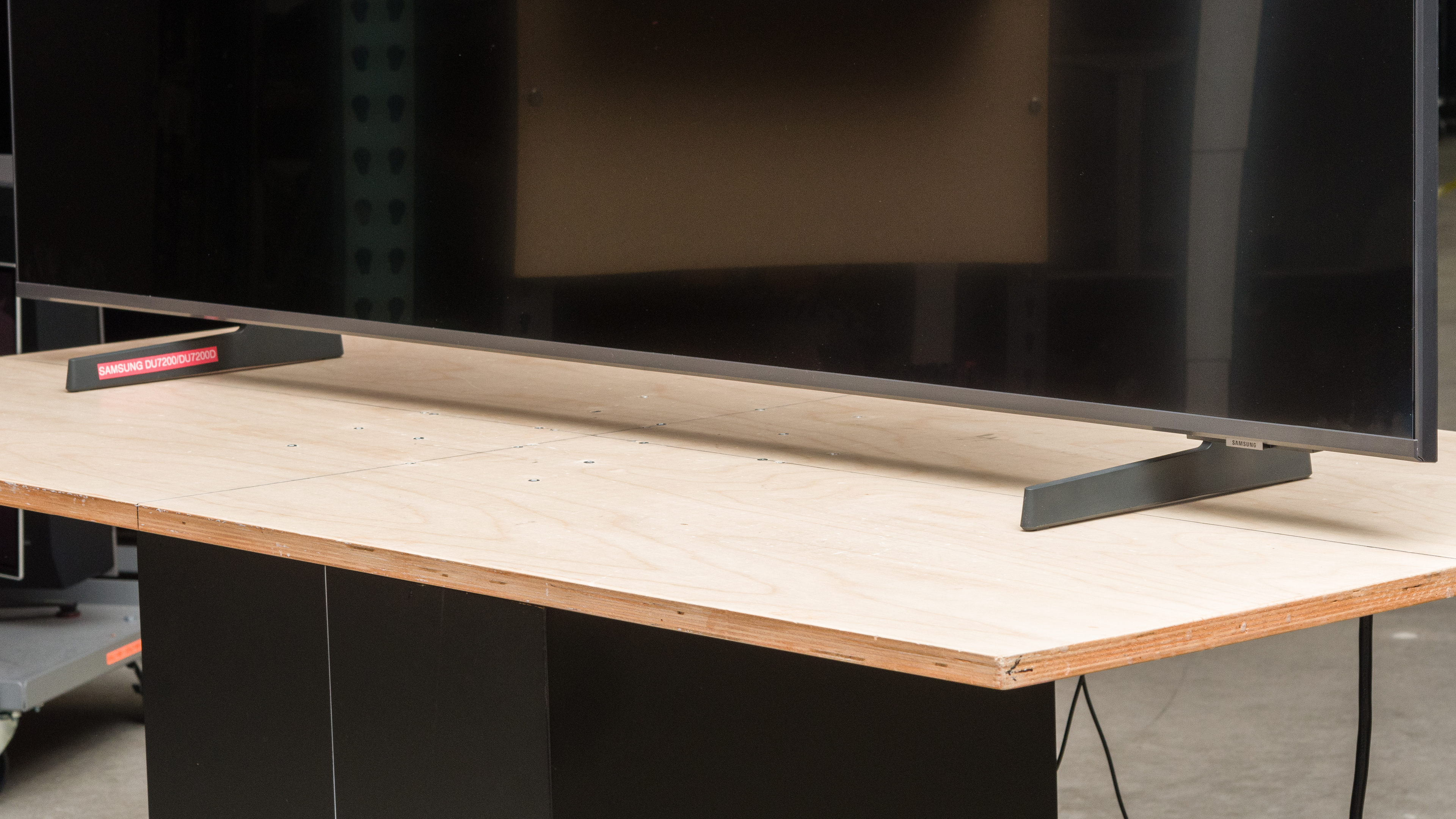
The TV uses a pair of plastic feet that can be adjusted into different positions depending on your needs. The narrow position (pictured above) brings the feet close together, which is great for smaller tables. You can also keep the feet close together and lower the height. If you're more worried about stability, you can widen the feet and set them to either a high or low position. In the higher position, the feet lift the TV about 3.54" above the table, so almost any soundbar fits underneath.
The footprint of the 65-inch stand is 40.28" x 10.5" in the wide position and 11.8" X 10.5" in the narrow position.
for pictures & test results

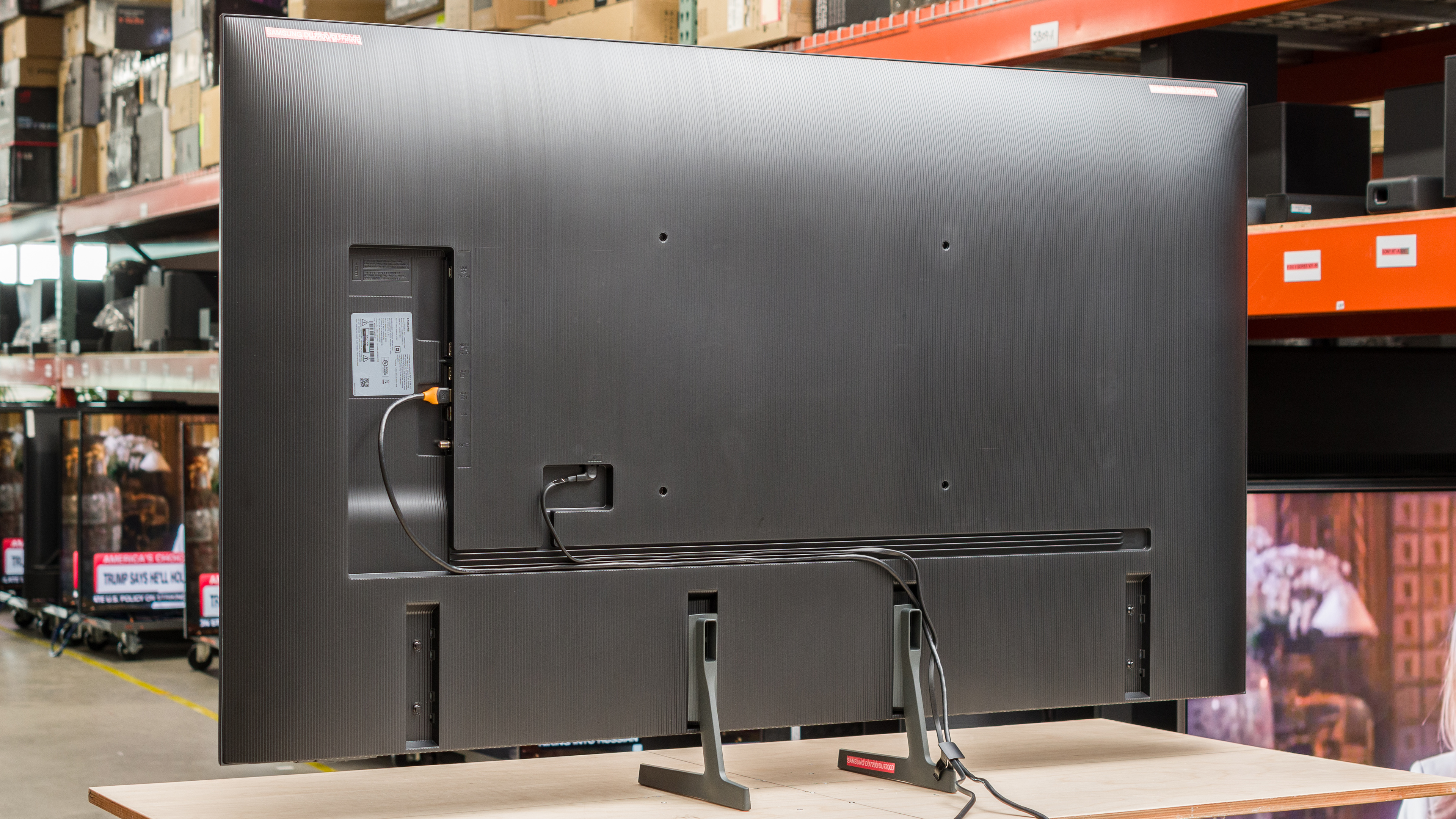
The back of the TV is made from plastic. All of the inputs are on the right side of the TV when facing the front, but they're in a recessed cutout that makes them quite hard to access if you have it wall-mounted. The back has grooves and a clip that can be attached to one of the feet to help with cable management.


for pictures & test results

The TV has alright build quality overall. It wobbles a bit when you're cleaning the screen, but it settles quickly and doesn't cause any issues. There's quite a bit of flex on the back panel that becomes more pronounced near the VESA mounting points, but it doesn't prevent you from wall-mounting it.
Unfortunately, our unit has a stuck pixel on the left side of the screen towards the middle.
for pictures & test results

The TV comes with the 2024 version of Samsung's proprietary Tizen OS but has a reduced feature set compared to more expensive models, so you don't get features like Samsung's Multi View.
for pictures & test results

Like most TVs, there are ads on the home screen. You can't disable them completely, although you can turn off targeted ads.
for pictures & test results

The TV comes with a simpler remote than the Samsung DU8000. It requires external batteries and lacks solar charging. It still has buttons for popular streaming services, but it doesn't have an integrated microphone for voice controls. Overall, a very simplistic but functional remote.
for pictures & test results

There's a single button underneath the Samsung branding on the right side of the TV. You can use it to turn the TV on/off, change channels, adjust the volume, and select inputs.
for pictures & test results

- Remote control (with 2x AAA batteries)
- Power cable
- Clip for cable management
- User guides
for pictures & test results

The TV has an alright frequency response. Like most TVs, deep bass is pretty much non-existent, but the sound is well-balanced at most volume levels. At maximum volume, the sound profile does become more unbalanced, but dialogue is still clear enough to understand. Unfortunately, the TV speakers don't get very loud.