See the previous 0.10 changelog.
Projector Test Bench 0.11 updates our Brightness and Contrast testing with a new measurement workflow built around the Konica Minolta T‑10A 3×3 sensor array. The goal is to improve consistency (especially at very low APL), reduce the need for extra correction steps, and make retesting faster and more repeatable. Our testing is also now performed in a newly updated, light-controlled room with fully velveted surfaces to minimize reflections.
This update also adds a dedicated Variable Refresh Rate (VRR) test box and integrates VRR into our Gaming usage score. Finally, we've reorganized how contrast results are presented: the previous Contrast box is now referred to as Native Contrast (our scored, in-content contrast metric), and Sequential (Full-On/Full-Off) Contrast is now reported within the Native Contrast test, but it has no impact on scoring.
Because not every legacy projector review will be retested, a banner will be displayed on each review indicating the test bench version under which it was tested.
What's New In 0.11
-
Overhauled Brightness testing
- Brightness measurements are now taken using the Konica Minolta T-10A 3×3 sensor array, affecting White Light Output, Color Light Output, and Screen Brightness results.
- Brightness Uniformity is now calculated using Mean Absolute Deviation (MAD) across all nine measurement points and has a reduced weight in the Brightness score.
-
Improved Native Contrast testing at very low APL
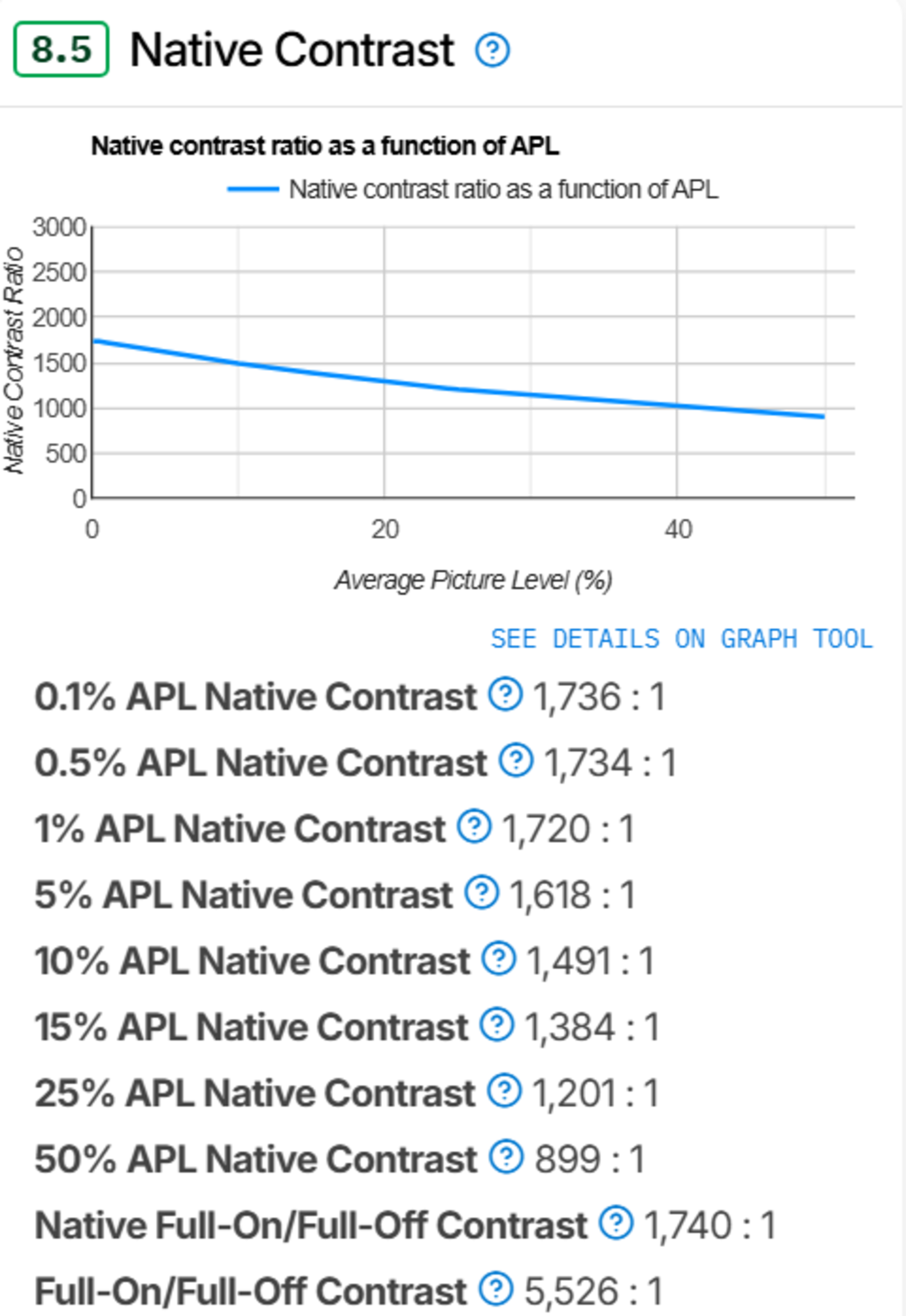
- We now measure 0.5% and 0.1% APL (0.10 bottomed out at 1%), giving better coverage of extremely dark content.
-
Contrast presentation changes
- The previous Contrast box is now labeled Native Contrast.
- The Native Contrast test now also reports Full-On/Full-Off (Sequential) Contrast alongside the APL-based native contrast results.
- Sequential (FOFO) Contrast has no impact on scoring and is included for reference, since it has limited real-world importance compared to intra-frame (APL) contrast.
-
New Variable Refresh Rate test
- Adds a VRR test box and incorporates VRR into the Gaming usage score.
-
Review UI additions
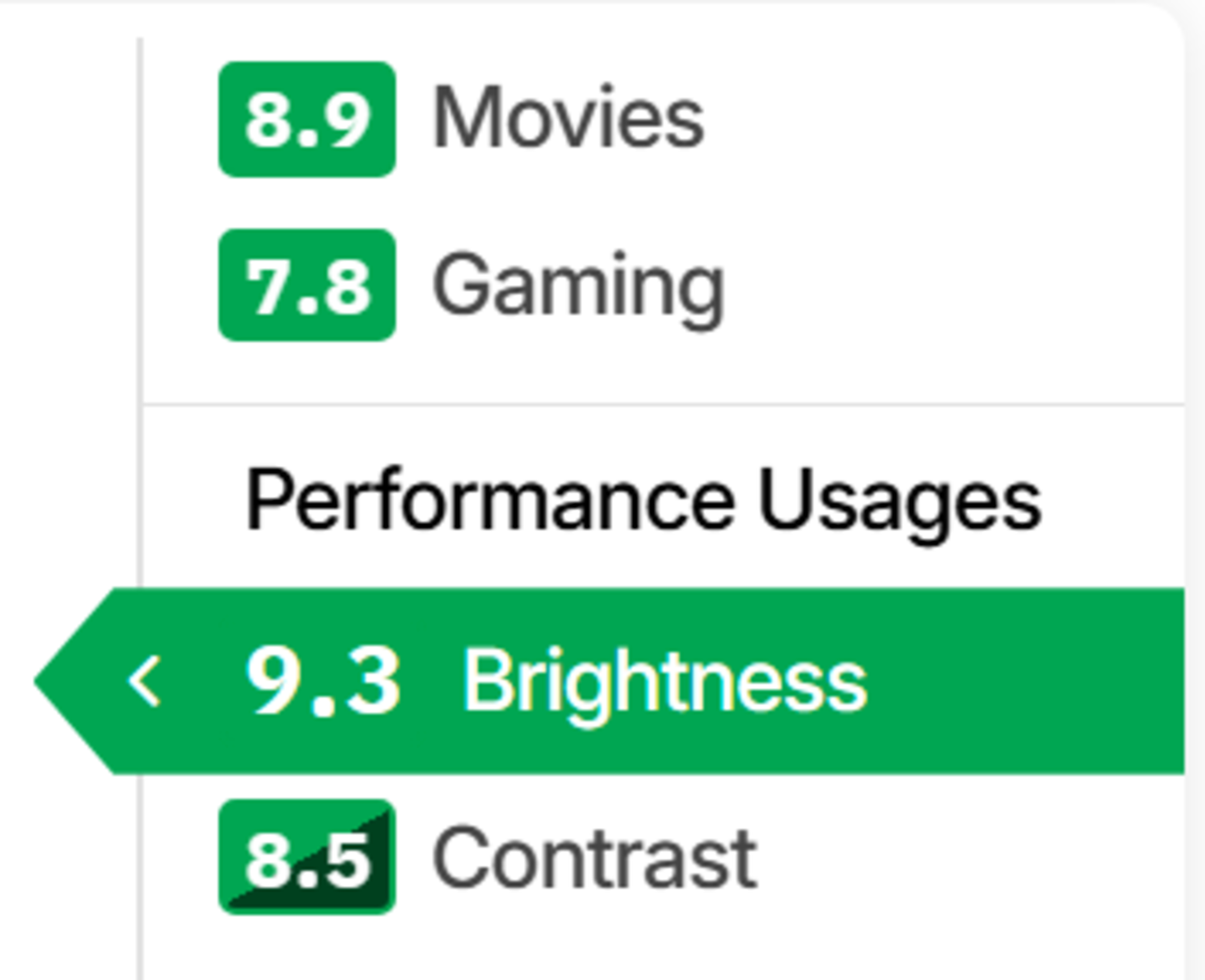
- Adds dedicated Brightness and Contrast Performance Usages in the Our Verdict section.
- Adds/expands the "tested under methodology vX.XX" banner to clarify comparability across versions.
Brightness
-
New measurement instrumentation
- Brightness testing now utilizes the Konica Minolta T-10A wall-mounted 3×3 illuminance meter array to capture nine measurements simultaneously across the projected image area.
- What it means for you: Brightness results under 0.11 are more consistent and repeatable, but they are not directly comparable to brightness results from older test benches that used different instrumentation/workflows.
-
White Light Output & Color Light Output
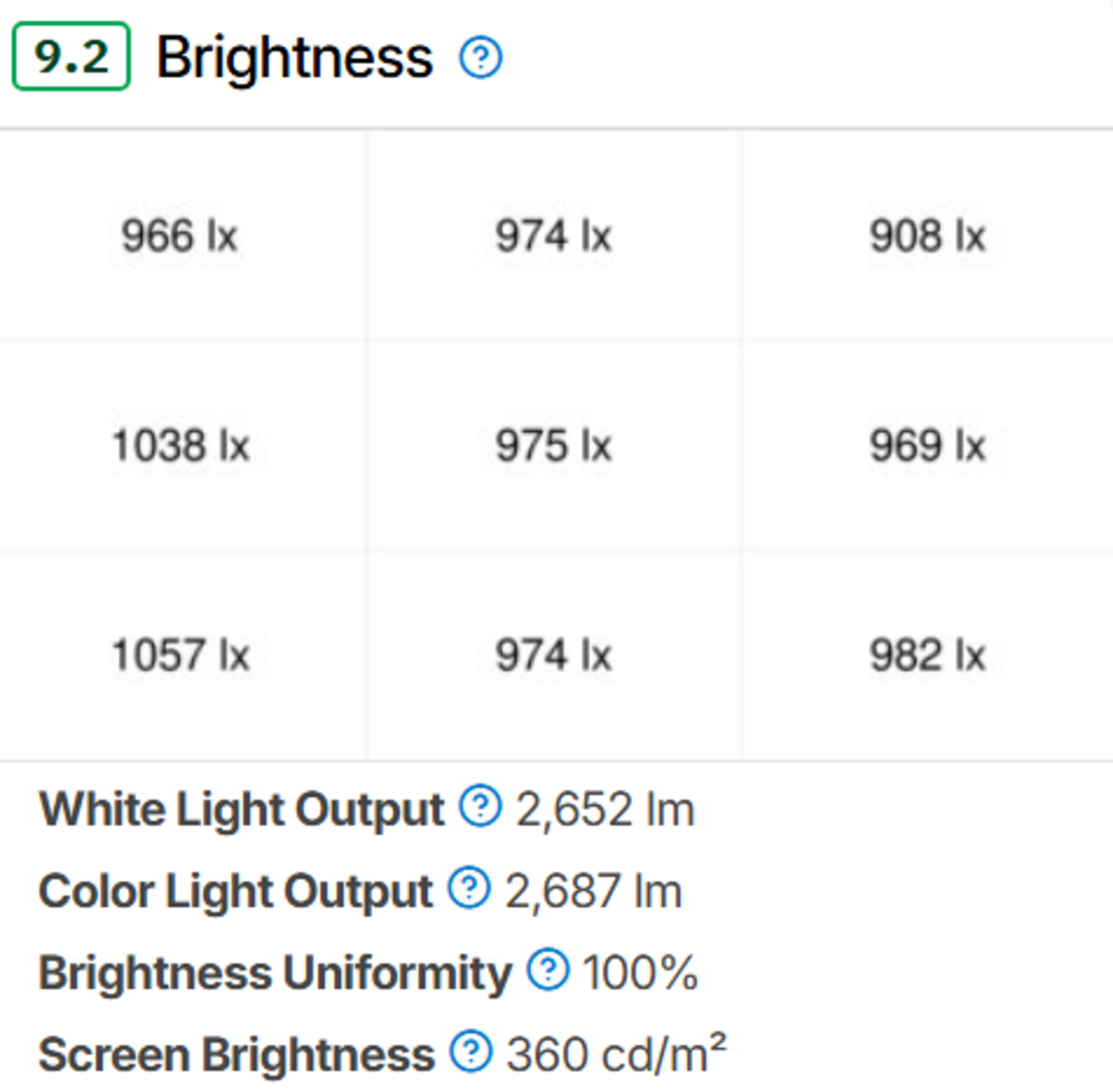
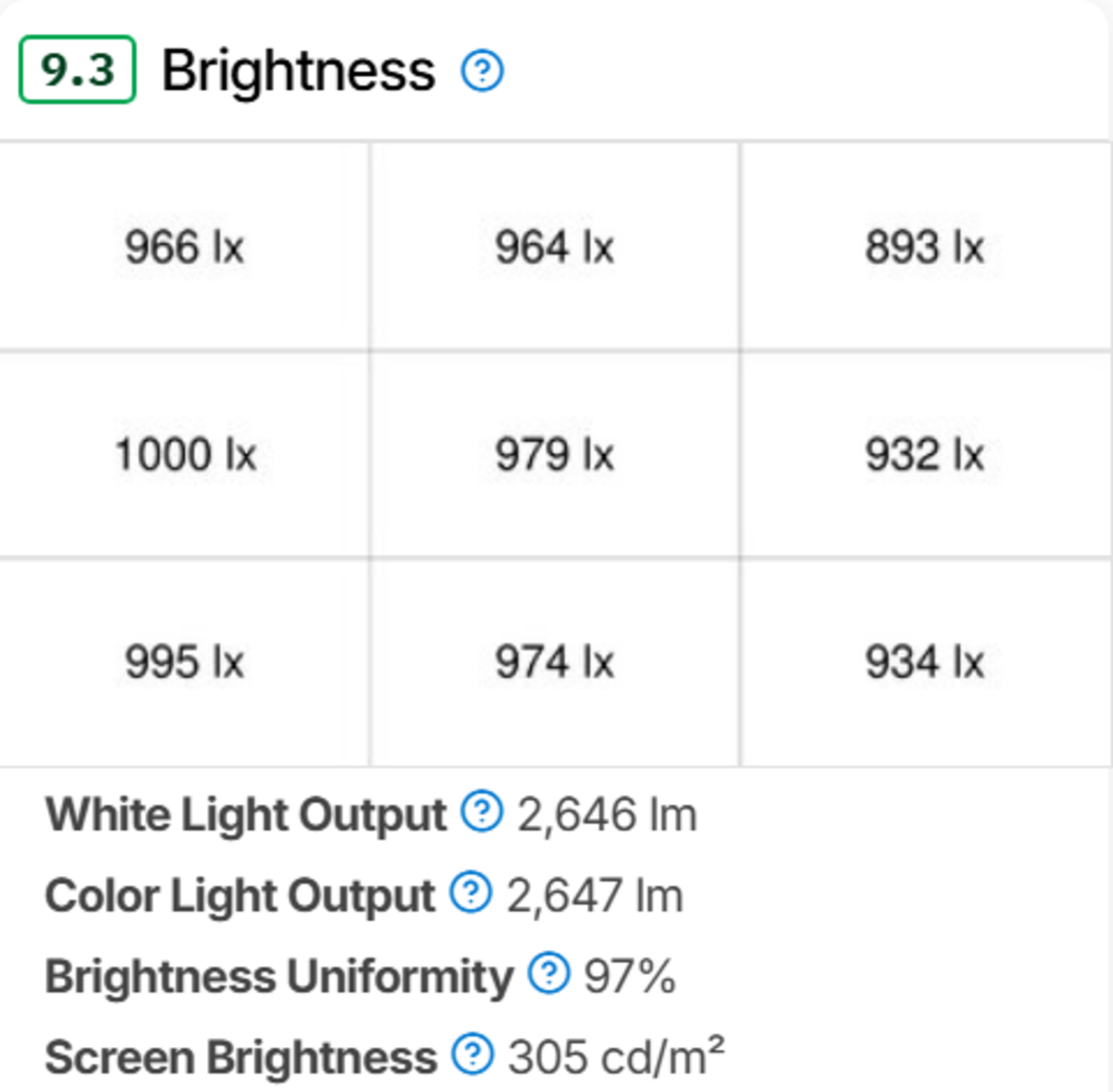
- White and color light output are now measured directly using the nine-point grid measurements captured by the T‑10A array (rather than relying on the older workflow).
- We still report both white and color light output to reflect "full-field brightness" vs "how bright real colors can get."
-
Brightness Uniformity: new metric + reduced score weight
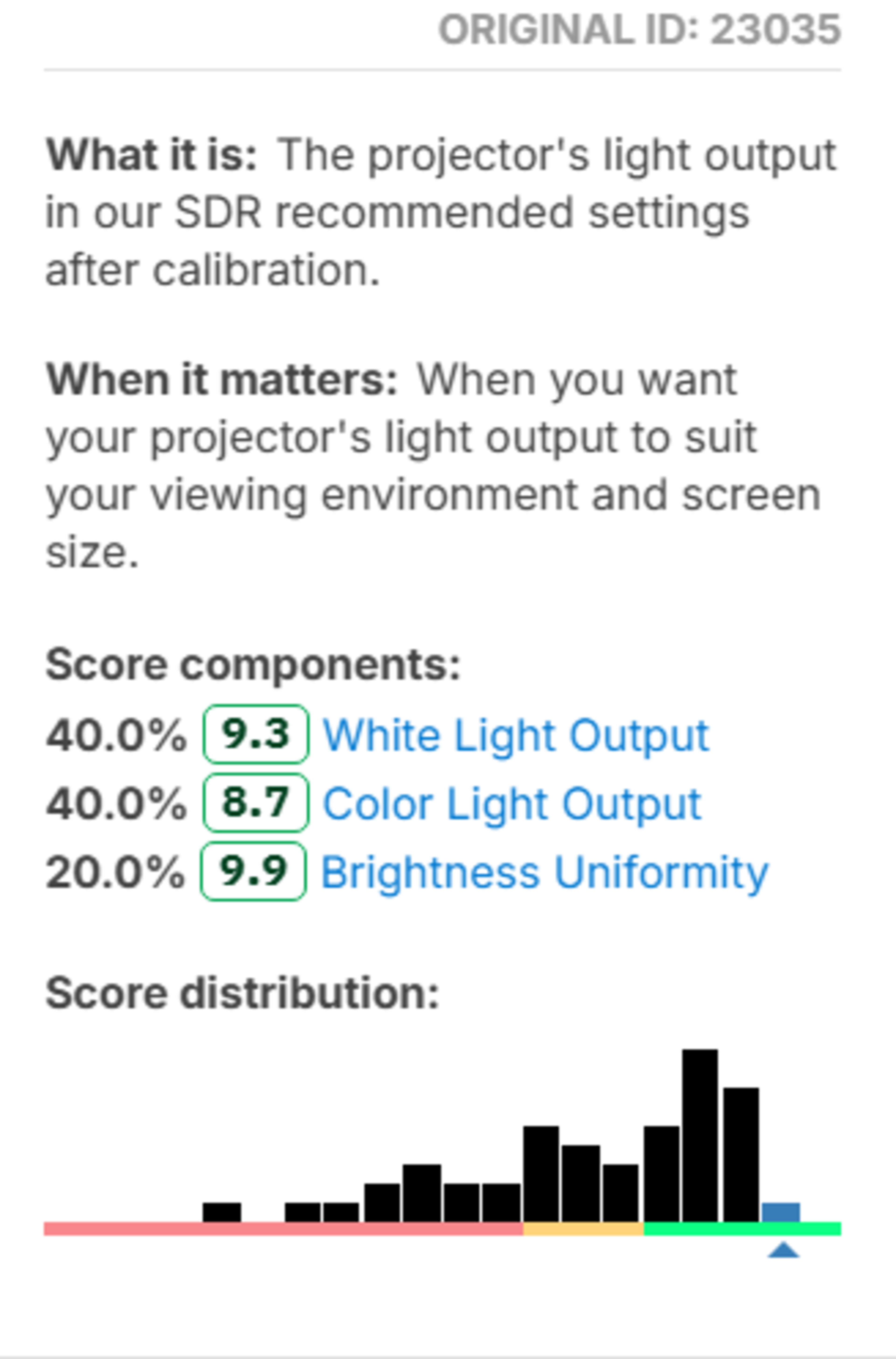
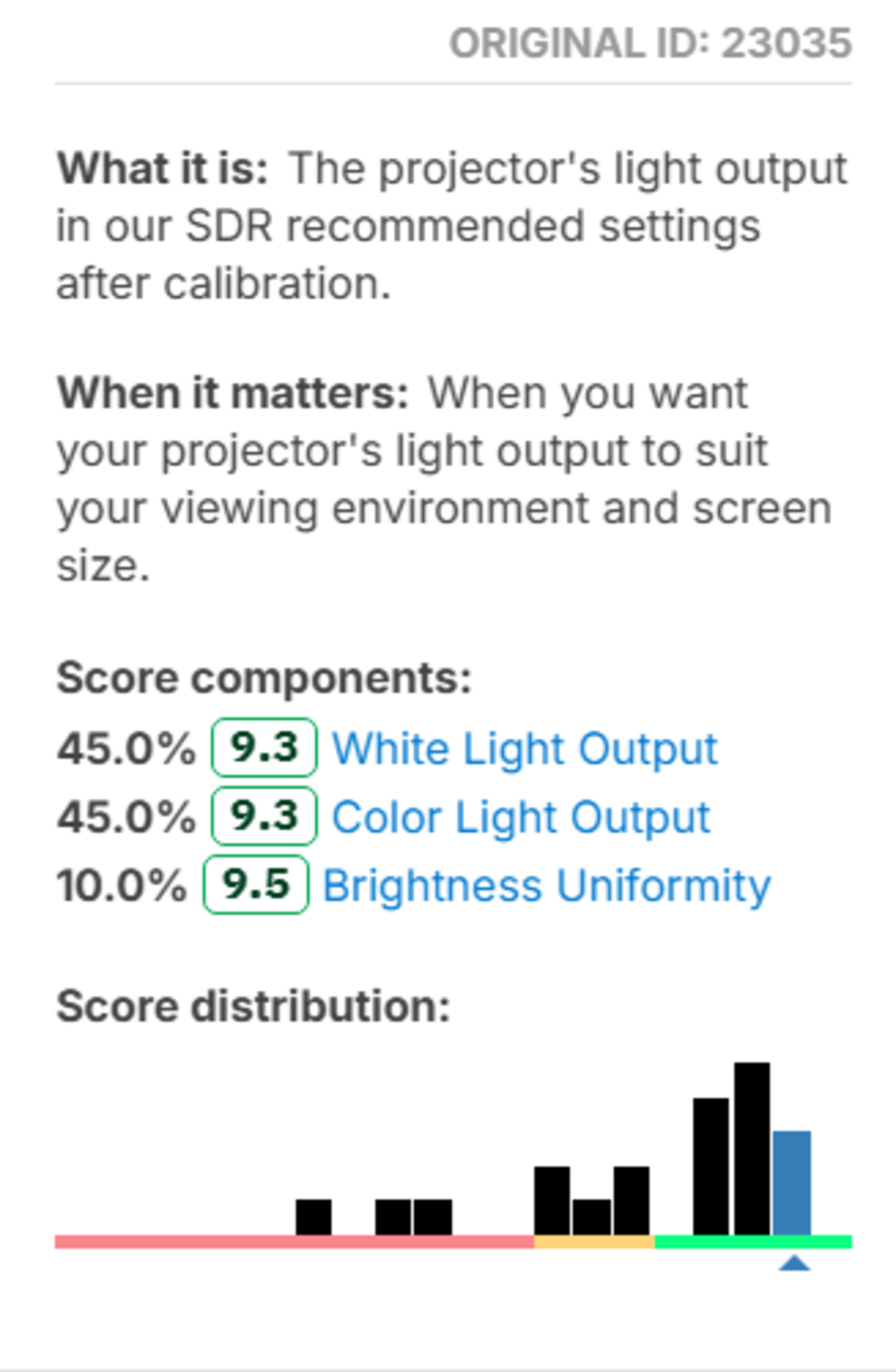
- 0.10: Based on a corners/center min/max style uniformity calculation; 20% of the Brightness score.
- 0.11: Calculated using Mean Absolute Deviation (MAD) across all nine measurement points and mapped to a 0–100 uniformity score; 10% of the Brightness score.
- What it means for you: The score is less dominated by a single best/worst point comparison and is less likely to over-penalize small localized variance.
 |
 |
-
Screen Brightness
- Screen Brightness is now derived from the average lux measured by the 3×3 grid and converted to cd/m² (nits).
- What it means for you: Screen Brightness values will shift relative to older reviews because the underlying measurement method changed.
 |
 |
Native Contrast
-
Expanded low‑APL testing
- 0.10: Lowest measured APL was 1%.
- 0.11: Adds 0.5% and 0.1% APL measurements to better represent very dark scenes and low‑average‑picture‑level content.
- What it means for you: Projectors that leak light or elevate blacks under very dark patterns may separate more clearly from stronger performers.
-
Sequential Contrast (FOFO) is now reported within Native Contrast
- In addition to APL-based native contrast measurements, we also report Native Full-On/Full-Off Contrast (often referred to as sequential contrast) within the Native Contrast test.
- No scoring impact: Full-On/Full-Off contrast does not affect any scores. It's shown for context only, as it's mostly a marketing-facing metric and doesn't reflect typical intra-frame contrast performance.
 |
|
-
Updated patterns/workflow for the sensor array
- Higher APL levels use fixed patterns aligned to the 3×3 array; very low APL uses a patch‑based workflow designed for precise sensor alignment.
- What it means for you: Reduced measurement noise and better repeatability at the lowest APL levels.
-
Removed geometric correction step (brightness/contrast math)
- The 0.11 workflow no longer relies on the prior geometric correction step that was used to compensate for measurement geometry in the older setup.
- What it means for you: Less manual adjustment, and fewer opportunities for small setup differences to skew results.
Variable Refresh Rate
-
New VRR test box
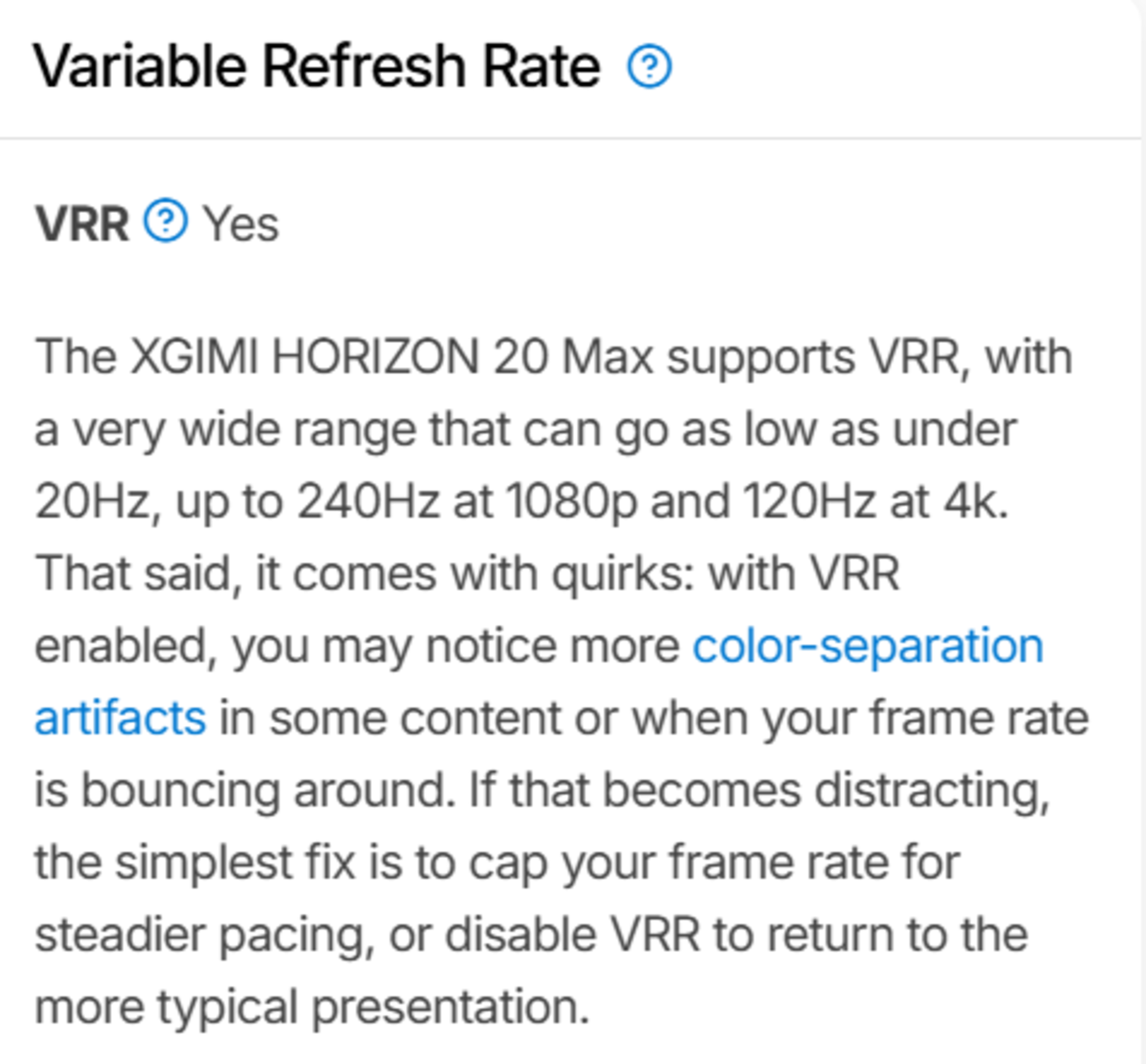
- Adds a VRR support result.
-
Gaming score integration
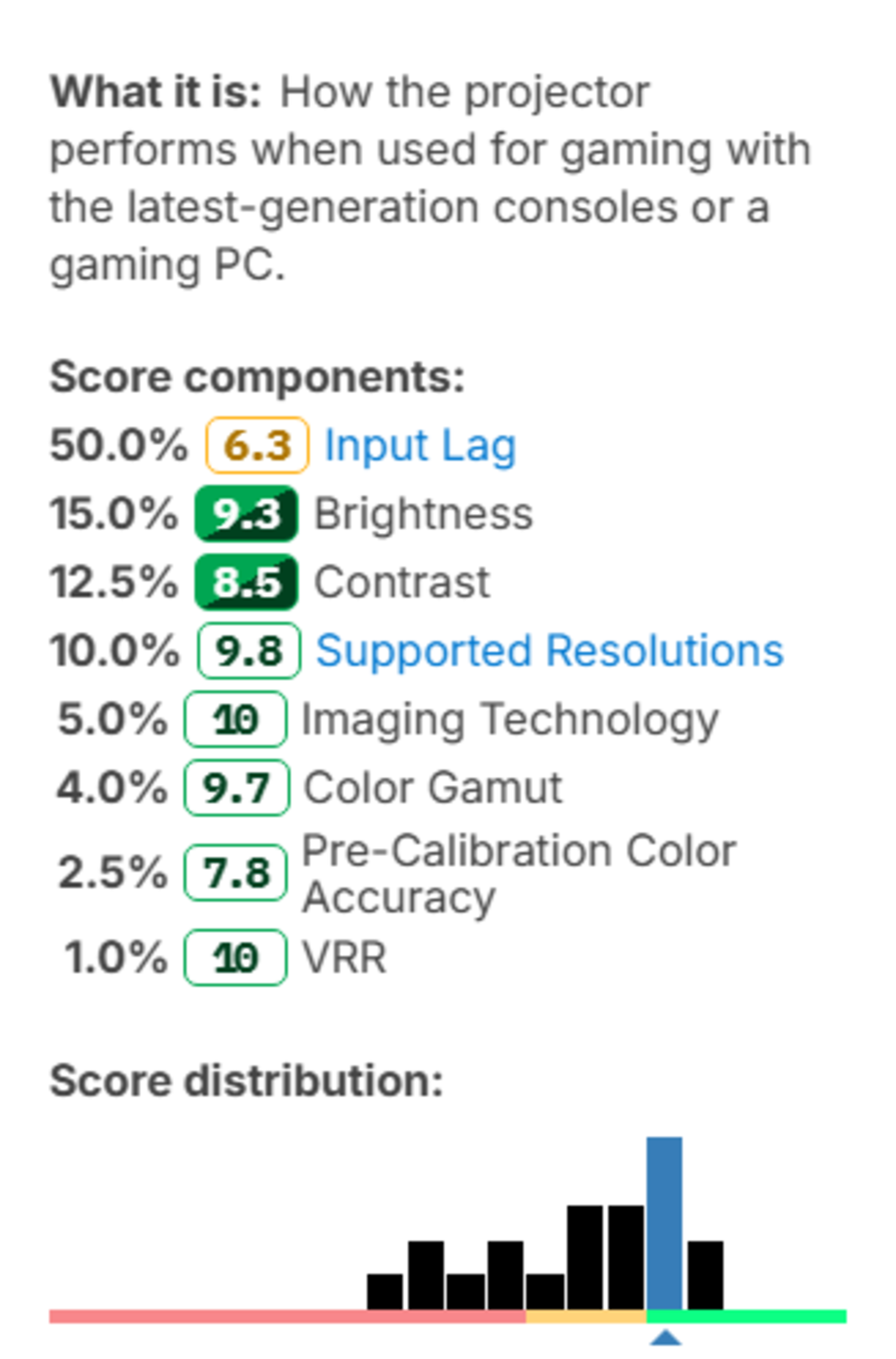
- VRR is now included as a component of the Gaming usage score.
- What it means for you: Projectors that support VRR (and do it well) may receive a higher Gaming score under 0.11.
Review presentation & comparability
-
New Performance Usages
- Brightness and Contrast now appear as dedicated "Performance Usages" in Our Verdict.
Which Reviews Are Being Updated?
Not all legacy reviews will be converted to TBU 0.11. This update is targeted at projectors that were previously tested using TBU 0.10, so our website contains a mix of methodologies. As a result, scores and results will not always be fully comparable between a projector tested on 0.11 and one tested on older benches.
The review banner on each page indicates the version of the methodology used.
47 Projectors Updated
We have retested popular models. The test results for the following models have been converted to the new testing methodology. However, the text might be inconsistent with the new results.
- Anker Nebula Capsule 3
- Anker Nebula Capsule 3 Laser
- Anker Nebula Mars 3
- Anker Nebula X1
- ASUS ProArt Projector A1
- AWOL Vision LTV-3000 Pro
- BenQ HT2060
- BenQ TH671ST
- BenQ TK700STi
- BenQ X3100i
- BenQ X500i
- Epson EpiqVision Flex CO-W01
- Epson EpiqVision Mini EF12
- Epson EpiqVision Mini EF21
- Epson EpiqVision Ultra LS300
- Epson EpiqVision Ultra LS800
- Epson EX3280
- Epson Home Cinema 1080
- Epson Home Cinema 2350
- Epson Home Cinema 3800
- Epson Home Cinema 5050UB
- Formovie THEATER
- Hisense C1
- Hisense C2 Ultra
- Hisense M2 Pro
- Hisense PX3-PRO
- JMGO N1S Ultimate
- LG CineBeam Q
- NexiGo Aurora Pro
- NexiGo PJ40 (Gen 3)
- NexiGo TriVision Ultra
- Samsung The Freestyle 2nd Gen
- Valerion VisionMaster Max
- Valerion VisionMaster Pro 2
- VANKYO Leisure 470
- ViewSonic PX701-4K
- XGIMI AURA 2
- XGIMI Elfin
- XGIMI Halo+
- XGIMI HORIZON 20 Max
- XGIMI HORIZON Pro
- XGIMI Horizon S Max
- XGIMI HORIZON Ultra
- XGIMI MoGo 2
- XGIMI MoGo 2 Pro
- XGIMI MoGo 3 Pro
- XGIMI MoGo 4
