Test Bench 0.8 originally introduced performance tests for energy return, stability, and cushioning, alongside design-related metrics like weight, shape, and stack height. With Test Bench 0.8.1, we refined both the usages and the underlying test methods to make our scoring more accurate, particularly for Marathon Racing and its lateral stability component, so that results better reflected real-world performance and known user feedback.
In the same spirit of continuous improvement, Test Bench 0.8.2 focuses on compression testing. Our earlier compression methodology was based on scientific studies of ground reaction forces, which report peak loads of two to three times body weight and break down how those forces are distributed across different regions of the foot. Using this data, we calibrated our testing so that the heel and forefoot were subjected to realistic pressures in line with how runners actually land, as explained in detail in our original Compression Testing R&D article, particularly in the section on Choosing a Testing Force. While this gave us consistent and meaningful results, it still didn't fully replicate the complex timing and shape of a real-world impact curve, and it simplified how the loading and release phases play out during running.
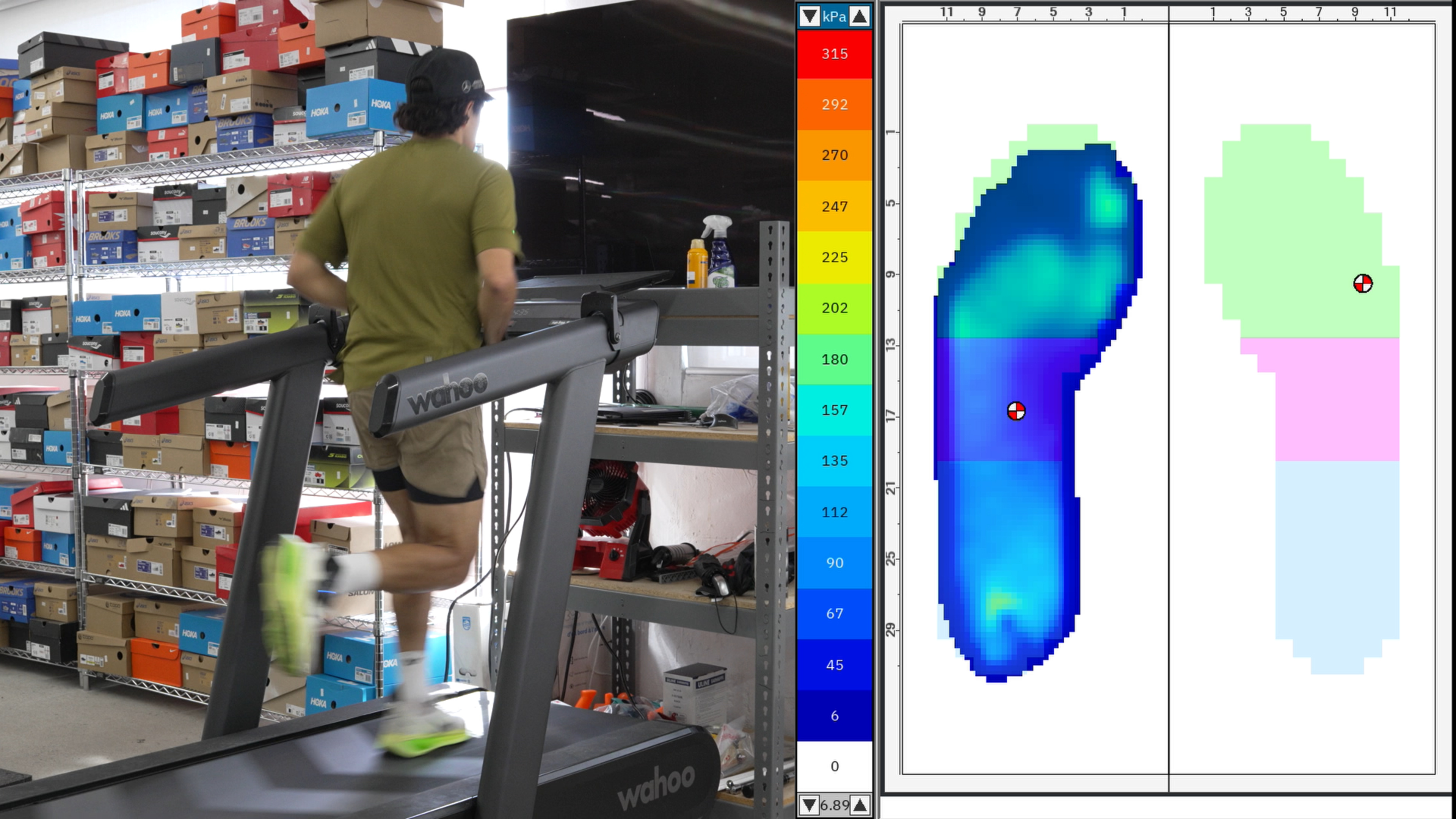
To address this, we collected our own dataset. We equipped a diverse pool of runners (covering a range of weights, paces, and strike patterns) with pressure-sensing insoles and had them run on a treadmill. This allowed us to map the forces of different foot strikes and produced detailed foot maps that let us actually determine what forces to apply in testing. In general, the forces we recorded were much higher than the range we covered with the previous method. Based on this data, we found that loads can reach up to 1950 newtons at the heel and 2100 newtons at the forefoot, but also vary significantly by runner. To capture this, our updated protocol now spans a full range from about 550 to 1950 newtons at the heel and 800 to 2100 newtons at the forefoot. These values are then applied using a new loading pattern, which more accurately reproduces the full cycle of loading, contact, and release during running. To learn more about our Pressure Mapping testing, check out this R&D article, which explains the process in detail.
What's Changed?
| Test Group | Description |
| Performance | Heel Energy Return |
|
| Performance | Forefoot Energy Return |
|
| Performance | Heel Cushioning and Heel Firmness |
|
| Performance | Forefoot Cushioning and Forefoot Firmness |
|
Along with these changes, we also updated the tables that appear in the tooltips of our cushioning and firmness tests. These tables now provide an easier way for runners to convert the test forces in newtons to their own weight and speed, making it more relatable and individualized for each scenario. For example:
| Weight (kg) | Weight (lbs) | 7 min/km | 5 min/km | 3 min/km |
|---|---|---|---|---|
| 50 | 110 | 550 | 700 | 1100 |
| 75 | 165 | 800 | 1100 | 1500 |
| 100 | 220 | 1100 | 1400 | 1900 |
Strike Force Conversion Table for the Heel Cushioning test. Data varies depending on the test; this is just a visual example. Refer to the actual table in each tooltip of the Cushioning and Firmness tests within a review.
This example illustrates how the updated force ranges are broad enough to capture most types of runners. For instance, a lightweight heel striker running fast (around 3 min/km), a mid-weight runner at moderate speed (around 5 min/km), and a heavyweight runner at slower speeds (around 7 min/km) apply about 1100 newtons of force when hitting the ground. Therefore, these runners should look at the medium-force level score (Energy Absorbed at 1100N) since it will provide the most precise indication of how cushioned the shoe feels in practice for them. In fact, it will be even more accurate for their scenario than the overall cushioning score, which averages results across all three force levels. These performance test updates affect the various usage boxes of the Our Verdict section of the reviews. Here's an overview of those changes and why they matter.
Verdicts And Usages
Since all of our current usage and performance usage boxes incorporate at least one of the compression-based tests as score components, every usage is affected by the updates described above. The underlying methodology for how usages are calculated remains the same, but the results shift a bit because the performance test scores that feed into them (energy return, cushioning, and firmness) have been adjusted. Here's how those changes play out for each usage:
| Usages/Performance Usages | Description |
| Marathon Racing |
|
| 5K/10K Racing |
|
| Cushioning |
|
| Energy Return |
|
| Lateral Stability |
|
Conclusion
Overall, this update improves the accuracy of our compression-based tests and makes cushioning, energy return, and firmness results more relatable to different types of runners. Since many of our usage boxes rely on these tests, their scores now provide a closer reflection of real-world performance. Our methodology still can't capture every nuance runners feel in training or racing, but this is an important step forward. If you have suggestions or ideas to help us refine our reviews, feel free to comment on any page or reach out at feedback@rtings.com. Your feedback plays a key role in shaping our test bench, and we truly appreciate it.
86 Running Shoes Updated
We have retested popular models. The test results for the following models have been converted to the new testing methodology. However, the text might be inconsistent with the new results.
- adidas Adizero Adios 9
- adidas Adizero Adios Pro 3
- adidas Adizero Adios Pro 4
- adidas Adizero Adios Pro Evo 1
- adidas Adizero Adios Pro Evo 2
- adidas Adizero Boston 12
- adidas Adizero Boston 13
- adidas Adizero Evo SL
- adidas Adizero Prime X 2.0 STRUNG
- adidas Adizero Prime X3 STRUNG
- adidas Supernova Rise
- Altra Torin 7
- Altra Torin 8
- ASICS GEL-KAYANO 31
- ASICS GEL-KAYANO 32
- ASICS GEL-NIMBUS 26
- ASICS GEL-NIMBUS 27
- ASICS GLIDERIDE MAX
- ASICS GT-2000 14
- ASICS MAGIC SPEED 4
- ASICS MEGABLAST
- ASICS METASPEED EDGE PARIS
- ASICS METASPEED EDGE TOKYO
- ASICS METASPEED SKY PARIS
- ASICS METASPEED SKY TOKYO
- ASICS NOVABLAST 4
- ASICS NOVABLAST 5
- ASICS SONICBLAST
- ASICS SUPERBLAST 2
- Brooks Ghost 17
- Brooks Ghost Max 2
- Brooks Glycerin Max
- Brooks Hyperion 2
- Brooks Hyperion Elite 5
- Brooks Hyperion Max 2
- Brooks Hyperion Max 3
- Diadora Gara Carbon 2
- HOKA Cielo X1 2.0
- HOKA Clifton 10
- HOKA Clifton 9
- HOKA Mach 6
- HOKA Mach X
- HOKA Mach X 2
- HOKA Rocket X 3
- HOKA Skyward X
- Kiprun KS900 2
- Mizuno Neo Vista
- Mizuno Neo Vista 2
- Mizuno Neo Zen
- Mizuno Wave Rebellion Pro 3
- New Balance Fresh Foam X 1080v14
- New Balance FuelCell Rebel v4
- New Balance FuelCell Rebel v5
- New Balance FuelCell SuperComp Elite v4
- New Balance FuelCell SuperComp Trainer v3
- Nike Alphafly 3
- Nike Invincible 3
- Nike Pegasus 41
- Nike Streakfly 2
- Nike Structure 26
- Nike Vaporfly 3
- Nike Vaporfly 4
- Nike Vomero 17
- Nike Vomero 18
- Nike Zoom Fly 6
- On Cloudboom Max
- On Cloudboom Strike
- On Cloudboom Zone
- On Cloudmonster 2
- On Cloudmonster Hyper
- On Cloudrunner 2
- On Cloudsurfer 2
- On Cloudsurfer Max
- PUMA Deviate NITRO 3
- PUMA Deviate NITRO Elite 3
- PUMA Fast-R NITRO Elite 3
- PUMA MagMax NITRO
- PUMA Magnify NITRO 3
- PUMA Velocity NITRO 4
- Saucony Endorphin Elite 2
- Saucony Endorphin Pro 4
- Saucony Endorphin Speed 4
- Saucony Endorphin Speed 5
- Saucony Hurricane 25
- Saucony Triumph 22
- Topo Phantom 4
