Test Bench 0.9 marks the first expansion of our testing, with the introduction of a new compression test: Forefoot Long Run Cushioning. While our existing Energy Absorption tests across different loads provide a meaningful and accurate picture of a shoe's overall cushioning, we knew from both experience and user feedback that they didn't tell the full story. How that cushioning evolves over the course of a run matters just as much, if not more.
Some midsoles feel soft and well-cushioned initially, but lose that comfort after only a few kilometers. This is what the running community often refers to as a shoe bottoming out. While the foam doesn't necessarily collapse completely, certain models reach a point where Energy Absorption drops sharply, creating a harsher, more fatiguing feel. In practice, this becomes especially important during long runs, when reliable cushioning is most valuable as the runner's legs are fatigued from the effort.
To capture this aspect of performance, we developed a new Forefoot Long Run Cushioning test that measures how cushioning evolves over the equivalent of up to 50 km of running, with data recorded every 10 km (10km, 20km, 30km, 40km, and 50km).
Initially, we considered introducing a Heel Long Run Cushioning test as well, but ultimately determined that it would provide limited additional value compared to the forefoot for real-world running scenarios. There are two main reasons for this. First, the forefoot typically bottoms out before the heel. Because it's usually lower stacked, it tends to absorb less energy overall. Second, even for heel strikers who land with significant force at the rear of the shoe, the stride naturally transitions toward the forefoot. In practice, this makes the forefoot the region where runners begin to feel the decline in protection first. For this reason, the Forefoot Long Run Cushioning test is the most representative indicator of how a shoe will hold up over the course of a long run.
What's Changed?
| Test Group | Description |
| Performance | Forefoot Long Run Cushioning |
|
Here's how that new Forefoot Long Run Cushioning test appears in the performance section of the review, using the Nike Vaporfly 4 as an example.
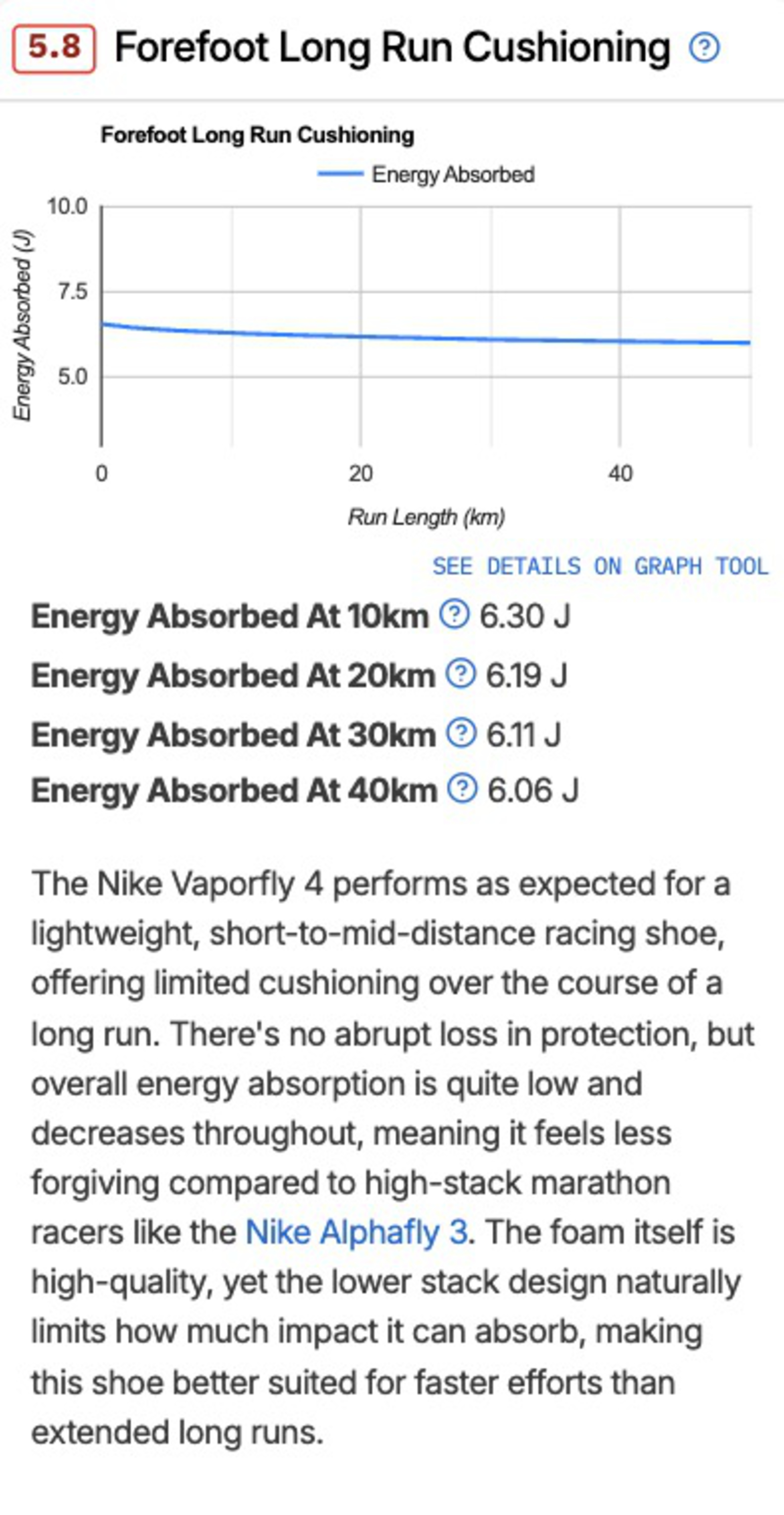
This is the only change introduced in Test Bench 0.9. It doesn't affect the existing Heel Cushioning or Forefoot Cushioning tests, nor does it currently impact any Usage or Performance Usage scores in the Our Verdict section of our reviews.
Conclusion
Overall, this update introduces a more targeted addition to our test bench, capturing a new dimension of performance: how cushioning evolves over distance during a long run. The Forefoot Long Run Cushioning test gives a clearer view of how shoes maintain comfort and protection as mileage accumulates, complementing our existing compression-based tests.
Let Us Know What You Think!
We plan to continue expanding on this by developing a dedicated Midsole Durability test, which will assess performance not just within a single run, but across multiple runs and higher total distances. If you have suggestions or ideas to help guide this development (or other concepts you'd like to see tested), feel free to comment on any page or reach out at feedback@rtings.com. Your feedback has been essential in shaping our methodology, and we're grateful for your continued input.
100 Running Shoes Updated So Far
We are retesting popular models first. So far, the test results for the following models have been converted to the new testing methodology. However, the text might be inconsistent with the new results.
- 361 Flame 4
- adidas Adizero Adios 9
- adidas Adizero Adios Pro 3
- adidas Adizero Adios Pro 4
- adidas Adizero Adios Pro Evo 1
- adidas Adizero Adios Pro Evo 2
- adidas Adizero Boston 12
- adidas Adizero Boston 13
- adidas Adizero Evo SL
- adidas Adizero Prime X 2.0 STRUNG
- adidas Supernova Rise
- adidas Ultraboost 5X
- Altra Escalante 4
- Altra Escalante Racer 2
- Altra Torin 7
- ASICS GEL-KAYANO 31
- ASICS GEL-KAYANO 32
- ASICS GEL-NIMBUS 26
- ASICS GEL-NIMBUS 27
- ASICS GLIDERIDE MAX
- ASICS GT-2000 13
- ASICS MEGABLAST
- ASICS METASPEED EDGE PARIS
- ASICS METASPEED EDGE TOKYO
- ASICS METASPEED SKY PARIS
- ASICS METASPEED SKY TOKYO
- ASICS NOVABLAST 4
- ASICS NOVABLAST 5
- ASICS SONICBLAST
- ASICS SUPERBLAST 2
- Brooks Adrenaline GTS 23
- Brooks Adrenaline GTS 24
- Brooks Ghost 16
- Brooks Ghost 17
- Brooks Glycerin 22
- Brooks Glycerin Max
- Brooks Hyperion 2
- Brooks Hyperion 3
- Brooks Hyperion Elite 5
- Brooks Hyperion Max 2
- Brooks Hyperion Max 3
- Diadora Gara Carbon 2
- HOKA Bondi 9
- HOKA Cielo X1 2.0
- HOKA Clifton 10
- HOKA Clifton 9
- HOKA Mach 6
- HOKA Mach X 2
- HOKA Mach X 3
- HOKA Rocket X 3
- HOKA Skyward X
- Kiprun KD900X LD+
- Mizuno Neo Vista
- Mizuno Neo Vista 2
- Mizuno Neo Zen
- Mizuno Wave Rebellion Flash 3
- Mizuno Wave Rebellion Pro 3
- Mizuno Wave Rider 29
- New Balance FuelCell Propel v5
- New Balance FuelCell Rebel v4
- New Balance FuelCell Rebel v5
- New Balance FuelCell SuperComp Elite v4
- Nike Alphafly 3
- Nike Downshifter 13
- Nike Invincible 3
- Nike Pegasus 41
- Nike Pegasus Plus
- Nike Pegasus Premium
- Nike Revolution 8
- Nike Streakfly 2
- Nike Structure 26
- Nike Vaporfly 3
- Nike Vaporfly 4
- Nike Vomero 17
- Nike Vomero 18
- Nike Vomero Plus
- Nike Winflo 11
- Nike Zoom Fly 6
- On Cloudboom Strike
- On Cloudboom Zone
- On Cloudmonster 2
- On Cloudmonster Hyper
- On Cloudsurfer 2
- PUMA Deviate NITRO 3
- PUMA Deviate NITRO Elite 3
- PUMA Fast-R NITRO Elite 3
- PUMA ForeverRUN NITRO 2
- PUMA MagMax NITRO
- PUMA Magnify NITRO 3
- Salomon Aero Blaze 3
- Saucony Endorphin Elite
- Saucony Endorphin Elite 2
- Saucony Endorphin Pro 4
- Saucony Endorphin Speed 4
- Saucony Endorphin Speed 5
- Saucony Triumph 22
- Saucony Triumph 23
- Skechers Aero Tempo
- Topo Atmos
- Tracksmith Eliot Runner
1 Running Shoes Planned To Be Updated
We are also planning to retest the following products over the course of the next few weeks: