Our running shoe Test Bench 0.11 addresses responsiveness, a multifaceted concept that has not previously been quantified. This update adds five new tests and replaces the Energy Return usage score with a Responsiveness score that takes more factors into consideration.
Our previous test benches measured Energy Return by vertically compressing the midsole and measuring the amount of force that it returns when decompressing (You can read more about how we test energy return). This gave us a good indication of the bounciness of a shoe's midsole, but didn't fully capture how well a shoe would be able to pick up the pace. For example, shoes like the Saucony Triumph 23 and PUMA Magnify NITRO 3 scored very well on the compression energy return tests, even though community feedback and our subjective experience showed us that these were not highly responsive shoes, due to their geometry.
While Energy Return remains relevant when evaluating the responsiveness of a shoe, there are, in practice, a number of other factors that determine how much of the force that a runner applies to a shoe will be converted into forward propulsion. After a review of the scientific literature, discussions of responsiveness in online running communities, and our own subjective experience running in shoes, we identified a shoe's rocker, bending stiffness and bending energy return as key, measurable components of a shoe's responsiveness.
The new tests examine the geometry and stiffness of the midsole, and how these interact to make a running shoe more (or less) responsive to the force applied to them.
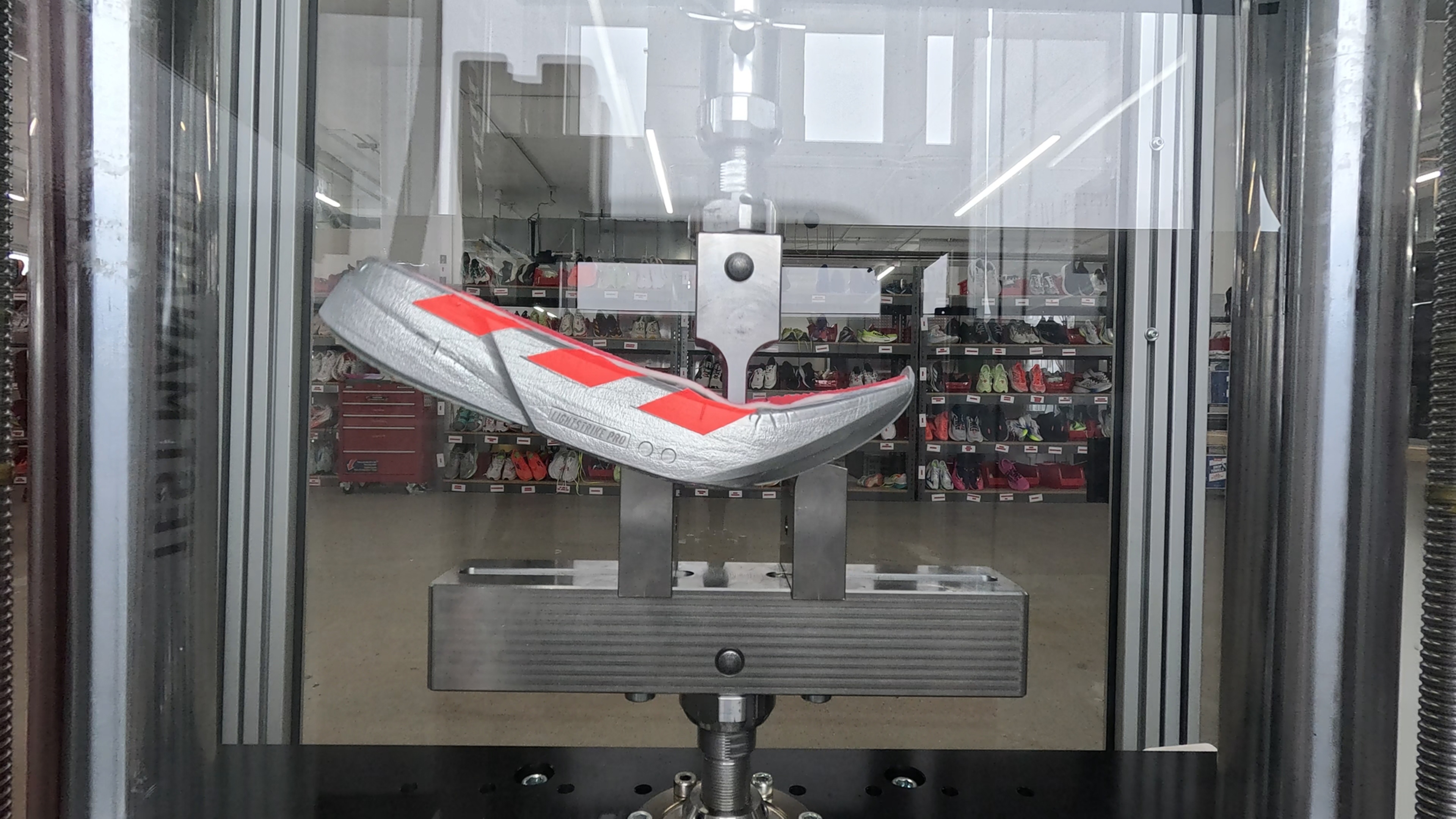
What's Changed
| Test Group | Description |
| Design | Heel Rocker Geometry |
|
| Design | Forefoot Rocker Geometry |
|
| Performance | Rocker Stiffness |
|
| Performance | Forefoot Bending Energy Return |
|
| Performance |Forefoot Bending Stiffness |
|
Each of these aspects plays a role in moving your foot forward when force is applied to a running shoe's midsole. By synthesizing the results of multiple tests, we created a new usage score, Responsiveness, which is explained below.
Verdicts And Usages
| Performance Usage | Description | Weighting |
| Responsiveness | Replaces the Energy Return usage, and considers multiple factors that determine how well the shoe converts the force applied by the runner into forward propulsion. |
New Responsiveness score calculated using:
|
The Responsiveness score is meant to show how efficiently a shoe accelerates when greater force is applied. For this reason, we focused on forefoot and toe-off mechanics and have not incorporated heel rocker geometry into Responsiveness. Instead, we plan on considering heel rocker geometry when developing new usage scores, such as long run and daily training.
Conclusion
This update not only expands the concept of energy return by measuring the bending energy return of the midsole, but also moves beyond energy return as the only metric for how responsive a running shoe is. The new tests give the most comprehensive picture to date of how aggressive and efficient a running shoe's rocker is at aiding forward propulsion. The forefoot bending stiffness test will better accounts for the role of a plate in contributing to the midsole's responsiveness, and marks the first attempt to quantify the 'snappiness' of a shoe's forefoot. Taken together, these new tests will help runners choose a shoe that matches their performance goals.
Let Us Know What You Think
With this update, we have expanded the number of aspects we test when evaluating running shoes, and developed a new responsiveness usage score. We plan to continue iterating on our test methodology, incorporating the responsiveness elements into other usages, such as Marathon Racing and 5k/10k Racing. If you have suggestions or ideas to help guide this development (or other concepts you'd like to see tested), feel free to comment on any page or reach out at feedback@rtings.com. Your feedback has been essential in shaping our methodology, and we're grateful for your continued input.
137 Running Shoes Updated So Far
We are retesting popular models first. So far, the test results for the following models have been converted to the new testing methodology. However, the text might be inconsistent with the new results.
- 361 Flame 4
- adidas Adizero Adios 9
- adidas Adizero Adios Pro 4
- adidas Adizero Adios Pro Evo 1
- adidas Adizero Adios Pro Evo 2
- adidas Adizero Boston 12
- adidas Adizero Boston 13
- adidas Adizero Evo SL
- adidas Adizero Prime X3 STRUNG
- adidas Hyperboost Edge
- adidas Supernova Rise
- adidas Supernova Rise 3
- adidas Ultraboost 5X
- Altra Escalante 4
- Altra Escalante Racer 2
- Altra Experience Flow 2
- Altra Torin 7
- Altra Torin 8
- ANTA C202 7
- ASICS GEL-KAYANO 31
- ASICS GEL-KAYANO 32
- ASICS GEL-NIMBUS 26
- ASICS GEL-NIMBUS 27
- ASICS GEL-NIMBUS 28
- ASICS GLIDERIDE MAX 2
- ASICS GT-2000 13
- ASICS GT-2000 14
- ASICS MAGIC SPEED 4
- ASICS MAGIC SPEED 5
- ASICS MEGABLAST
- ASICS METASPEED EDGE PARIS
- ASICS METASPEED EDGE TOKYO
- ASICS METASPEED RAY
- ASICS METASPEED SKY PARIS
- ASICS METASPEED SKY TOKYO
- ASICS NOVABLAST 4
- ASICS NOVABLAST 5
- ASICS SONICBLAST
- ASICS SUPERBLAST 2
- ASICS SUPERBLAST 3
- Brooks Adrenaline GTS 23
- Brooks Adrenaline GTS 25
- Brooks Ghost 16
- Brooks Ghost 17
- Brooks Glycerin 23
- Brooks Glycerin Flex
- Brooks Glycerin Max
- Brooks Glycerin Max 2
- Brooks Hyperion 2
- Brooks Hyperion 3
- Brooks Hyperion Elite 5
- Brooks Hyperion Max 2
- Brooks Hyperion Max 3
- Diadora Gara Carbon 2
- Diadora Gara Carbon 3
- HOKA Bondi 9
- HOKA Cielo X1 2.0
- HOKA Cielo X1 3.0
- HOKA Clifton 10
- HOKA Clifton 9
- HOKA Mach 6
- HOKA Mach 7
- HOKA Mach X 2
- HOKA Mach X 3
- HOKA Rocket X 3
- HOKA Skyward X
- Kiprun KD900X LD+
- Kiprun Kipride Max
- Kiprun Kipstorm Elite
- Kiprun Kipstorm Tempo
- Kiprun KS900 2
- Mizuno Hyperwarp Elite
- Mizuno Hyperwarp Pro
- Mizuno Hyperwarp Pure
- Mizuno Neo Vista
- Mizuno Neo Vista 2
- Mizuno Wave Rebellion Flash 3
- Mizuno Wave Rider 29
- New Balance 1080v15
- New Balance Ellipse
- New Balance Fresh Foam X 1080v14
- New Balance Fresh Foam X 880v15
- New Balance FuelCell Propel v5
- New Balance FuelCell Rebel v4
- New Balance FuelCell Rebel v5
- New Balance FuelCell SuperComp Elite v4
- New Balance FuelCell SuperComp Elite v5
- New Balance FuelCell SuperComp Trainer v3
- Nike Alphafly 3
- Nike Downshifter 13
- Nike Downshifter 14
- Nike Invincible 3
- Nike Pegasus 41
- Nike Pegasus Plus
- Nike Pegasus Premium
- Nike Revolution 8
- Nike Streakfly 2
- Nike Structure 26
- Nike Structure Plus
- Nike Vaporfly 3
- Nike Vaporfly 4
- Nike Vomero 17
- Nike Vomero 18
- Nike Vomero Plus
- Nike Vomero Premium
- Nike Winflo 11
- Nike Zoom Fly 6
- On Cloudboom Max
- On Cloudboom Strike
- On Cloudboom Zone
- On Cloudmonster 2
- On Cloudmonster 3
- On Cloudmonster 3 Hyper
- On Cloudmonster Hyper
- On Cloudsurfer 2
- On Cloudsurfer Max
- PUMA Deviate NITRO 4
- PUMA Deviate NITRO Elite 3
- PUMA Deviate NITRO Elite 4
- PUMA Fast-R NITRO Elite 3
- PUMA ForeverRUN NITRO 2
- PUMA Magnify NITRO 3
- PUMA Velocity NITRO 4
- R.A.D UFO
- Salomon Aero Blaze 3
- Saucony Endorphin Azura
- Saucony Endorphin Elite
- Saucony Endorphin Elite 2
- Saucony Endorphin Pro 4
- Saucony Endorphin Pro 5
- Saucony Endorphin Speed 4
- Saucony Endorphin Speed 5
- Saucony Hurricane 25
- Saucony Ride 19
- Saucony Triumph 22
- Saucony Triumph 23
- Topo Phantom 4
23 Running Shoes Planned To Be Updated
We are also planning to retest the following products over the course of the next few weeks:
- adidas Adizero Adios Pro 3
- adidas Adizero Prime X 2.0 STRUNG
- Altra FWD VIA 2
- ASICS GLIDERIDE MAX
- Brooks Adrenaline GTS 24
- Brooks Ghost Max 2
- Brooks Glycerin 22
- Brooks Launch 12
- HOKA Gaviota 6
- Mizuno Neo Zen
- Mizuno Neo Zen 2
- Mizuno Wave Rebellion Pro 3
- On Cloudrunner 2
- On Cloudrunner 3
- PUMA Deviate NITRO 3
- PUMA MagMax NITRO
- PUMA MagMax NITRO 2
- Salomon Aero Glide 3
- Salomon Aero Glide 4
- Skechers Aero Tempo
- Topo Atmos
- Tracksmith Eliot Runner
- Under Armour Velociti Elite 3