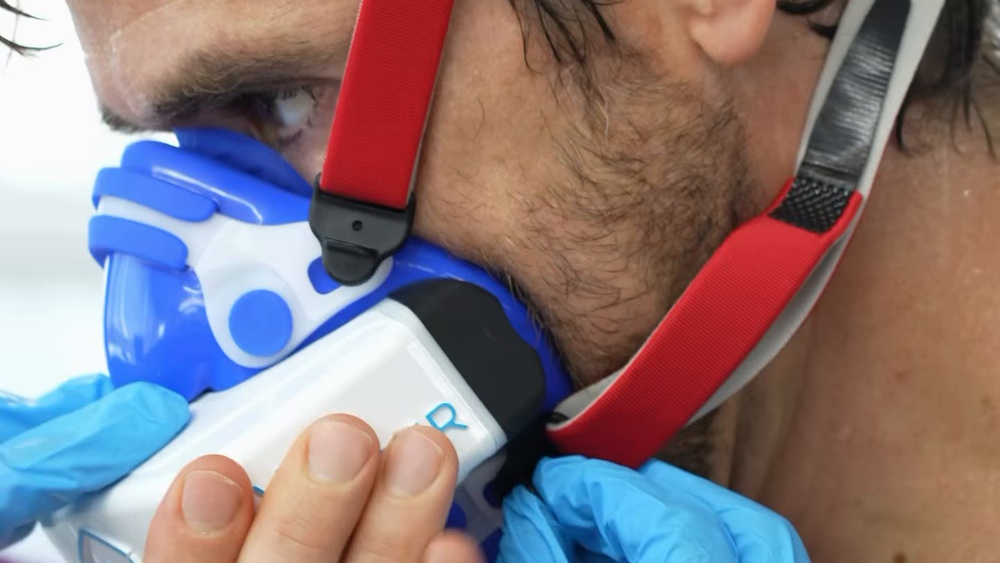
With Test Bench 1.1, we're measuring how running shoes affect runners' efficiency. Our initial selection includes 20 models spanning daily trainers, super trainers, and super shoes from multiple brands. To our knowledge, this is the first independent comparison of running economy across a group of runners to cover this many models.
Our existing tests for energy return and cushioning, along with those developed to evaluate responsiveness, already measured properties that can influence running economy. What was missing was a standardized method for directly measuring running economy.
This test bench update adds running economy testing, bringing us closer to understanding the full picture of how a shoe affects a runner's performance. Running economy is the energy your body needs to maintain a given pace, which we assess by measuring oxygen consumption. Using less oxygen at the same speed means better running economy.
Our R&D article covers the full testing protocol and our findings, but here are the basics.
Six experienced runners tested each shoe on a treadmill using a VO2 Master analyzer. Each ran at their own marathon pace, keeping that pace unchanged across all shoes; the speed therefore differed between runners. We averaged oxygen consumption over the final two minutes of each five-minute trial, allowing time for it to stabilize.
To improve precision and reduce the influence of fatigue and day-to-day variation, we divided the shoes into three batches. We tested each batch twice per runner, reversing the shoe order for the second session. Food and fluid intake were also standardized. Each of the 6 sessions included the HOKA Clifton 11 as our control and the Nike Vaporfly 4 as our advanced footwear technology (AFT) reference to help account for and adjust for differences between sessions.
What's Changed
| Test Group | Description |
| Performance | Average Running Economy |
|
| Performance | Runner Variance |
|
| Performance | Runner 1–6 |
|
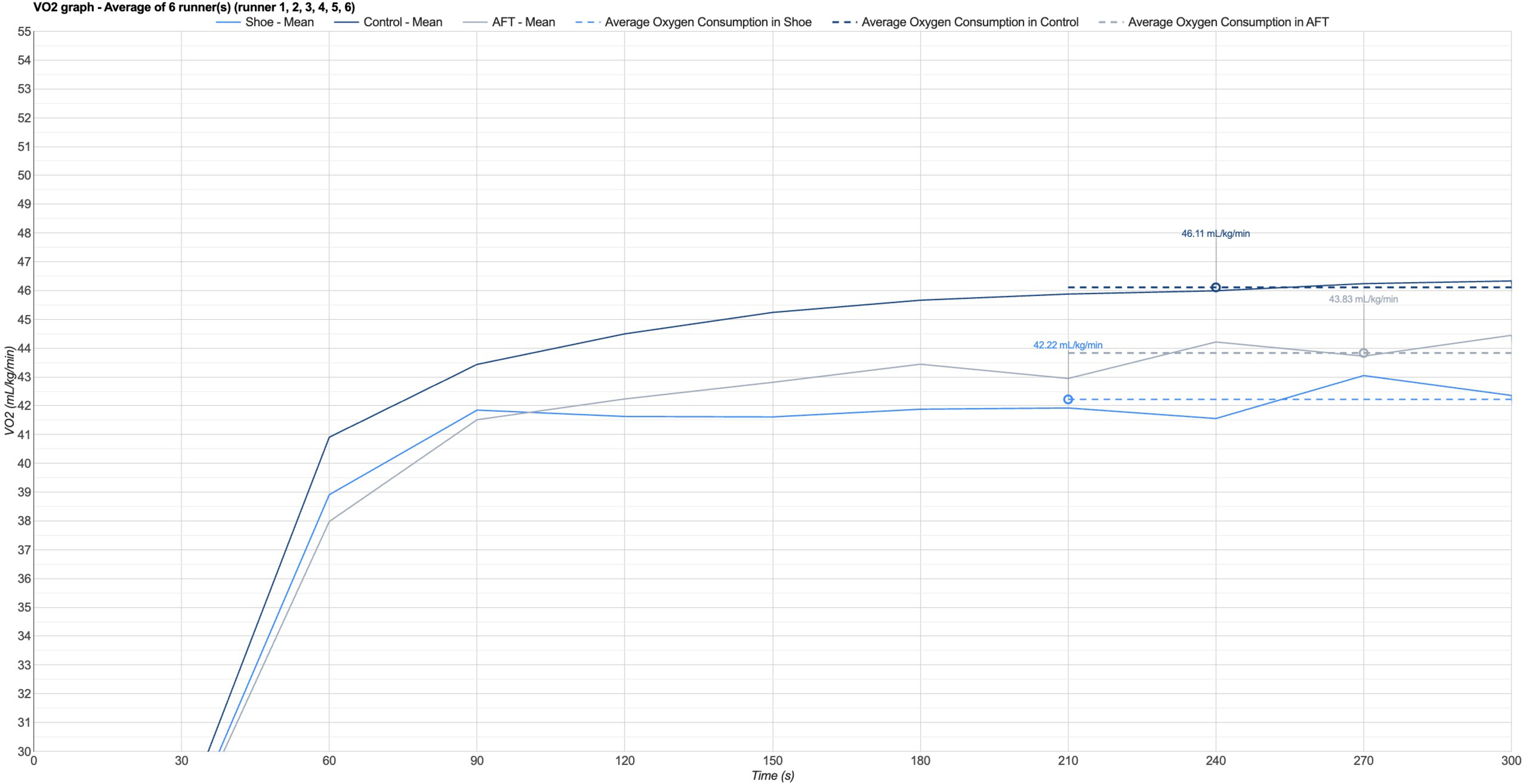
The average results show how oxygen consumption compares across the tested shoe and both references. Lower oxygen consumption at the same pace means the runners maintained that pace more economically. This helps you identify shoes that could reduce the effort needed to sustain your pace.
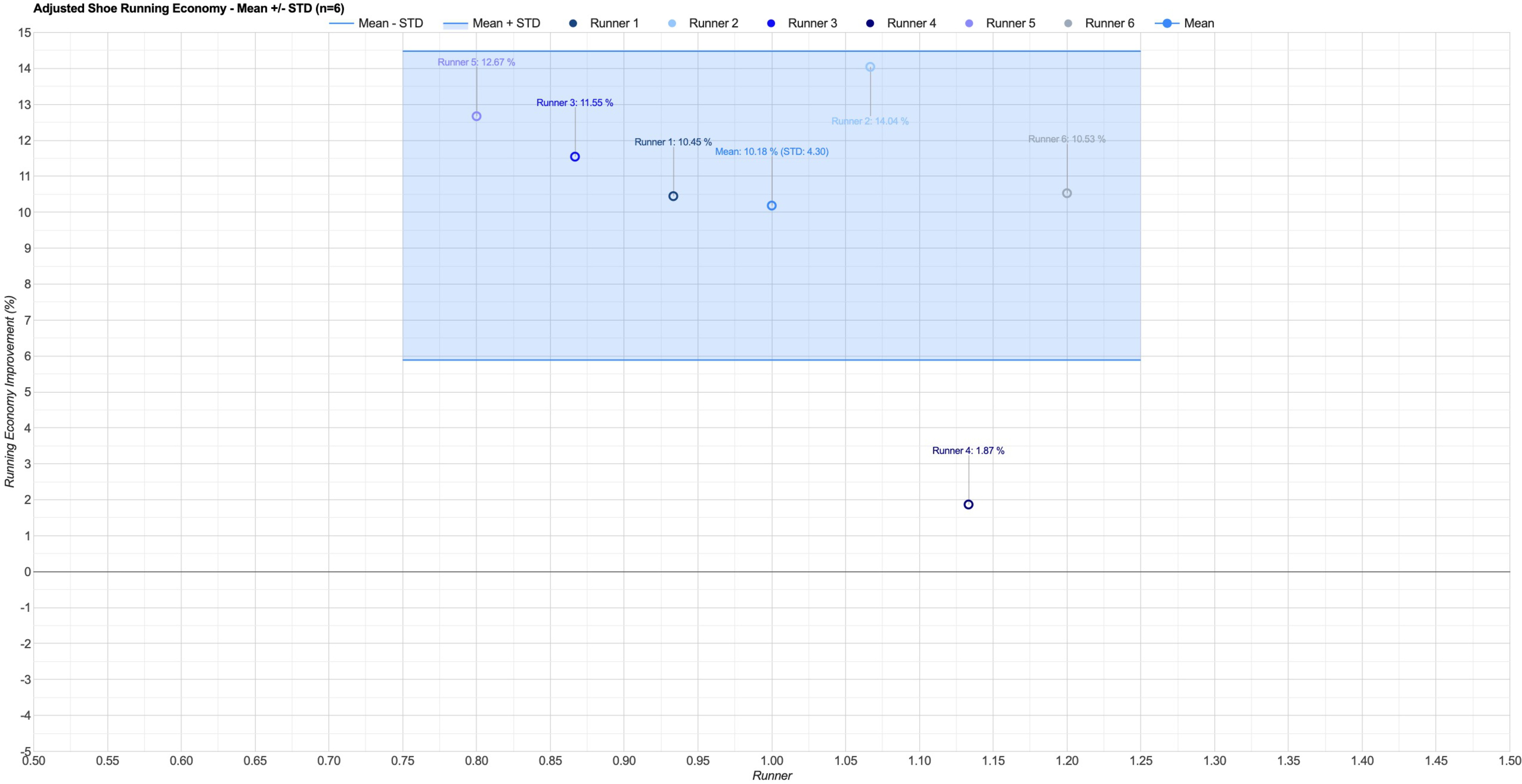
Runner Variance shows how consistently a shoe improved running economy across our runners. A lower standard deviation means runners saw similar benefits and earns a higher Runner Variance usage score. A higher standard deviation indicates less consistent benefits and results in a lower usage score. In this example, all six runners benefited, but one improved much less than the others.
For a closer look, the individual runner sections let you explore each person's results alongside their running form. Open a runner's tooltip to see their age, height, weight, marathon pace, foot strike, and cadence.
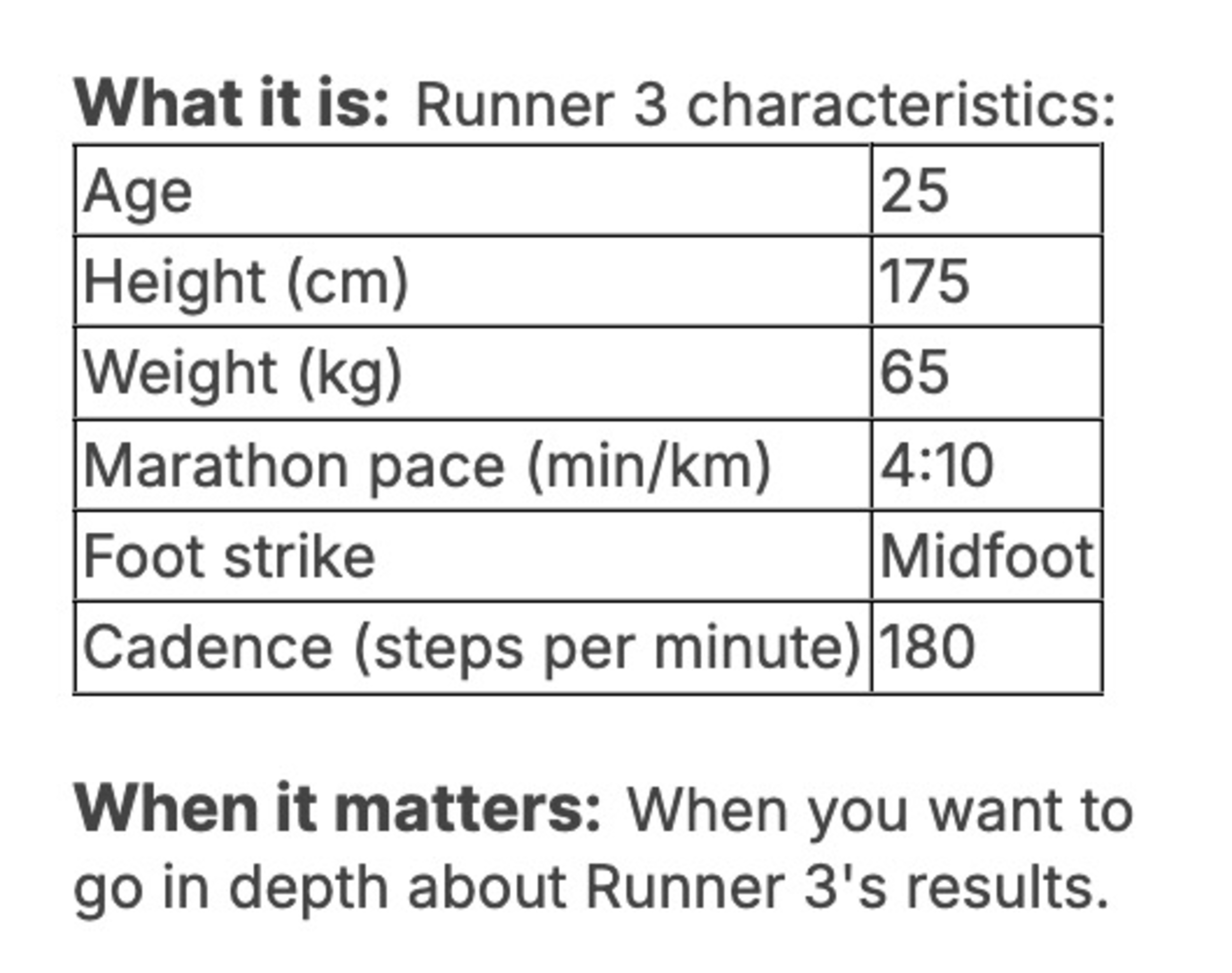
These profiles provide context, but keep in mind that someone with similar characteristics could respond very differently to the same shoe. That's why our main results emphasize the average across runners rather than treating any one profile as a prediction for you.
Verdicts And Usages
Together, Average Running Economy and Runner Variance form our new Running Economy performance usage. It places most of the weight on the average benefit while also considering how consistently runners experience that benefit.
| Performance Usage | Description | Weighting |
| Running Economy | Evaluates how effectively a shoe reduces oxygen consumption at a given pace across our runners. |
Running Economy score calculated using:
|
Conclusion
You can now compare which shoes helped our runners maintain their pace with less oxygen and how widely that benefit varied. These measurements complement our existing tests, bringing us closer to understanding how a shoe's properties translate into running performance.
For now, this testing covers our initial selection of 20 models. We may expand that selection through additional rounds of testing, although we don't expect to test every shoe for running economy.
Let Us Know What You Think
Let us know what you think of these additions and which models you'd like to see included in future testing. You can leave a comment below or email feedback@rtings.com.
We are retesting popular models first. So far, the test results for the following models have been converted to the new testing methodology. However, the text might be inconsistent with the new results.
257 Running Shoes Planned To Be Updated
We are also planning to retest the following products over the course of the next few weeks:
- 361 Flame 4
- 361 Flame 5
- adidas Adizero Adios 9
- adidas Adizero Adios Pro 3
- adidas Adizero Adios Pro 4
- adidas Adizero Adios Pro 5
- adidas Adizero Adios Pro Evo 1
- adidas Adizero Adios Pro Evo 2
- adidas Adizero Adios Pro Evo 3
- adidas Adizero Boston 12
- adidas Adizero Boston 13
- adidas Adizero Evo SL
- adidas Adizero Pacer
- adidas Adizero Prime X 2.0 STRUNG
- adidas Adizero Prime X3 STRUNG
- adidas Boost Run
- adidas Hyperboost Edge
- adidas Hyperboost Run
- adidas Questar 4
- adidas Runfalcon 6 CLOUDFOAM
- adidas Supernova Rise
- adidas Supernova Rise 3
- adidas Ultraboost 5X
- adidas Zenboost
- Altra Escalante 4
- Altra Escalante 5
- Altra Escalante Racer 2
- Altra Experience Flow 2
- Altra Experience Flow 3
- Altra FWD VIA 2
- Altra Torin 7
- Altra Torin 8
- Altra Torin 9
- Altra Vanish Carbon 3
- Altra Vanish Pulse
- Altra Vanish Tempo 2
- ANTA C202 7
- ANTA PG7 3
- ANTA Zone 2 90
- ASICS DYNABLAST 6
- ASICS GEL-CUMULUS 28
- ASICS GEL-EXCITE 11
- ASICS GEL-KAYANO 31
- ASICS GEL-KAYANO 32
- ASICS GEL-KAYANO 33
- ASICS GEL-NIMBUS 26
- ASICS GEL-NIMBUS 27
- ASICS GEL-NIMBUS 28
- ASICS GEL-SLOWCUSH
- ASICS GLIDERIDE MAX
- ASICS GLIDERIDE MAX 2
- ASICS GT-1000 15
- ASICS GT-2000 13
- ASICS GT-2000 14
- ASICS GT-2000 15
- ASICS HYPER SPEED 6
- ASICS MAGIC SPEED 4
- ASICS MAGIC SPEED 5
- ASICS MEGABLAST
- ASICS METASLEEK
- ASICS METASPEED EDGE PARIS
- ASICS METASPEED EDGE TOKYO
- ASICS METASPEED RAY
- ASICS METASPEED SKY PARIS
- ASICS METASPEED SKY TOKYO
- ASICS NOVABLAST 4
- ASICS NOVABLAST 5
- ASICS NOVABLAST 6
- ASICS SONICBLAST
- ASICS SONICBLAST 2
- ASICS SUPERBLAST 2
- ASICS SUPERBLAST 3
- ASICS YOGIRI SPEED
- Brooks Adrenaline GTS 24
- Brooks Adrenaline GTS 25
- Brooks Adrenaline GTS 26
- Brooks Anthem 7
- Brooks Anthem 8
- Brooks Ghost 17
- Brooks Ghost 18
- Brooks Ghost Amp
- Brooks Ghost Max 4
- Brooks Glycerin 22
- Brooks Glycerin 23
- Brooks Glycerin Flex
- Brooks Glycerin GTS 23
- Brooks Glycerin Max
- Brooks Glycerin Max 2
- Brooks Hyperion 2
- Brooks Hyperion Elite 6
- Brooks Hyperion Max 2
- Brooks Hyperion Max 3
- Brooks Hyperion Max 4
- Brooks Launch 12
- Brooks Revel 9
- Brooks Trace 4
- Diadora Corsa
- Diadora Gara Carbon 2
- Diadora Gara Carbon 3
- Diadora Nucleo 2
- Dynafish Xiaonian
- HOKA Arahi 9
- HOKA Bondi 9
- HOKA Cielo X1 2.0
- HOKA Cielo X1 3.0
- HOKA Clifton 10
- HOKA Clifton 11
- HOKA Clifton 9
- HOKA Clifton PRO
- HOKA Gaviota 6
- HOKA Mach 6
- HOKA Mach 7
- HOKA Mach X 2
- HOKA Mach X 3
- HOKA Rincon 5
- HOKA Rocket X 3
- HOKA Skyward X
- HOKA Skyward X 2
- Kiprun KD900X LD+
- Kiprun Kipride Max
- Kiprun Kipstorm Challenger
- Kiprun Kipstorm Elite
- Kiprun Kipstorm Lab
- Kiprun Kipstorm Tempo
- Kiprun KS900 2
- Li-Ning Chaoying Pro
- Li-Ning Feidian 6 Elite
- Li-Ning Feidian 6 Ultra
- Li-Ning Red Hare 9 Pro
- Li-Ning Red Hare 9 Ultra
- Mizuno Hyperwarp Elite
- Mizuno Hyperwarp Pro
- Mizuno Hyperwarp Pure
- Mizuno Neo Vista
- Mizuno Neo Vista 2
- Mizuno Neo Vista 3
- Mizuno Neo Zen
- Mizuno Neo Zen 2
- Mizuno Sky Prime
- Mizuno Wave Horizon 9
- Mizuno Wave Inspire 22
- Mizuno Wave Prophecy 15
- Mizuno Wave Rebellion Flash 3
- Mizuno Wave Rebellion Pro 3
- Mizuno Wave Rider 29
- Mizuno Wave Rider 30
- Mount to Coast C1
- New Balance 1080v15
- New Balance AC Runner
- New Balance Ellipse
- New Balance Fresh Foam 520v9
- New Balance Fresh Foam X 1080v14
- New Balance Fresh Foam X 860v15
- New Balance Fresh Foam X 880v15
- New Balance FuelCell Propel v5
- New Balance FuelCell Rebel v4
- New Balance FuelCell Rebel v5
- New Balance FuelCell SuperComp Elite v4
- New Balance FuelCell SuperComp Elite v5
- New Balance FuelCell SuperComp Trainer v3
- New Balance SuperComp Elite v6
- New Balance SuperComp Rebel
- Nike Alphafly 3
- Nike Alphafly 4
- Nike Downshifter 13
- Nike Downshifter 14
- Nike Invincible 3
- Nike Pegasus 41
- Nike Pegasus 42
- Nike Pegasus Plus
- Nike Pegasus Plus 2
- Nike Pegasus Premium
- Nike Quest 7
- Nike Revolution 8
- Nike Run Defy
- Nike Run Swift 3
- Nike Streakfly 2
- Nike Structure 26
- Nike Structure Plus
- Nike Vaporfly 4
- Nike Vomero 17
- Nike Vomero 18
- Nike Vomero Plus
- Nike Vomero Premium
- Nike Winflo 11
- Nike Winflo 12
- Nike Zoom Fly 6
- On Cloudboom Max
- On Cloudboom Strike
- On Cloudboom Strike 2
- On Cloudboom Volt
- On Cloudboom Zone
- On Cloudmonster 2
- On Cloudmonster 3
- On Cloudmonster 3 Hyper
- On Cloudmonster Hyper
- On Cloudrunner 2
- On Cloudrunner 3
- On Cloudrunner 3 Max
- On Cloudsurfer 2
- On Cloudsurfer Max
- PUMA Deviate NITRO 3
- PUMA Deviate NITRO 4
- PUMA Deviate NITRO Elite 3
- PUMA Deviate NITRO Elite 4
- PUMA Deviate Pure NITRO
- PUMA Fast-FWD NITRO Elite 2
- PUMA Fast-R NITRO Elite 3
- PUMA ForeverRUN NITRO 2
- PUMA ForeverRun NITRO 3
- PUMA MagMax NITRO
- PUMA MagMax NITRO 2
- PUMA Magnify NITRO 3
- PUMA Velocity NITRO 5
- Qiaodan Feiying Plaid 3.0
- Qiaodan Leili 2.0
- R.A.D MALLOW
- R.A.D SYNTH
- R.A.D UFO
- Salomon Aero Blaze 3
- Salomon Aero Blaze 4
- Salomon Aero Glide 3
- Salomon Aero Glide 4
- Salomon S/LAB Phantasm 3
- Saucony Cohesion 19
- Saucony Endorphin Azura
- Saucony Endorphin Elite
- Saucony Endorphin Elite 2
- Saucony Endorphin Elite 3
- Saucony Endorphin Pro 4
- Saucony Endorphin Pro 5
- Saucony Endorphin Speed 4
- Saucony Endorphin Speed 5
- Saucony Endorphin Speed 6
- Saucony Guide 19
- Saucony Hurricane 25
- Saucony Hurricane 26
- Saucony Paramount Max
- Saucony Procyon Max
- Saucony Ride 19
- Saucony Triumph 22
- Saucony Triumph 23
- Saucony Triumph 24
- Skechers Aero Razor
- Skechers Aero Tempo
- Speedland RX:PNW
- Topo Atmos
- Topo Aura 2
- Topo Phantom 4
- Topo Specter 3
- Tracksmith Eliot Runner
- Tracksmith Eliot Ryder
- Under Armour Charged+ Assert 11
- Under Armour Velociti Elite 3
- XTEP 160X 7.0 PRO
- XTEP 260X 3.0
- XTEP 360X 2.0