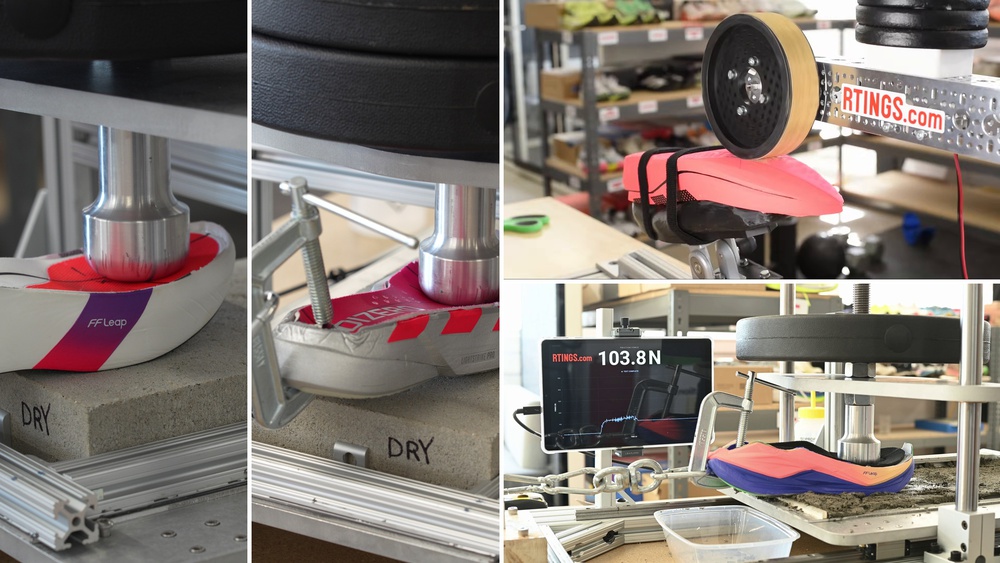
Our running shoe Test Bench 1.0 expands our coverage with new tests for traction and outsole durability.
We've added a forefoot grip test to show how securely each shoe holds onto different surfaces. We test the forefoot across dry concrete, wet concrete, wet aluminum, gravel, and mud, applying varying loads to the shoe while pulling each surface underneath it at a constant speed. Each test includes a video and a force-over-time graph, along with sliding force and coefficient-of-friction measurements showing when the shoe begins to slide and how much grip it provides. These results should give you a much better idea of how confidently a shoe will hold the ground in different conditions (or where it might struggle).
We've also introduced new outsole durability testing to show how it withstands repeated wear. We decided to use a slow-moving, sandpaper-covered wheel applied to the outsole under a specified load rather than high-speed rotary tools like a Dremel (primarily used for cutting, grinding, and carving), as these tools generate significant frictional heat that can soften or even melt rubber rather than replicating how an outsole wears during running. When you land, push off, or slip, the outsole wears away through friction against the ground rather than melting. Our slower wheel more closely replicates this interaction, avoiding temperatures that can melt rubber and allowing us to measure abrasion rather than heat damage. We subjectively assign separate scores to the heel and forefoot based on the depth and length of the abrasion marks, as well as whether any exposed foam is affected. We've also added a video of the test and zoomable outsole photos showing wear in both areas. This should give you a clearer idea of which parts of the outsole wear fastest and how well it holds up over time.
What's Changed
| Test Group | Description |
| Performance | Dry Concrete Grip |
|
| Performance | Wet Concrete Grip |
|
| Performance | Wet Aluminum Grip |
|
| Performance | Gravel Grip |
|
| Performance | Mud Grip |
|
| Performance | Outsole Abrasion Wear |
|
| Performance | Exposed Foam |
|
These tests give us a more complete picture of how running shoes perform on different surfaces and how well their outsoles resist wear.
Verdicts and Usages
We've used the results of our new tests to introduce two new performance usages: Traction and Outsole Durability. These combine the results to help you compare how securely shoes grip different surfaces and how well their outsoles resist wear.
The Traction score places the greatest emphasis on dry concrete, while still accounting for how well a shoe grips wet and loose surfaces. This helps you identify shoes that provide dependable grip on regular roads and those that may struggle in less favorable conditions.
The Outsole Durability score places most of its emphasis on abrasion resistance. Exposed foam accounts for the remaining portion, helping identify areas with less protective outsole coverage that will wear down faster.
| Performance Usage | Description | Weighting |
| Traction | Measures how much grip the forefoot provides across different surfaces and conditions. It combines dry-road grip with performance on wet and loose surfaces, such as trails. |
Traction score calculated using:
|
| Outsole Durability | Measures how well the outsole resists wear, considering both its resistance to abrasion and the amount of exposed foam underfoot. This helps indicate how well the outsole is likely to hold up over time, particularly in areas that experience repeated contact with the ground. |
Outsole Durability score calculated using:
|
How We Developed Our Traction Test
To conduct our traction tests, we designed and built our own testing machine. This gave us full control over the surfaces being tested, how quickly they move, and how frequently we measure the forces involved, particularly when a shoe first begins to slide.
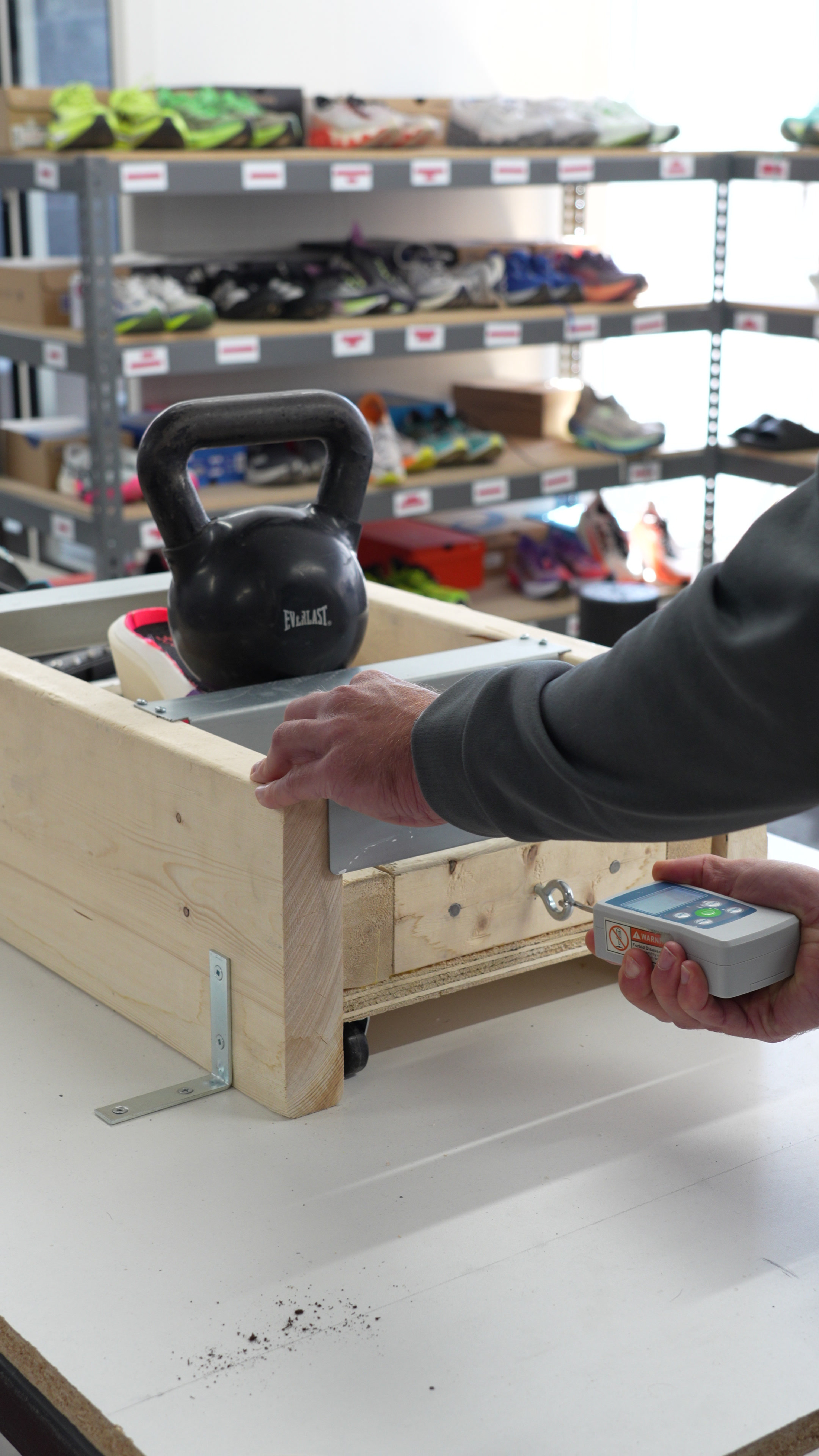
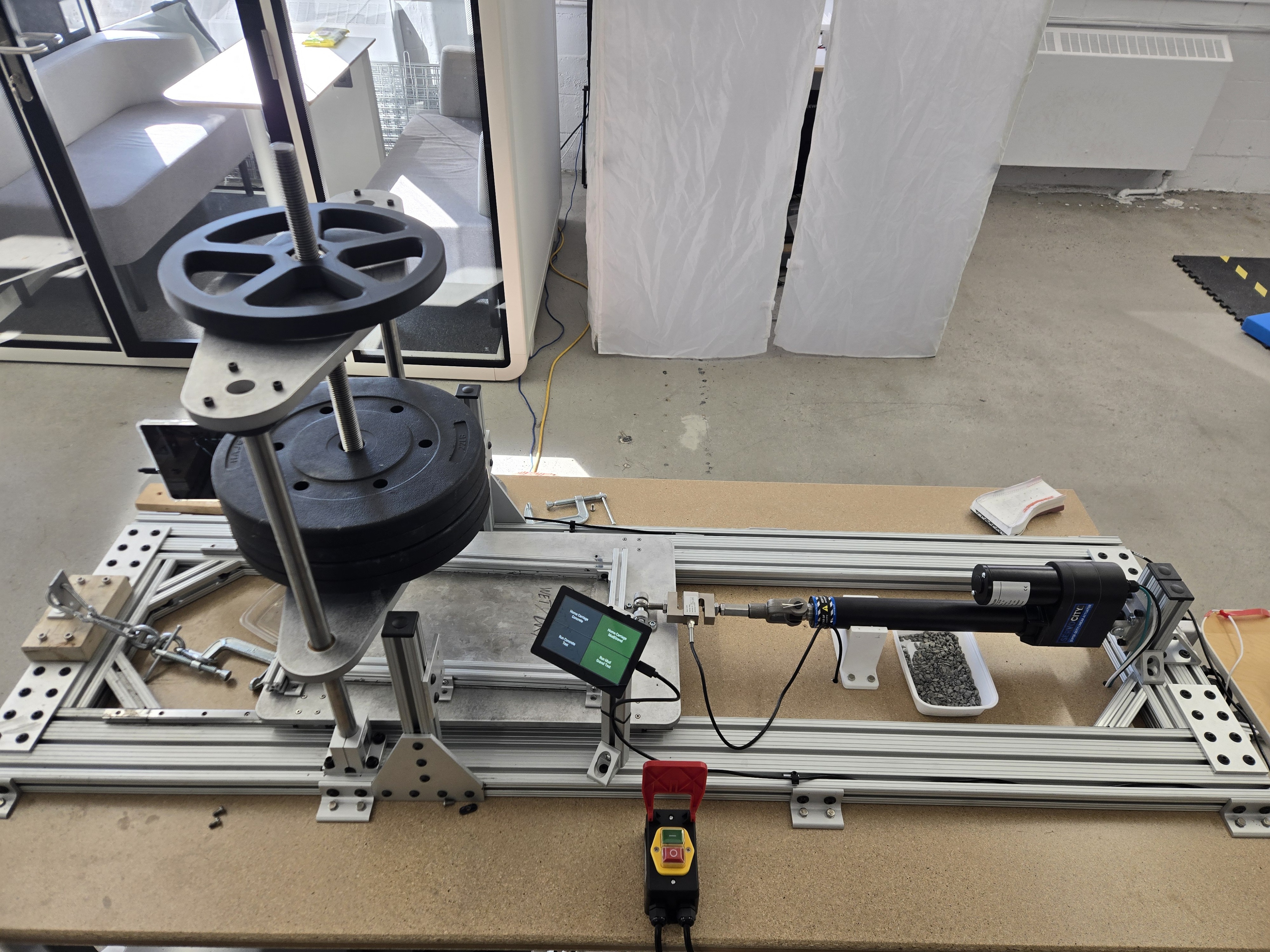
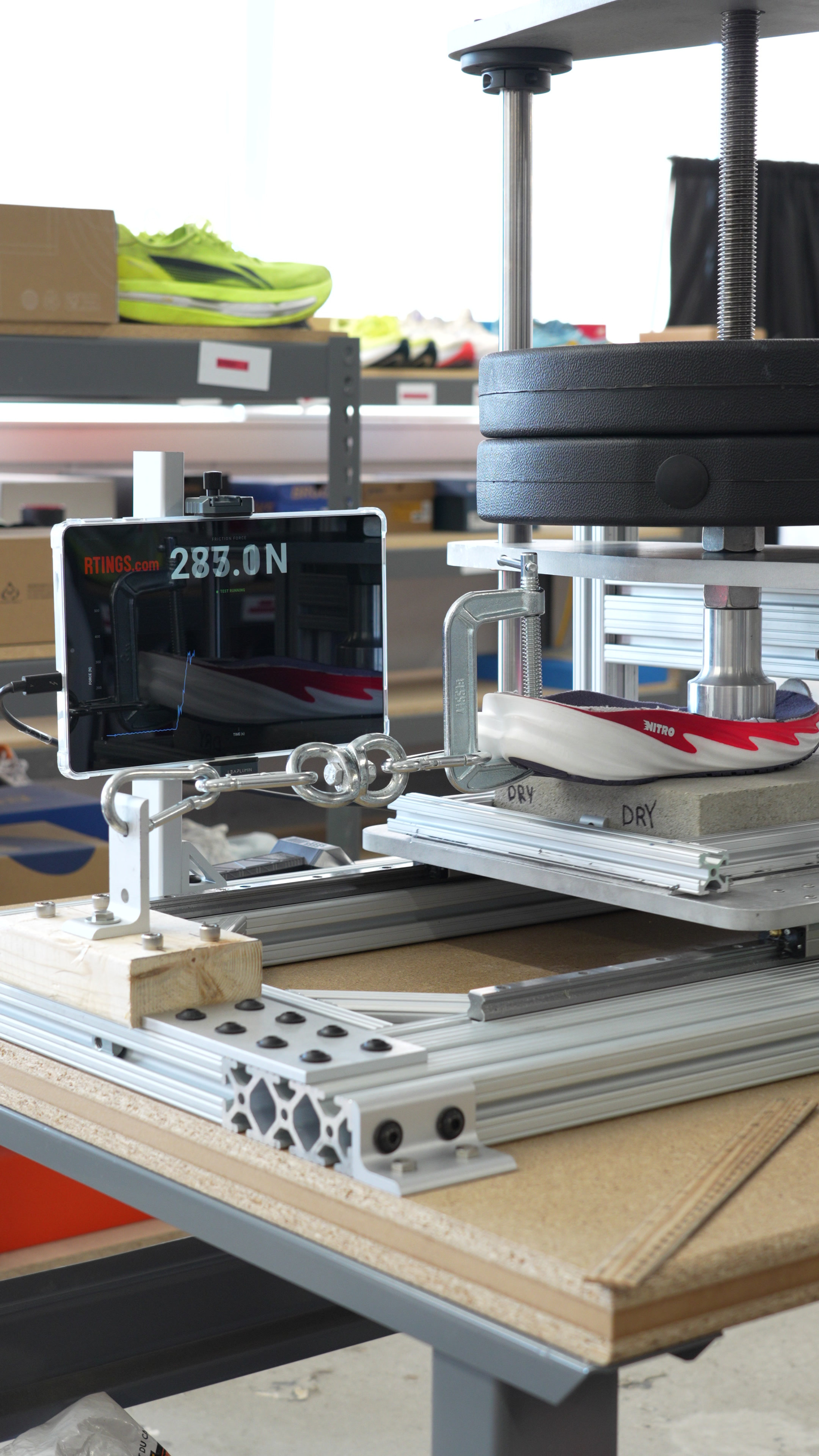
The machine uses a linear actuator and a load cell to measure grip. We apply a load to the shoe, compressing the outsole tread to better simulate its interaction with the ground during running. The actuator then pulls the test surface beneath the shoe at a constant speed, while the load cell measures the resistance in real time.
We currently record these measurements at 100Hz (meaning 100 readings per second) to track how grip changes as the shoe begins to slide. We also tested higher sampling rates of around 200Hz, but these produced less reliable recordings without improving our results.
To further standardize our testing, we even sieve the rock dust used in our gravel tests, keeping particle sizes consistent across tests.
What We've Learned So Far
Developing the machine has also presented some interesting challenges. We initially expected to see a distinct peak in static friction before the outsole began sliding, but we haven't consistently observed one. We're still investigating whether this is due to the outsole's interaction with the surface or to our measurement frequency needing to be increased.
We're also working to improve consistency, as our measurements currently show a variation of approximately ±15 N.
Some of the results have also surprised us. The PUMA Fast-R NITRO Elite 3, for example, performs better on wet concrete than dry concrete, something we're still trying to understand. The rubber outsole on the adidas Adizero Adios Pro Evo 3 has also impressed us with its grip on wet concrete. Despite its smooth design, it grips the wet surface much better than we initially expected.
These findings are a good reminder that outsole appearance alone doesn't necessarily tell you how well a shoe will grip different surfaces, which is why we wanted to introduce standardized traction testing.
How We Developed Our Outsole Durability Test
Our goal with outsole durability testing was to develop a consistent way to compare how different shoes resist abrasion, without trying to replicate the exact wear a shoe would experience after a certain number of miles. We also needed to wear down the outsole without generating enough heat to soften or melt the rubber.
Off-the-shelf workshop tools weren't suitable, as they typically operate at very high speeds or can't accommodate a mounted shoe. Instead, we built our own testing jig using a low-speed, high-torque motor paired with an abrasive wheel, giving us control over the wheel's size and speed.
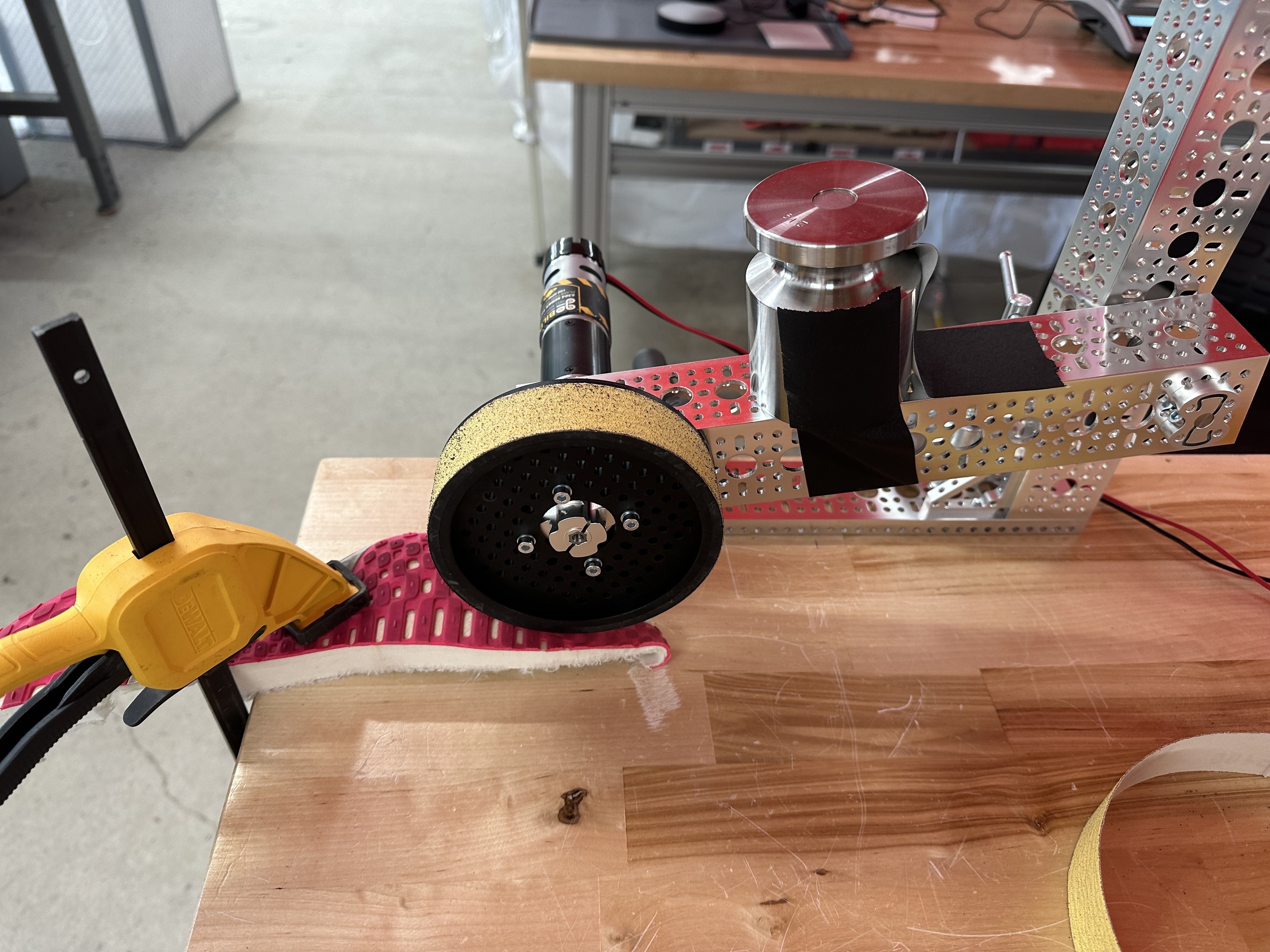
Throughout development, we tested different combinations of wheel sizes and speeds while monitoring temperature and abrasion. We eventually settled on a 120 mm wheel rotating at approximately 54 rpm, giving us a surface speed of around 0.34 m/s.
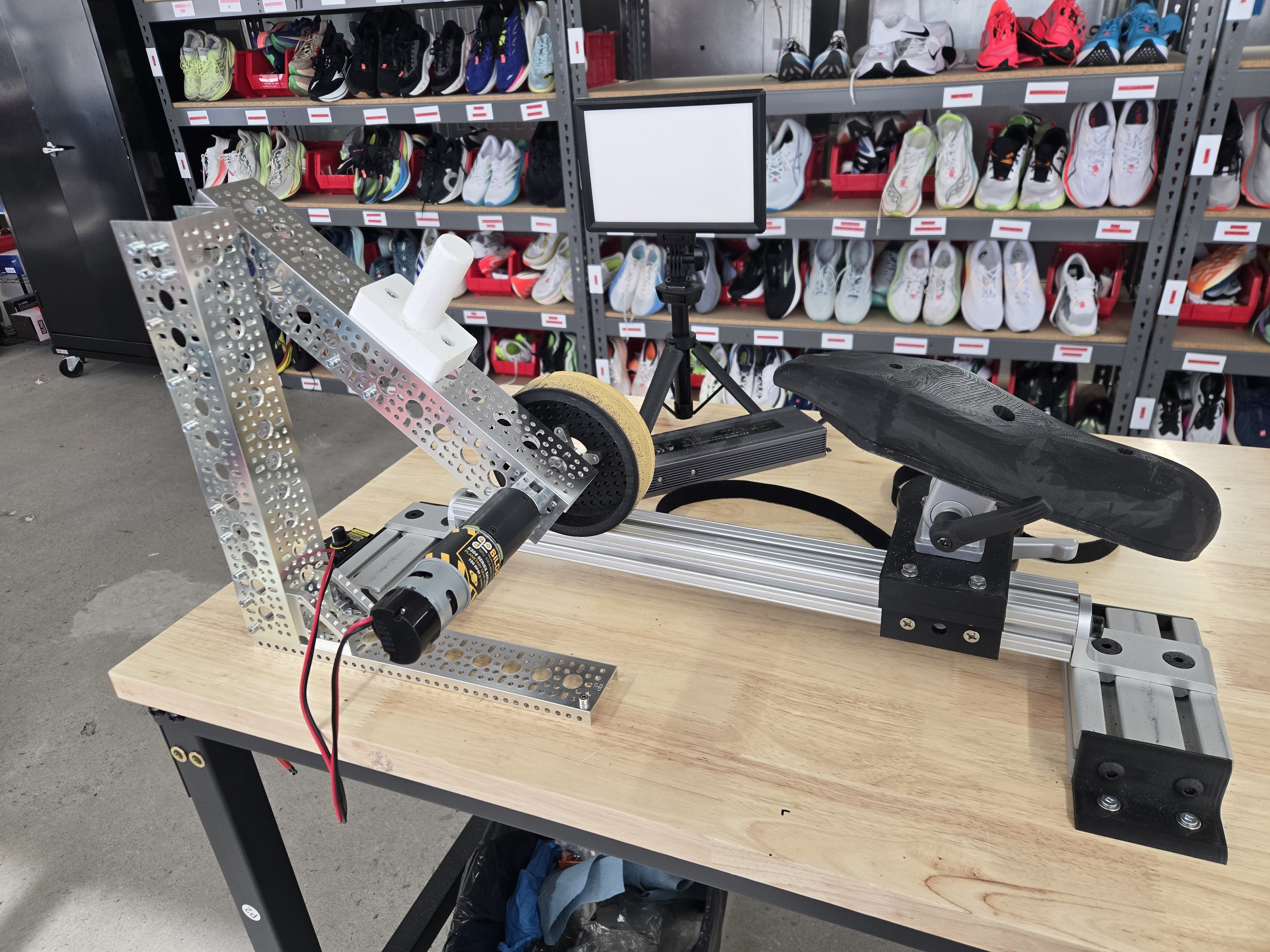
Our final setup allows us to abrade each outsole under the same controlled conditions, without excessive heat affecting how the rubber wears. It gives us a consistent way to compare outsole durability across different running shoes.
Conclusion
Overall, these new tests give you a clearer picture of how securely a shoe grips the ground under different conditions and how well its outsole holds up over time, helping you choose the right shoe for where you run and how much wear you can expect from the outsole.
By measuring grip on five different surfaces and testing abrasion resistance at both the heel and forefoot, we can now provide more detailed comparisons between shoes that may perform similarly in other areas but differ considerably in traction or durability.
This also marks the first time we've tested the outsole's performance, meaning our running shoe testing now covers all three main components of a shoe: the upper, midsole, and outsole.
Let Us Know What You Think
With this update, we've expanded our running shoe testing methodology to include two important performance aspects we hadn't previously measured. We plan to continue refining our tests as we evaluate more shoes, and we'd like to hear whether these new results reflect your experience running in different conditions.
If there are other surfaces you'd like us to test or aspects of outsole durability you'd like to see covered (or even other tests or performance uses), feel free to comment on any page or reach out at feedback@rtings.com. Your feedback helps us improve our testing methodology and identify areas for future development.
20 Running Shoes Updated So Far
We are retesting popular models first. So far, the test results for the following models have been converted to the new testing methodology. However, the text might be inconsistent with the new results.
- adidas Adizero Adios 9
- adidas Adizero Adios Pro 4
- adidas Adizero Adios Pro 5
- adidas Adizero Adios Pro Evo 3
- adidas Adizero Evo SL
- ASICS MEGABLAST
- ASICS METASPEED EDGE TOKYO
- ASICS METASPEED RAY
- ASICS METASPEED SKY TOKYO
- ASICS SUPERBLAST 3
- HOKA Clifton 11
- Li-Ning Red Hare 9 Ultra
- New Balance 1080v15
- Nike Alphafly 3
- Nike Pegasus 42
- Nike Vaporfly 4
- Nike Vomero Plus
- PUMA Fast-R NITRO Elite 3
- Saucony Endorphin Azura
- Saucony Endorphin Speed 5
238 Running Shoes Planned To Be Updated
We are also planning to retest the following products over the course of the next few weeks:
- 361 Flame 4
- 361 Flame 5
- adidas Adizero Adios Pro 3
- adidas Adizero Adios Pro Evo 1
- adidas Adizero Adios Pro Evo 2
- adidas Adizero Boston 12
- adidas Adizero Boston 13
- adidas Adizero Pacer
- adidas Adizero Prime X 2.0 STRUNG
- adidas Adizero Prime X3 STRUNG
- adidas Hyperboost Edge
- adidas Questar 4
- adidas Runfalcon 6 CLOUDFOAM
- adidas Supernova Rise
- adidas Supernova Rise 3
- adidas Ultraboost 5X
- adidas Zenboost
- Altra Escalante 4
- Altra Escalante 5
- Altra Escalante Racer 2
- Altra Experience Flow 2
- Altra Experience Flow 3
- Altra FWD VIA 2
- Altra Torin 7
- Altra Torin 8
- Altra Torin 9
- Altra Vanish Carbon 3
- Altra Vanish Pulse
- ANTA C202 7
- ANTA PG7 3
- ANTA Zone 2 90
- ASICS DYNABLAST 6
- ASICS GEL-CUMULUS 28
- ASICS GEL-EXCITE 11
- ASICS GEL-KAYANO 31
- ASICS GEL-KAYANO 32
- ASICS GEL-KAYANO 33
- ASICS GEL-NIMBUS 26
- ASICS GEL-NIMBUS 27
- ASICS GEL-NIMBUS 28
- ASICS GEL-SLOWCUSH
- ASICS GLIDERIDE MAX
- ASICS GLIDERIDE MAX 2
- ASICS GT-1000 15
- ASICS GT-2000 13
- ASICS GT-2000 14
- ASICS GT-2000 15
- ASICS HYPER SPEED 6
- ASICS MAGIC SPEED 4
- ASICS MAGIC SPEED 5
- ASICS METASLEEK
- ASICS METASPEED EDGE PARIS
- ASICS METASPEED SKY PARIS
- ASICS NOVABLAST 4
- ASICS NOVABLAST 5
- ASICS NOVABLAST 6
- ASICS SONICBLAST
- ASICS SONICBLAST 2
- ASICS SUPERBLAST 2
- ASICS YOGIRI SPEED
- Brooks Adrenaline GTS 23
- Brooks Adrenaline GTS 24
- Brooks Adrenaline GTS 25
- Brooks Anthem 7
- Brooks Anthem 8
- Brooks Ghost 16
- Brooks Ghost 17
- Brooks Ghost 18
- Brooks Ghost Amp
- Brooks Ghost Max 2
- Brooks Ghost Max 4
- Brooks Glycerin 22
- Brooks Glycerin 23
- Brooks Glycerin Flex
- Brooks Glycerin GTS 23
- Brooks Glycerin Max
- Brooks Glycerin Max 2
- Brooks Hyperion 2
- Brooks Hyperion 3
- Brooks Hyperion Elite 5
- Brooks Hyperion Elite 6
- Brooks Hyperion Max 2
- Brooks Hyperion Max 3
- Brooks Hyperion Max 4
- Brooks Launch 12
- Brooks Revel 9
- Brooks Trace 4
- Diadora Corsa
- Diadora Gara Carbon 2
- Diadora Gara Carbon 3
- Diadora Nucleo 2
- Dynafish Xiaonian
- HOKA Arahi 9
- HOKA Bondi 9
- HOKA Cielo X1 2.0
- HOKA Cielo X1 3.0
- HOKA Clifton 10
- HOKA Clifton 9
- HOKA Clifton PRO
- HOKA Gaviota 6
- HOKA Mach 6
- HOKA Mach 7
- HOKA Mach X 2
- HOKA Mach X 3
- HOKA Rincon 5
- HOKA Rocket X 3
- HOKA Skyward X
- HOKA Skyward X 2
- Kiprun KD900X LD+
- Kiprun Kipride Max
- Kiprun Kipstorm Challenger
- Kiprun Kipstorm Elite
- Kiprun Kipstorm Lab
- Kiprun Kipstorm Tempo
- Kiprun KS900 2
- Li-Ning Chaoying Pro
- Li-Ning Feidian 6 Elite
- Li-Ning Feidian 6 Ultra
- Li-Ning Red Hare 9 Pro
- Mizuno Hyperwarp Elite
- Mizuno Hyperwarp Pro
- Mizuno Hyperwarp Pure
- Mizuno Neo Vista
- Mizuno Neo Vista 2
- Mizuno Neo Vista 3
- Mizuno Neo Zen
- Mizuno Neo Zen 2
- Mizuno Sky Prime
- Mizuno Wave Horizon 9
- Mizuno Wave Inspire 22
- Mizuno Wave Prophecy 15
- Mizuno Wave Rebellion Flash 3
- Mizuno Wave Rebellion Pro 3
- Mizuno Wave Rider 29
- Mizuno Wave Rider 30
- Mount to Coast C1
- New Balance AC Runner
- New Balance Ellipse
- New Balance Fresh Foam 520v9
- New Balance Fresh Foam X 1080v14
- New Balance Fresh Foam X 860v15
- New Balance Fresh Foam X 880v15
- New Balance FuelCell Propel v5
- New Balance FuelCell Rebel v4
- New Balance FuelCell Rebel v5
- New Balance FuelCell SuperComp Elite v4
- New Balance FuelCell SuperComp Elite v5
- New Balance FuelCell SuperComp Trainer v3
- New Balance SuperComp Elite v6
- New Balance SuperComp Rebel
- Nike Alphafly 4
- Nike Downshifter 13
- Nike Downshifter 14
- Nike Invincible 3
- Nike Pegasus 41
- Nike Pegasus Plus
- Nike Pegasus Plus 2
- Nike Pegasus Premium
- Nike Quest 7
- Nike Revolution 8
- Nike Run Defy
- Nike Run Swift 3
- Nike Streakfly 2
- Nike Structure 26
- Nike Structure Plus
- Nike Vaporfly 3
- Nike Vomero 17
- Nike Vomero 18
- Nike Vomero Premium
- Nike Winflo 11
- Nike Winflo 12
- Nike Zoom Fly 6
- On Cloudboom Max
- On Cloudboom Strike
- On Cloudboom Strike 2
- On Cloudboom Volt
- On Cloudboom Zone
- On Cloudmonster 2
- On Cloudmonster 3
- On Cloudmonster 3 Hyper
- On Cloudmonster Hyper
- On Cloudrunner 2
- On Cloudrunner 3
- On Cloudrunner 3 Max
- On Cloudsurfer 2
- On Cloudsurfer Max
- PUMA Deviate NITRO 3
- PUMA Deviate NITRO 4
- PUMA Deviate NITRO Elite 3
- PUMA Deviate NITRO Elite 4
- PUMA Deviate Pure NITRO
- PUMA Fast-FWD NITRO Elite 2
- PUMA ForeverRUN NITRO 2
- PUMA ForeverRun NITRO 3
- PUMA MagMax NITRO
- PUMA MagMax NITRO 2
- PUMA Magnify NITRO 3
- PUMA Velocity NITRO 4
- PUMA Velocity NITRO 5
- Qiaodan Feiying Plaid 3.0
- R.A.D MALLOW
- R.A.D SYNTH
- R.A.D UFO
- Salomon Aero Blaze 3
- Salomon Aero Blaze 4
- Salomon Aero Glide 3
- Salomon Aero Glide 4
- Salomon S/LAB Phantasm 3
- Saucony Cohesion 19
- Saucony Endorphin Elite
- Saucony Endorphin Elite 2
- Saucony Endorphin Elite 3
- Saucony Endorphin Pro 4
- Saucony Endorphin Pro 5
- Saucony Endorphin Speed 4
- Saucony Guide 19
- Saucony Hurricane 25
- Saucony Hurricane 26
- Saucony Paramount Max
- Saucony Procyon Max
- Saucony Ride 19
- Saucony Triumph 22
- Saucony Triumph 23
- Saucony Triumph 24
- Skechers Aero Razor
- Skechers Aero Tempo
- Speedland RX:PNW
- Topo Atmos
- Topo Aura 2
- Topo Phantom 4
- Topo Specter 3
- Tracksmith Eliot Runner
- Tracksmith Eliot Ryder
- Under Armour Charged+ Assert 11
- Under Armour Velociti Elite 3
- XTEP 160X 7.0 PRO
- XTEP 260X 3.0
- XTEP 360X 2.0